Studying in Madison, United States: universities, housing and student life
A practical, sourced guide to UW–Madison and its sister schools, where students live on the isthmus, the mid-August lease scramble, thrift markets, bus passes, libraries and real costs.
A campus laid across a narrow isthmus
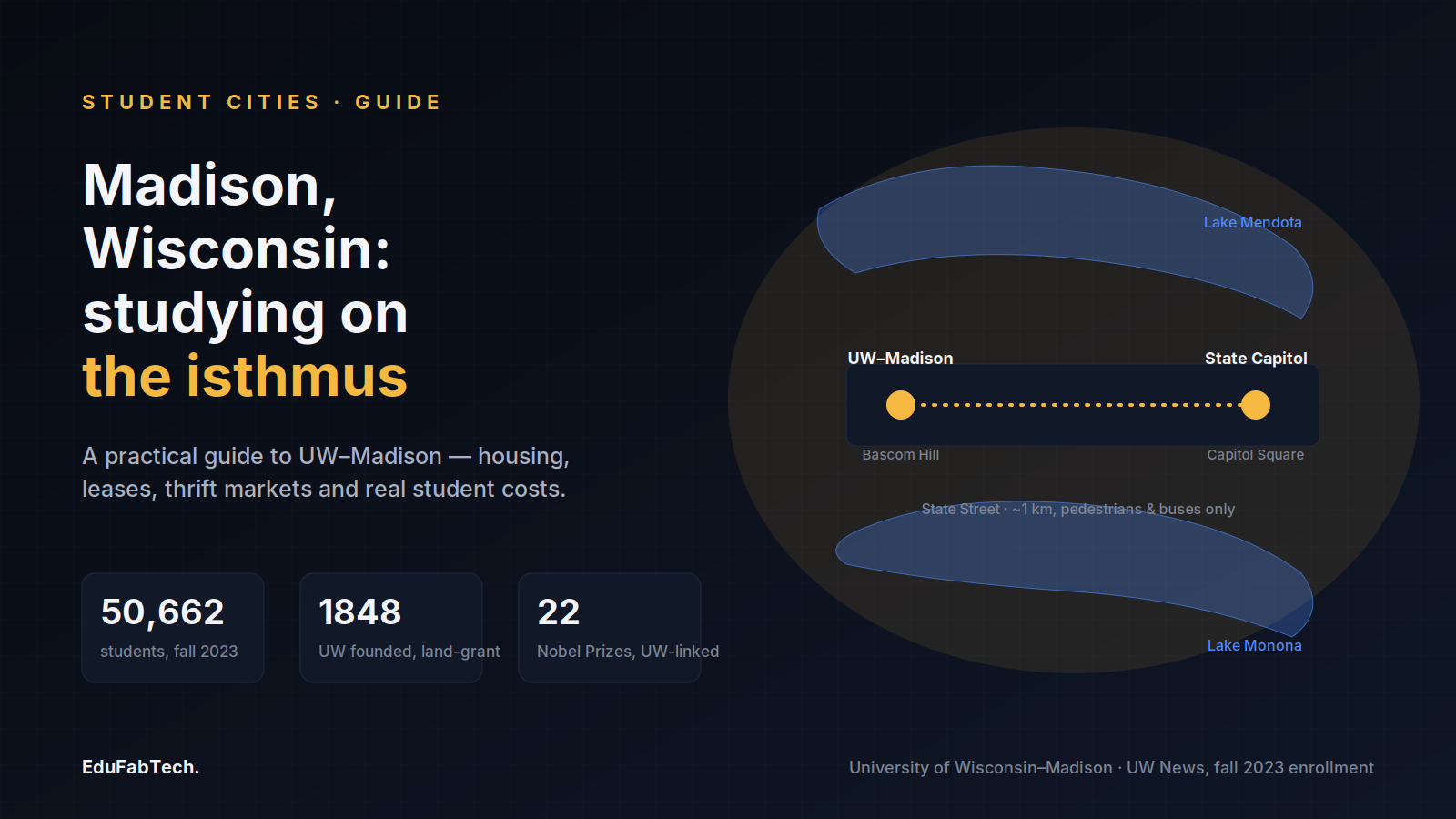
Madison sits on a strip of land between two lakes, Mendota to the north and Monona to the south, with the Wisconsin State Capitol at one end of the isthmus and the University of Wisconsin–Madison at the other. The two are joined by State Street, a pedestrian-and-bus-only run of about a kilometre lined with bookshops, cheap food and buskers. The university's historic core climbs Bascom Hill, a glacial drumlin topped by Bascom Hall, and then spreads west along the Mendota shoreline. Knowing this geography matters for a student: almost everything worth reaching is within a walk or a short bus ride, and the lakes, not a ring road, set the edges of where you can live.
The University of Wisconsin–Madison describes itself as a public land-grant university founded in 1848, with public service — the "Wisconsin Idea," the principle that the university's work should reach beyond the campus into the whole state — as its guiding commitment; its About page counts 22 Nobel Prizes among people connected to the institution. It is large: a university news release reported a record total enrolment of 50,662 students in fall 2023, the first time the figure topped 50,000. That scale shapes daily life. Lectures can hold hundreds, the bus routes are busy, and the social world is organised around colleges, residence halls, student organisations and the lakeshore rather than one central quad.
Within that university sit the named schools a prospective student is likely to be choosing between. The University of Wisconsin–Madison College of Engineering teaches on the western part of campus and runs departments from biomedical to nuclear engineering; the college reported being ranked seventh among public universities in the 2027 edition of U.S. News & World Report's Best Engineering Schools undergraduate rankings, published September 2026. The University of Wisconsin–Madison School of Journalism & Mass Communication is a professional school inside the College of Letters & Science; the university's course guide shows it confers Bachelor of Arts and Bachelor of Science degrees in journalism. The Robert M. La Follette School of Public Affairs is the university's graduate public-policy school, whose graduate programs grant the Master of Public Affairs and the Master of International Public Affairs, the latter built for students headed into government and international work.
Madison is not a one-university town, though UW dominates. Edgewood College — a private institution with Dominican roots that now also uses the name Edgewood University — occupies a wooded campus overlooking Lake Wingra on the near-west side, a far smaller and quieter setting than the main campus. Between them the two draw students from across the state, the country and abroad, and most of the practical advice below applies wherever you enrol.
Where students end up living
Three broad zones hold most students. Closest in is the downtown-campus belt — Langdon Street with its fraternity and sorority houses and private halls, the blocks around State Street, and the "Mifflin" neighbourhood of old wooden houses carved into student flats. It is the shortest walk to class and the loudest on weekends. The near-west side, out along Regent Street and toward Camp Randall Stadium and Monroe Street, trades a few minutes of commute for quieter streets and slightly lower rents. South and east of the isthmus — Williamson Street ("Willy Street"), Atwood and the areas near Lake Monona — attract graduate students and anyone who prefers a neighbourhood that is not built entirely around undergraduates.
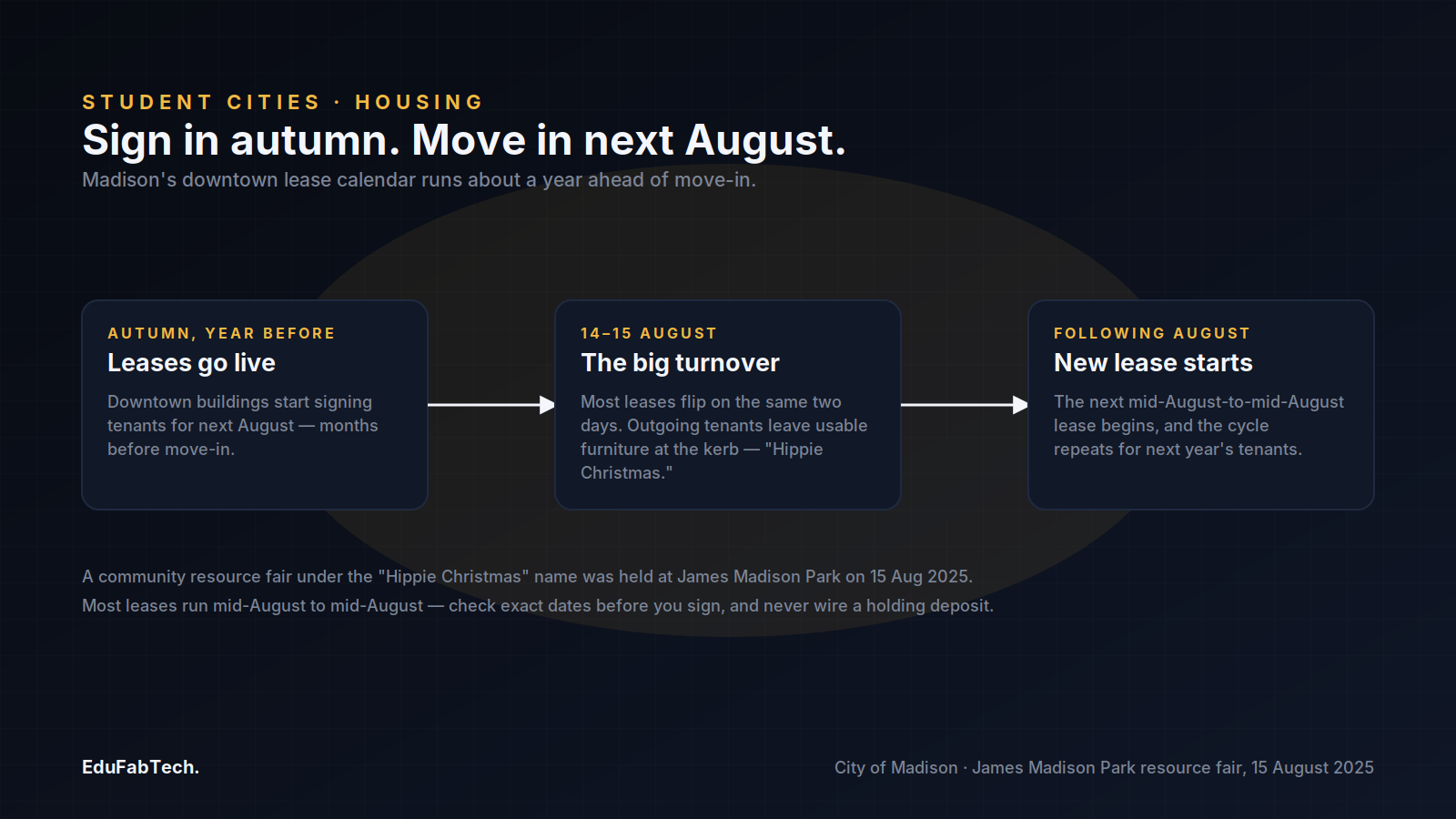
First-year undergraduates are mostly in University Housing, split between the Lakeshore neighbourhood of halls along Mendota and the Southeast neighbourhood near State Street. After that, the majority move to private leases, since University Housing has room for only a fraction of the student body. If you want a dorm place, apply through University Housing as early as your admission allows, because demand outstrips the newer, nicer rooms. For a private lease the Madison rhythm is unusual and worth planning around: the leasing season for downtown flats opens absurdly early, with many buildings signing tenants in the autumn for a lease that will not begin until the following August. You can browse what is currently listed near campus on EduFabTech's Madison rooms page, and the broader Madison city listings collect rooms, jobs and second-hand goods in one place.
Signing a lease without losing a deposit
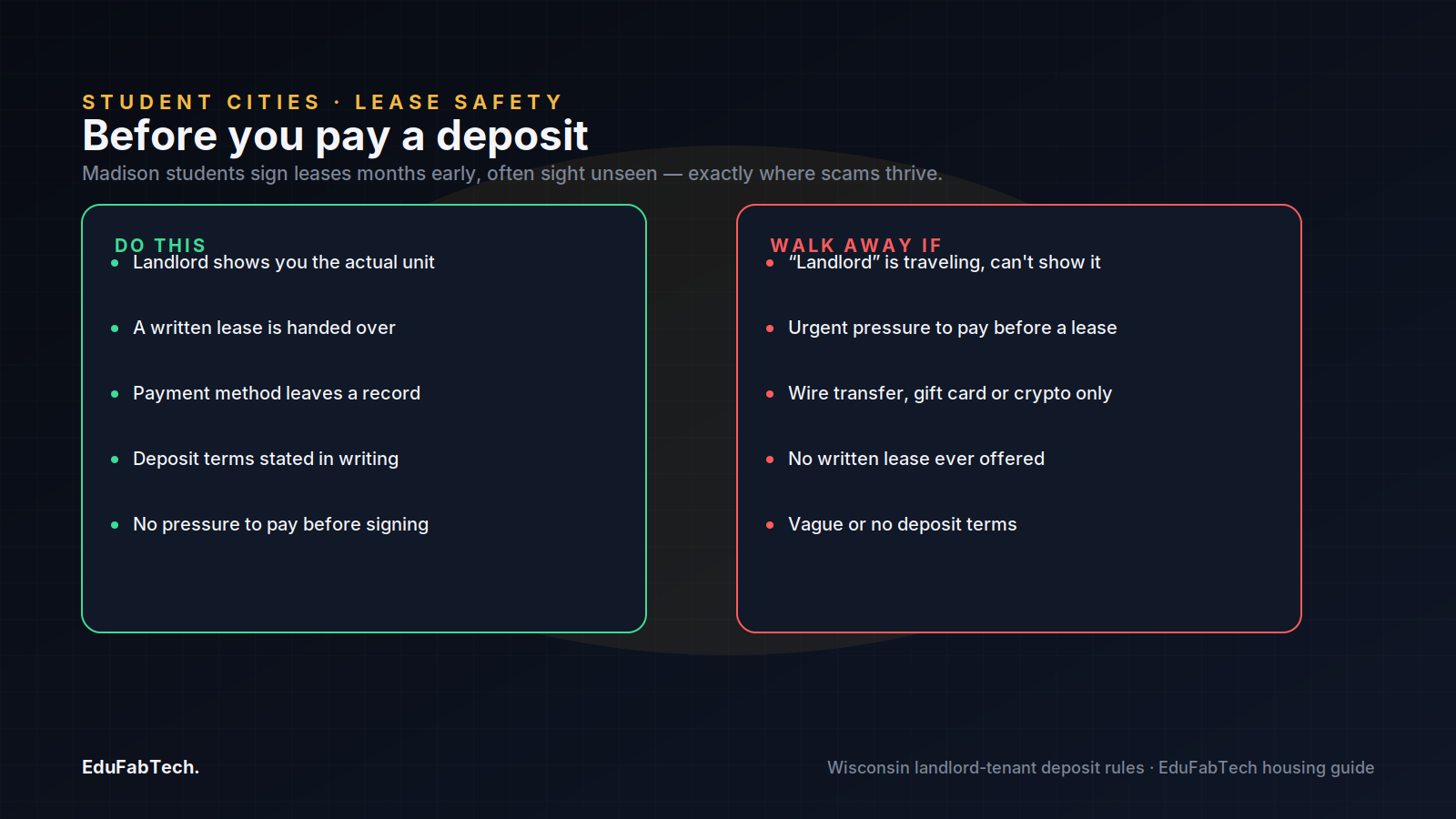
Madison's compressed leasing calendar is exactly where rental scams thrive, because students sign months in advance, often from another city or country, sight unseen. The safe rule is simple: see the actual unit, or have someone you trust see it, before any money changes hands. A legitimate landlord in Madison expects to show the apartment and to hand you a written lease; a "landlord" who is travelling, cannot let you in, and wants a holding deposit wired immediately is the classic warning sign. Never send money by bank wire transfer, gift card or cryptocurrency to "hold" a room — those payments cannot be recovered, and no honest Madison landlord requires them. Pay by a method that leaves a record, get receipts, and keep the signed lease.
Check a few concrete things before paying. Confirm the exact lease dates, since so many run from mid-August to mid-August and a gap between leases is common here. Ask what the security deposit is and what can be deducted; Wisconsin regulates how deposits must be handled and returned, so get the terms in writing. Walk the unit for working heat — Madison winters are long and cold — and note any existing damage so it is not charged to you later. If a deal is being pushed with urgency and a request for money before you have seen a lease, slow down. Listings you find through EduFabTech's rooms page still deserve the same in-person check.
Furnishing a room for very little
Madison has a genuinely useful second-hand economy, partly because of its own moving habits. Every year around 14–15 August, when a huge share of downtown leases turn over on the same two days, outgoing tenants pile usable furniture on the kerb in an event locals have nicknamed "Hippie Christmas"; a community resource fair under that name was held at James Madison Park on 15 August 2025. For a day or two the streets near campus are an open-air free market of desks, shelves and chairs — bring help to carry and inspect anything upholstered before taking it indoors.
The rest of the year, the Society of St. Vincent de Paul runs a pay-by-the-pound Dig & Save outlet at 1900 South Park Street, where clothing, household goods and furniture that did not sell elsewhere are priced by weight — the cheapest tier of thrift in the city. For food and local produce, the Dane County Farmers' Market fills the sidewalks around the Capitol Square on Saturday mornings from spring to late autumn, a producers-only market where the people selling the cheese, vegetables and bread are the ones who made them. EduFabTech also tracks give-aways and resale locally: see second-hand goods in Madison for what is currently on offer.
Part-time work and the rules for international students
Many students work part-time, and on a large campus the jobs are real: dining halls, libraries, labs, the student union. For international students the rules are set by federal immigration law, not by the university, and they are worth reading from the source rather than from hearsay. The U.S. Citizenship and Immigration Services Policy Manual states that F-1 status permits students, with their Designated School Official's approval, to work an on-campus job for up to 20 hours per week when school is in session, with full-time work allowed during official breaks. Off-campus work, and any practical training, has separate and stricter conditions. This article is not legal advice: confirm your own situation with UW–Madison's international student office, which acts as your DSO, before you accept any job. Current openings students are posting and looking for appear on EduFabTech's Madison jobs page.
Libraries and places to study
The university library system is one of the largest in the country, and for undergraduates the social centre of it is College Library in Helen C. White Hall at 600 N. Park Street, overlooking Lake Mendota; it keeps overnight hours on weekdays, requiring a UW–Madison ID to enter between midnight and 7 a.m., and ranges from loud collaborative floors to silent rooms, with bookable group rooms. Memorial Library next door holds the deeper research collections and quieter reading rooms for those writing theses. Beyond campus, the Madison Public Library's central branch downtown is open to everyone and is a good neutral space when you want distance from student noise. Because study-space pressure spikes at exam time, it helps to know several spots; EduFabTech lists desks and rooms students share on the Madison study-spaces page.
Getting around a compact city
Madison's public transport is run by Metro Transit, the City of Madison's bus network, which in 2026 lists an adult single-ride fare of $2.00 and a monthly fare cap of $65, so frequent riders never pay more than the monthly amount. The city opened bus rapid transit routes that run across the isthmus, speeding up the busiest corridors. For UW–Madison students the biggest saving is the student bus pass: the university's bus-pass policy explains that it is prepaid through the mandatory student transportation segregated fee, so eligible enrolled students ride all fare-accepting Metro routes, including bus rapid transit, without paying per trip. Campus routes 80–84 are free to everyone.
Most students, though, get around on foot and by bicycle. The isthmus is small and flat enough that walking from State Street to far-west campus is realistic, and Madison maintains an extensive network of bike paths and lanes. Winter is the honest catch: snow and ice from roughly December to March make cycling harder and walking slower, and the bus becomes the reliable option. A warm coat and boots are not optional here.
What things cost — the figures that can be sourced
Housing is the largest line, and two dated figures anchor it. For students in the dorms, University Housing's 2026–27 rates run from $7,350 to $10,150 for the academic year depending on room type — a standard double is listed at $7,850 — and that figure includes utilities, furniture, internet and staff support; a required dining plan is separate, from $4,200 for the Go10 plan to $5,900 for GoUnlimited for the year. For the private market, the U.S. Census Bureau's QuickFacts for Madison reports a median gross rent of $1,413 per month across the city for 2020–2024 — a citywide median that includes family housing, so a shared student flat near campus can fall below it or a studio rise above it. The same source puts Madison's 2020 Census population at 269,840.
| Item | Figure | Source (year) |
|---|---|---|
| Dorm room, academic year | $7,350–$10,150 (double: $7,850) | UW–Madison University Housing (2026–27) |
| Required dining plan, year | $4,200–$5,900 | UW–Madison University Housing (2026–27) |
| Median gross rent, citywide | $1,413 / month | U.S. Census Bureau QuickFacts (2020–2024) |
| Metro single ride / monthly cap | $2.00 / $65 | City of Madison Metro Transit (2026) |
The honest trade-offs
Madison regularly lands near the top of liveability lists, and much of what students enjoy is real: a walkable isthmus, two lakes you can swim in and skate on, a serious research university, a farmers' market that is a civic event, and a food-and-music scene larger than the city's size suggests. The flip side is equally real. Winter is long, grey and genuinely cold, and it reshapes months of the year. Downtown rents are high for a mid-sized city, and the mid-August lease turnover forces thousands of students to move on the same two days, which is chaotic and occasionally leaves people with a gap in housing. Parking near campus is scarce and expensive, nudging most people onto bikes and buses whether they planned to or not. And the sheer scale of UW–Madison means large early-year lectures where it takes effort to be more than a number.
A checklist for the first weeks
- Pick up your Wiscard (student ID) — it is your library access, dorm entry and, through the segregated fee, your bus pass.
- If you are an international student, meet your DSO at the international student office and confirm work rules before taking any job.
- Learn two or three Metro bus routes between home and campus, and note the free campus routes 80–84.
- Find more than one study spot — College Library for late nights, a quieter branch for focus — before exam-week crowds hit.
- Furnish from the Dig & Save outlet and, if you arrive in August, the kerbside turnover, rather than buying new.
- Read your lease dates and deposit terms in full, and never pay to "hold" a room you have not seen.
- Buy real winter clothing early; the first cold snap arrives before you expect it.
With those settled, the rest of Madison opens up quickly — and listings for rooms, jobs and second-hand goods specific to the city are gathered on EduFabTech's Madison page.
A quick question for readers
Do you work part-time while you study?
Many students work to pay the bills. See how common it is — and how many hours people really do.
Pick an answer, create a free account in a minute, and your vote counts. Already a member? Sign in
Source: University of Wisconsin–Madison, University Housing
Sources (5)
- University of Wisconsin–Madison. About the university: the Wisconsin Idea, founding, honours. University of Wisconsin–Madison, 2026. wisc.edu ↗ · checked 6 Oct 2026
- University of Wisconsin–Madison, University Housing. 2026–27 Housing Costs (room and dining rates). University of Wisconsin–Madison, 2026. housing.wisc.edu ↗ · checked 6 Oct 2026
- U.S. Census Bureau. QuickFacts: Madison city, Wisconsin. U.S. Census Bureau, 2025. census.gov ↗ · checked 6 Oct 2026
- City of Madison Metro Transit. Fares. City of Madison, 2026. cityofmadison.com ↗ · checked 6 Oct 2026
- U.S. Citizenship and Immigration Services. Policy Manual, Volume 2, Part F, Chapter 6: Employment. USCIS, 2026. uscis.gov ↗ · checked 6 Oct 2026