Studying in Magdeburg: universities, housing and student life
A practical, sourced guide to Otto von Guericke University, where to live safely, what rooms and the semester cost, and how students get around Saxony-Anhalt's capital on the Elbe.
Magdeburg sits on the Elbe in the flat, open country of central Germany, the capital of the state of Saxony-Anhalt and a city still visibly shaped by heavy reconstruction: wide boulevards, post-war blocks, a surviving medieval cathedral and, near the centre, the brightly irregular Grüne Zitadelle that Friedensreich Hundertwasser designed. The man the main university is named after, Otto von Guericke, was a seventeenth-century mayor and physicist here, remembered for the vacuum experiment with the two copper hemispheres. For students the city has a particular texture: large enough to carry a real university and a lively second-hand culture, small and affordable enough that most daily life happens within a few tram stops of the river.
This guide covers the two state institutions in the city, where students actually find rooms, how to avoid the deposit scams that recur here, what a room and a semester cost with the figures sourced, the rules on working, the libraries, and how to move around on one ticket. It is written for people arriving from elsewhere in Germany and from abroad.
A university assembled in 1993, on the northern riverbank
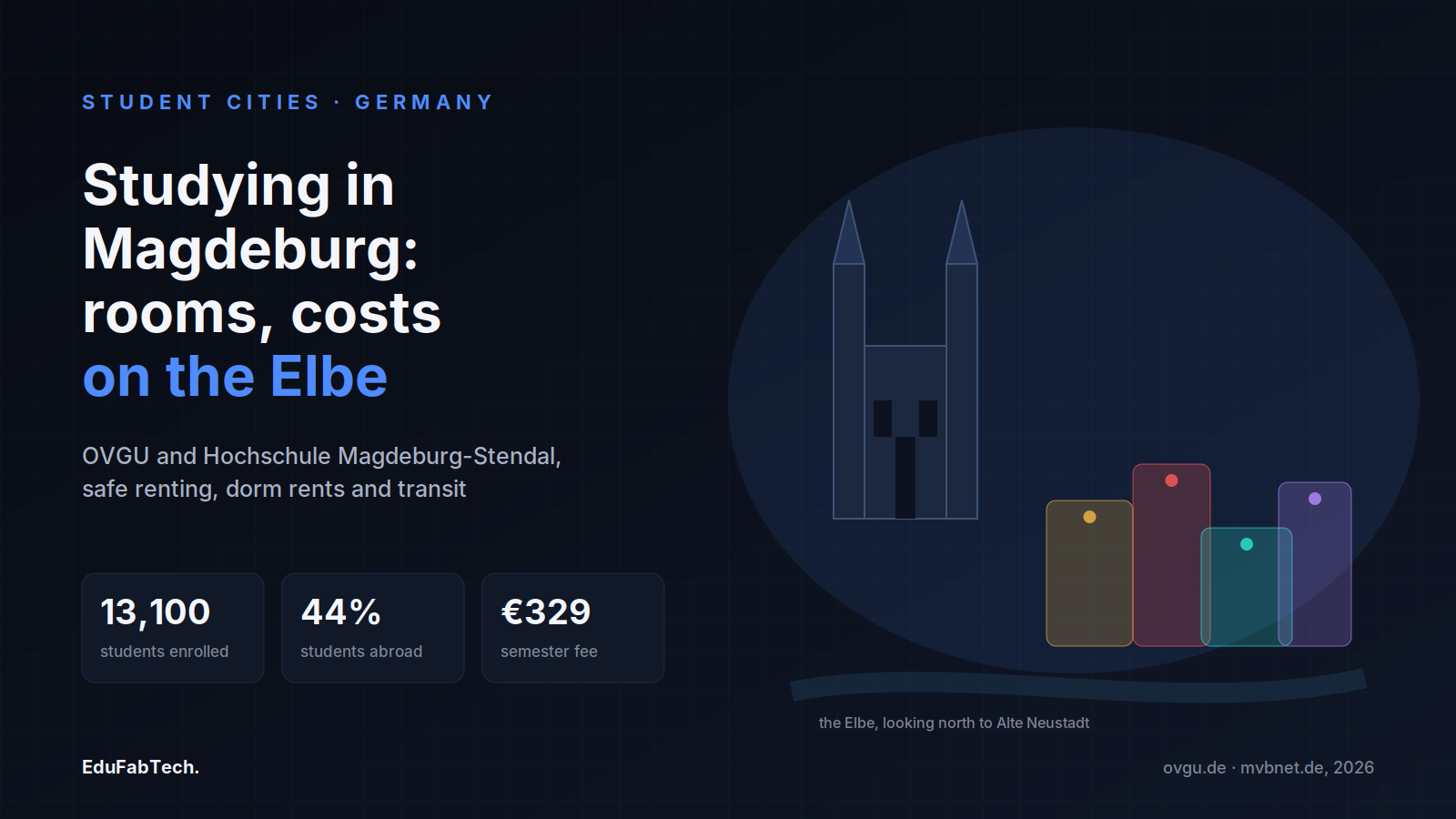
Otto von Guericke University Magdeburg (the University of Magdeburg), known as OVGU, is the city's research university, and a young one: it was formed in 1993 from the merger of the former technical university, a teacher-training college and a medical academy. Its nine faculties run from mechanical and electrical engineering through computer science and mathematics to medicine, natural sciences, economics and the humanities, across roughly 100 degree programmes. At the start of the 2026/27 winter semester the university reported more than 13,100 students enrolled and around 3,000 newly matriculated, with about 5,700 international students — some 44 per cent of the body — according to its own press office in a statement dated 2 October 2026, which noted the figures were preliminary until the enrolment deadline at the end of the month (ovgu.de, 2026). The main campus is compact and self-contained at Universitätsplatz 2 in the north of the city, in the Alte Neustadt district close to the Elbe, so lecture halls, the library, the Mensa and much of the student housing sit within walking distance of one another.
The city's second state institution is Hochschule Magdeburg-Stendal, a university of applied sciences with its Magdeburg campus on Breitscheidstraße, near the Herrenkrug parkland by the river, and a second campus in the town of Stendal to the north. The two institutions share services: the Magdeburger Verkehrsbetriebe page on the semester ticket states that students of both Otto von Guericke University and Hochschule Magdeburg-Stendal receive the ticket automatically on enrolment or re-registration (mvbnet.de, 2026). If you are weighing the two, an applied-sciences degree here leans towards practice and placements; the research university leans towards engineering, computing and medicine.
Where students live: the dorm cluster in Alte Neustadt and the districts beyond
The simplest housing in Magdeburg is also the closest to campus. The Studentenwerk Magdeburg runs eleven halls of residence in the city, and most of them are grouped in Alte Neustadt within a short walk of the university — on Hohepfortestraße, along Johann-Gottlob-Nathusius-Ring, and on Walther-Rathenau-Straße — with two further houses further out, at Fermersleber Weg to the south and on Breitscheidstraße near the Hochschule (studentenwerk-magdeburg.de, 2026). A dorm place is the surest first-year option because it removes the twin problems of furnishing and of being judged on your German credit history before anyone will rent to you.
Beyond the halls, three districts carry most of the private student rental. Stadtfeld, west of the centre, is a grid of restored Gründerzeit tenement streets with cafés along Wilhelm-Külz-Straße, popular and relatively central. Buckau, south along the Elbe, is the old industrial quarter turned creative corner, with converted factory buildings and a music and bar scene. Sudenburg, further south-west, is a plainer, lived-in neighbourhood of older buildings that tends to be cheaper. None of these is far by tram, which matters more than exact distance in a city laid out along its tram lines. You can browse what is currently listed in the city on EduFabTech's Magdeburg page and its rooms section.
Renting safely here: viewings, deposits and the scams that recur
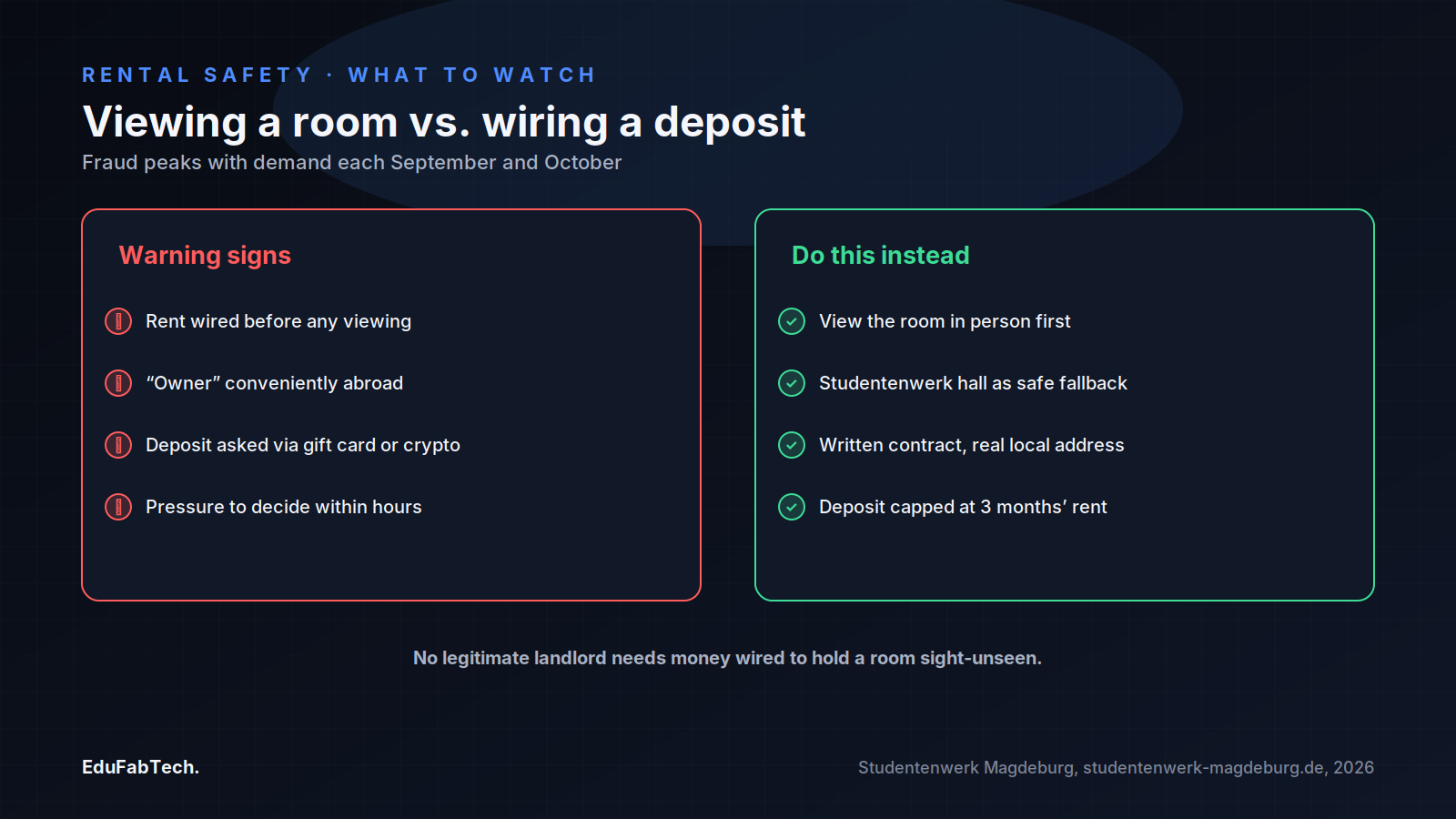
The hardest part of arriving is that demand for shared-flat rooms and small apartments peaks sharply in September and October, and that pressure is exactly what rental fraud feeds on. The pattern in Magdeburg is the familiar one for German university cities: an attractive room appears online at a suspiciously low rent, the supposed owner is conveniently abroad and cannot show it, and you are asked to send a deposit or a "reservation fee" by bank transfer, gift card or cryptocurrency before you can see the place or get a key. Do not. No legitimate landlord or the Studentenwerk needs money wired to hold a room sight-unseen.
Protect yourself with a few fixed rules. View the room in person, or have someone you trust view it, before any money moves; if you are still abroad, favour a Studentenwerk hall, where the contract and the organisation are verifiable, and arrive before committing to a private flat. In Germany a security deposit (Kaution) is normally up to three months' cold rent, held and returned at move-out — so a request for a large cash payment, or for rent months in advance, is a warning sign. Insist on a written contract with a real local address, and be wary of anyone who refuses a viewing or pushes you to decide within hours. For furniture and give-aways you will meet sellers in person too; the same in-person principle applies. Start the search early and keep the dorm application running in parallel as your safety net.
Furnishing a room: the Messe flea market and second-hand routes
Dorm rooms come furnished, but a private flat usually does not, and in Germany that can mean no kitchen fitted at all. The city's largest second-hand event is the Nachtflohmarkt, a recurring indoor evening flea market held in the halls of the Messe Magdeburg on Tessenowstraße; the venue operator Messe- und Veranstaltungsgesellschaft Magdeburg (MVGM) lists more than 270 stalls of furniture, books, records, clothing and household goods (mvgm.de, 2026). Because it is indoors it runs through the colder months, which suits a term-time move. Smaller outdoor flea markets appear across the city in the warmer half of the year.
For the slower, cheaper route, work the student-to-student channels: departing students sell or give away desks, shelves and kitchen equipment at the end of each semester, and the turnover is high in a city with thousands of international students cycling through. EduFabTech keeps city-specific listings for exactly this — second-hand things, furniture, and items given away free in Magdeburg. A room can be furnished for very little if you are patient across the first few weeks rather than buying everything new at once.
What it costs: the semester fee and dormitory rents
There are no tuition fees for standard degree programmes at the public universities, but every student pays a semester contribution. At Otto von Guericke University the fee for the 2026/27 winter semester is €329.30, made up of €90.00 for the Studentenwerk Magdeburg, €226.80 for the Deutschlandsemesterticket, and €12.50 for the student council (Studierendenrat), according to the university's fees page (ovgu.de, 2026). You pay it each semester to re-register; the large transport component is the reason the ticket feels "included".
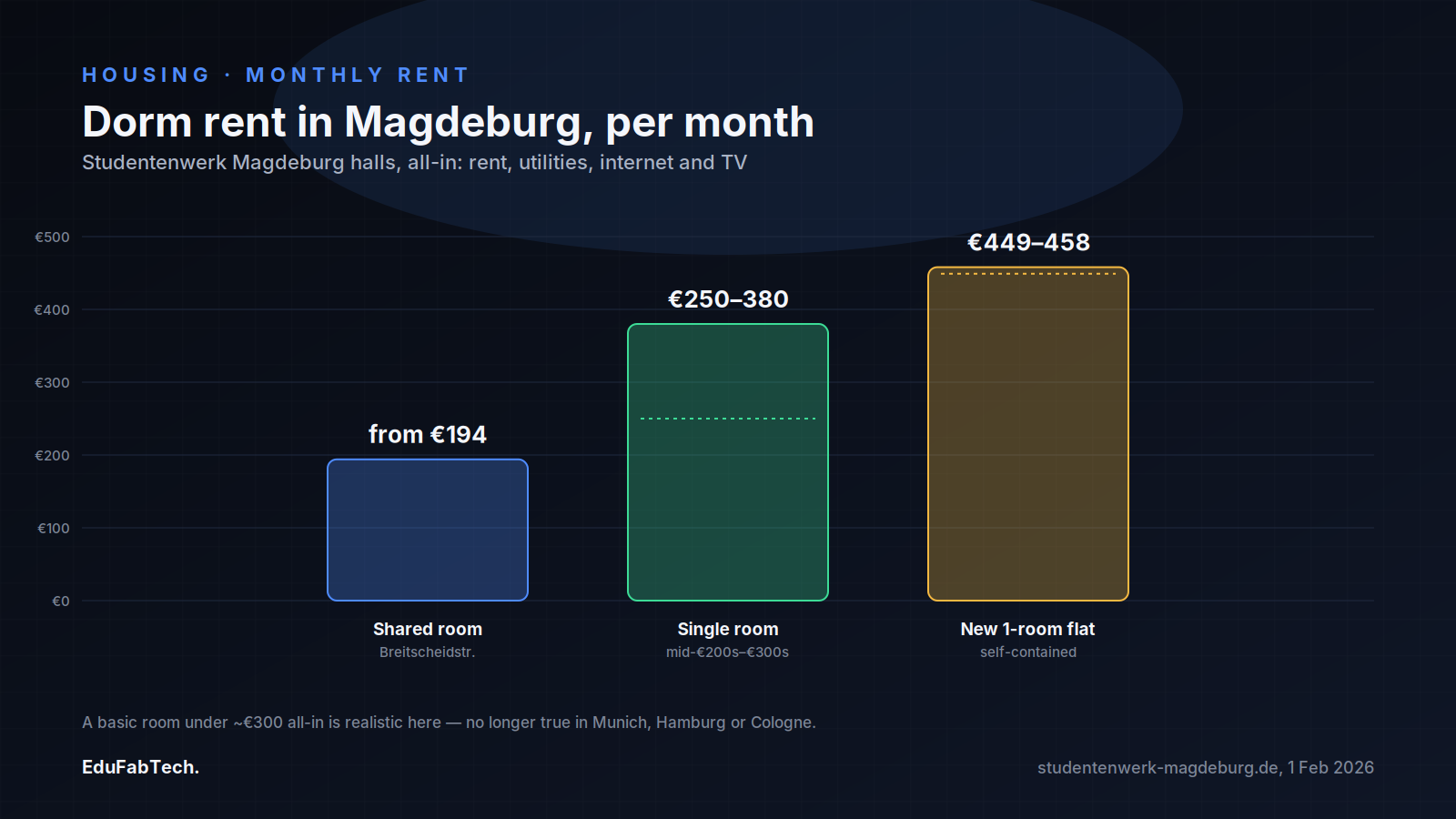
Dormitory rent is where Magdeburg's affordability shows most clearly. The Studentenwerk Magdeburg's own dormitory pages, updated as of 1 February 2026, list monthly rents including utilities, internet and television: shared rooms in flat-shares start around €194 per month at the Breitscheidstraße house, single rooms and small one-room apartments run from roughly the mid-€200s to the €300s, and the newest self-contained one-room apartments reach up to €449–€458 (studentenwerk-magdeburg.de, 2026). An all-in figure below about €300 for a basic room is realistic here in a way it no longer is in Munich, Hamburg or Cologne, and that single fact changes the monthly budget more than any other. Private-market rents vary and move, so confirm any figure against a current listing rather than an old average.
Working while you study
Many students here take a term-time job, and the rules depend on where you are from. Students from the EU, Iceland, Liechtenstein, Norway and Switzerland have, in DAAD's words, unrestricted access to the German labour market with practically the same rights as German students; students from other countries are allowed to work 140 full days or 280 half days per year, according to the DAAD's guidance on side jobs (daad.de, 2026). This is a general summary, not legal advice: your own residence permit and the local foreigners' authority (the Ausländerbehörde of the city of Magdeburg) set the conditions that actually apply to you, so check your permit and ask them before you sign anything. Work on campus as a student or academic assistant is treated differently from outside jobs. Current openings in the city are collected on EduFabTech's Magdeburg jobs page.
Libraries, desks and the remade campus
The central place to study is the University Library (Universitätsbibliothek) by Universitätsplatz. Its opening hours are Monday to Friday from 8 a.m. to 9 p.m. and Saturday from 10 a.m. to 6 p.m., with extended Sunday opening during the exam weeks, as listed on the library's own site (ub.ovgu.de, 2026). Medical and clinical students also use the Medical Central Library (Medizinische Zentralbibliothek) on the university hospital side of the city. The university reconstructed the main library and rebuilt the Mensa ahead of the 2025/26 year and added outdoor study and seating areas on campus, which it set out when announcing that semester's start (ovgu.de, 2025). When the library fills during exam season — and it does — EduFabTech lists other desks and quiet spaces in the city on its study spaces page.
Getting around on the Deutschlandsemesterticket
Magdeburg runs on trams and buses operated by the Magdeburger Verkehrsbetriebe (MVB), and the network is dense enough that most students never need a car. The semester contribution already includes the Deutschlandsemesterticket, which the MVB describes as valid nationwide on local and regional public transport — trams, buses, U- and S-Bahn and second-class regional trains (mvbnet.de, 2026); like other Deutschlandticket-based passes, it does not cover long-distance ICE, IC or EC trains. From the 2026/27 winter semester the ticket is accessed digitally through the MVB app with photo identification, according to the same page, so set that up early rather than at the first ticket check. The practical gain is large: one enrolment covers not just Magdeburg's trams but regional trains across Germany, which makes weekend travel essentially free once the semester fee is paid. The campus itself is in the north, so a tram line and a bicycle together cover most student life; for a flat, test the actual commute to campus before you sign.
The honest ledger, and a first-weeks checklist
What is genuinely good about Magdeburg for a student is cost and scale. Dormitory rent well under €300 all-in, no tuition, a compact campus by the river, and a semester ticket that reaches the whole country make the monthly arithmetic forgiving in a way the larger German cities no longer manage. The university is strongly international and heavily weighted towards engineering, computing and medicine, which suits the many who come for those fields. What is hard is the flip side of a mid-sized eastern city: nightlife and the international "scene" are more modest than in Berlin or Leipzig, the architecture left by the war and the GDR is an acquired taste, and the autumn room crunch is real, so arriving in September without a plan is stressful. The flat central terrain is kind to cyclists; the open-country winters are grey and cold. Whether that trade is right for you depends on what you want from a city, but the finances are hard to argue with.
A short checklist for the first weeks:
- Apply to the Studentenwerk Magdeburg for a dorm place as early as you can, and keep it running even while you look privately.
- Never send a deposit or "reservation fee" for an unseen room by bank transfer, gift card or crypto; view in person first.
- Budget around the €329.30 semester fee for winter 2026/27 and an all-in dorm rent that can sit below €300.
- Register your address (Anmeldung) at the city's Bürgerbüro, and open a German bank account for rent and the fee.
- If you are a non-EU student, confirm your work allowance with your residence permit and the Magdeburg Ausländerbehörde before taking a job.
- Install the MVB app and activate the Deutschlandsemesterticket once your fee is paid.
- Furnish slowly from the Messe flea market and end-of-semester give-aways rather than buying new.
- Find your study spots — the University Library plus a backup — before exam weeks, and look at what else is on in the city via EduFabTech's Magdeburg events page and the listings near the university.
A quick question for readers
Do you work part-time while you study?
Many students work to pay the bills. See how common it is — and how many hours people really do.
Pick an answer, create a free account in a minute, and your vote counts. Already a member? Sign in
Comments 3
Comment-
The number that undercuts the piece's own "honest ledger" framing is the student share: 44% international against roughly 13,100 enrolled. T…
-
The enrolment numbers are doing a lot of work here and they're explicitly shaky: 13,100 students, 5,700 international, 44 per cent of the bo…
-
The number that undercuts the "honest ledger" framing is the 44% international share against the nightlife caveat - a near-majority internat…
Join free to read the full comments and reply Comments are between members; an account takes a minute.
Source: Otto von Guericke University Magdeburg
Sources (5)
- Otto von Guericke University Magdeburg. Universität Magdeburg wächst und gewinnt an internationaler Attraktivität (Pressemitteilung 75/2026). Otto von Guericke University Magdeburg, 2026. ovgu.de ↗ · checked 24 Nov 2026
- Studentenwerk Magdeburg. Dormitories in Magdeburg. Studentenwerk Magdeburg, 2026. studentenwerk-magdeburg.de ↗ · checked 24 Nov 2026
- Otto von Guericke University Magdeburg. Fees & Charges. Otto von Guericke University Magdeburg, 2026. ovgu.de ↗ · checked 24 Nov 2026
- Magdeburger Verkehrsbetriebe (MVB). Semesterticket. Magdeburger Verkehrsbetriebe, 2026. mvbnet.de ↗ · checked 24 Nov 2026
- DAAD. Side jobs: Working during your studies. Deutscher Akademischer Austauschdienst, 2026. daad.de ↗ · checked 24 Nov 2026