Studying in Manchester, United Kingdom: universities, housing and student life
A practical guide to Manchester's universities, the neighbourhoods students actually rent in, what a room costs in 2026 (University of Manchester and ONS figures), how the £2 Bee Network fare works, markets and study spaces — with the honest trade-offs.
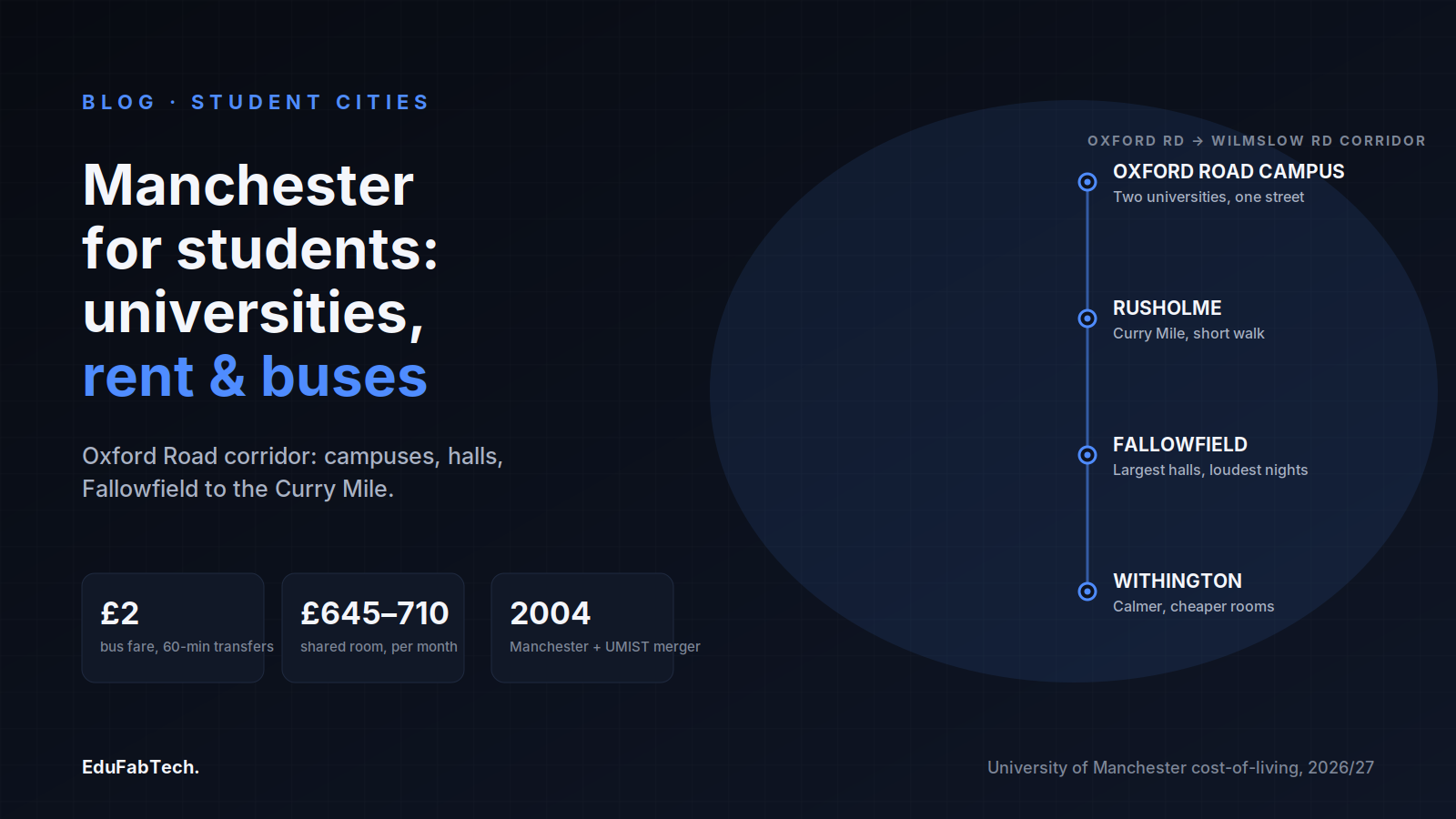
Manchester is unusual among British cities in how tightly its student life is wrapped around a single street. Walk south from the city centre down Oxford Road and you pass, in less than two kilometres, two of the largest universities in the United Kingdom, a teaching hospital complex, a music conservatoire and the start of the long residential corridor where tens of thousands of students rent. Keep walking and Oxford Road becomes Wilmslow Road, running through Rusholme, Fallowfield and Withington. That spine — campuses at the top, bedrooms at the bottom, buses every couple of minutes in between — is the geography a Manchester student lives inside.
This guide covers who teaches where, which neighbourhoods students pick and why, what a room costs with figures you can trace to their source, how the Bee Network fares work, where to study, and the parts of living here that are genuinely hard. It is written for someone deciding whether to come, and for someone who has just arrived and needs to find a room without being cheated.
The universities along Oxford Road, and a few beyond it
The University of Manchester sits on Oxford Road just south of the centre, on the single city-centre campus the university describes on its campus pages. The institution in its present form dates from 2004, when the Victoria University of Manchester merged with the University of Manchester Institute of Science and Technology (UMIST) — the two names you will still see on older buildings and plaques. It is a broad research university with particular strength in physics and engineering, and it is home to the National Graphene Institute.
Manchester Metropolitan University (MMU) occupies the next stretch of the corridor, describing itself as a city-centre campus clustered around All Saints and Oxford Road. It is home to the Manchester School of Art, as the art school's own pages confirm, and has one of the largest student populations in the country. The two campuses are close enough that visitors often cannot tell where one ends and the other begins.
The Royal Northern College of Music (RNCM), a specialist conservatoire formed in 1973, stands on the same road and trains performers and composers to professional level while running a busy public concert programme. Two more degree-awarding universities sit in the wider Greater Manchester area rather than in the city itself: the University of Salford, whose main Peel Park campus is on the banks of the River Irwell with a second base at MediaCityUK next to the BBC and ITV; and the University of Greater Manchester in Bolton, which was the University of Bolton until the Office for Students approved its renaming, announced in December 2024. If you are applying to Salford or Bolton, plan your housing search around those towns, not around Oxford Road.
Fallowfield, Withington and the corridor south
Most undergraduates live in halls for first year, then move south into the private corridor. The character changes mile by mile.
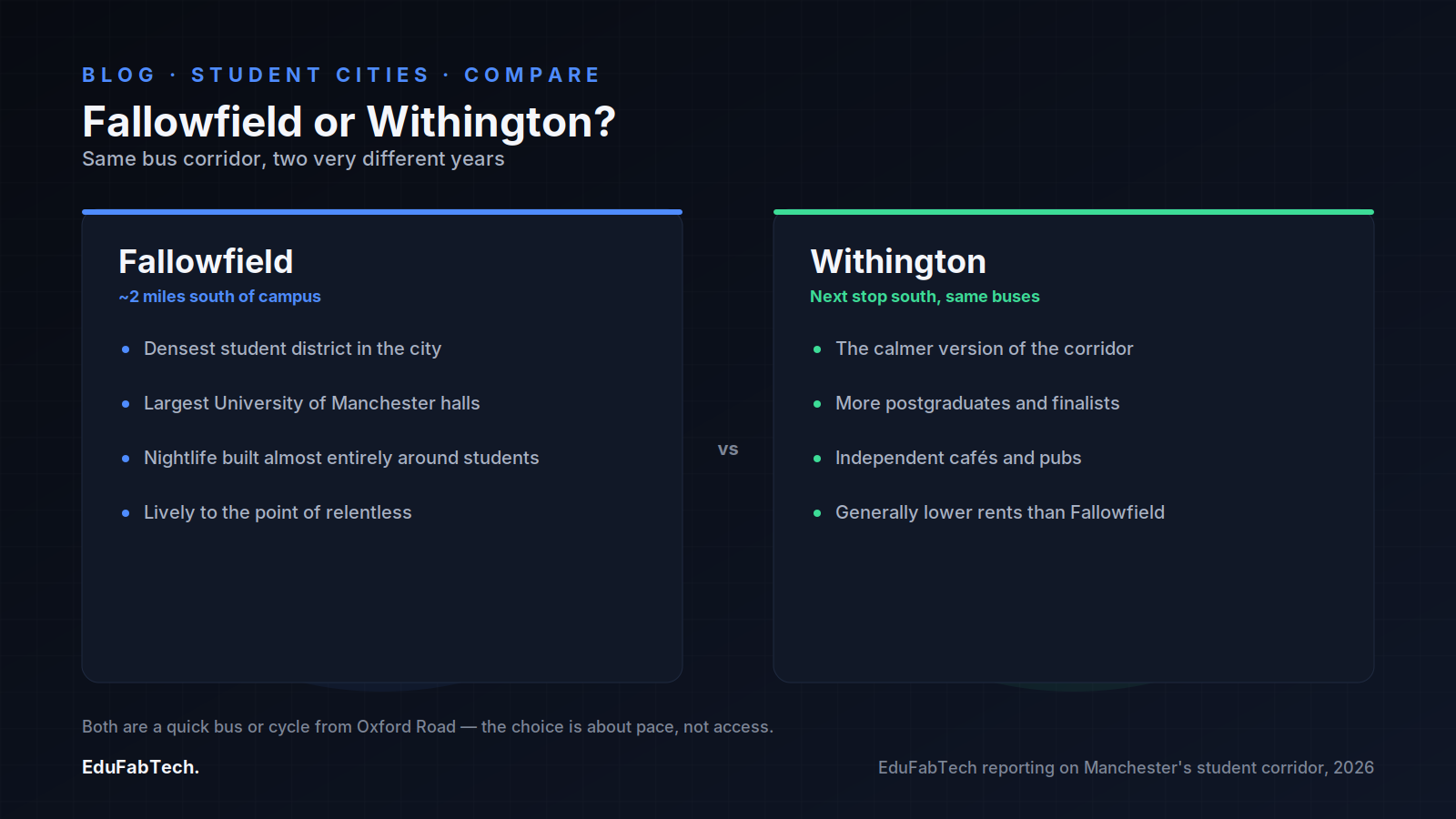
Fallowfield, about two miles south, is the densest student district in the city — street after street of shared houses, the University of Manchester's largest halls, and a nightlife built almost entirely around students. It is lively to the point of relentless, and quiet it is not. Withington, the next stop south, is the calmer version: the same quick bus into campus, more postgraduates and finalists, independent cafés and pubs, and generally lower rents than Fallowfield. Rusholme, closer to the universities, is best known for the stretch of Wilmslow Road lined with South Asian restaurants that the city calls the Curry Mile; rooms here are cheap and the walk to campus is short, though the main road is noisy.
Victoria Park and the edges of Hulme and Moss Side, between Rusholme and the centre, put you within walking distance of both main universities and are popular with students who want to avoid the bus altogether. The city centre itself — the Northern Quarter, Deansgate, around Oxford Road station — is where a growing share of international and postgraduate students live, almost entirely in purpose-built private halls; it is the most expensive option but removes the commute. For Salford students, Salford Crescent and the MediaCityUK area put you beside your own campus and one tram or train stop from central Manchester.
Signing a house share: timing, and the deposit scams to dodge
The private-house hunt in Manchester starts early and moves fast. Groups of friends who want a house in Fallowfield or Withington for the next academic year often sign before the winter break — far earlier than the housing market in many other countries, and earlier than is comfortable. There is no need to panic-sign in October, but do expect the best-regarded streets to go first.
The scams here follow a predictable shape: a room advertised below the going rate, a landlord or "agent" who is conveniently abroad or too busy to let you in, and pressure to pay a holding fee or deposit immediately to secure it before a viewing. Treat any request to transfer money by bank transfer, gift card or cryptocurrency to "hold" a room as a scam, full stop — no legitimate Manchester landlord needs that. See the place in person or on a live video call, meet whoever holds the keys, and never pay before you have.
Two rules protect you under English law. First, your deposit must be placed in a government-approved tenancy deposit scheme; GOV.UK states the landlord must do this within 30 days of getting it, and you are entitled to the scheme details. Second, check that the property has a current gas safety certificate and an energy performance certificate before you sign. If a landlord cannot or will not show you deposit-scheme confirmation, walk away. University accommodation offices and students' unions at the University of Manchester, MMU and Salford run housing advice services and maintain lists of vetted landlords — a safer first stop than an open marketplace.
What it actually costs
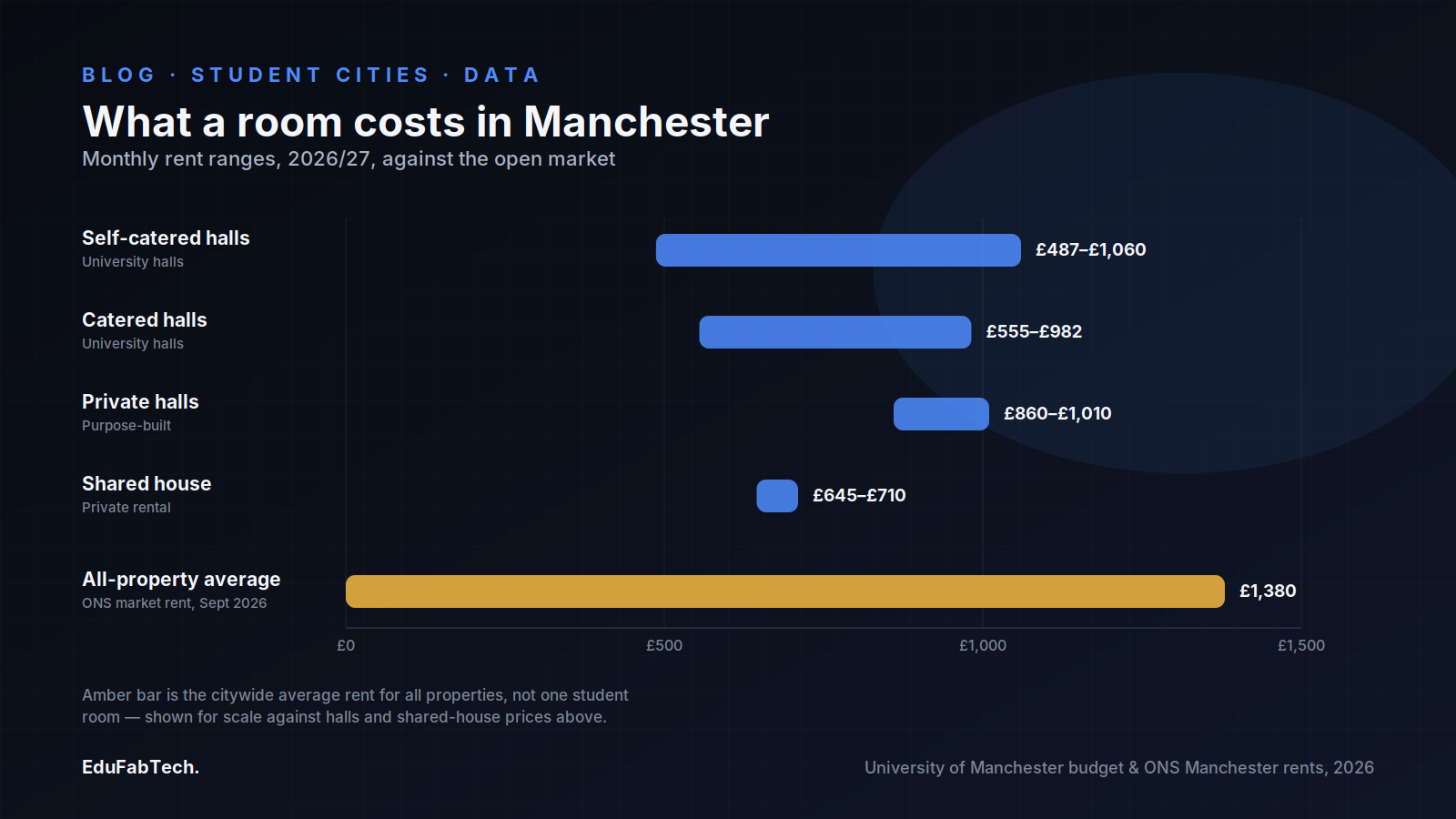
The University of Manchester publishes a budget for prospective students that is one of the few precisely dated figures available. On its cost of living page, updated for the 2026/27 academic year, it gives monthly rent of £487–£1,060 for self-catered university halls, £555–£982 for catered halls, £860–£1,010 for private halls and £645–£710 for a room in a shared house. Its grocery estimate is based on a weekly budget-supermarket shop priced in April 2026, and it budgets £700 for a year of local transport.
For the open rental market, the Office for National Statistics reports that the average monthly private rent in Manchester was £1,380 in September 2026, up 4.6% from £1,319 in September 2025, on its local rent and house-price data. That is an average across all property sizes, not a student room — a bed in a shared house costs a fraction of it — but it is a useful gauge of how fast rents are climbing, and they are climbing faster than many students expect.
Furnishing a room: Afflecks, Levenshulme and the charity-shop belt
Manchester is a good city to furnish a room cheaply, partly because its student turnover creates a constant second-hand supply. In the Northern Quarter, Afflecks — an indoor emporium of independent traders running since 1982 across four floors — is the place for vintage clothing, records and oddments rather than furniture, but it sets the tone for the district's second-hand and independent shops. For furniture and household things, head south to Levenshulme: the Levenshulme Antiques Village, in the former town hall on Stockport Road, deals in vintage and pre-war furniture, and the community-run Levenshulme Market runs most weekends between spring and December with vintage and homeware traders alongside the food stalls.
The charity shops along Wilmslow Road in Withington and Chorlton, and the reuse networks that fill up as students move out each June and July, are where a desk, lamp or bookshelf costs a few pounds. On EduFabTech you can browse what Manchester students are selling or giving away locally: second-hand things, second-hand furniture and items given away free. Furnishing a first house from these costs a fraction of buying new, and the end-of-year glut means patience is rewarded.
Getting around on the Bee Network
Manchester's buses, trams and (increasingly) local rail are being brought together under the publicly controlled Bee Network, run by Transport for Greater Manchester (TfGM). For a student the headline is the bus fare: a single adult "hopper" ticket is £2 and lets you change onto other Bee Network buses within 60 minutes at no extra cost, and a seven-day bus ticket is £20, as listed on TfGM's bus tickets and 7-day Bee Bus pages. TfGM has said these fares are held for 2026. On the dense Wilmslow Road corridor this makes the bus the default way in and out of campus; services run constantly along that route.
Metrolink, the tram network, is priced by zone. TfGM's 28-day adult travelcard is £36.40 for a single zone and £101.80 for all zones. There is no general adult student discount on Metrolink; the dedicated young-person schemes such as the igo card are limited to specific ages, so most university students pay adult fares. Given the layout, many students in the south corridor rely on buses and bikes rather than trams, since the tram lines do not follow Wilmslow Road.
Part-time work and the visa rules
Term-time jobs — in bars, shops, campus roles and the restaurants of Rusholme and the city centre — are common and help with rent. If you are an international student, your right to work is set by your visa and is not something to guess at. The UK Council for International Student Affairs (UKCISA) explains in its guidance on working with a Student visa that most students can work up to 20 hours a week during term time, that some are restricted to 10 hours, and that some have a work prohibition — so you must check your own visa, biometric residence permit or eVisa for your specific condition. The hours are a strict weekly limit that cannot be averaged across weeks, and self-employment and professional sport are not permitted; the official statement of what a Student visa does and does not allow is on GOV.UK. This is a summary, not legal advice — confirm your position with your university's international student support team. You can see current local openings via jobs and part-time work in Manchester on EduFabTech.
Libraries and places to study
Beyond your own university library, two public study spaces are worth knowing. The city's Central Library in St Peter's Square — opened by King George V in 1934 and reopened in 2014 after a major refurbishment — has a domed reading room and group study spaces that are free to use, as Manchester City Council's Central Library page sets out; it is a quiet alternative when campus libraries fill up in exam season. The John Rylands Library on Deansgate, the University of Manchester's neo-Gothic special-collections library opened to readers in 1900, holds collections ranked among the top university special collections in the country and runs a public reading room. For day-to-day revision, cafés and bookable desks across the city fill the gaps; EduFabTech lists study spaces and desks around Manchester.
The good, the hard, and a first-weeks checklist
What is genuinely good about studying here: the sheer scale of the student population makes the city feel built for you, the £2 bus fare keeps a basic commute affordable, music and nightlife are among the best in the country, and second-hand everything is easy to find. The compact corridor means you can live cheaply in Withington and still be on campus in fifteen minutes.
What is hard: rents are rising faster than many budgets, as the ONS 2026 figure shows, and the early sign-up pressure pushes groups into year-long contracts before they know their housemates well. Fallowfield's density is exhausting for some; the city's weather is reliably grey and wet; and the gap between the polished city-centre halls and the tired housing stock in parts of the student belt is wide. None of this is a reason to stay away — but go in with eyes open. You can see the full picture of local listings, rooms and events at EduFabTech's Manchester page, with places near each campus at the University of Manchester, MMU and Salford.
First weeks
- Register with your university and, if you are international, confirm your exact work hours with student support before taking any job.
- Get a Bee Network bus pass sorted and learn the Wilmslow Road services — they are your lifeline south.
- If you are already house-hunting for next year, view in person, meet the key-holder, and never transfer money to hold a room.
- Check your deposit is placed in a government-approved scheme within 30 days, and keep the paperwork.
- Register with a local GP and a dentist early, before you need one.
- Furnish from Levenshulme, charity shops and the June–July student clear-out rather than buying new.
A quick question for readers
Do you work part-time while you study?
Many students work to pay the bills. See how common it is — and how many hours people really do.
Pick an answer, create a free account in a minute, and your vote counts. Already a member? Sign in
Comments 3
Comment-
The piece leans hard on the University of Manchester's own shared-house figure (£645–£710) to make the city sound affordable, then tucks the…
-
The furniture section is the strongest part of this guide precisely because it's testable: Afflecks since 1982, Levenshulme Antiques Village…
-
The furnishing-and-fares stuff is the bit I'd actually photocopy for incoming students, but the two headline rent figures sitting in the sam…
Join free to read the full comments and reply Comments are between members; an account takes a minute.
Source: University of Manchester
Sources (5)
- University of Manchester. Cost of living. University of Manchester, 2026. manchester.ac.uk ↗ · checked 5 Nov 2026
- Office for National Statistics. Private rent and house prices, Manchester. Office for National Statistics, 2026. ons.gov.uk ↗ · checked 5 Nov 2026
- Transport for Greater Manchester. Metrolink 28-day travelcard (adult). Transport for Greater Manchester, 2026. tfgm.com ↗ · checked 5 Nov 2026
- UK Council for International Student Affairs. Navigating work and study with a Student visa. UKCISA, 2024. ukcisa.org.uk ↗ · checked 5 Nov 2026
- GOV.UK. Tenancy deposit protection. Government Digital Service, 2026. gov.uk ↗ · checked 5 Nov 2026