Studying in Mankato: universities, housing and student life
A practical, sourced guide to Minnesota State Mankato and Bethany Lutheran College — where students live, what a dorm room costs, how the free bus works, and the honest trade-offs of a river-bend city.
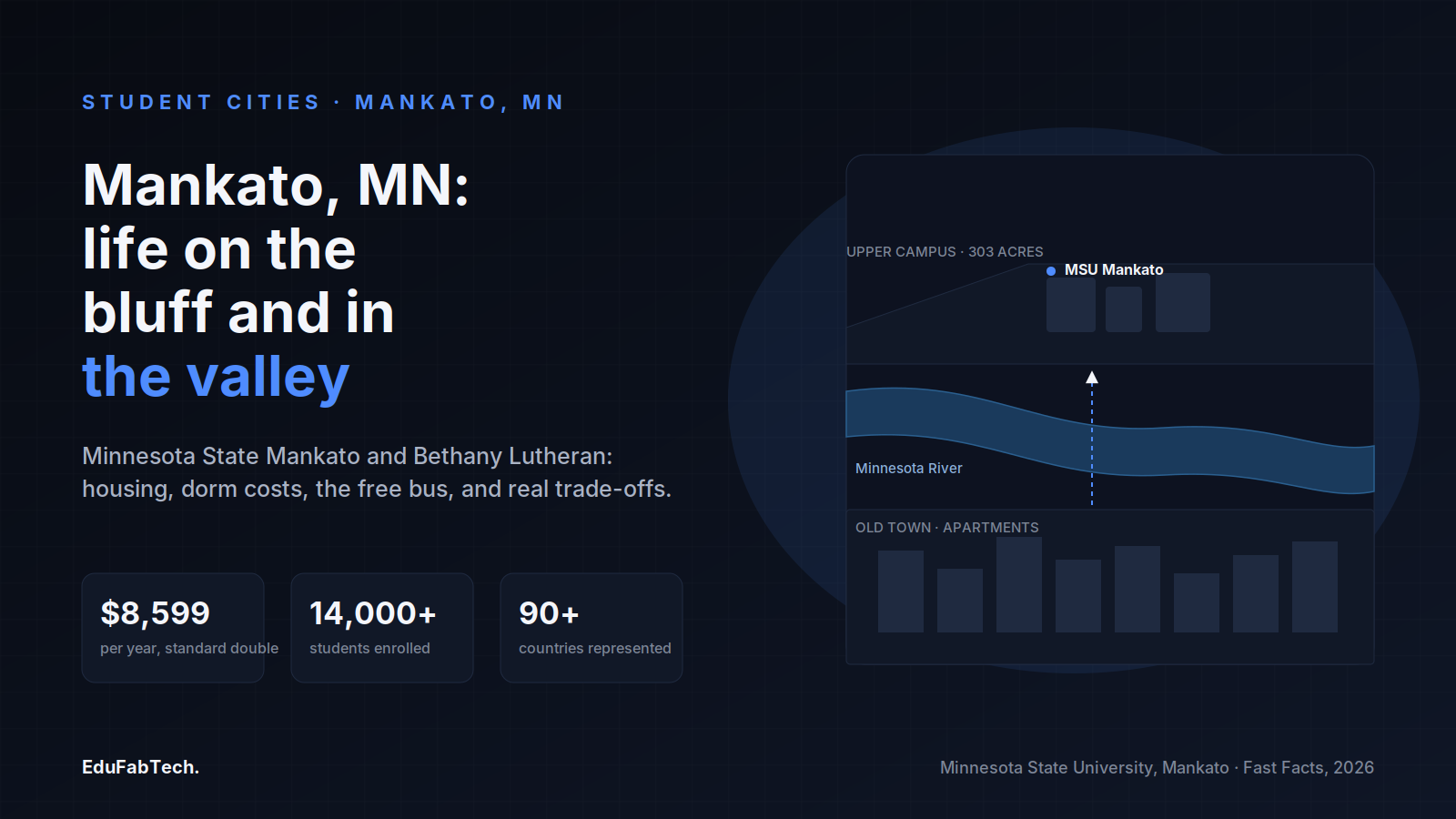
Mankato sits where the Minnesota River makes a sharp elbow and turns north toward the Twin Cities, with the older part of town strung along the river flats and the main university campus climbing the bluff above it. According to the Fast Facts page published by Minnesota State University, Mankato (2026), the university sits on 303 acres overlooking the Minnesota River Valley, about 85 miles southwest of the Twin Cities of Minneapolis and St. Paul. That geography shapes student life more than any brochure: the campus is up on the hill, much of the cheap housing and nightlife is down in the valley, and in winter the walk between them is cold.
For a student arriving from abroad or from another US state, Mankato is a mid-sized regional city rather than a big metro. It has one large public university, one small private college, a river, a shopping mall, and a transit system that happens to be free if you carry the right card. This guide works through the universities, where people actually find rooms, what those rooms cost, how to furnish one for very little, the rules on part-time work, where to study, how to get around, and the honest pros and cons.
Everything below is tied to a named source you can open. Where a figure needs a date or a caveat, that stays attached to the number, because housing rates, bus fees and immigration rules all change.
Two campuses: one on the bluff, one in the valley
The dominant institution is Minnesota State University, Mankato. Its own Fast Facts page (2026) traces the school to its founding in 1868 as Mankato Normal School, a teacher-training college, and says it now enrolls more than 14,000 students, including more than 1,300 international students from more than 90 countries. The same page lists five academic colleges — Allied Health and Nursing; Business; Education; Humanities and Social Sciences; and Science, Engineering, and Technology — so the subject mix runs from nursing and engineering to teaching and the arts. The sports teams are the Mavericks, and the student ID card you will hear about constantly is the MavCARD; it is your library card, your meal-plan card and, as you will see, your bus pass. Listings near the main campus are collected on EduFabTech at the Minnesota State Mankato page.
The second institution is Bethany Lutheran College, a small private Christian liberal arts college on Luther Drive, on high ground above the river valley. Its About page records that Bethany was founded in 1927 and is run by the Evangelical Lutheran Synod. With far fewer students than the state university, it is the small, faith-based alternative across town for those who want a tiny campus and close contact with faculty.
Where students live: dorms on the hill, apartments in the valley
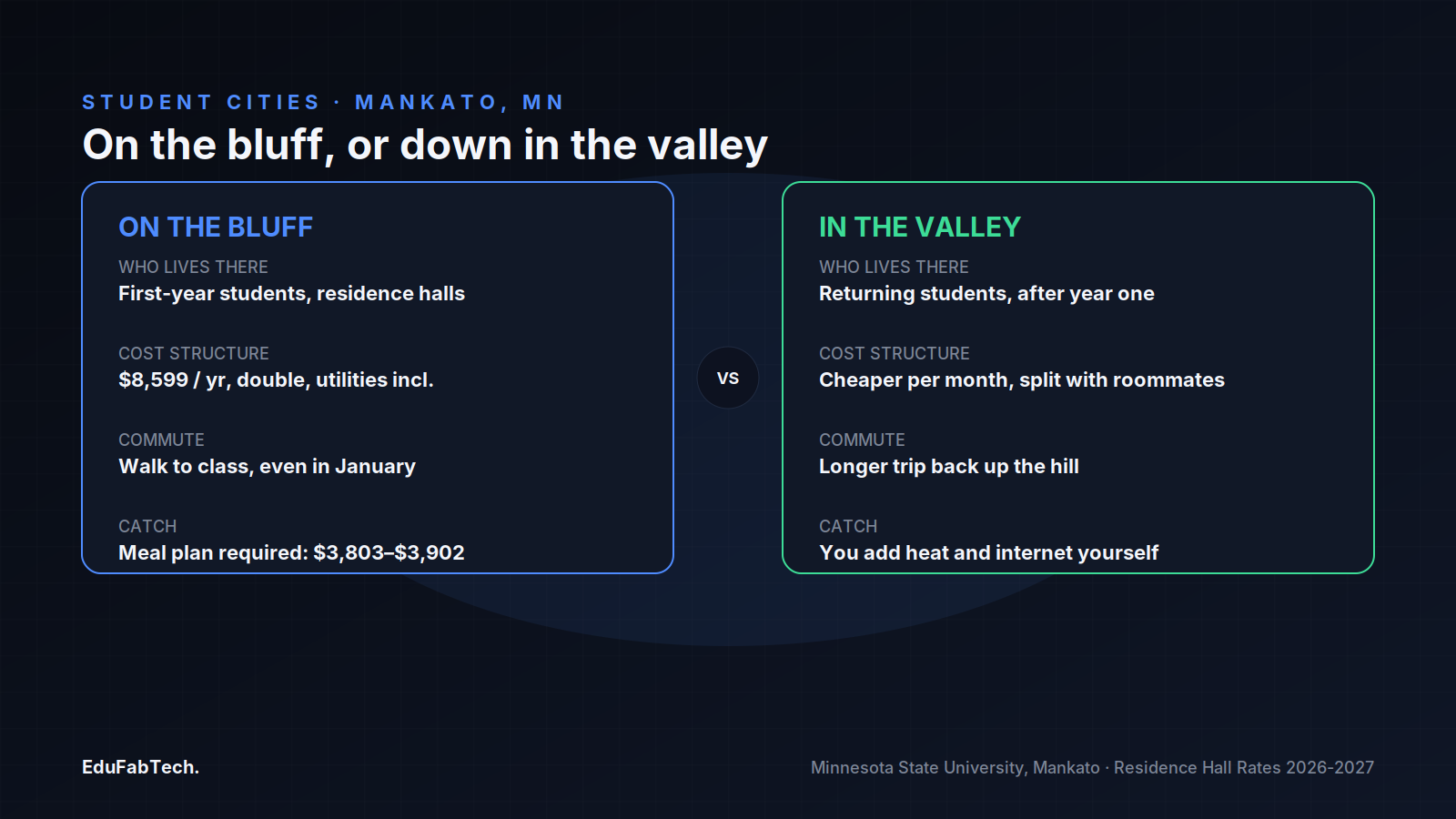
First-year students at Minnesota State Mankato mostly live in the residence halls on the upper campus, within walking distance of classes — which matters in January. After the first year, the pattern flips: most students move off campus, into the apartment blocks and older houses that spread down toward Old Town along North Riverfront Drive and out along the main road corridors. The neighbourhoods closest to campus fill first and command the highest rents; the further down the hill and across the river into North Mankato you go, the cheaper and quieter it tends to get, at the cost of a longer commute.
If you want a room off campus, the single most important thing to understand is the timing. Mankato's student leases turn over on an academic cycle, and the better units near campus are often signed many months in advance — students frequently commit to next year's house before the current winter is over. Start looking early, keep your options open, and do not panic-sign the first thing you see. The university also runs an off-campus housing listing service, and EduFabTech keeps its own Mankato rooms listings alongside the full set of student listings for the city.
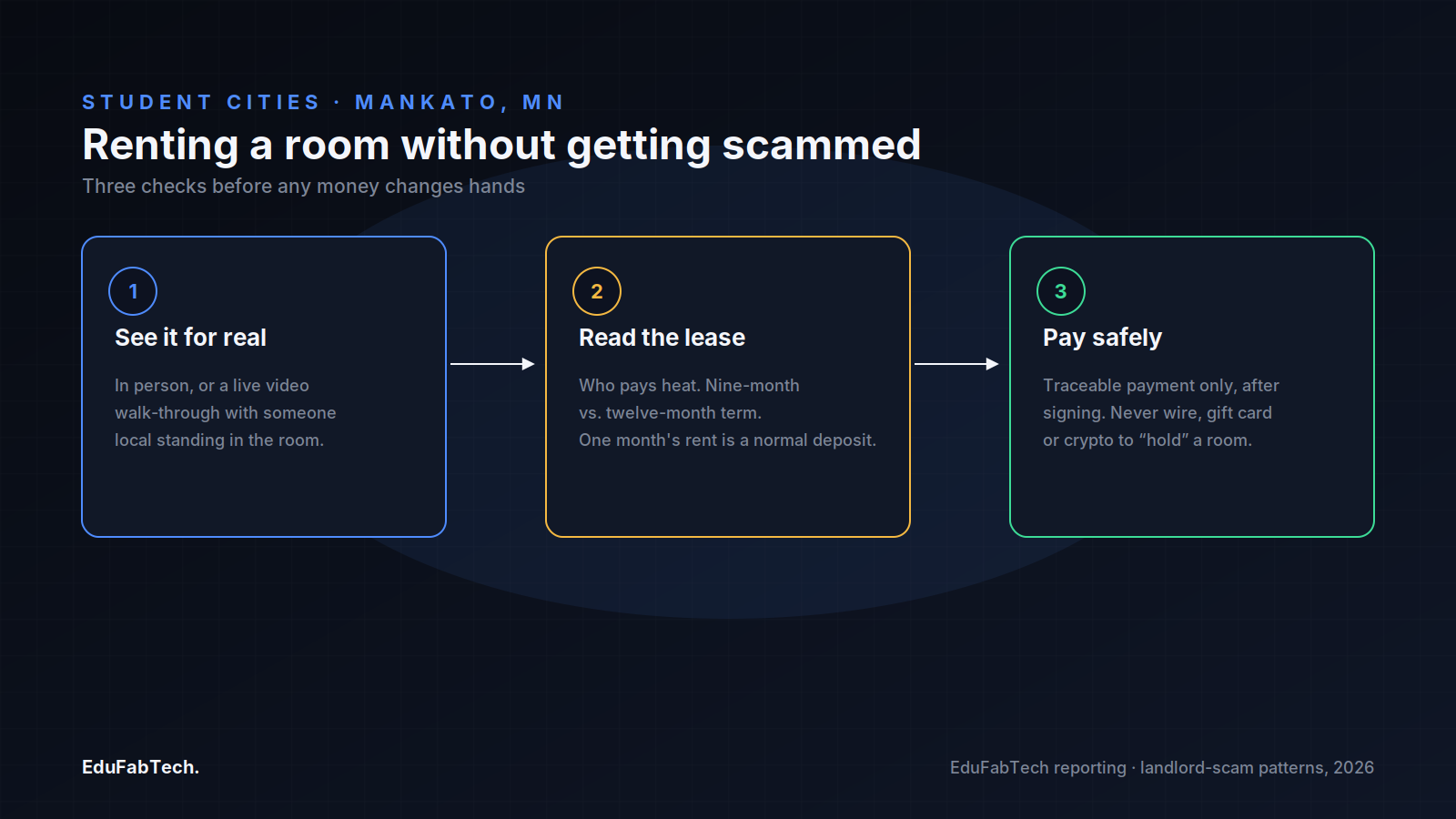
Before you pay anything, there is a short list of things to check, and it is specific to how renting works here. See the actual unit in person, or on a live video walk-through if you are still abroad, ideally with someone local standing in the room. Confirm who pays for heat — Minnesota winters make heating a real line item, and a cheap rent with tenant-paid heat can cost more than a dearer all-inclusive room. Get the lease in writing and read the end date, because a nine-month student lease and a twelve-month lease are very different commitments. Ask what deposit is normal; a month's rent as a damage deposit is ordinary, but be wary of anyone demanding far more up front for a place you have not seen.
On scams: the warning signs in Mankato are the same ones that show up wherever students rent in a hurry. A "landlord" who is conveniently out of state, cannot let you in to view, and wants money to "hold" the room before you have signed anything is the classic pattern. Never send a deposit or first month's rent by bank wire transfer, gift card or cryptocurrency to secure a room — legitimate local landlords do not ask for that, and money sent that way is effectively gone. Pay by a traceable method, after you have seen the place and signed a lease with a real address and a name you can verify.
What a dorm room costs
For a figure you can rely on, use the university's own published rates. The 2026-2027 residence hall rates from Minnesota State University, Mankato list the academic-year cost of a standard double room at $8,599, a triple at $7,807, and a single at $10,921, with suite and apartment-style rooms running higher. Those rates are per person, include utilities, and the page states plainly that they are subject to approval by the Minnesota State Board of Trustees, which it says historically acts on rates by late June before students arrive in August — so treat them as the proposed figures until that vote.
A meal plan is required in the residence communities, which adds a separate charge: the same 2026-2027 page lists the Anytime plan at $3,803 for the academic year and a 14-meals-per-week plan at $3,902. Add room and board together and on-campus living is a substantial, predictable annual cost rather than a monthly rent. Off-campus apartments are usually cheaper per month once you split a unit with roommates, which is why so many students move out after first year — but you then take on heat, internet and the longer trip up the hill.
Furnishing a room cheaply, and the Saturday market
An empty off-campus room needs filling, and Mankato has the usual second-hand infrastructure of an American college town: national-chain thrift stores including Goodwill and a Salvation Army family store operate in the city, alongside smaller local charity and resale shops that cycle through furniture, kitchenware and winter coats. The move-out weeks in spring are the best time to find cheap or free furniture as graduating students empty their flats. EduFabTech gathers local second-hand listings on its Mankato furniture page.
For food and local produce, the long-running Mankato Farmers' Market is the fixture. Explore Minnesota's listing (2026) says the market runs Saturdays from 8:00am to noon, May through October, in the Best Buy parking lot on Adams Street, with additional Tuesday and Thursday afternoon sessions starting in June, and a smaller winter market on the first and third Saturdays inside Bomgaars Supply from November through March. The same listing notes vendors must grow or make their goods within 40 miles of Mankato, so it is genuinely local produce rather than resold stock.
Working while you study
Part-time work is common, and the rules depend heavily on your immigration status, so rely on the official source rather than word of mouth. For international students on an F-1 visa, Minnesota State Mankato's on-campus employment page states that undergraduate F-1 students may work 20 hours per week or less during the regular full-time semester and may work full-time (more than 20 hours) between semesters, while graduate students are limited to 14 hours per week or less under Minnesota state law (Mn. Statute 179A.03). Off-campus work, and training schemes such as CPT and OPT, carry their own conditions and require authorization from the university's Kearney Center for International Student Services and, for OPT, from USCIS — so talk to that office before accepting any job off campus. This is a summary of what the university publishes, not legal advice; your own adviser and the official pages govern your case.
For domestic students the constraints are practical rather than legal: the campus, the hospital, retail at the River Hills Mall and the restaurants of Old Town are the usual employers. Local openings students post and search are collected on EduFabTech's Mankato jobs page.
Libraries and places to study
The main academic study building is Memorial Library at Minnesota State Mankato, at 601 Maywood Ave. Its website advertises a Learning Commons, bookable group study rooms, and separate social and quiet study areas, plus a 24/7 Ask a Librarian chat service. During exam weeks the building keeps long hours, so it functions as the default late-night workspace for students who live off campus and do not want to study in a shared apartment. Bethany Lutheran College has its own library for its students. Beyond the campuses, EduFabTech lists quieter desks and study rooms around the city on its Mankato study-spaces page, which is useful if you want somewhere to work that is not your bedroom.
Getting around with a MavCARD
This is where Mankato is genuinely generous to students. According to Minnesota State Mankato's bus information page, if you show your MavCARD there is no charge for riding any bus or shuttle route within Mankato and North Mankato, a benefit the page says Student Government enabled through a $1.10-per-credit-hour Green Transportation Fee. The buses are run by the City of Mankato's Mankato Transit System, whose own fares and passes page lists Minnesota State University, Mankato students among those who ride at no cost with appropriate identification. In practice that means a student living down in the valley or across the river can ride up to campus and back without paying a fare at the door, which softens the main drawback of the hilltop campus. Students without a car lean on this heavily, especially in winter; students with a car still use it to avoid the climb and the parking.
What is good, and what is hard
The good: Mankato is affordable by big-city standards, the free student bus removes a real cost and a real hassle, the university is large enough to offer a wide range of subjects and more than 1,300 international classmates per its Fast Facts page, and the river valley and bluffs make for genuinely pleasant walking and cycling in the warm months. It is a city you can live in without a car.
The hard: the winters are long, cold and snowy, and the split between the hilltop campus and the valley housing means a lot of your life is organised around that climb and the weather. It is a regional city, not a metropolis — if you want the scale of nightlife, museums and work options of a major metro, the Twin Cities are 85 miles away and that is a planned trip, not a casual one. Housing near campus is competitive and signs early, so students who arrive late or search late get the longer commutes and the worse units. And as everywhere, the cheapest-looking listing is sometimes the scam.
A checklist for your first weeks
- Collect your MavCARD early — it is your bus pass, library card and meal-plan card in one.
- If you are an international student, visit the Kearney Center for International Student Services and confirm your work limits before taking any job.
- Decide dorm versus off-campus with the numbers in front of you: the university's 2026-2027 rates for a room plus required meal plan, against a shared apartment's rent once heat and internet are added.
- If renting off campus, view the unit (in person or by live video with someone local), read the lease end date, and never wire a deposit to hold a place you have not seen.
- Learn your bus route up and down the hill before the first snow, not after it.
- Hit the thrift stores and the spring move-out giveaways for furniture; save the Farmers' Market Saturdays for food.
- Book a Memorial Library group study room for your first big assignment so you know how the system works before finals.
A quick question for readers
Do you work part-time while you study?
Many students work to pay the bills. See how common it is — and how many hours people really do.
Pick an answer, create a free account in a minute, and your vote counts. Already a member? Sign in
Comments 2
Comment-
The number that jumps out is the $1.10-per-credit-hour Green Transportation Fee funding a genuinely free bus system. That's the right way to…
-
The furniture timing tip buried near the bottom is actually the sharpest bit of practical advice in here - pairing the spring move-out givea…
Join free to read the full comments and reply Comments are between members; an account takes a minute.
Source: Minnesota State University, Mankato
Sources (5)
- Minnesota State University, Mankato. Fast Facts About Minnesota State Mankato. Minnesota State University, Mankato, 2026. mankato.mnsu.edu ↗ · checked 24 Oct 2026
- Minnesota State University, Mankato. 2026-2027 Residence Hall and Meal Plan Rates. Minnesota State University, Mankato, 2026. mankato.mnsu.edu ↗ · checked 24 Oct 2026
- Minnesota State University, Mankato. On-Campus Employment (F-1 Students). Minnesota State University, Mankato, 2026. mankato.mnsu.edu ↗ · checked 24 Oct 2026
- City of Mankato. Mankato Transit System — Fares and Passes. City of Mankato, 2026. mankatomn.gov ↗ · checked 24 Oct 2026
- Explore Minnesota. Mankato Farmers' Market. Explore Minnesota Tourism, 2026. exploreminnesota.com ↗ · checked 24 Oct 2026