Studying in Mannheim: universities, housing and student life
A practical, sourced guide to Mannheim's universities, its grid-city neighbourhoods, finding a room safely, second-hand markets, study spaces, transport and what a student year really costs.
A city you can read like a grid
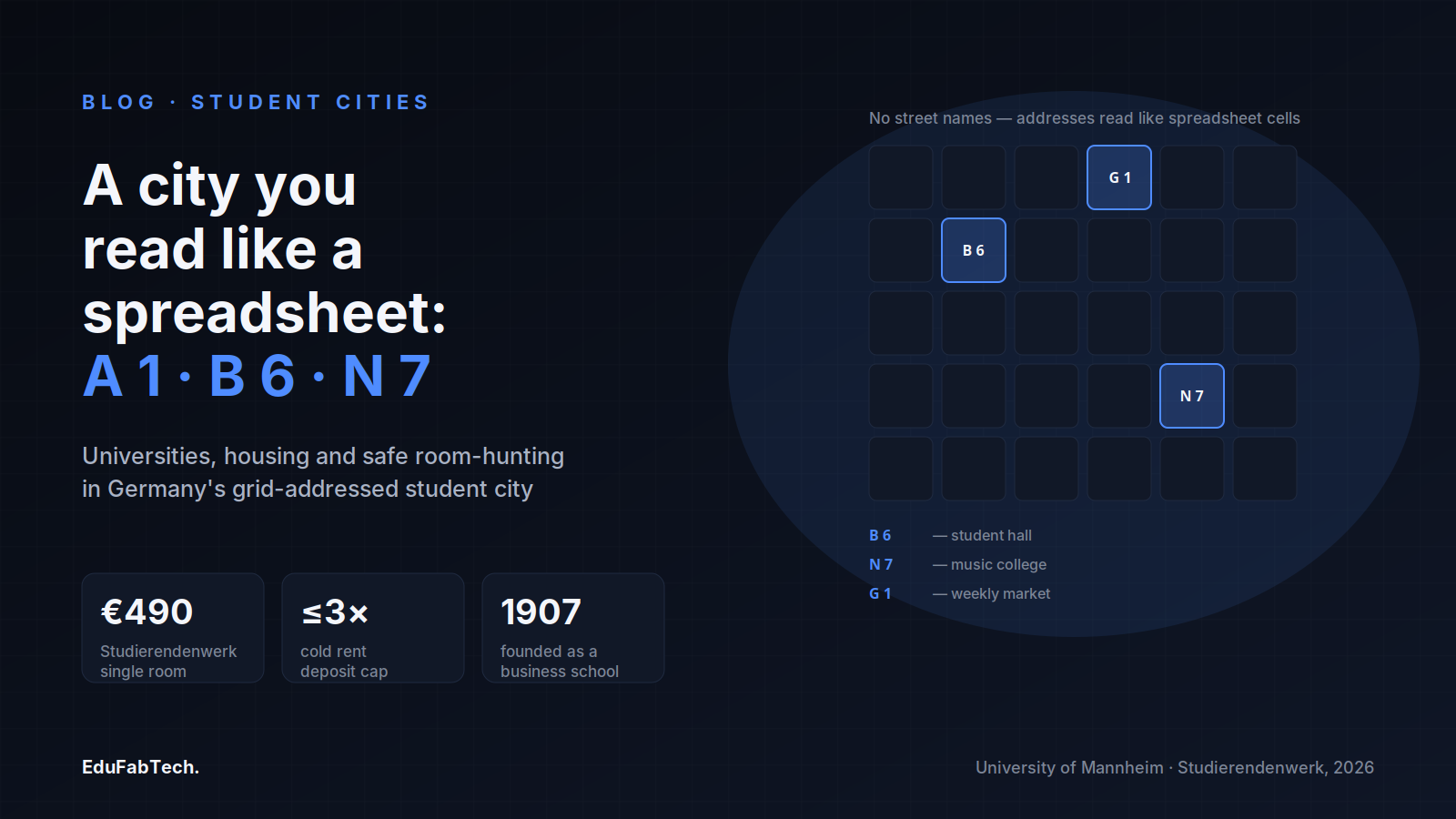
Mannheim sits where the Neckar flows into the Rhine, in the corner where Baden-Württemberg, Rhineland-Palatinate and Hesse nearly meet. Its centre is unlike anywhere else in Germany: instead of street names, the old town is a chessboard of blocks labelled by letter and number — A 1, B 6, N 7 — so an address reads like a cell in a spreadsheet. Residents simply call the area the Quadrate, the squares. Across the Rhine lies Ludwigshafen; a quarter of an hour up the Neckar by train is Heidelberg. The three form the Rhine-Neckar region, and students routinely live in one city and study in another.
It is a working city. BASF's main plant is over the river, the Rhine port is still busy, and the skyline runs to cranes and the old water tower rather than church spires. That practical character shapes student life: rents sit below Heidelberg or Munich, the music and nightlife scenes are unusually strong for the city's size, and the institutions themselves lean towards the applied. The University of Mannheim occupies a Baroque palace at the southern edge of the grid, the Mannheim Technical University of Applied Sciences trains engineers in the Lindenhof district south of the centre, and the city's state music college sits right inside the squares.
What follows is who teaches here, where students actually live, how to find a room without being cheated, where to furnish it for very little, where to study, how to get around, and what a year costs — with the honest trade-offs at the end. You can also browse current Mannheim student listings on EduFabTech alongside it.
The universities, named
The University of Mannheim is the anchor. Its predecessor, the Städtische Handelshochschule Mannheim, was founded in 1907 and the institution gained full university status in 1967, according to the university's own historical timeline. Most of it is housed in and around the Mannheim Schloss, one of the largest Baroque palaces in Europe; the university's campus page describes the paved Ehrenhof as the heart of the campus, home to the weekly Schneckenhof parties and a much-photographed magnolia. The university is known above all for business, economics and the social sciences, with law, humanities, mathematics and computer science alongside.
The Mannheim Technical University of Applied Sciences is the city's engineering school, on Paul-Wittsack-Straße in the Lindenhof district, south of the Hauptbahnhof. Its own profile puts it at roughly 5,200 students with about 180 professors, with engineering departments — mechanical, electrical and chemical engineering and information technology — tracing back to the Mannheim School of Engineering of 1898, now joined by computer science, biotechnology, design and social work. The Mannheim University of Music and Performing Arts occupies N 7, 18 in the Quadrate; it is the region's state college for music and the performing arts and runs bachelor's and master's programmes in jazz and popular music among its degrees.
Two smaller Mannheim institutions round out the city itself: the College of Economics for Management, a small private management school, and the German University of Applied Labour Studies, run by Germany's Federal Employment Agency, which offers dual degrees in careers guidance and labour-market management. The wider Rhine-Neckar region adds several more that Mannheim students sometimes commute to or transfer between: the German University of Administrative Sciences Speyer (postgraduate public administration, in Speyer); the University of Applied Sciences Ludwigshafen across the Rhine, focused on business, social work and health; and in nearby Heidelberg the Heidelberg University of Education, the Center for Jewish Studies Heidelberg, SRH Hochschule Heidelberg and the University of applied science for international management. Further out sit the University of Applied Sciences Worms, the civil-service Schwetzingen Technical Institute & Graduate Court Registrars' College, and the Hochschule für Finanzen Rheinland-Pfalz in Edenkoben, which trains tax officials. Heidelberg University, Germany's oldest, is also a half-hour away for those who want its library or lectures.
The neighbourhoods students settle in
The Quadrate (city centre). Living inside the grid means being able to walk to the Schloss, the trams and the music college. It is the most convenient address and among the most contested; several Studierendenwerk residences sit here, including the one at B 6, and WG rooms turn over quickly. Expect noise and few green spaces in exchange for the central location.
Jungbusch. The former harbour district just north-west of the centre is Mannheim's creative quarter, with music venues, bars, the Popakademie and a young, mixed crowd. It is lively and walkable, and historically cheaper, though demand and gradual gentrification have narrowed that gap. Good for anyone who wants nightlife on the doorstep and does not mind it being loud at the weekend.
Neckarstadt. Across the Neckar to the north, Neckarstadt-West and Neckarstadt-Ost are large, diverse and comparatively affordable, with small shops, cafés and the Neuer Messplatz (where the flea market is held). West is more working-class and busy; East is quieter and closer to the river parks. Trams connect both to the centre in minutes.
Lindenhof. South-west of the Hauptbahnhof, Lindenhof is calmer and leafier, popular with families and postgraduates, and it is where the Mannheim Technical University of Applied Sciences has its campus. It is central and well connected but tends to cost more than Neckarstadt for the same space.
Schwetzingerstadt and Oststadt. East of the centre, around the Wasserturm and the water-tower gardens, these are handsome, central districts within easy reach of the University of Mannheim. Rents reflect the address.
Neuostheim and the Eastsite. Further east, newer flats around the Eastsite development offer quieter streets and modern buildings, at the cost of a longer tram ride into the Quadrate and away from the main campuses.
Finding a room without losing a deposit
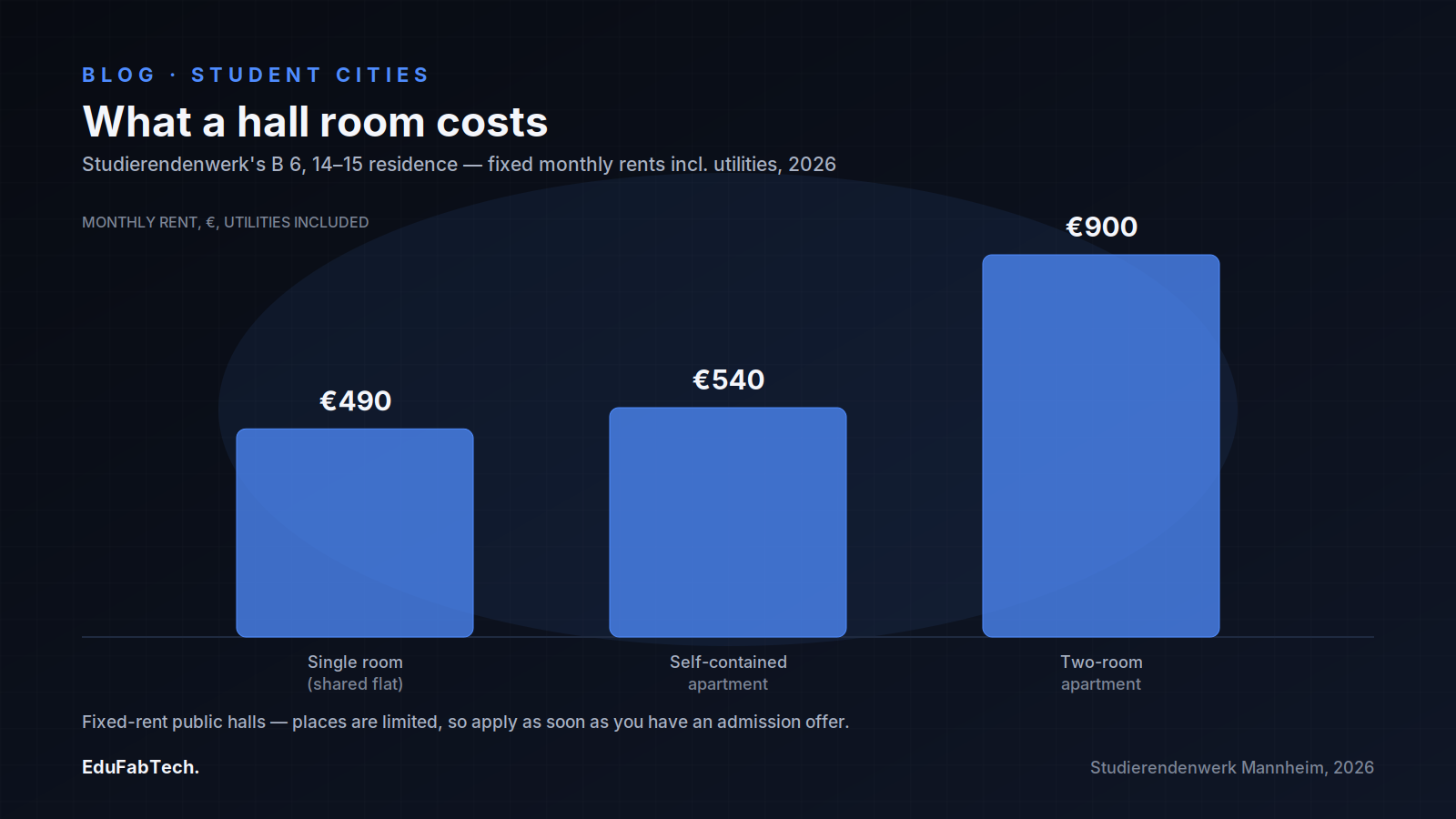
The cheapest route is the Studierendenwerk Mannheim, the public body that runs student residences across the city. Its halls are advertised with fixed monthly rents including utilities: the residence at B 6, 14–15 lists, as of 2026, a single room in a shared flat (a Doublette) at €490, a self-contained apartment at €540 and a two-room apartment at €900, per the Studierendenwerk's own page. Places are limited and applications are made online, so apply as early as you can — ideally as soon as you have an admission offer, and well before the semester begins. Browse what is currently available via Mannheim rooms on EduFabTech.
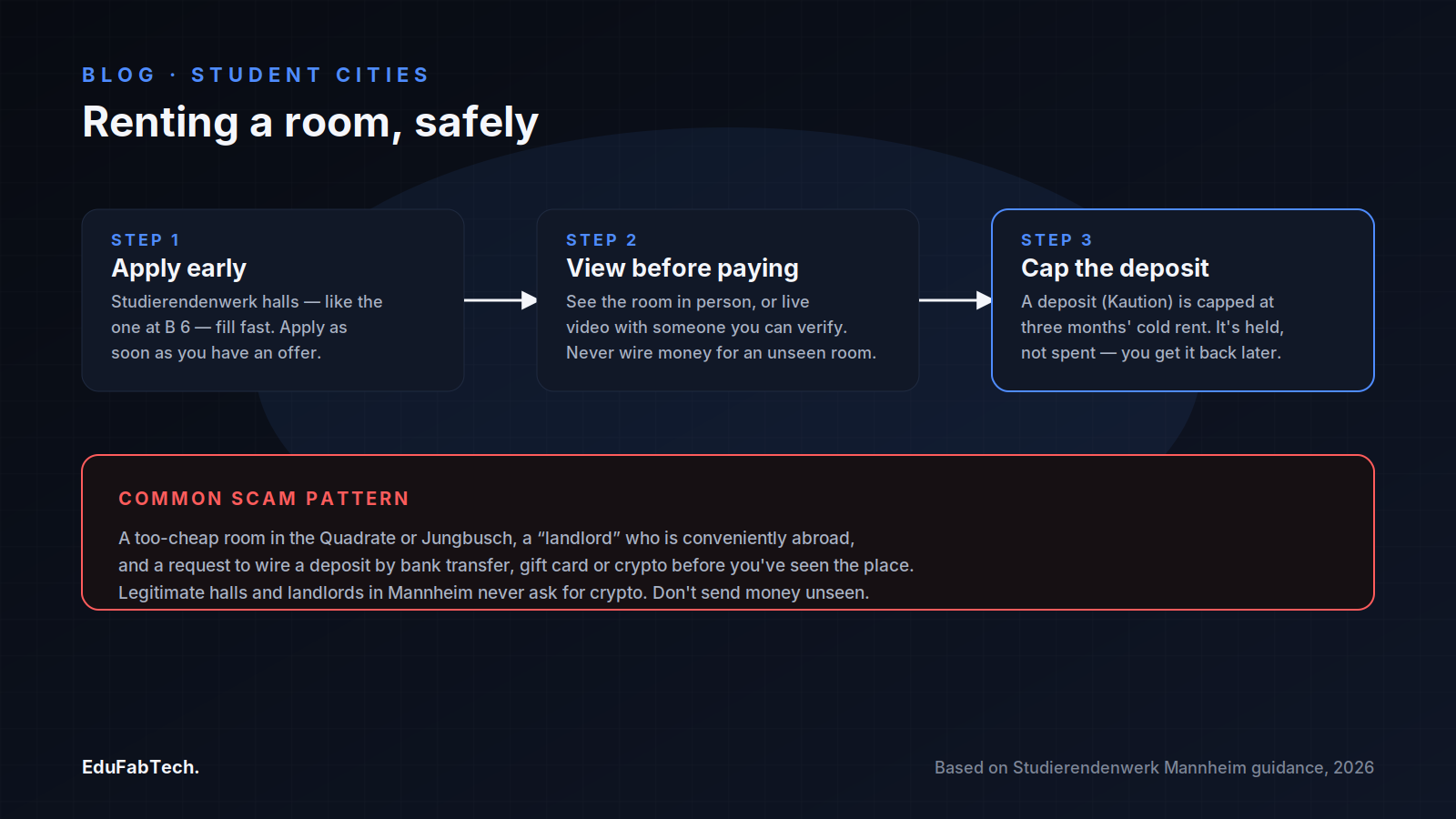
Most students who are not in a hall rent a room in a shared flat (a WG). In Germany a deposit (Kaution) is normally capped at three months' cold rent and is held, not spent; you should get it back when you leave. The scams in Mannheim follow a familiar shape: a too-cheap room in the Quadrate or Jungbusch, a "landlord" who is conveniently abroad and cannot show you the flat, and a request to wire a deposit or the first month's rent to "hold" it. Do not. Never send money by bank transfer, gift card or cryptocurrency to reserve a room you have not seen, and never pay before you have viewed the place — in person or by live video with someone you can verify — and have a written contract with a real address inside the city. Legitimate halls and landlords in Mannheim do not ask for crypto.
Furnishing a room for very little
Mannheim has a genuine second-hand culture. Markthaus Mannheim, a social second-hand department store, runs a large branch in Neckarau at Im Morchhof 33–35 selling used furniture, clothes, media, china and household goods across roughly 1,000 m², plus a small city boutique at Ifflandstraße 1, according to its own site. For one-off bargains, the Mannheimer Krempelmarkt flea market has run on the Neuer Messplatz in Neckarstadt since 1970 and is held seven market days a year, organised by the non-profit Projekt Freiraum e.V., as listed on the market's site; check its calendar before going, as it is not weekly. For food and plants, the city's weekly market fills the central Marktplatz at G 1. Online, EduFabTech aggregates local second-hand items and used furniture, and lists things given away free in the city.
Libraries and places to study
The University of Mannheim's library is spread through the Schloss. Its Learning Center at Schloss Schneckenhof offers around 180 varied workspaces and group-study technology and, in normal term time, stays open until 11 p.m. on weekdays — the kind of late access that matters in exam season, when the library extends its hours further. Non-students can use the city's public Stadtbibliothek Mannheim, whose central library sits in the Stadthaus at N 1 with individual and group workspaces, internet PCs and free Wi-Fi. If you need a quiet desk away from campus, EduFabTech also lists study spaces in Mannheim.
Getting around
Mannheim runs on trams and buses operated by the rnv (Rhein-Neckar-Verkehr), with the Hauptbahnhof a major ICE hub that puts Frankfurt and Stuttgart within an hour. Students are enrolled into the nationwide Deutschland-Semesterticket, which replaced the old regional semester ticket. The Verkehrsverbund Rhein-Neckar (VRN) set its price at €208.80 per semester from the 2025/26 winter semester, up from €176.40 (€29.40 a month); it covers local and regional trains, trams and buses across Germany but not fast long-distance ICE, IC or EC services. For most students the central grid is small enough to cross on foot or by bike, and the ticket is really for getting to Ludwigshafen, Heidelberg and beyond.
What it costs, and working alongside study
Housing is the largest line in any Mannheim budget. The Studierendenwerk's dormitory rents above — €490 to €900 a month in 2026 depending on type — are the reliable anchor; private WG rooms vary more and are worth comparing against those figures before you commit. On top of rent come health insurance, the semester fee and the Deutschland-Semesterticket noted above, and day-to-day costs that are lower here than in Munich but not negligible.
Many students work part-time. For non-EU international students, the DAAD states that you may work 140 full days or 280 half days per year without special permission, and it notes that working more than 20 hours a week during term brings mandatory social-insurance contributions; self-employment and some roles need approval from the foreigners' office (Ausländerbehörde). These rules change and your own visa conditions govern — treat the DAAD page and Mannheim's Ausländerbehörde as the authorities, not this guide, and confirm your limits before you sign anything. EduFabTech lists local student jobs in Mannheim.
The honest ledger
What is good: Mannheim is affordable by German big-city standards, central to a dense triangle of universities, and culturally rich for its size, with an open, unpretentious feel and a real music scene. The grid makes the centre quick to learn and quick to cross. Transport is excellent, and Heidelberg's charm is a tram and a train away when you want it.
What is hard: it is an industrial city, and it looks it — parts of the centre and Neckarstadt are gritty, and some arrivals find it less pretty than they expected. Rooms in the Quadrate and Jungbusch are in short supply at the start of each semester, so late arrivals scramble. Summers in the Rhine valley are hot and muggy, winters grey. And because so much of life straddles three cities, you will spend time on trams and regional trains whether you planned to or not.
First-weeks checklist
- Apply to the Studierendenwerk Mannheim for a hall as soon as you are admitted; have a short-term fallback room booked for your first weeks.
- Register your address (Anmeldung) at the city's Bürgerdienste after you move in, and sort student health insurance before enrolment.
- Never pay a deposit for a room you have not seen; keep the three-months'-rent cap and a written contract in mind.
- Collect or activate your Deutschland-Semesterticket and learn your nearest rnv tram stop.
- Furnish from Markthaus or the Krempelmarkt rather than new, and check EduFabTech's free-stuff and second-hand listings first.
- Find your study base early — the Schloss Learning Center or the Stadtbibliothek at N 1 — before exam season fills every desk.
A quick question for readers
Do you work part-time while you study?
Many students work to pay the bills. See how common it is — and how many hours people really do.
Pick an answer, create a free account in a minute, and your vote counts. Already a member? Sign in
Comments 3
Comment-
The DAAD side-job numbers deserve a bit more scrutiny than a passing mention. 140 full days or 20 hours a week during term sounds generous u…
-
The Studierendenwerk numbers are the only genuinely load-bearing figures in this piece, and they're given with enough detail to actually use…
-
The number that actually changes my travel calculus is the Semesterticket jump: €176.40 to €208.80 a semester is a 18% increase in one year,…
Join free to read the full comments and reply Comments are between members; an account takes a minute.
Source: Studierendenwerk Mannheim
Sources (5)
- University of Mannheim. Historical Data at a Glance. University of Mannheim, 2026. uni-mannheim.de ↗ · checked 12 Nov 2026
- Technische Hochschule Mannheim. About Hochschule Mannheim. Technische Hochschule Mannheim, 2026. english.hs-mannheim.de ↗ · checked 12 Nov 2026
- Studierendenwerk Mannheim. B 6 student accommodation. Studierendenwerk Mannheim, 2026. stw-ma.de ↗ · checked 12 Nov 2026
- Verkehrsverbund Rhein-Neckar (VRN). Deutschland-Semesterticket. VRN, 2026. vrn.de ↗ · checked 12 Nov 2026
- DAAD. Side jobs. Deutscher Akademischer Austauschdienst, 2026. daad.de ↗ · checked 12 Nov 2026