Studying in Marquette: Northern Michigan University, housing and student life
A practical, honest guide to studying and living in Marquette, Michigan — the university, where students live, costs, second-hand shops, work rules, study spaces and getting around on Lake Superior's shore.
A college town on the edge of Lake Superior
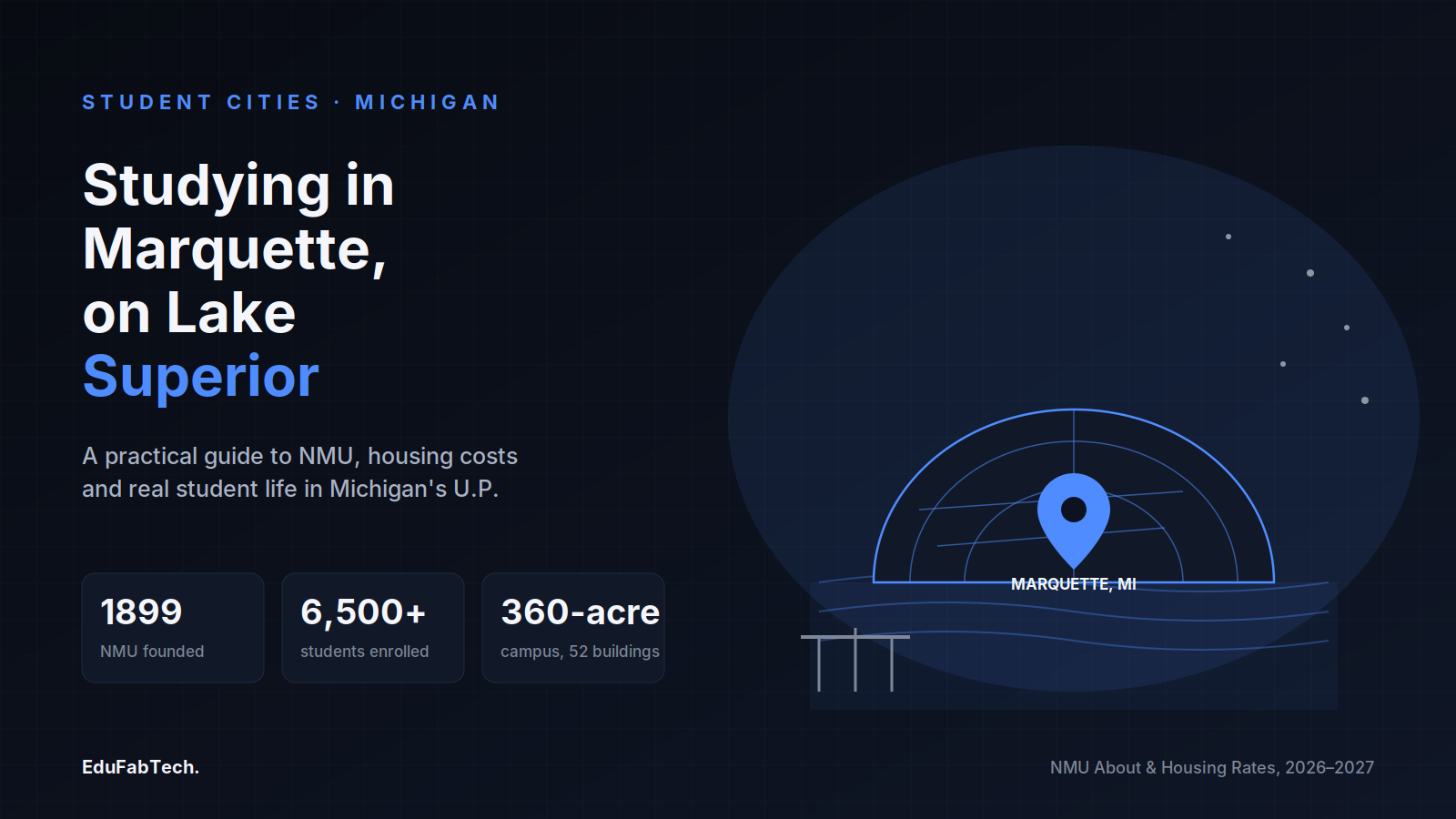
Marquette sits on the south shore of Lake Superior, roughly in the middle of Michigan's Upper Peninsula — the sparsely populated northern half of the state that is closer to Minnesota and Ontario than to Detroit. It is a long way from anywhere: the drive to the Mackinac Bridge, the only road link to the Lower Peninsula, is a few hours south. That isolation shapes student life as much as the university does. Weather, groceries, work and travel all run on the terms of a small lakeside city at a high latitude, not those of a big metro area.
The city grew around iron ore shipped out from a dock on the lake, and the ore dock still stands over the harbour. Today the economy leans on health care, the university and the outdoors — a working waterfront with Presque Isle Park at its northern tip, hiking and ski trails inland, and Lake Superior itself, which stays cold enough to swim in only briefly. Winter is long and genuinely snowy here; lake-effect snow off Superior falls from roughly November into April, and snow management is part of daily life rather than an occasional disruption. A reader deciding whether to come should treat the climate as a real factor, not a footnote.
For students the centre of gravity is Northern Michigan University, whose campus runs between the lake and the city's residential streets. Downtown — with its independent shops, the public library and the Saturday farmers market — is a short bus ride or a walkable distance from campus, which makes Marquette unusually self-contained for a university town of its size. You can reach most of what you need without owning a car, though a car widens your options considerably once winter sets in.
Northern Michigan University
Northern Michigan University (NMU) is the public university in the city, and for most students reading this it is the reason to be in Marquette at all. According to NMU's own about page, the university was founded in 1899 as Northern State Normal School — originally a teacher-training college — and now enrolls more than 6,500 students across more than 190 degree programmes, including 25 graduate programmes, on a 360-acre campus made up of 52 facilities. The same page describes the campus landmark, the Superior Dome, as the world's largest wooden dome; it is used for athletics and large events and is hard to miss from the road.
The programme mix reflects the region: alongside the traditional arts and sciences, NMU is known locally for nursing and health fields, education, outdoor-oriented and applied-science programmes, and technical and trades training that fits the Upper Peninsula's economy. Class sizes are modest and the campus is compact enough to cross on foot between lectures. For an international or out-of-state student, the appeal is a smaller, less anonymous setting than a flagship state university; the trade-off is a narrower range of courses and a remote location.
If you are comparing NMU against other institutions, be wary of ranking claims that do not name the ranking and its year — this guide does not rank it. What matters more for day-to-day life is that NMU is effectively the city's largest shared institution, so its calendar, its housing rules and its bus arrangement set the rhythm for most students.
Living on campus: the two-year rule and what rooms cost
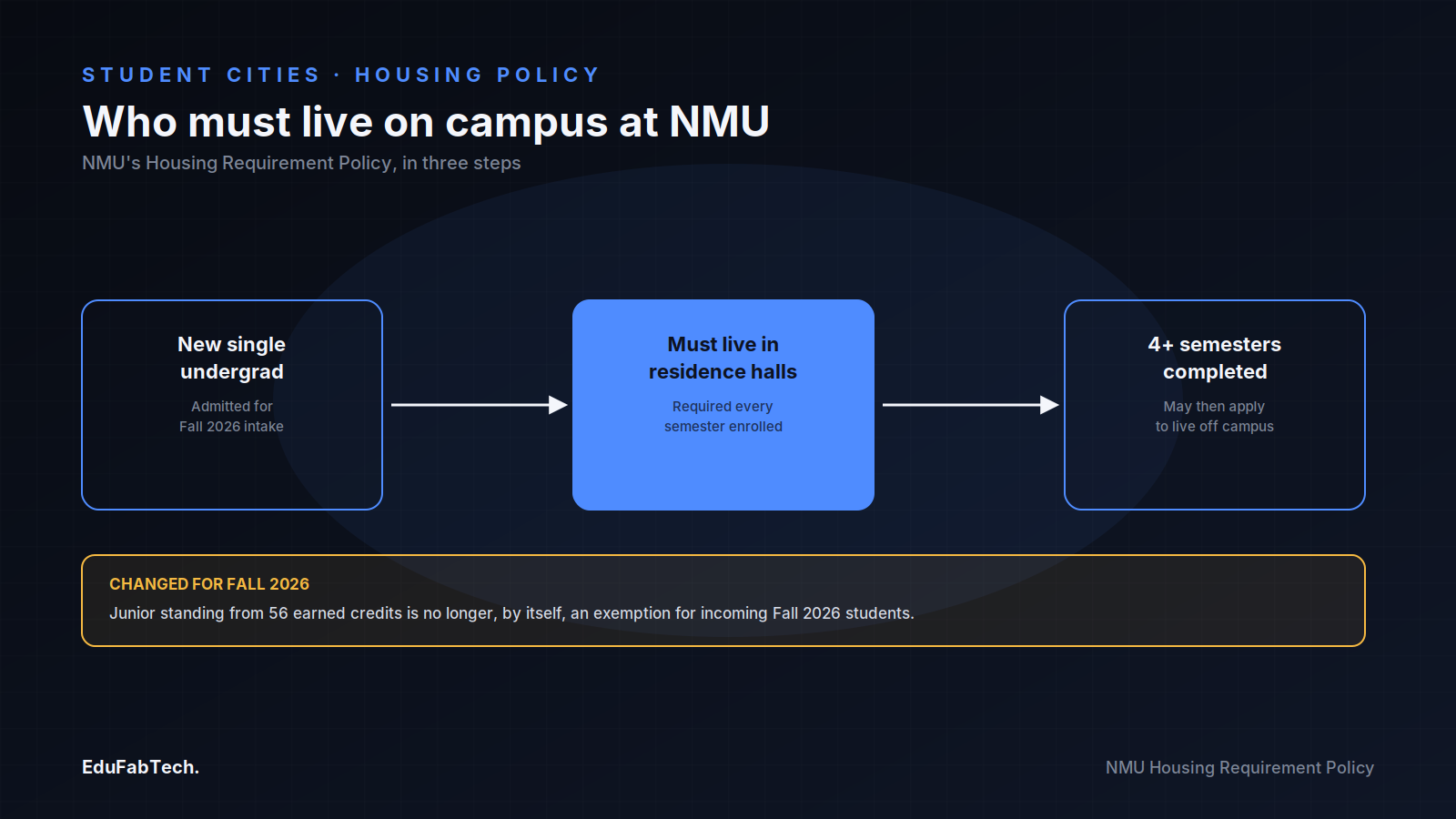
Before you plan anything off campus, check whether you are allowed to live off campus at all. Under NMU's Housing Requirement Policy, beginning in Fall 2026 all single undergraduate students must live in university residence halls while enrolled, with exemptions available only after four or more semesters; the university's page states that junior standing based on 56 earned credits is no longer an exemption for incoming Fall 2026 students. In practice that means most first- and second-year students will be in halls whether they like the idea or not, and should plan budgets around on-campus rates.
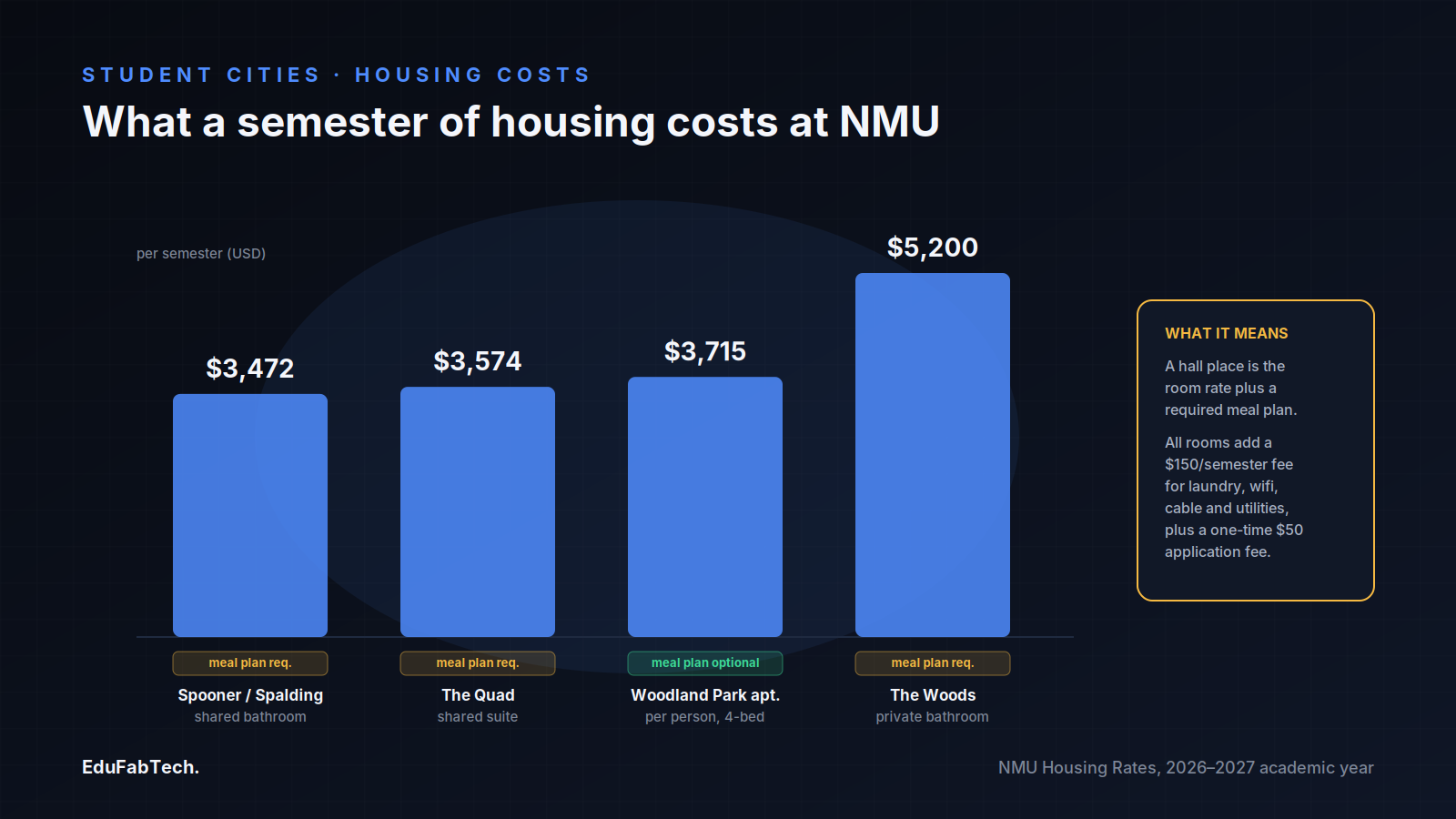
Those rates are published in detail. NMU's 2026-2027 housing rates page lists residence-hall rooms from $3,472 per semester for a single room with a shared bathroom in Spooner Hall or Spalding Hall, up to $5,200 per semester for a single bedroom with a private bathroom in The Woods; a shared bedroom suite in The Quad is $3,574 per semester. On top of the room rate the same page lists a one-time $50 application fee, a $200 advance payment released at move-in, and a $150-per-semester comprehensive fee covering laundry, internet, cable and utilities. Meal plans are required for residence-hall students, so the real cost of a hall place is the room rate plus a meal plan plus that comprehensive fee.
NMU also runs apartments, which matter once you clear the live-on requirement or arrive with a family. The rates page lists single-student apartments such as a four-bedroom unit in Woodland Park at $3,715 per semester per person and a two-bedroom Lincoln Townhouse shared by three at $2,608 per semester per person, with meal plans optional. For student families it quotes monthly rents — for example, an unfurnished Lincoln Townhouse at $1,317 per month and an unfurnished Lincoln Single at $1,117 per month, each with a monthly comprehensive fee. Because these figures are dated to the 2026-2027 year and come straight from the university, they are a reliable anchor for budgeting; private rents in town will sit alongside them but are not something this guide will quote from listings.
Renting off campus, and how scams show up in Marquette
Once you are eligible to live off campus, the local rental market is small, seasonal and tight around the start of the academic year. The neighbourhoods students favour are the streets immediately south and west of campus and the blocks running down toward downtown and the lake, where older houses are split into flats. Demand peaks in late spring and summer as leases turn over for the autumn, so the practical advice is to start looking months ahead rather than in August, when little is left.
Scams in a market like Marquette's tend to follow a pattern: a listing for a house near campus at a suspiciously low rent, a "landlord" who says they are out of town — a common claim in a town people leave for work elsewhere — and a request to wire a deposit or pay to "hold" the place before you have seen inside. Treat any of those as a stop sign. See the unit in person, or have someone you trust see it, before paying anything; confirm the person collecting rent actually controls the property; and never send a deposit or first month by bank wire transfer, gift card or cryptocurrency, none of which you can claw back. A normal local arrangement is a signed lease, a deposit and first month paid by a traceable method once you have keys in hand and have met the landlord. EduFabTech's own rooms listings for Marquette are a starting point, but the same in-person rule applies to every source.
Furnishing a room: thrift stores, the ReStore and the market
Marquette is a good town for furnishing a room cheaply, partly because a transient student and outdoors-gear population keeps usable second-hand goods circulating. The Marquette County Habitat for Humanity ReStore at 133 Carmen Drive sells donated and new furniture, home accessories, appliances and building materials, and lists its hours as Monday to Friday 11am–5pm and Saturday 11am–4pm — a sensible first stop for a desk, a chair or a bed frame. For clothing, kitchen things and smaller household items, St. Vincent de Paul on Presque Isle Avenue and Goodwill on US-41 West are the standbys, both locally used by students for cheap basics.
For food and local produce, the Downtown Marquette Farmers Market runs at the Marquette Commons, 112 S. Third Street, on Saturdays from 9am to 1pm between 16 May and 21 November 2026, with an added Wednesday evening market in the warmer months. It is seasonal — there is no outdoor market in deep winter — so it supplements rather than replaces a supermarket run. For the rest, the Friday shopping shuttle described below takes students to the larger grocery stores. If you would rather not buy new at all, EduFabTech keeps separate local pages for second-hand goods and used furniture, worth watching in the move-in and move-out weeks when students shed furniture quickly.
Part-time work, and what international students must check first
Term-time work is common, mostly on campus and in the city's health, hospitality and retail jobs. For domestic students the limits are practical ones — your course load and the local supply of jobs. For international students the rules are strict and worth reading before you rely on any income. NMU's International Programs office states that F-1 students may work on campus 20 hours per week while school is in session and 40 hours per week during school breaks, and that off-campus work is allowed only with written authorization approved by U.S. Citizenship and Immigration Services (USCIS) and the International Programs Office. The same page describes Curricular Practical Training (CPT), which is tied to your programme and is not capped at 20 hours, and Optional Practical Training (OPT), granted for up to 12 months per degree level with a possible extension for STEM fields.
This is not legal advice, and the rules can change: confirm your own situation with the International Programs Office and the official USCIS guidance before accepting any job, and never work off campus without authorization in hand. For finding roles, NMU points students to on-campus postings, and EduFabTech lists local part-time work in Marquette that you can filter alongside campus openings.
Libraries, study spaces and getting around without a car
On campus, the Lydia M. Olson Library is the main study building. The NMU Library lists bookable study rooms for individual and group work — reservable online, with limits on how long one person may hold a room — and there are additional quiet study spaces in academic buildings across campus. Downtown, the Peter White Public Library at 217 N. Front Street is open to everyone, with hours listed as Monday to Thursday 9:30am–8:30pm, Friday 9:30am–5:30pm and Saturday 9:30am–4:30pm; it is a calmer, non-campus option near the waterfront and a good change of scene. EduFabTech also collects study spaces and desks in Marquette if you want somewhere beyond the two libraries.
Getting around is where Marquette treats students well. The city bus operator is the Marquette County Transit Authority (Marq-Tran). NMU's Wildcat Shuttle page states that NMU faculty, staff and students ride free on any Marq-Tran fixed route with an NMU I.D. — a genuine benefit in a snowy city where the alternative is walking or paying for parking. For everyone else, Marq-Tran's South Marquette route schedule lists a general public fare of $0.80 and a $0.40 fare for college students with valid ID. NMU also runs a Friday shopping shuttle from Lot 9 to Meijer, Walmart and Target; the Wildcat Shuttle page gives its dates as every Friday from 28 August 2026 through 23 April 2027, except 25 December 2026 and 1 January 2027, with departures at 3:00pm and 4:15pm. For listings right by campus, EduFabTech groups everything near Northern Michigan University.
What is good, what is hard, and a first-weeks checklist
The honest case for Marquette is that it is compact, affordable to get around, and surrounded by Lake Superior and public land, with a university at the centre of town and a free bus for students. The honest case against it is distance and weather. You are far from a major city and a major airport, winter is long and heavy with snow, the off-campus rental market is small and tightest exactly when new students arrive, and the live-on requirement means most undergraduates cannot escape residence-hall costs for their first two years. Jobs exist but the labour market is small. None of this is hidden if you plan for it; it is only a problem if you arrive expecting a large, warm, car-optional metro and find a remote lake town instead.
A short checklist for the first weeks:
- Confirm whether the live-on requirement applies to you before signing anything off campus, and if it does, lock in a residence-hall room early — rooms are assigned first-come, first-served.
- Budget from the 2026-2027 rates page: room rate, plus a required meal plan if you are in a hall, plus the $150-per-semester comprehensive fee.
- Get your NMU I.D. promptly so you can ride Marq-Tran free, and note the Friday shopping-shuttle times for groceries.
- If you are an international student, meet the International Programs Office about work rules before accepting any job, and keep off-campus work authorization in hand before starting.
- Furnish from the Habitat ReStore, St. Vincent de Paul and Goodwill, and watch local second-hand and free-stuff listings during move-in and move-out weeks.
- For anything rented off campus, view it in person first and pay deposits only by traceable methods — never by wire, gift card or crypto to "hold" a place you have not seen.
- Prepare for winter early: proper boots and a warm coat are not optional here from November onward.
A quick question for readers
Do you work part-time while you study?
Many students work to pay the bills. See how common it is — and how many hours people really do.
Pick an answer, create a free account in a minute, and your vote counts. Already a member? Sign in
Comments 3
Comment-
The checklist says 'lock in a residence-hall room early — first-come, first-served,' but the actual policy buried above it is the real headl…
-
The number that undercuts the "compact and affordable" framing is the two-year live-on rule combined with the fact that junior standing at 5…
-
What stands out is the Fall 2026 housing policy change folded into this: dropping the 56-credit/junior-standing exemption means students who…
Join free to read the full comments and reply Comments are between members; an account takes a minute.
Source: Northern Michigan University
Sources (5)
- Northern Michigan University. 2026-2027 Housing Rates. Northern Michigan University, 2026. nmu.edu ↗ · checked 31 Oct 2026
- Northern Michigan University. About NMU. Northern Michigan University, 2026. nmu.edu ↗ · checked 31 Oct 2026
- Marquette County Transit Authority. South Marquette Route & Schedule. Marq-Tran, 2026. marq-tran.com ↗ · checked 31 Oct 2026
- Northern Michigan University International Programs. Employment. Northern Michigan University, 2026. nmu.edu ↗ · checked 31 Oct 2026
- Downtown Marquette Farmers Market. Downtown Marquette Farmers Market. Downtown Marquette Farmers Market, 2026. mqtfarmersmarket.com ↗ · checked 31 Oct 2026