Studying in Medford, Oregon: Southern Oregon University, housing and student life
A practical, sourced guide to studying in the Rogue Valley — Southern Oregon University in nearby Ashland, where students live around Medford, what rooms and buses cost, and the honest trade-offs.
One valley, several towns, one university
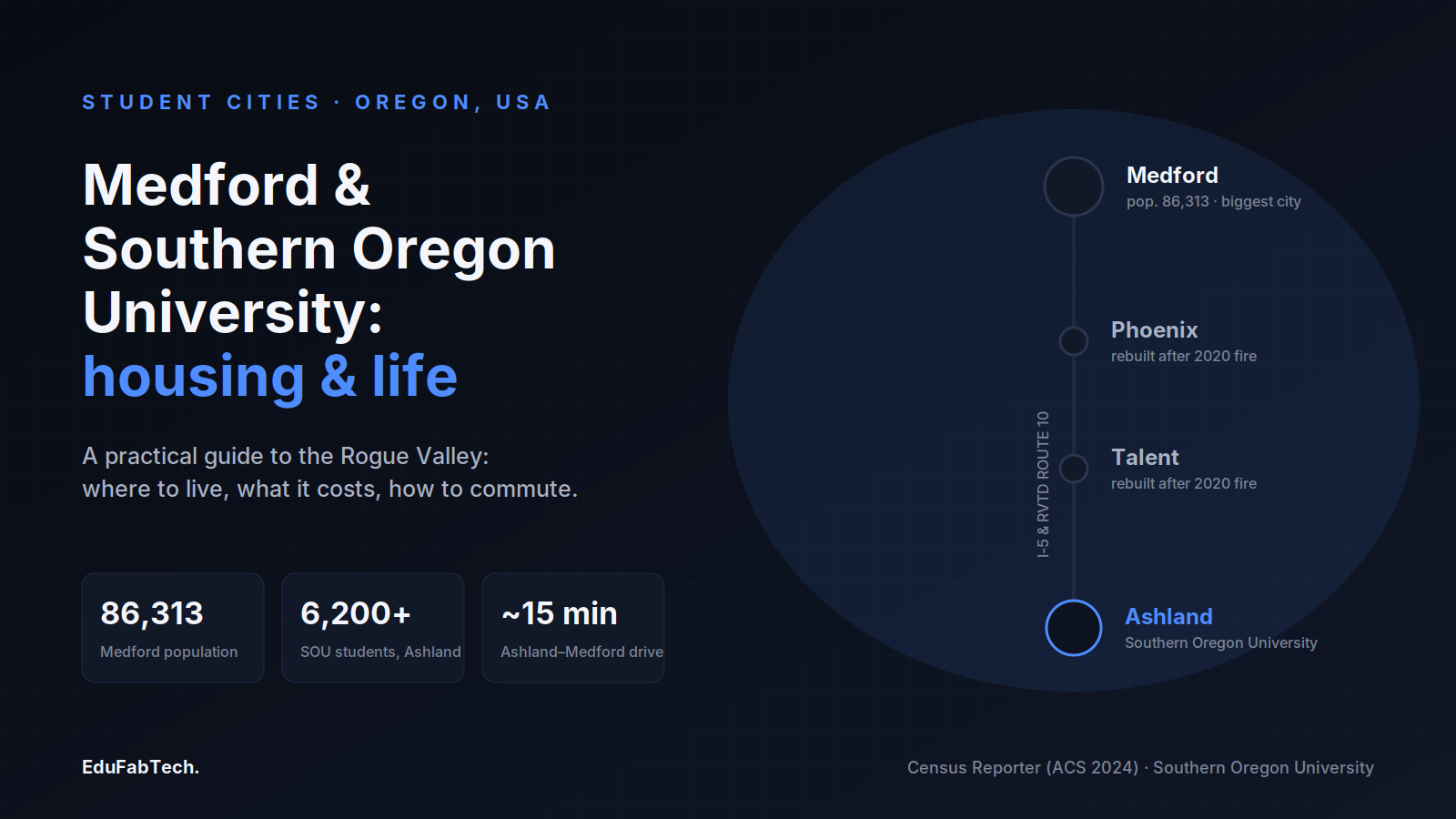
Medford is the commercial centre of the Rogue Valley in southern Oregon, strung along Interstate 5 between the Siskiyou and Cascade ranges. It is the place where the valley does its shopping, keeps its hospitals and runs its airport — but it is not, strictly, a university town. The region's public university, Southern Oregon University, sits about a quarter of an hour south in Ashland, with the small cities of Phoenix and Talent in between. Understanding Medford as a student means understanding this split: you may study in Ashland, live in Medford, and spend a good deal of time on the road that connects them.
Ashland's character is shaped by the Oregon Shakespeare Festival, one of the oldest regional theatre companies in the United States, and that theatrical pull runs straight into the university. Medford's character is more workaday — pear orchards (the Harry & David company began here), warehouses, medical campuses and the strip of retail around the Rogue Valley Mall. For a student deciding where to base themselves, the two cities offer a real choice rather than a formality.
According to U.S. Census Bureau figures reported by Census Reporter (American Community Survey 2024 1-year), Medford had a population of 86,313 and a median household income of $72,324. That makes it comfortably the largest city in the valley, which is precisely why so many of its rental rooms end up occupied by people who study elsewhere in the region.
Southern Oregon University, and the colleges in Medford itself
Southern Oregon University is in Ashland at 1250 Siskiyou Boulevard, in the foothills of the Siskiyou Mountains. The university describes itself on its own About page as a campus of over 6,200 students with 37 areas of study, a standalone Honors College open to all students, and the Oregon Center for the Arts; it also notes that it was the nation's first Bee Campus USA. Its traditional strengths show the Ashland influence — theatre, environmental science, business and psychology are among the programmes it is best known for.
Studying at SOU is a small-campus experience: quarter-system terms rather than semesters, class sizes that stay modest, and an outdoors-first culture in which hiking, river trips and the ski area on Mount Ashland are within easy reach. If you want a large research university with graduate departments in everything, this is not it; if you want faculty who know your name, it is.
Within Medford, the option most students use is Rogue Community College, a two-year college that grants associate degrees and transfer pathways and runs a campus on the city's east side. Downtown Medford also hosts the RCC/SOU Higher Education Center, where the community college and the university share space and where some SOU upper-division and graduate courses are delivered. For someone who wants to stay in Medford and finish a bachelor's degree, the common route is to start at Rogue Community College and transfer to SOU.
Where students actually base themselves, and why
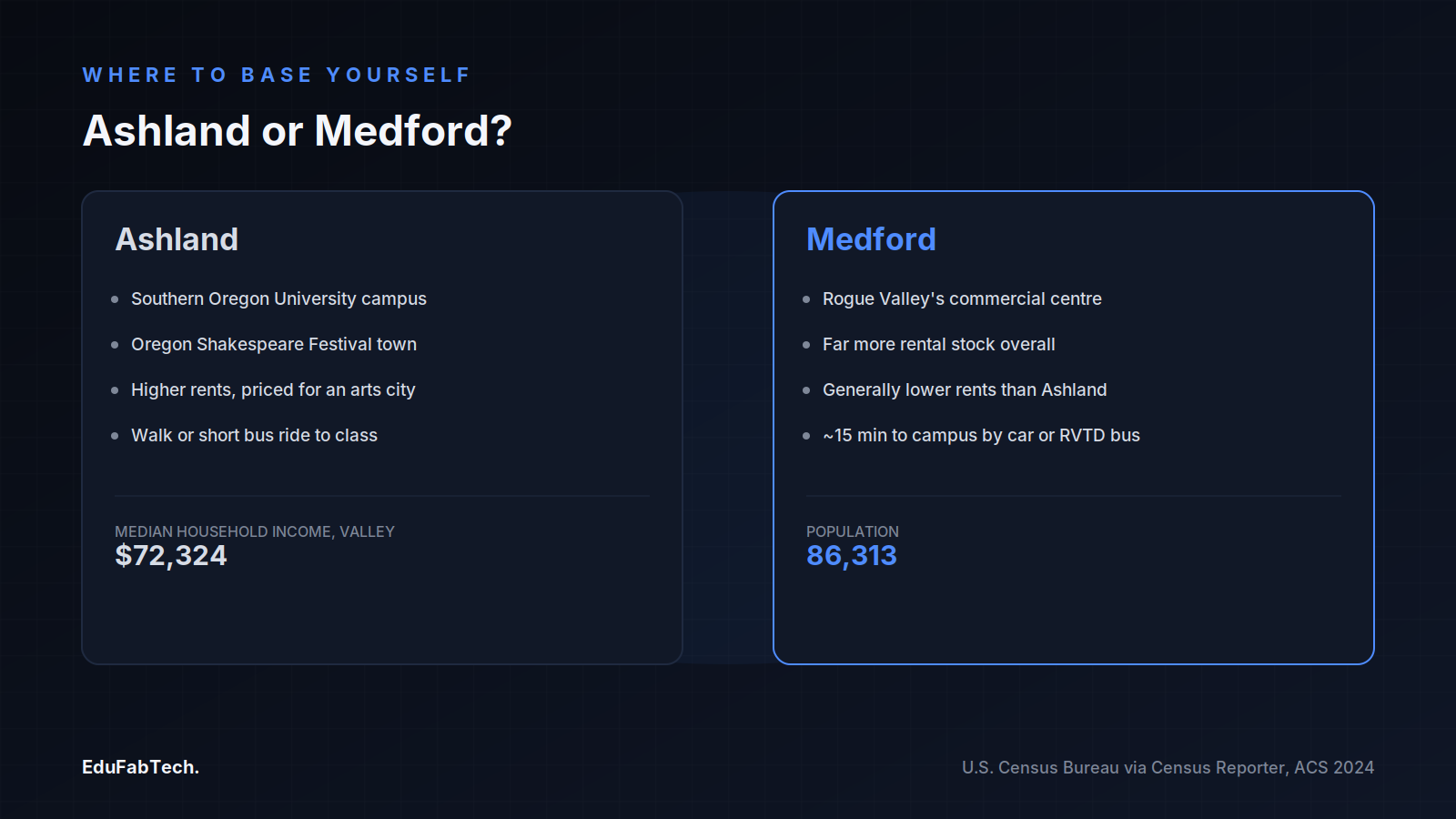
If you have a car or are happy on the bus, the maths is simple: Ashland rooms are closer to campus and priced for a desirable arts town; Medford has far more rental stock and, generally, lower rents. The towns in between — Phoenix and Talent — sit right on the bus line and have historically been the cheaper middle ground.
That middle ground is thinner than it was. The Almeda Fire of 8 September 2020 burned straight up the valley floor; Oregon Public Broadcasting reported (2021) that it destroyed more than 2,600 homes and businesses, with whole subdivisions and trailer parks lost in Talent and Phoenix. Much has been rebuilt, but the fire removed a large slice of the valley's lower-cost housing, and the pressure it put on rents is still part of the picture a student should expect. If you are weighing a cheaper room in Phoenix or Talent against one in Medford or Ashland, ask how new the building is and why.
Renting here without losing a deposit
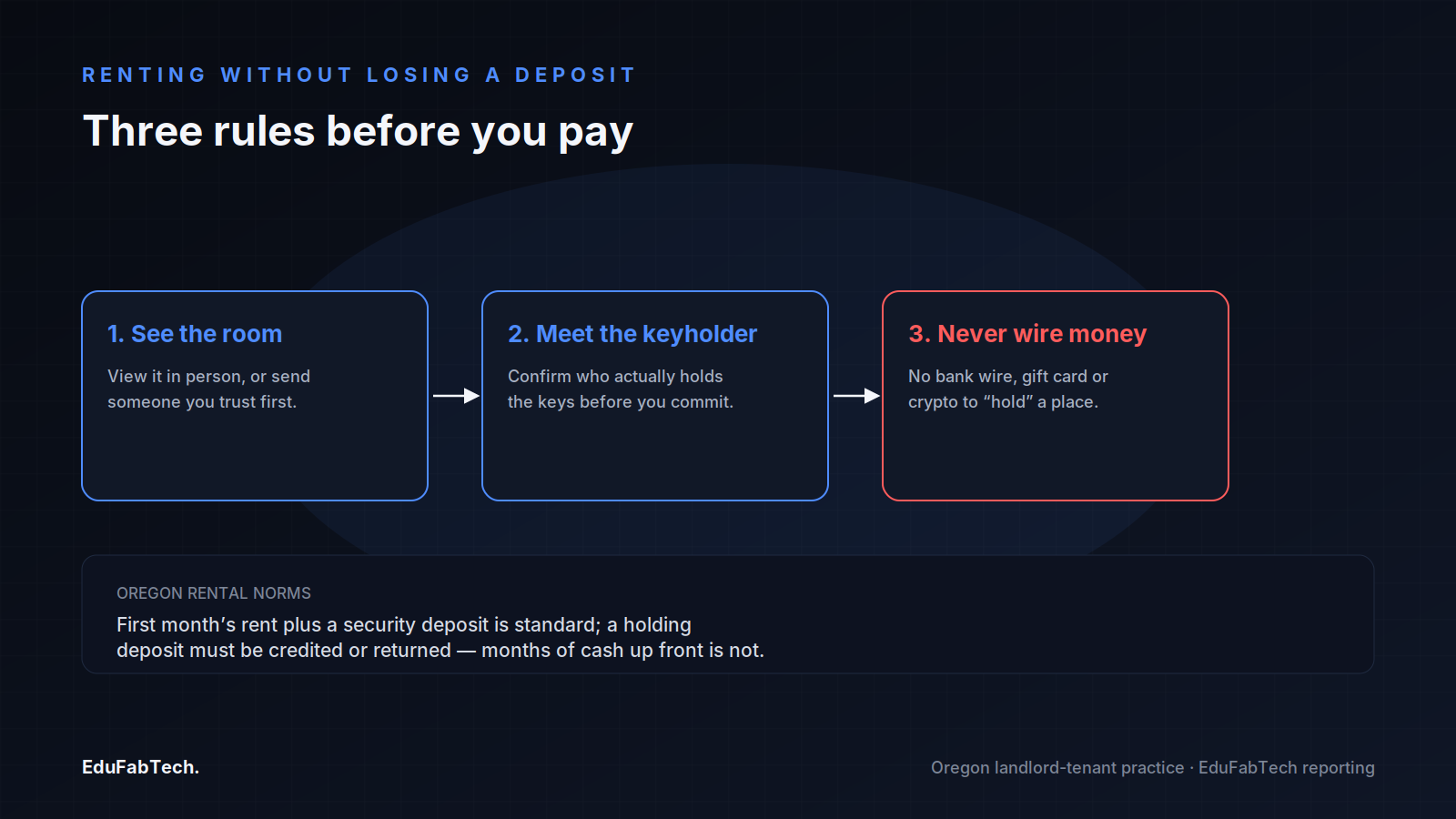
Most student renting in the Rogue Valley happens off-campus and through ordinary channels: community noticeboards, word of mouth, and online listings. That is also where the scams are. The pattern to watch for in Medford is the too-good listing for a house near Ashland or a rebuilt unit in Phoenix, posted by someone who says they are out of the area and asks you to secure it sight-unseen. The safe rule holds everywhere but matters especially when you are arriving from abroad: see the actual room in person (or send someone you trust), meet whoever holds the keys, and never send money by bank wire, gift card or cryptocurrency to "hold" a place. Legitimate landlords in Oregon do not need a crypto transfer before you have seen the unit.
Know what is normal before you hand anything over. In Oregon a landlord may ask for first month's rent and a security deposit, and a holding deposit must be credited or returned under state rules — so a demand for several months up front, in cash, is a warning sign rather than a local custom. Start looking early: SOU's residence-hall application for the coming year opens months ahead, and the private market near Ashland tightens over the summer as returning students re-sign. If you want to compare what is currently on offer, EduFabTech keeps local listings for rooms and places to stay in Medford and a wider board of everything for students in the city, and a feed of places near Southern Oregon University.
Furnishing a room, and the Thursday market
A room found late is usually an empty room, and buying everything new is the fastest way to wreck a first-term budget. The valley has a steady second-hand economy, and the place most students encounter first is the Rogue Valley Growers & Crafters Market, which runs its Medford market at Hawthorne Park (E. Jackson and Main Street) on Thursdays from March to November, having moved the Thursday market to Hawthorne Park in 2016. It is a food-and-crafts market rather than a flea market, but it is the reliable weekly fixture of downtown Medford and a good way to learn the city's rhythm.
For the furniture, kitchenware and bikes that actually fill a room, the cheapest routes are the valley's charity thrift stores and the hand-me-down market among departing students at the end of each term. EduFabTech lists local second-hand goods and things people are giving away as they move on — worth checking in the weeks around the end of spring quarter, when four years of accumulated furniture gets cleared out at once.
Working while you study
If you are an international student on an F-1 visa, the rules on work are set by the federal government, not the university, and they are worth reading from the source rather than from a forum. U.S. Citizenship and Immigration Services explains that F-1 students may generally work on campus subject to conditions, and that off-campus work during the first academic year is not permitted; afterwards, students may apply for Curricular Practical Training or Optional Practical Training, which require authorisation before the work begins. SOU's own Office of International Programs states that eligible students "can work up to 20 hours per week while school is in session or full-time during vacation periods." Treat this guide as a pointer to those sources, not as legal advice — the designated school official in SOU's international office is the person who signs off on your specific situation.
Domestic students face no such limits, but should be realistic about the local labour market: Medford's jobs are concentrated in retail, hospitality and health care, and the ones within walking distance of Ashland's campus are fewer and more sought-after than in a bigger city. If a job is in Medford and your classes are in Ashland, factor the bus into the shift.
Libraries and places to study
On campus, the main study building is the Lenn and Dixie Hannon Library — named, as the library's history page records, for the long-serving Oregon state senator and his wife in 2004, with the current building completed in 2005. It is the natural base for SOU students: research collections, group rooms and quiet floors in one place.
In Medford itself, the public option is the Medford branch of Jackson County Library Services at 205 South Central Avenue. Its branch page lists hours of 10:00 a.m. to 6:00 p.m. Monday to Thursday and 10:00 a.m. to 5:00 p.m. Friday and Saturday, closed Sunday — so a Medford-based student who wants a free, neutral desk close to home has one, though its Friday-and-weekend afternoons close earlier than a campus library's. EduFabTech also collects local study spaces and desks for when both libraries are full during exam weeks.
Getting around on RVTD
Public transport in the valley is run by the Rogue Valley Transportation District (RVTD), and its buses are what tie Medford to Ashland. The key service for students is Route 10, which runs the spine of the valley from Medford's Front Street Station through Phoenix and Talent to Ashland and the university — the single most important bus in the system if you live in one city and study in the other.
According to RVTD's fares page, a single full-fare ride is $2.00, a day pass is $6.00 and a one-month pass is $56.00; the reduced single and monthly fares are half the full price ($1.00 and $28.00), while the day pass is $6.00 for all riders. The district uses Umo cards and a mobile app, with a reusable card costing $2.00. A useful detail for anyone commuting daily: RVTD applies fare capping, so taps are capped at $6.00 a day and $56.00 a month at full fare (and $3.00/$28.00 reduced) no matter how often you ride, which means pay-as-you-go never costs more than a pass. Check your eligibility for the reduced fare, and ask SOU's student government about any current pass arrangement before you buy a month outright.
Be honest with yourself about the geography, though. The valley is built around the car and the freeway; buses run on headways that suit commuters more than night-owls, and a late class or an evening shift can leave you waiting. Many students end up keeping a car anyway.
Costs, the honest trade-offs, and a first-weeks checklist
The clearest dated housing figures come from the university's own halls. Southern Oregon University's 2026–2027 residence-hall costs list a double room in Shasta Hall at $3,677 per quarter ($11,030 per year) and a single at $4,477 per quarter ($13,432 per year); in the newer McLoughlin Hall a double is $3,872 per quarter ($11,617 per year) and a single $4,808 per quarter ($14,423 per year), with studio singles up to $5,395 per quarter ($16,184 per year). First-year students are also required to hold a meal plan, which the same page lists from $1,846 to $2,184 per term. Those are Ashland prices; the trade-off of living in Medford is a lower rent against a daily commute and the fares above.
What is good about studying here is real: a genuinely beautiful setting, a small university where you are not a number, an arts scene in Ashland that outsizes the region, and easy access to mountains, rivers and the Oregon coast. What is hard is equally real. Summers are hot and dry, and late-summer wildfire smoke is a recurring fact of valley life rather than a rare event. Housing is tighter and pricier than the valley's size would suggest, partly because of the 2020 fire. And without a car you are tied to a bus network built for commuters, with the university 13-odd miles from Medford's centre. None of this is a reason to stay away — but a reader deciding between Medford and a denser college town should go in with eyes open.
A short checklist for the first weeks:
- Decide early whether you are an Ashland resident or a Medford commuter, because it changes everything else — rent, bus pass, how late you can stay on campus.
- If you take an off-campus room, see it in person and pay a normal deposit through a traceable method; walk away from any landlord asking for a wire, gift card or crypto to hold it.
- Set up an Umo card or the RVTD app and learn the Route 10 timetable before term starts, especially the last departure that gets you home.
- Get your SOU ID and library access on day one, and scout both the Hannon Library and the Medford public branch so you have a fallback during exam crush.
- International students: book an appointment with SOU's Office of International Programs to confirm your work eligibility in writing before taking any job.
- Buy second-hand. Watch the end-of-term giveaways and the Thursday market, and furnish gradually rather than all at once.
A quick question for readers
Do you work part-time while you study?
Many students work to pay the bills. See how common it is — and how many hours people really do.
Pick an answer, create a free account in a minute, and your vote counts. Already a member? Sign in
Comments 2
Comment-
The fare-capping detail is the most useful thing in here and it's internally consistent: $2.00 full fare capped at $6.00/day and $56.00/mont…
-
The RVTD fare numbers contradict themselves: it states the day pass is $6.00 for all riders, then a couple of sentences later says reduced-f…
Join free to read the full comments and reply Comments are between members; an account takes a minute.
Source: Southern Oregon University
Sources (5)
- Southern Oregon University. Residence Hall Costs (2026–2027). Southern Oregon University, 2026. sou.edu ↗ · checked 30 Oct 2026
- Rogue Valley Transportation District. Fares & Passes. Rogue Valley Transportation District, 2026. rvtd.org ↗ · checked 30 Oct 2026
- U.S. Census Bureau. Medford, Oregon community profile (ACS 2024 1-year). Census Reporter, 2024. censusreporter.org ↗ · checked 30 Oct 2026
- U.S. Citizenship and Immigration Services. Students and Employment. U.S. Department of Homeland Security, 2026. uscis.gov ↗ · checked 30 Oct 2026
- Erin Ross. A hint of future fire seasons, as Southern Oregon emerges from the ashes of 2020. Oregon Public Broadcasting, 2021. opb.org ↗ · checked 30 Oct 2026