Studying in Miami, United States: universities, housing and student life
A practical, sourced guide to Miami's universities, the neighbourhoods students actually live in, renting safely, work rules for international students, transit and real costs.
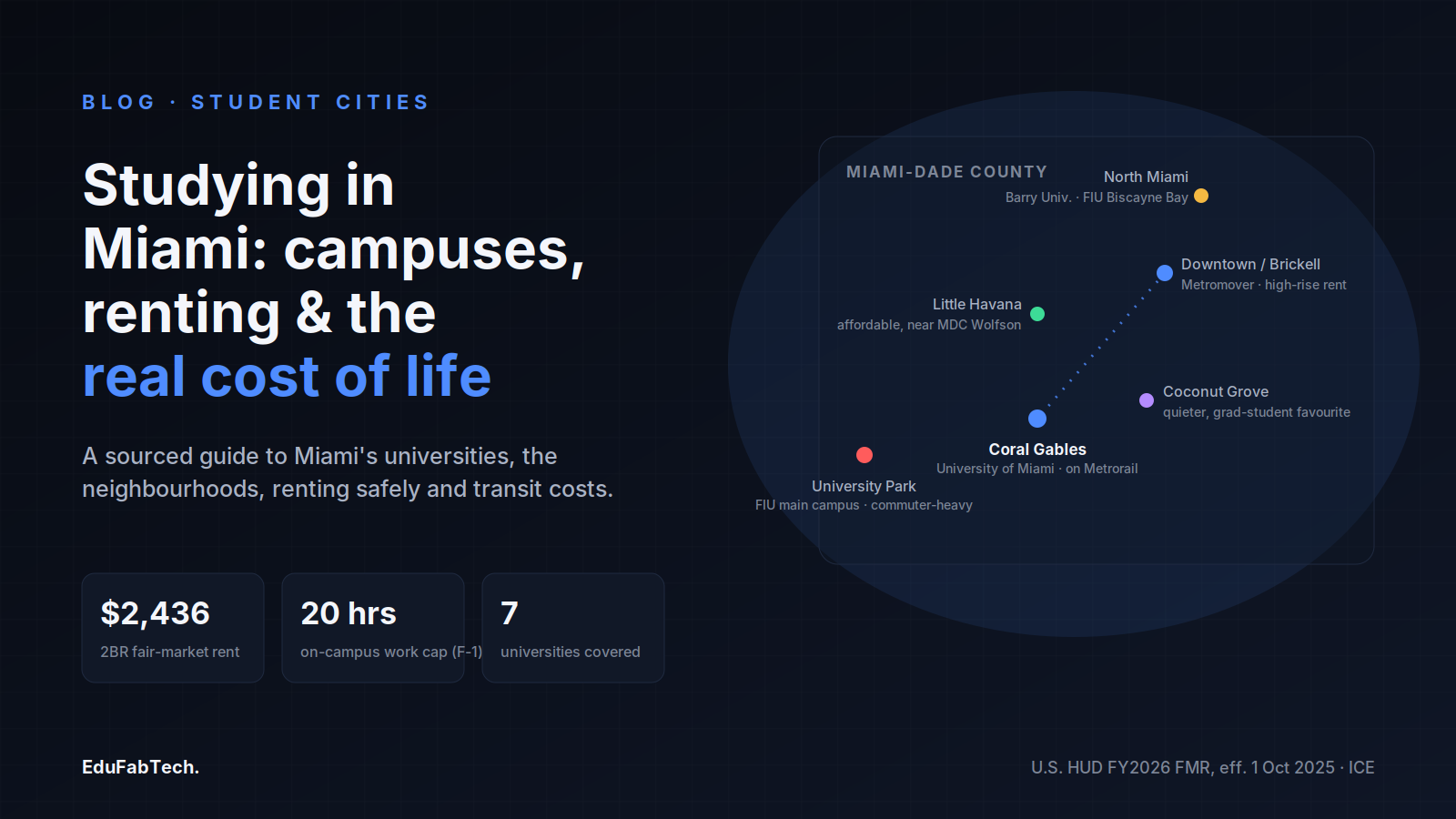
Miami is less a single city than a scatter of them across Miami-Dade County: Coral Gables and Coconut Grove to the south, Hialeah and Miami Gardens to the north-west, Miami Beach across the bay, Doral and Kendall out west toward the Everglades. For a student, that geography is the first thing to understand. Campuses sit miles apart, most daily life is organised around the car, and the two seasons that matter are the hot, wet summer and the hurricane watch that runs from June into November. Nothing here is within a short walk of everything else.
It is also one of the most bilingual places to study in the United States, where Spanish is heard as often as English and a large share of students are the first in their families to attend university. The campuses reflect that: a private research university in a Mediterranean-style suburb, one of the country's largest public universities out by the Tamiami Trail, Catholic universities to the north, and a community-college system that enrols more people than any other in Florida.
The universities, from Coral Gables to Hialeah
The University of Miami is the private research university most people mean when they say "the U". Its main campus occupies a 239-acre tract in Coral Gables, about seven miles from downtown Miami, according to the University of Miami's own description of its campuses; the same page places its Leonard M. Miller School of Medicine in the Health District near downtown and its Rosenstiel School for marine, atmospheric and earth science on Virginia Key in Biscayne Bay. The Coral Gables campus is where most undergraduates study, and it is unusual in being reachable by rail — the University of Miami's international office directs arrivals to take Metrorail to University station for the Coral Gables campus.
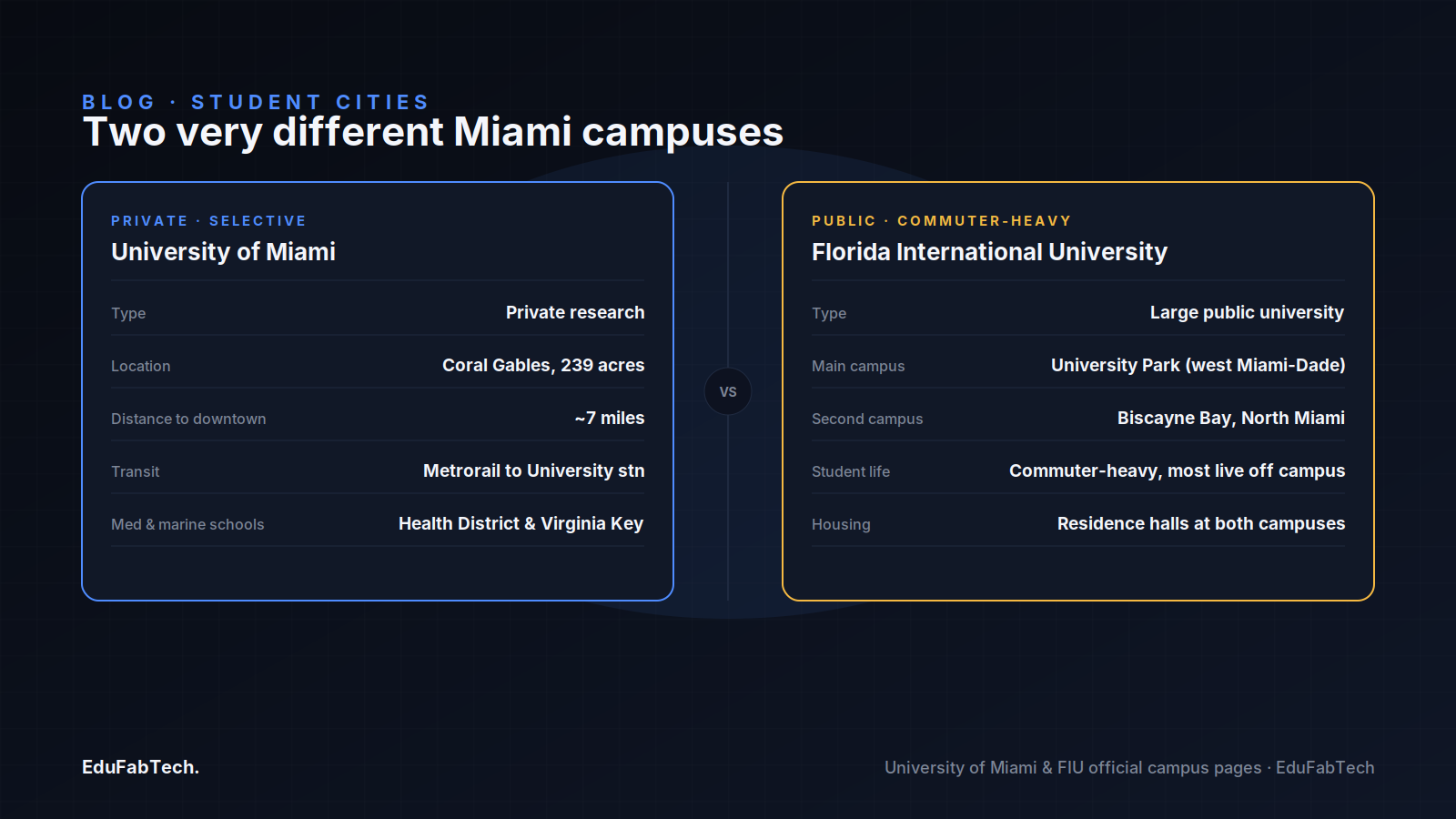
Florida International University is the large public option, and the one most local students attend. Its principal Modesto A. Maidique Campus sits in the University Park area of west Miami-Dade, with a second campus, Biscayne Bay, up in North Miami; FIU's housing office lists residence halls on both. It is a commuter-heavy university where a large majority of students live off campus and drive or bus in, which shapes everything from parking to when the library fills up.
Several more universities round out the picture, and each is worth knowing by name. Nova Southeastern University has its main campus in Davie, in greater Fort Lauderdale, but runs a Miami Regional Campus at 8585 SW 124th Avenue in the Kendall area. Barry University is a private Catholic university in Miami Shores, founded in 1940 by the Adrian Dominican Sisters. St. Thomas University is a private Catholic university in Miami Gardens, established in 1961 and home to a College of Law. Florida National University grants degrees from associate through master's level at its campus in Hialeah, with programmes concentrated in health, business and technology. And Miami Dade College — the largest institution in the Florida College System — runs its Wolfson Campus right in downtown Miami, a common and far cheaper route into a bachelor's degree. You can see the full set of local listings on EduFabTech's Miami page.
Where students settle across a spread-out county
Coral Gables and South Miami are the natural base for University of Miami students: leafy, low-rise, walkable in patches, and sitting on the Metrorail line, but among the more expensive places to rent in the county. Sweetwater, Westchester and University Park cluster around FIU's main campus — plainer, more residential, often cheaper, and full of student-shared houses within a bus ride or short drive of class. Little Havana, just west of downtown, is one of the more affordable inner neighbourhoods, dense with Cuban cafés and markets and close to Miami Dade College's Wolfson Campus.
Brickell and Downtown offer high-rise apartment living, a walkable core and the free Metromover, at a price premium that reflects their position as the city's financial district. Coconut Grove, between Coral Gables and the bay, is quieter and greener and popular with graduate students. To the north, Miami Shores and North Miami put you near Barry University and FIU's Biscayne Bay campus, with generally lower rents than the southern suburbs. As a rule, cost falls as you move away from the water and the downtown core — and rises again anywhere with a Metrorail stop. Listings near the main campuses are grouped on EduFabTech for University of Miami, Florida International University and Nova Southeastern University.
Renting in Miami without losing a deposit
Miami's rental market is expensive by national standards and moves fast, which is exactly the condition scams thrive in. The U.S. Department of Housing and Urban Development's FY2026 Fair Market Rents, effective 1 October 2025, set the two-bedroom rate for the Miami-Miami Beach-Kendall metropolitan area at US$2,436 a month — a 40th-percentile figure, so plenty of listings sit above it. That makes sharing the norm, and it makes a "cheap" room in Coral Gables or Brickell worth a second look.
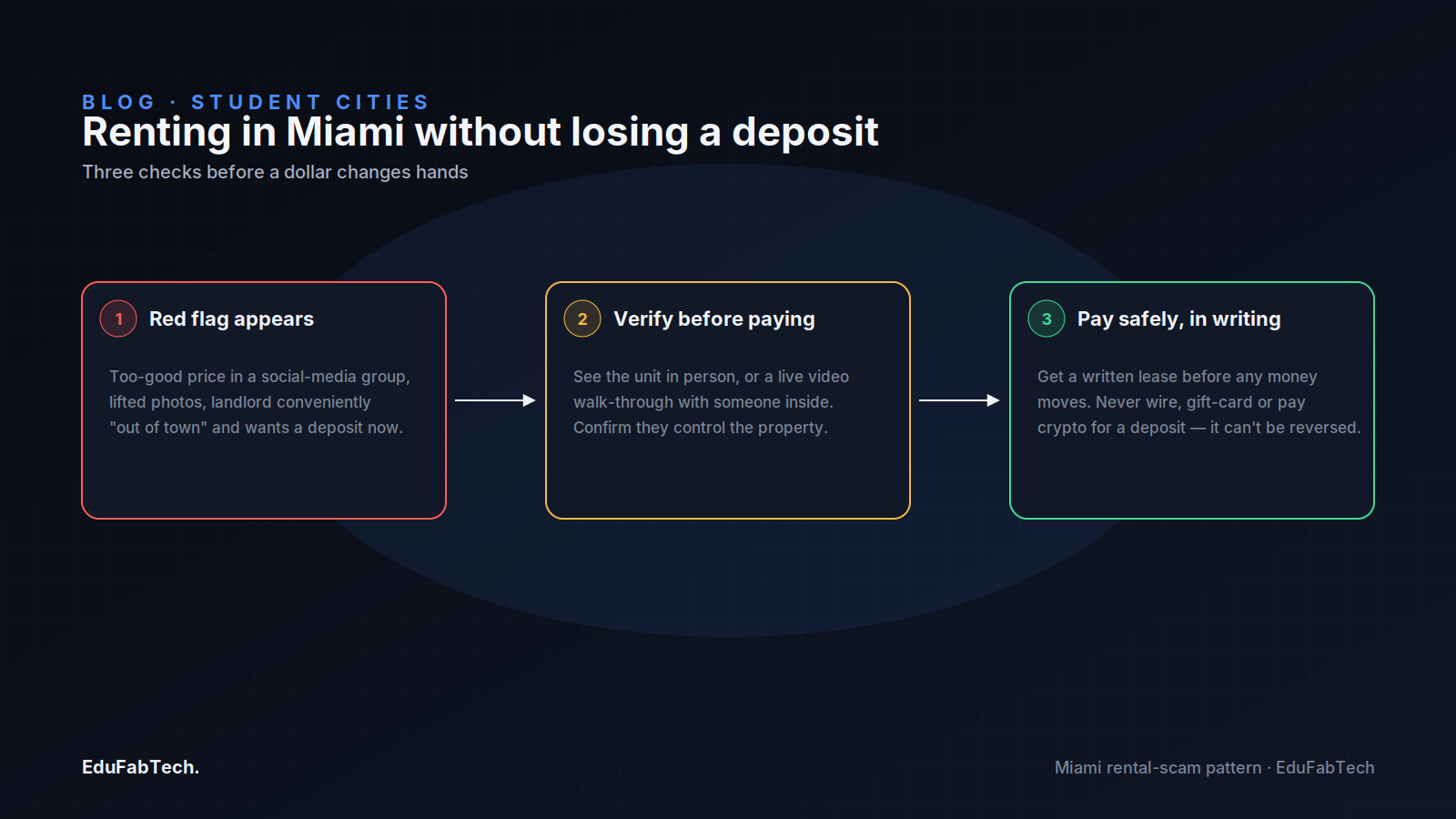
Most fraudulent listings in Miami surface the same way: a too-good price in a social-media housing group or a classifieds post, photos lifted from a real listing, and a "landlord" who is conveniently out of town — abroad, or "up north" for the season — and wants a deposit to hold the place. Do not send money to hold a room you have not seen. Local leases usually ask for first month, last month and a security deposit up front, so the sums are large; see the unit in person or on a live video walk-through with someone physically inside, confirm the person showing it controls the property, and get a written lease before any money moves. Never pay a deposit by bank wire, gift card or cryptocurrency — none of those can be reversed, and no legitimate Miami landlord needs them to "reserve" a room. Rooms and sublets posted by students are collected on EduFabTech's Miami rooms page.
Furnishing a room: markets and second-hand
Furnishing cheaply here means knowing the weekend markets. The Lincoln Road Farmers Market, run by the City of Miami Beach on Sundays from 9 a.m. to 6 p.m. between Washington and Meridian Avenues, is good for produce and small household goods; on select Sundays from autumn into spring the same strip hosts the long-running Lincoln Road Antique and Collectible Market. The Greater Miami flea-market guide lists the larger indoor-outdoor markets across the county where used furniture and kitchenware turn up cheaply, and the Coconut Grove Saturday organic market is a fixture for food and artisan goods. For the bulk of a room — desk, mattress, chairs — start with second-hand before buying new: EduFabTech carries Miami listings for second-hand things, used furniture and items given away free, the last of which fills up around end-of-semester move-outs in May and December.
Work, and the rules international students must check
If you are on an F-1 student visa, the limits are strict and worth reading from the source rather than a forum. U.S. Immigration and Customs Enforcement states that F-1 students may work on campus up to 20 hours per week while school is in session, and full-time during official breaks; on-campus work needs your Designated School Official's certification but not separate approval from U.S. Citizenship and Immigration Services. Off-campus employment is more restricted and generally requires formal authorisation such as Curricular Practical Training or Optional Practical Training, which ICE describes on the same page. This is not legal advice — rules change and individual cases differ, so confirm your own situation with your university's international-student office before you accept any job. Part-time openings students post locally are on EduFabTech's Miami jobs page.
Libraries and quiet desks
The University of Miami's Otto G. Richter Library anchors the Coral Gables campus. At Florida International University, the Steven and Dorothea Green Library sits on the Modesto A. Maidique Campus at 11200 SW 8th Street and the Glenn Hubert Library serves Biscayne Bay in North Miami; FIU lists term-time hours running as late as 1 a.m. on weeknights, with bookable study rooms. Off campus, the Miami-Dade Public Library System runs a large network of free branches, its Main Library at 101 West Flagler Street in the downtown Cultural Plaza, open to anyone who needs a desk and air-conditioning. Miami Dade College's Wolfson Campus downtown is another option for central study space. More study-space listings sit on EduFabTech's Miami study-spaces page.
Getting around, and what a month of transit costs
Public transport is run by Miami-Dade County's Department of Transportation and Public Works, and you pay with the reloadable EASY Card. Metrorail runs two lines, Green and Orange, with the Orange Line serving Miami International Airport; the standard one-way fare is US$2.25, or US$1.10 at the discount rate. Downtown, the Metromover is free and runs seven days a week across Brickell, the downtown core and Omni. The number that matters most to students is the pass: Miami-Dade Transit's College/Adult Education Monthly Pass costs US$56.25 for full-time college and adult-education students in the county, against US$112.50 for the standard monthly pass, US$29.25 for seven days and US$5.65 for a day. FIU adds its own free shuttle, the Panther Express between its two campuses, for enrolled students. Even so, Miami is built for cars: outside the Metrorail corridor and the downtown mover loops, bus journeys can be long, and many students end up driving.
The honest trade-offs
What is good about studying here is genuine. The winters are mild when much of the country is cold, the city is deeply international and Spanish-speaking, the beaches and the bay are close, and a large hospitality, trade and finance economy means part-time and seasonal work exists for those allowed to take it. What is hard is just as real. Rents are among the highest in the United States, as the HUD figure above shows, and the squeeze pushes students into shared rooms and long commutes. The county is sprawling and car-dependent, so time and transport cost add up. Summers are intensely hot and humid, hurricane season brings genuine disruption and the risk of flooding, and affordable housing near the water is scarce. It is a rewarding place to study if you plan for the distances and the costs, and a frustrating one if you assume it will behave like a compact walkable city.
First weeks: a checklist
- Confirm your work limits and any training authorisation with your university's international-student office before taking a job; rely on your Designated School Official, not forums.
- Buy and register an EASY Card, and if you qualify, load the College/Adult Education Monthly Pass rather than paying per ride.
- See any room in person or on a live walk-through before paying, and never wire a deposit or send gift cards or cryptocurrency to "hold" a place.
- Check the commute from a prospective room to your actual campus at rush hour, not just the distance on a map.
- Get a library card for the Miami-Dade Public Library System and learn your campus library's late-night hours and study-room booking.
- Furnish from weekend markets and second-hand listings, and watch the May and December move-out weeks for free furniture.
- Know your hurricane plan — your university's alerts, nearest shelter and what to keep on hand — before the season peaks.
A quick question for readers
Do you work part-time while you study?
Many students work to pay the bills. See how common it is — and how many hours people really do.
Pick an answer, create a free account in a minute, and your vote counts. Already a member? Sign in
Source: University of Miami
Sources (5)
- University of Miami. Campuses. University of Miami, 2026. welcome.miami.edu ↗ · checked 3 Oct 2026
- Miami-Dade County. Transit Pass. Miami-Dade County Department of Transportation and Public Works, 2026. miamidade.gov ↗ · checked 3 Oct 2026
- U.S. Immigration and Customs Enforcement. Employment. U.S. Department of Homeland Security, 2026. ice.gov ↗ · checked 3 Oct 2026
- U.S. Department of Housing and Urban Development. FY2026 Fair Market Rents Schedule. HUD Office of Policy Development and Research, 2026. huduser.gov ↗ · checked 3 Oct 2026
- Florida International University. Rental Rates. FIU Housing and Residential Life, 2026. housing.fiu.edu ↗ · checked 3 Oct 2026