Studying in Middlesbrough: universities, housing and student life
A practical, honest guide to Teesside University, the neighbourhoods students rent in, costs, work rules, markets and transport in Middlesbrough — for local and international students alike.
Middlesbrough sits on the south bank of the River Tees, at the centre of the Tees Valley in the north-east of England, with the blue steel of the Transporter Bridge still marking the skyline that the town's iron and shipbuilding trade built. For students it is one of the more compact and affordable places to study in the United Kingdom: the main campus, the shops, the station and the cheapest shared houses are all within a walk of one another, and rents are well below the national picture. This guide covers who teaches here, where students actually rent, what it costs, how to work legally while you study, and the parts of the place that are genuinely hard as well as the parts that are easy.
Most of what follows is specific to Middlesbrough itself. A few facts — the rules on working hours, the way deposits are protected — apply across the country, and those are flagged with the official source so you can read the rule yourself rather than take it second-hand.
Teesside University, and the campuses within reach
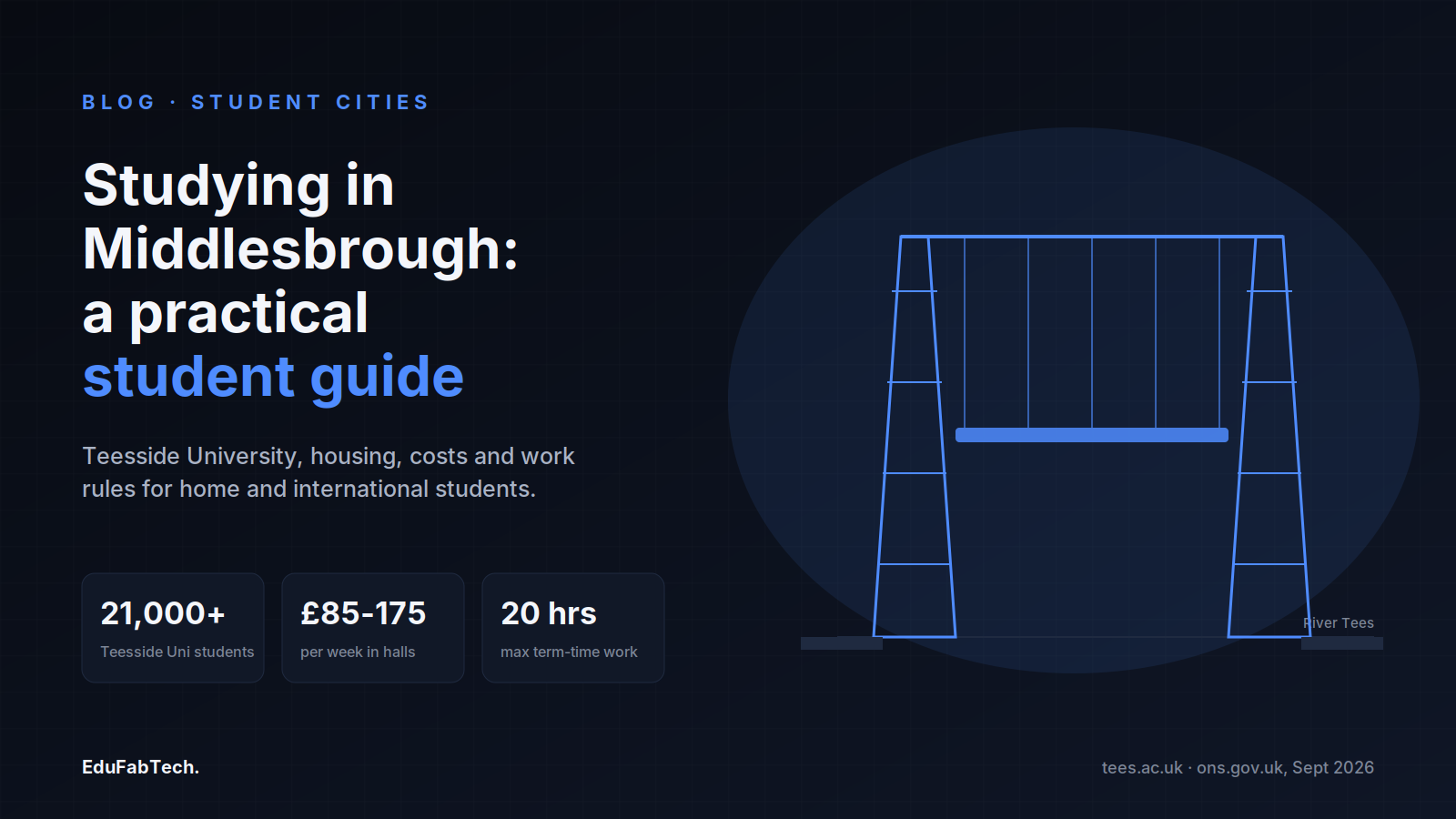
The university in the town is Teesside University, whose main campus is in central Middlesbrough at postcode TS1 3BX, a few minutes' walk from the railway station and the main shopping streets. According to the university's own media pack, it opened in 1930 as Constantine Technical College to serve the area's engineering and shipping industries, became a polytechnic in 1969, and was granted university status in 1992; it states that it now has more than 21,000 students and more than 2,300 staff (tees.ac.uk).
The same source lists five academic schools: Arts & Creative Industries; Computing, Engineering & Digital Technologies; Health & Life Sciences; Social Sciences, Humanities & Law; and Teesside University International Business School (tees.ac.uk). The computing and digital side — games art and animation, cybersecurity, engineering — is the part the campus is best known for locally, and much of it is taught in and around the Campus Heart building at the middle of the site. The university's media pack states it was named University of the Year for Social Inclusion in The Times and Sunday Times Good University Guide 2022; treat that as the institution describing itself, which is where it comes from.
Two other named institutions sit close by in the city of Durham, roughly 30 km north and on the main rail line. Durham University is a collegiate research university in the historic centre of Durham — a separate city with its own student scene, not a Middlesbrough campus, though some who live around Darlington commute between the two. Teikyo University of Japan in Durham is an overseas campus of Teikyo University of Tokyo, running study-abroad and language programmes rather than a local option you apply to from scratch. For further-education courses and access routes, Middlesbrough College sits beside the dock at MiddlesHaven, and Darlington College, Hartlepool College of Further Education, Redcar & Cleveland College, Bishop Auckland College and New College Durham cover the surrounding towns.
The student map: Central, Southfield Road, Gresham, Linthorpe and beyond
Middlesbrough is a real town rather than a campus village, so where you live changes your rent, your walk and your week. The areas students cluster in run in a rough band south and west of the university. You can browse what is currently listed across the city on EduFabTech's Middlesbrough listings and rooms pages, but it helps to know the character of each district first.
Central Middlesbrough (TS1) is the postcode wrapped around the campus itself, taking in Borough Road, Albert Road and Linthorpe Road's town-centre end. This is where the purpose-built halls and the newest student blocks are, where you are closest to lectures, the bus station and the nightlife, and where you pay a premium for being able to roll out of bed at nine. It is the busiest and, at night, the liveliest part of the map.
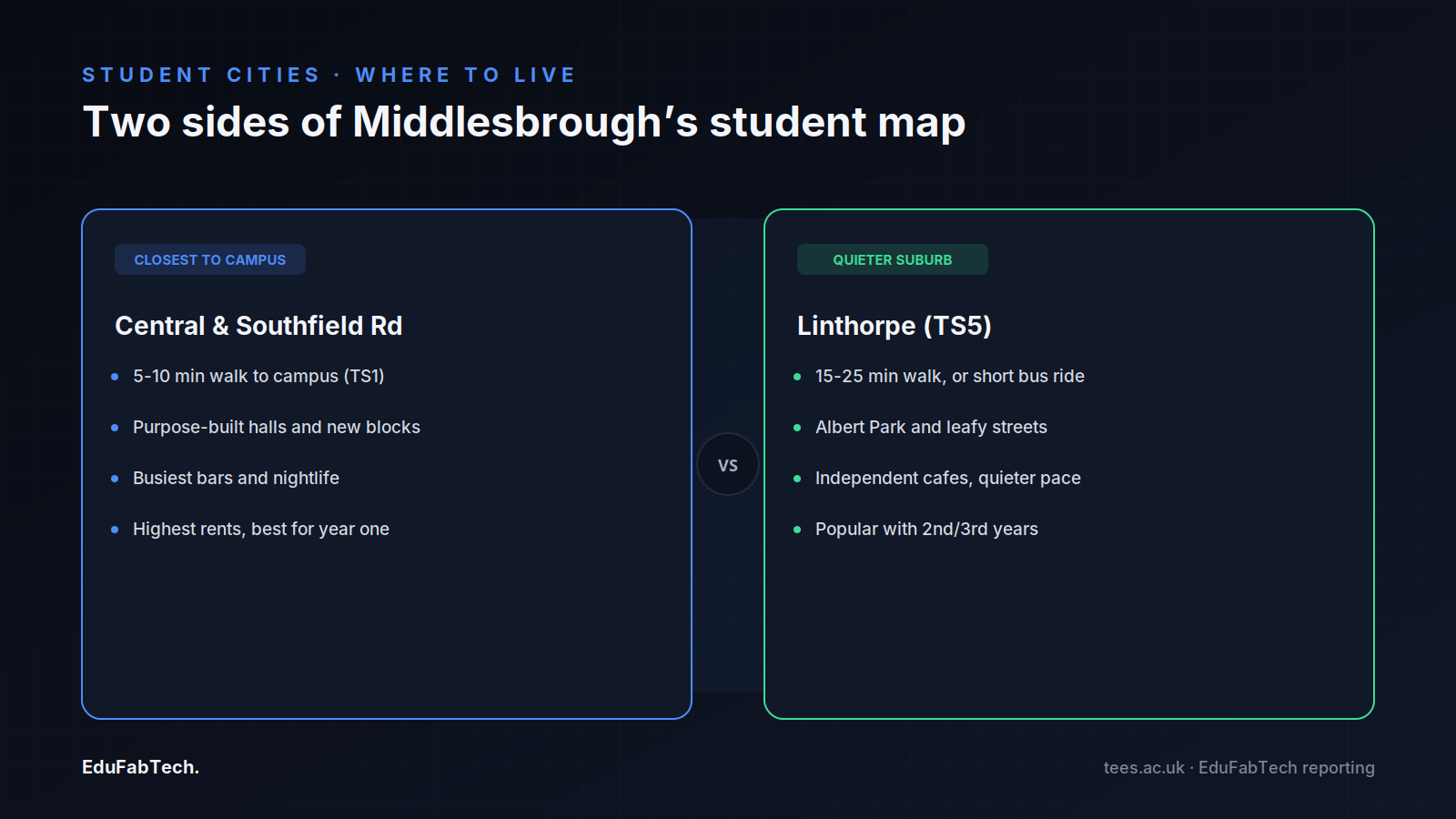
Southfield Road and Woodlands Road form the traditional student strip immediately south of the university — terraced houses, takeaways and the bars that spill out of the campus edge. New student blocks keep being proposed around these streets. It is about as close to lectures as a shared house gets.
Gresham, between the centre and Linthorpe Road, is the inner area the council has long earmarked for regeneration, with plans to pull the university further into the town. Rooms here are among the cheapest in the city, but you will see demolition, building sites and streets mid-change, so look at the specific house rather than the postcode.
Linthorpe (TS5) is the leafier suburb further out along Linthorpe Road, with Albert Park, a large Victorian park, on its edge, independent cafés and a quieter, more residential feel. It suits second and third years and postgraduates who want a proper neighbourhood over a student strip, at a slightly higher rent and a 15–25 minute walk or a short bus ride in. Ayresome and the streets around the old football ground sit between Gresham and Linthorpe, cheaper and still walkable. Acklam and Marton, further south-east along Marton Road, are suburban and family-heavy — greener and calmer, but you will depend on the bus.
Halls, shared houses and paying safely
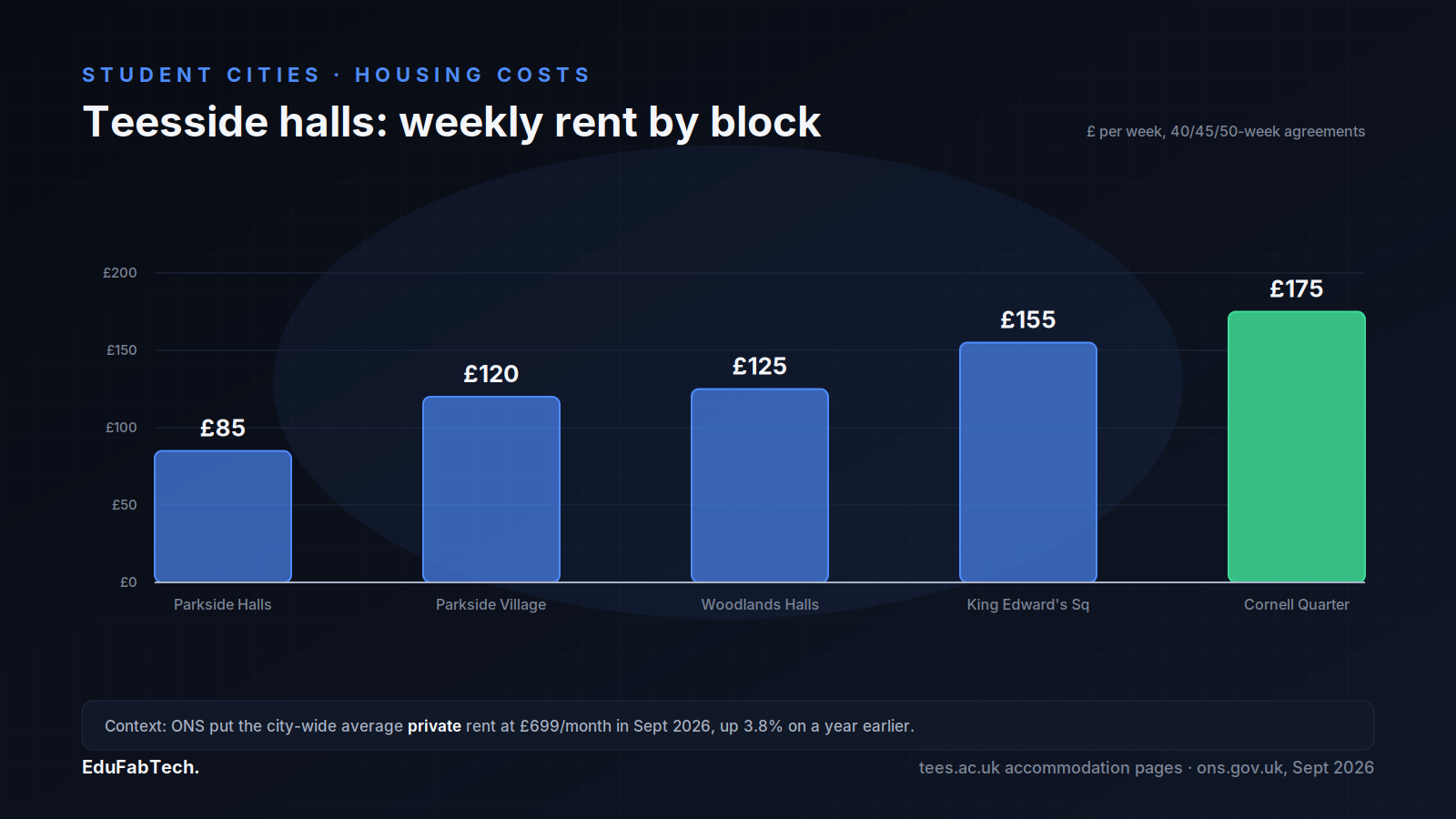
Teesside University runs its own halls within about five minutes' walk of campus. Its accommodation pages list weekly rents from £85 at Parkside Halls, £120 at East and West Parkside Village, £125 at Woodlands Halls, from £155 at King Edward's Square, up to £175 at Cornell Quarter, on 40, 45 or 50-week agreements with bills, Wi-Fi and contents insurance included (tees.ac.uk). Those are the clearest dated figures to anchor a budget to; apply through the university rather than a third party, and note that the length of the contract — not just the weekly rate — decides what you actually pay over a year.
The private market is where most second and third years end up, and it is cheap by national standards. The Office for National Statistics put the average monthly private rent in Middlesbrough at £699 in September 2026, up from £673 a year earlier — a 3.8% rise — with one-bedroom homes averaging £498 and two-bedroom homes £634 (ons.gov.uk). Shared student houses advertised per room sit well below those whole-property figures. Start looking from late in the second term for the following September; the cheapest, best-placed houses near campus go first, but there is no need to panic-sign in your first week.
Renting safely in Middlesbrough comes down to a few habits. View the actual room in person — or have someone you trust view it — before any money changes hands; the scams that circulate here tend to be adverts for rooms in the busy TS1 and Southfield Road streets that look too cheap and whose "landlord" is conveniently away. A deposit on an assured shorthold tenancy in England must by law be protected in a government-approved deposit scheme, and you should get the scheme details in writing. Never send money by bank transfer, gift card or cryptocurrency to "hold" a room you have not seen, and never pay a deposit before you have a tenancy agreement with a name and address on it. EduFabTech's rooms and listings near Teesside University can show what is realistic for the area before you commit.
Kitting out a room: Dundas market, charity shops and car boots
Furnishing a room cheaply is easy here because the town centre still has a working market and a dense run of charity shops. The Dundas Shopping Centre and Indoor Market, off Dundas Street, is the town-centre indoor market, home to independent traders and a large YMCA charity superstore that is a reliable source of second-hand furniture, kitchen kit and clothes, with free collection offered on larger items (dundasshoppingcentre.co.uk). The charity shops along Linthorpe Road and in Linthorpe village itself are worth a slow morning for crockery, lamps and bookshelves.
For a day out that doubles as shopping, the Orange Pip Market is Middlesbrough's seasonal street market of independent food, drink and makers, held on Baker Street and Bedford Street in the town's small-independents quarter, with live music; in summer a family version runs on Centre Square (wearemiddlesbrough.com). It runs across the warmer months rather than year-round, so check dates before planning around it. For the furniture and free-to-collect end of things, EduFabTech lists local second-hand furniture and things given away free in the city — collecting a desk or a sofa someone is throwing out is often cheaper than the market.
Working term-time hours
Many students here take part-time work in the town-centre shops, cafés and campus jobs. If you are an international student on a Student visa, how much you can work is set by UK immigration rules, not by your employer. UKCISA, which advises international students, states that you can work up to 20 hours a week in term time if you are studying a course at degree level or above, and up to 10 hours a week for a course below degree level — and it stresses that you must always check the conditions printed on your own immigration document, because if it says "No work" you must not work (ukcisa.org.uk). The 20 hours is a total across all jobs in a week, not per employer, and self-employment is not permitted. This is a summary, not legal advice: read your own visa conditions and ask your university's international team if anything is unclear. Local vacancies are collected on EduFabTech's Middlesbrough jobs page.
The 24/7 library and other desks
Study space is one of the things Middlesbrough does well for its size. The Middlesbrough Campus Library sits in the Campus Heart building at the centre of the university and is open 24 hours a day, seven days a week, with a mix of study spaces across its floors; entry is by swiping a TUSC student card in and out (libguides.tees.ac.uk). Round-the-clock access matters most in the weeks before deadlines, when the quietest desks fill early. Off campus, Middlesbrough Central Library on Centre Square, which reopened in 2026 after a major Arts Council-funded refurbishment (middlesbrough.gov.uk), gives you a calm, free alternative in the town centre when you want to be away from coursemates. EduFabTech also lists bookable study spaces around the city for the times both are full.
Buses, the one London train, and getting around Teesside
Middlesbrough is small enough to walk across, which is its biggest transport advantage. For everything beyond walking distance, local buses are run by Arriva and Stagecoach, with routes stopping outside the campus; Teesside University's own cost-of-living page notes £1 single fares and £3 all-day travel for under-21s on those services (tees.ac.uk). Services run from Middlesbrough bus station in the centre. For heavier users there are annual student bus passes such as Stagecoach's UniRider; check the current price and coverage directly with the operator before buying.
Middlesbrough railway station, a short walk from campus, is served by Northern and TransPennine Express, linking the town to Darlington, Newcastle, Leeds and Manchester, and there is one weekday LNER service each way direct to and from London King's Cross. For most students the useful trains are the frequent local and regional ones to the rest of the Tees Valley and the North East; the single London working is handy but not a commuter option. Teesside International Airport lies to the south-west near Darlington for flights home at the start and end of term.
What it costs, and what is genuinely hard
The honest case for Middlesbrough is money and compactness. Halls start at £85 a week and private rents are among the lowest for any university town in the country, as the ONS figures above show; nearly everything a first year needs is within a walk, and the £1 bus fares for under-21s keep getting-around cheap. The independent food-and-music scene around Baker and Bedford Streets gives the centre more life than its size suggests.
The hard parts are real too. Middlesbrough is a post-industrial town that has carried high deprivation in parts of its inner neighbourhoods, and some of the cheapest streets near campus are mid-regeneration, with building sites and empty units next to lived-in houses — which is exactly why viewing the specific property matters more than the postcode. The town is smaller and quieter than Newcastle or Leeds, so students wanting a big-city nightlife often travel out; the north-east weather is cool, grey and wet for much of the academic year; and if you live in Acklam or Marton you will be tied to bus timetables. None of this is hidden if you visit before you sign.
Your first two weeks: a checklist
- Collect your TUSC student card and register for 24/7 library access before the first deadline rush.
- Confirm your work conditions against your own visa document if you are an international student, using the UKCISA guidance.
- If you are in private housing, check your deposit is registered in a government-approved protection scheme and get it in writing.
- Sort a bus arrangement — the £1 under-21 fares or an annual pass — and locate Middlesbrough bus station and the railway station.
- Furnish the gaps from Dundas market, the Linthorpe Road charity shops, and EduFabTech's second-hand listings before buying anything new.
- Walk Linthorpe, Gresham and Southfield Road in daylight so you know the areas before next year's house hunt, and check what is on in the city.
A quick question for readers
Do you work part-time while you study?
Many students work to pay the bills. See how common it is — and how many hours people really do.
Pick an answer, create a free account in a minute, and your vote counts. Already a member? Sign in
Comments 3
Comment-
The accommodation section leans on two sets of numbers that don't actually answer the question most readers have. Halls run £85 to £175 a we…
-
The ONS rent figure is the one piece of hard data here and it's worth sitting with: £699/month average in September 2026, up 3.8% from £673…
-
The stat that'd actually make me pause before signing anything is the 3.8% year-on-year rent rise, from £673 to £699, because that's the reg…
Join free to read the full comments and reply Comments are between members; an account takes a minute.
Source: Teesside University
Sources (5)
- Teesside University. Media pack (facts and figures). Teesside University, 2026. tees.ac.uk ↗ · checked 11 Nov 2026
- Teesside University. Student accommodation — Middlesbrough. Teesside University, 2026. tees.ac.uk ↗ · checked 11 Nov 2026
- Office for National Statistics. Housing prices in Middlesbrough (local area). Office for National Statistics, 2026. ons.gov.uk ↗ · checked 11 Nov 2026
- UKCISA. Working as an international student. UK Council for International Student Affairs, 2026. ukcisa.org.uk ↗ · checked 11 Nov 2026
- Teesside University. Middlesbrough Campus Library 24/7 opening. Teesside University, 2026. libguides.tees.ac.uk ↗ · checked 11 Nov 2026