Studying in Milwaukee: universities, housing and student life
A sourced, practical guide to Milwaukee's universities, the neighbourhoods students rent in, what a room and a bus pass actually cost, and the winter that comes with them.
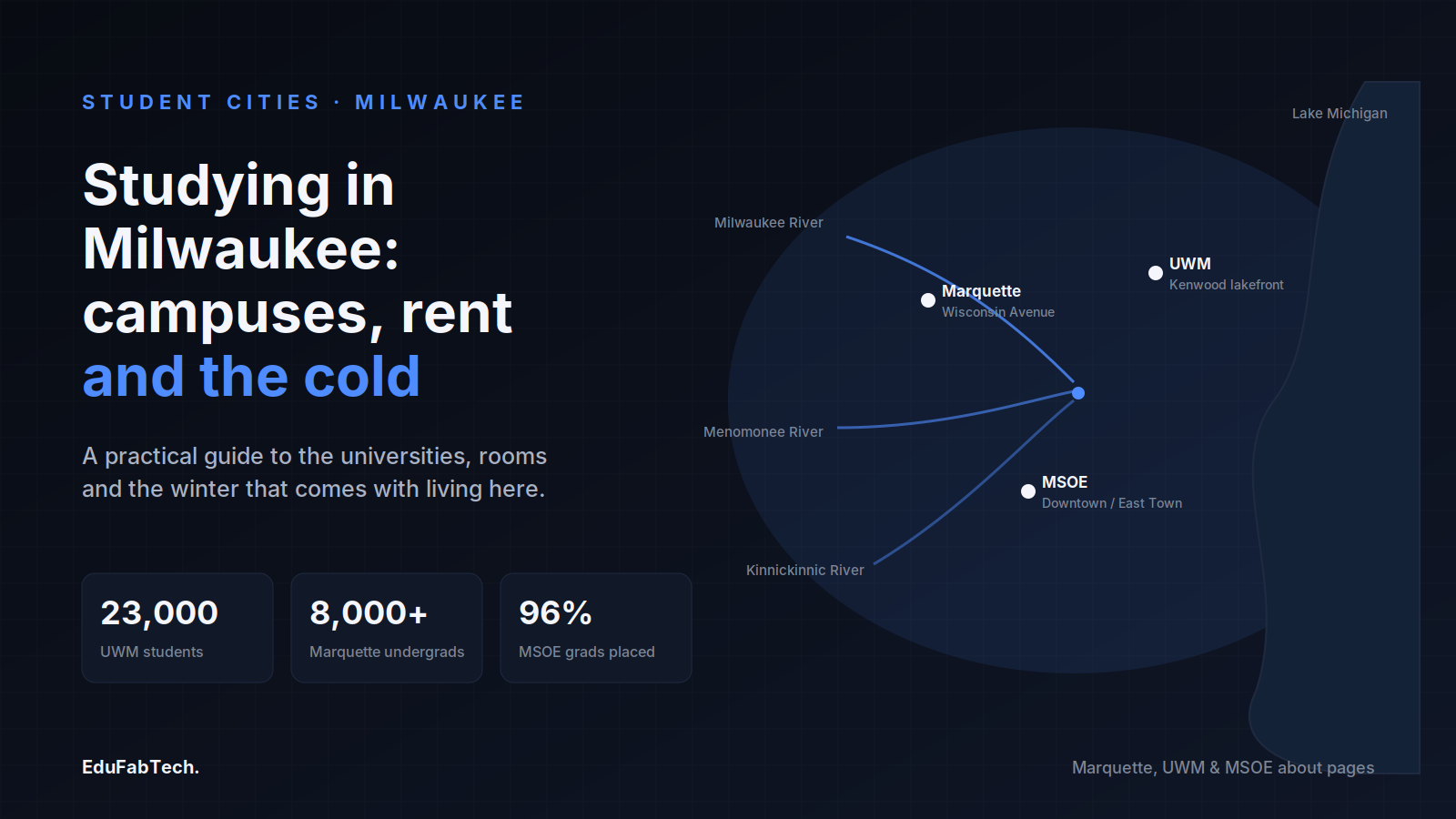
Milwaukee sits on the western shore of Lake Michigan, where three rivers — the Milwaukee, the Menomonee and the Kinnickinnic — meet before emptying into the lake. It is Wisconsin's largest city, built in pale "Cream City" brick on bluffs above the water, and it wears its brewing and manufacturing history openly. For students, the useful thing to know is that the universities are not clustered in one quarter: they string along Wisconsin Avenue on the near west side, climb the lakefront bluffs on the east side, and scatter into the suburbs of Waukesha and Ozaukee counties.
That geography decides almost everything else — which neighbourhood you can afford, how long your commute is, and whether you will spend January waiting for a bus in the wind off the lake. This guide walks through the institutions, where students actually rent, how to sign a lease without being cheated, and what the year costs, with each figure tied to the source that published it.
Universities along Wisconsin Avenue and the lakefront bluffs
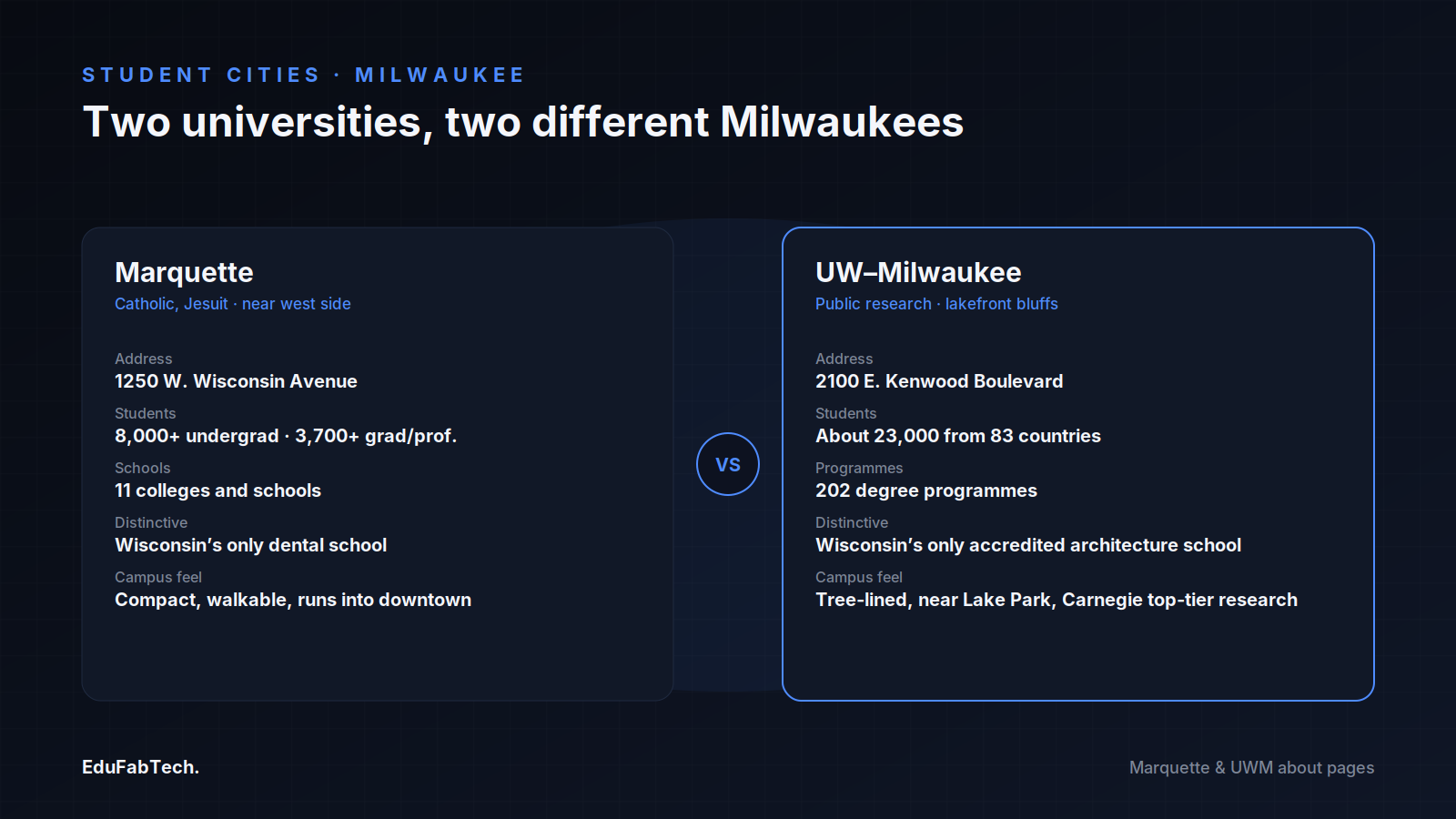
Two institutions dominate. Marquette University describes itself as "a Catholic, Jesuit university in the heart of Milwaukee," sitting at 1250 West Wisconsin Avenue on the near west side, with more than 8,000 undergraduates and over 3,700 graduate and professional students across eleven colleges and schools, according to Marquette's own about page. It runs the only dental school in Wisconsin and a law school, and its campus — compact, walkable, centred on the St. Joan of Arc Chapel — runs right up to downtown. A few kilometres east, the University of Wisconsin–Milwaukee is the bigger of the two: its main campus is at 2100 East Kenwood Boulevard in a tree-lined neighbourhood near Lake Park, and the university states it serves roughly 23,000 students from 83 countries across 202 degree programmes, holding the Carnegie "highest research activity" classification, per UWM's about page. The same page notes UWM has the only accredited architecture school in Wisconsin and a School of Freshwater Sciences it calls the only one of its kind in the country; its teacher-training arm, the University of Wisconsin–Milwaukee School of Education, is one of the state's largest.
Downtown, in East Town at 1025 North Broadway, the Milwaukee School of Engineering (MSOE) grants bachelor's and master's degrees in engineering, business, computer science and nursing, and reports on its about page that in 2024-25, 96% of its graduates got the job or graduate-school place of their choice; its Grohmann Museum, devoted to the imagery of human work, is open to the public. These three define the city's student core, but the metropolitan area holds many more.
Carroll University, in Waukesha about 30 minutes west, calls itself Wisconsin's first four-year institution of higher learning, chartered in 1846, and is strong in the health sciences (carrollu.edu). Alverno College, on Milwaukee's south side, is a Catholic college known nationally for its abilities-based approach to assessment and for educating women at undergraduate level, with graduate programmes open more widely. Mount Mary University, near the Menomonee River Parkway on the north-west side, is a Catholic university also rooted in women's education, now granting degrees through the doctoral level. Wisconsin Lutheran College is a Christian liberal-arts college on the west side at 8800 West Bluemound Road, and Concordia University Wisconsin is a Lutheran university on the lakeshore up in Mequon, north of the city.
The region's career and technical options matter just as much to many students. Milwaukee Area Technical College (MATC) is the public two-year college, with campuses downtown, in Mequon, Oak Creek and West Allis, granting associate degrees, technical diplomas and transfer courses. Waukesha County Technical College plays the same role in Pewaukee. Herzing University, headquartered on Wisconsin Avenue downtown with its Wisconsin campus in Brookfield, offers career-focused degrees from associate to doctoral level in health, nursing, business and technology. Milwaukee Career College runs accelerated programmes in medical, dental and veterinary assisting, and the Wisconsin School of Professional Psychology in West Allis is a small independent graduate school granting a doctorate (PsyD) in clinical psychology. You can see all the city's student listings on EduFabTech at /in/united-states/milwaukee.
Where students settle: the East Side, Riverwest and beyond
Milwaukee is a city of named neighbourhoods, and which one you pick shapes your rent and your commute more than the headline "Milwaukee" figure ever will.
The East Side (Murray Hill, North Point) is the classic UWM district: dense blocks of older flats within walking or cycling distance of the Kenwood campus, cafés and bars along North and Brady Streets, and a short bus ride from downtown. It is the easiest place to be car-free near UWM, and prices reflect that demand. North of it across the Milwaukee River, Riverwest is described by the UWM-published Encyclopedia of Milwaukee as a neighbourhood long home to artists, activists, students and working families, with a cooperative grocery and a strong do-it-yourself culture (emke.uwm.edu); rents tend to run a little below the East Side, and you can still reach UWM on foot or by bike.
Downtown — East Town and Westown — puts you among MSOE, Marquette's eastern edge and the office towers, with newer apartment stock and the free streetcar at the door; it is convenient and generally pricier. South of the Menomonee Valley, Walker's Point is a former industrial district of brick warehouses converted to lofts, close to downtown and full of restaurants, and Bay View, further south along the lake, is characterised by the Encyclopedia of Milwaukee as a close-knit, historically working-class neighbourhood (emke.uwm.edu) that now draws many renters and young professionals for its lower-rise housing and lakefront parks — though it is a longer trip to the UWM and Marquette campuses. West of the city, Wauwatosa ("Tosa") offers quieter residential streets near Mount Mary and Wisconsin Lutheran and the medical-campus jobs, better suited to students with a car. Browse rooms by area at /in/united-states/milwaukee/rooms.
Signing a lease in Wisconsin without losing a deposit
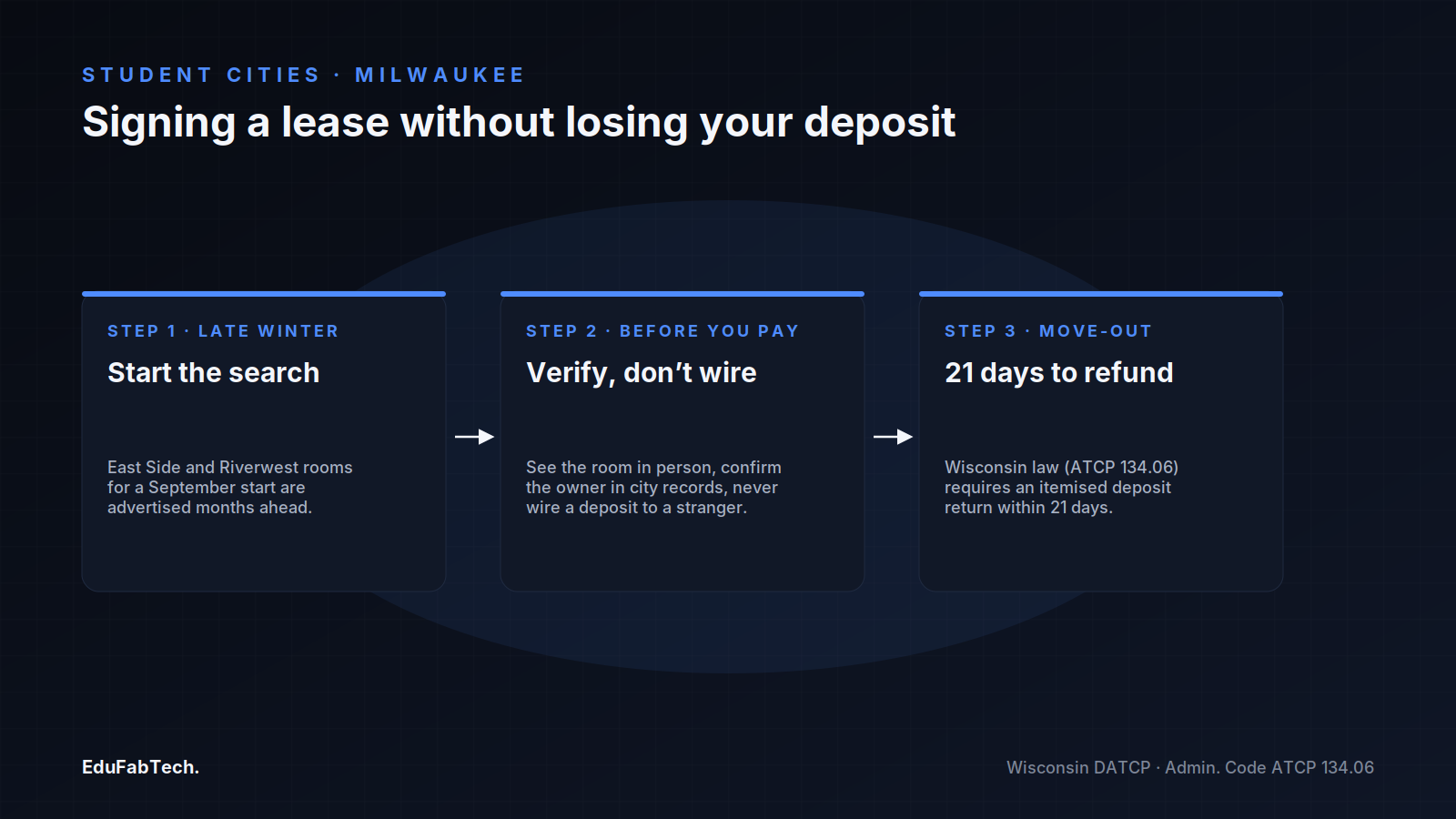
Most students who do not live in halls rent a room or a flat in one of the neighbourhoods above. The academic-year leasing cycle starts early in Milwaukee: good East Side and Riverwest units are often advertised months ahead, so the practical advice is to begin looking in late winter for a September start, and to see any place in person — or send someone you trust — before committing.
Wisconsin law gives tenants real protection, and it is worth knowing before you hand over money. Under the state administrative code, a landlord must return your security deposit, minus any lawful deductions with a written itemised list, within 21 days of the end of the tenancy — see Wisconsin Administrative Code ATCP 134.06. Knowing that rule helps you spot a landlord who treats deposits casually.
Rental scams in Milwaukee follow a recognisable pattern, and they cluster on open listing platforms. The Wisconsin Department of Agriculture, Trade and Consumer Protection (DATCP) warns that scammers advertise properties on sites such as Craigslist that were never available, then ask you to wire money to "hold" the place before disappearing; its guidance is blunt: "Never wire funds to strangers or provide the code and PIN from a prepaid debit or gift card," be cautious if asked to send money out of state for a Wisconsin property, and "inspect the property (inside and out) before you put any money down" (DATCP, 2017). In practice that means: never send a deposit by bank transfer, gift card or cryptocurrency to reserve a room you have not seen, be wary of a "landlord" who is conveniently out of state, and use the City of Milwaukee's public property-ownership records to check that the person collecting rent actually owns the building. For more listings, see /in/united-states/milwaukee.
Furnishing a room: thrift aisles and the Public Market
An empty room is cheaper to fill in Milwaukee than many newcomers expect, because the second-hand network is dense. St. Vincent de Paul runs several thrift stores across the metro area — including large shops on West Lincoln Avenue and North 76th Street — and Goodwill operates retail stores and donation centres throughout south-eastern Wisconsin, with a boutique in the Historic Third Ward. Between them you can furnish a desk, bed and kitchen for a fraction of retail, and student move-out weeks in spring flood these stores with donated furniture. For anything you would rather collect locally, EduFabTech lists second-hand things and items given away free in the city.
For food and the simple pleasure of a market day, the Milwaukee Public Market in the Historic Third Ward at 400 North Water Street is the city's permanent indoor food market, home to around a score of independent vendors selling produce, cheese, seafood and prepared meals (milwaukeepublicmarket.org). It is a food-and-grocery market rather than a flea market, but it is the one most students come to know, and seasonal outdoor farmers' markets run in neighbourhoods across the city through the warmer months.
Working a job while you study
International students should treat work rules as a matter of their visa status, not local custom. For students in F-1 status, the U.S. Department of Homeland Security states that on-campus employment is capped at 20 hours per week while school is in session, and that off-campus work generally requires having completed at least one full academic year plus authorisation tied to economic hardship, obtained through your Designated School Official and a Form I-765 filed with USCIS — with the warning that "you cannot begin to work while the Form I-765 is pending" (Study in the States, DHS). This is not legal advice; confirm your own situation with your university's international-student office before accepting any job. Campus jobs, libraries and labs are the usual starting point; local openings are collected at /in/united-states/milwaukee/jobs.
Libraries and quiet desks
Each main campus has a serious library. UWM's Golda Meir Library at 2311 East Hartford Avenue is the university's central library and also holds the American Geographical Society Library (uwm.edu/libraries); Marquette's Raynor Memorial Libraries serve its campus on Wisconsin Avenue (marquette.edu/library). Beyond the campuses, the Milwaukee Public Library system is the city's free study infrastructure: its Central Library at 814 West Wisconsin Avenue — a grand Beaux-Arts building a few blocks from Marquette — offers reading rooms, Wi-Fi and public computers, with opening hours listed on the library's Central branch page. A Wisconsin residence lets you borrow for free. EduFabTech also tracks bookable study spaces in the city.
Buses, the U-PASS and a free streetcar
Getting around is handled mainly by the Milwaukee County Transit System (MCTS). It has moved to the WisGo fare system, paid through the Umo app or a reloadable WisGo card: a single adult ride is $2.75, and fare capping means you never pay more than $8.25 in a day, $33 in a week or $99 in a month once you have tapped enough times with Umo, WisGo or a contactless card — cash fares do not qualify for capping, according to MCTS's fares page. Students at participating universities can ride free: UWM students paying segregated fees are eligible for the U-PASS, which works through the Umo app or a WisGo card and must be re-activated with a benefit code each semester, per UWM Transportation Services. Check whether your own institution offers an equivalent pass before buying fares.
Downtown adds a second option: The Hop, Milwaukee's modern streetcar, which runs a loop linking the Lower East Side, downtown and the Historic Third Ward and is, in the operator's words, "free to ride! No tickets or vouchers needed" (thehopmke.com). It will not replace the bus for a cross-city commute, but it is genuinely useful for getting around the downtown core and the lakefront at no cost.
What a year costs — and the winter that comes with it
Costs depend heavily on which institution you attend. Marquette announced undergraduate tuition of $52,070 for 2025-26, a 4% increase, on its rates page. Public tuition at UWM is far lower and splits sharply by residency: for 2025-26 the university's cost-of-attendance page lists full-time undergraduate tuition of about $10,398 for Wisconsin residents and $22,398 for non-residents (UWM Cost of Attendance). For a dated housing figure, UWM's own University Housing rates for 2026-27 price a standard double room in Sandburg Hall at $6,300 and a RiverView double at $6,700 for the academic year, with all utilities and high-speed internet included and a dining plan charged separately.
| Item (year, source) | Amount |
|---|---|
| Marquette undergraduate tuition, 2025-26 (Marquette) | $52,070 |
| UWM undergraduate tuition, resident, 2025-26 (UWM) | ~$10,398 |
| UWM undergraduate tuition, non-resident, 2025-26 (UWM) | ~$22,398 |
| UWM Sandburg double room, 2026-27 (UWM) | $6,300 / year |
| MCTS monthly fare cap, 2026 (MCTS) | $99 |
Then there is the climate, which is not a minor footnote here. Milwaukee's winters are long and cold, with wind off Lake Michigan that makes exposed waits colder than the thermometer suggests; the National Weather Service lists the city's average seasonal snowfall at 48.7 inches (about 124 cm) over the 1991-2020 normals period (NWS Milwaukee). Budget for a serious winter coat and boots, and factor the weather into how far you are willing to live from campus.
The honest trade-offs
What is good about Milwaukee for students: it is affordable by the standards of large American cities, the lakefront and the parks are genuinely part of daily life, the second-hand economy is strong, and free travel — a campus U-PASS plus The Hop — can cut transport costs to almost nothing if you live centrally. The neighbourhoods are distinct and walkable, and the two big universities put most of student life within a few kilometres of the water.
What is hard: the winter is real and long, and it shapes the year. Housing near UWM can be tight — the university has reported its residence halls full for recent autumn terms — so starting your search late is costly. A car remains useful for the suburban campuses and for getting around after the buses thin out at night, and Milwaukee is a segregated city whose neighbourhoods differ sharply in investment and feel, which is worth understanding before you choose where to live. None of this is unusual for a mid-sized Great Lakes city, but it is better known in advance than discovered in January.
First weeks in Milwaukee: a short checklist
- Start the room search early — late winter for a September lease — and never pay a deposit before seeing the place; use the City of Milwaukee property records to confirm the owner.
- Set up your transit: download the Umo app or get a WisGo card, and activate your university's U-PASS benefit code if you are eligible.
- Get a Wisconsin library card for free borrowing, Wi-Fi and study space at the Milwaukee Public Library, alongside your campus library account.
- If you are an international student, visit your university's international office to confirm the work rules for your visa status before taking any job.
- Furnish from St. Vincent de Paul and Goodwill, especially around student move-out in spring, and check EduFabTech's free-stuff and second-hand listings.
- Buy winter gear before December — a proper coat, boots and gloves — and keep track of local events to meet people once term begins.
A quick question for readers
Do you work part-time while you study?
Many students work to pay the bills. See how common it is — and how many hours people really do.
Pick an answer, create a free account in a minute, and your vote counts. Already a member? Sign in
Source: University of Wisconsin–Milwaukee
Sources (5)
- University of Wisconsin–Milwaukee. About UWM. University of Wisconsin–Milwaukee, 2026. uwm.edu ↗ · checked 4 Oct 2026
- Milwaukee County Transit System. WisGo Fares. Milwaukee County Transit System, 2026. ridemcts.com ↗ · checked 4 Oct 2026
- Wisconsin Department of Agriculture, Trade and Consumer Protection. Beware of Online Rental Scams. State of Wisconsin, 2017. datcp.wi.gov ↗ · checked 4 Oct 2026
- U.S. Department of Homeland Security. Working in the United States. Study in the States, 2026. studyinthestates.dhs.gov ↗ · checked 4 Oct 2026
- Marquette University. 2025-26 tuition, housing and food rates announced. Marquette University, 2025. today.marquette.edu ↗ · checked 4 Oct 2026