Studying in Minneapolis: universities, housing and student life
A practical, sourced guide to the universities, neighbourhoods, housing, work rules, transport and real costs of being a student in Minneapolis, Minnesota.
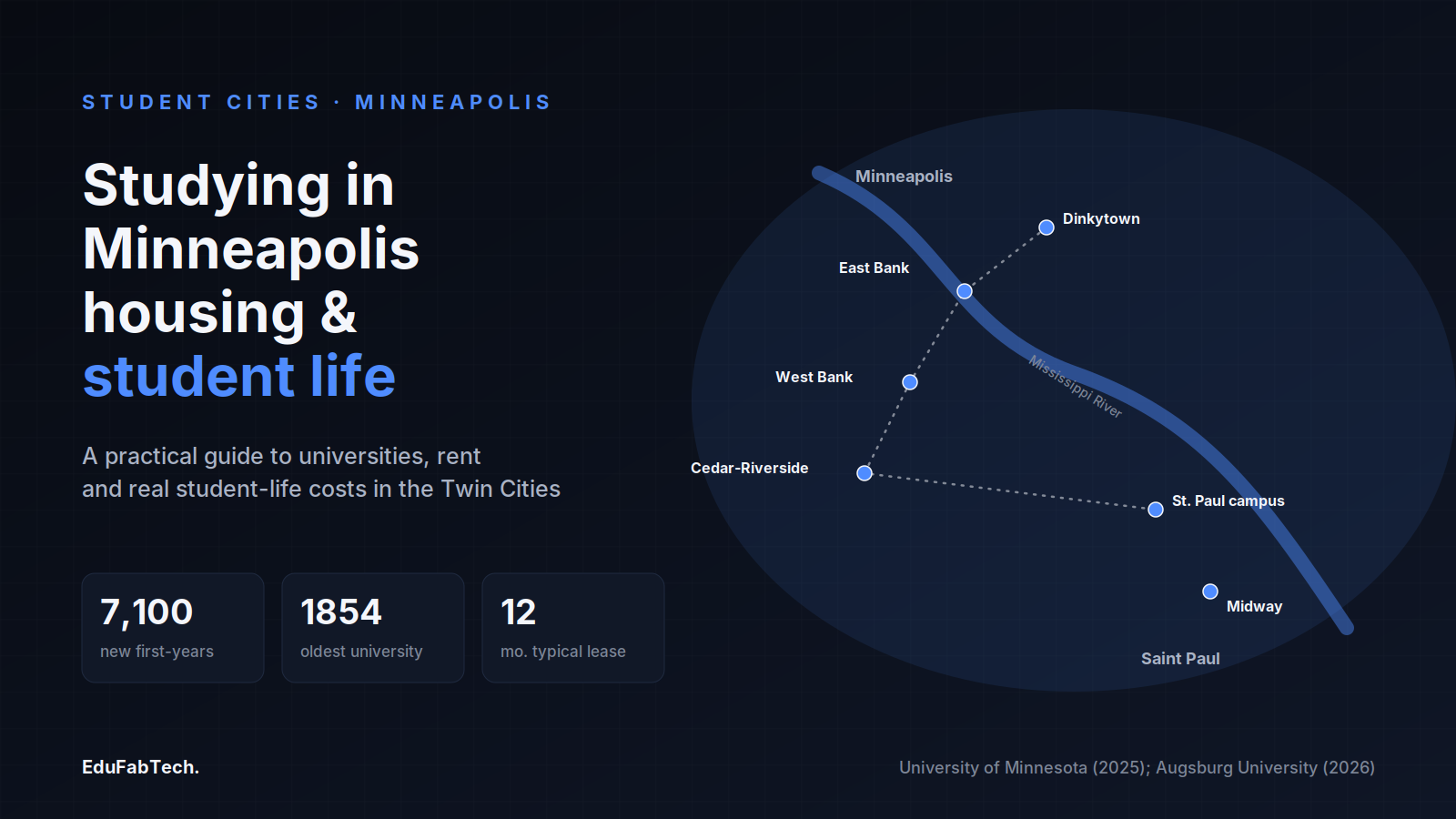
Minneapolis rarely calls itself a college town, and yet it behaves like one. It is the larger half of the Twin Cities — paired across the Mississippi River with Saint Paul, the state capital — and together the two cities and their suburbs hold one of the densest concentrations of universities in the middle of North America. A student here can live in one city, study in another, and never think of the border. Much of the practical advice below spills naturally across that line, because so does student life.
Studying at the University of Minnesota
The gravitational centre is the University of Minnesota, whose Twin Cities campus is one of the largest single campuses in the United States. In fall 2025 it welcomed roughly 7,100 first-year students and 1,700 transfer students, with tens of thousands of returning students alongside them, according to the University of Minnesota (2025). That scale shapes everything: the housing market, the transit map, the rhythm of the academic year.
The campus is split by the river. The East Bank in Minneapolis holds most of the engineering and science buildings — the University of Minnesota College of Science and Engineering is here — while the West Bank, a short walk or one light-rail stop away, is home to much of the University of Minnesota College of Liberal Arts and the arts and social-science departments. A second cluster sits a few kilometres north in Falcon Heights, where the agricultural and life-science programmes of the University of Minnesota College of Food, Agricultural and Natural Resource Sciences share the Saint Paul campus. A free campus-connector bus links the two.
Studying at a university this size is a trade-off that is worth naming early. The library system, laboratories, research funding and sheer range of courses are enormous; the flip side is that introductory lecture courses can be large, and you have to be deliberate about finding the smaller seminars, the lab groups and the student organisations that make a place feel human. Most students who thrive here do so by picking a neighbourhood, a routine and a handful of regular study spaces, rather than trying to absorb the whole institution at once.
The other universities in and around Minneapolis
Minneapolis is far from a one-university town. In the Cedar-Riverside neighbourhood, a few blocks from the river, Augsburg University has taught the liberal arts and professional studies since 1869 and now enrols nearly 3,500 students, wrapped around Murphy Square, the city's oldest park (Augsburg University, 2026). Downtown, in the Elliot Park neighbourhood, North Central University has been a small Pentecostal institution since 1930, while near Loring Park Dunwoody College of Technology trains students in trades and applied technology — welding, HVAC, radiologic technology, computing — in programmes that are often two years or less. Two more Minneapolis-based institutions, Capella University and Walden University, are primarily online universities with headquarters in the city rather than traditional residential campuses.
Across the river in Saint Paul and the inner suburbs, the choice widens. Hamline University, founded in 1854, is the state's oldest university and sits in Saint Paul's Midway district. University of St. Thomas, the largest private university in the state, has its main campus on Summit Avenue in Saint Paul and a second campus in downtown Minneapolis; its college seminary, St. John Vianney Seminary, shares the Summit Avenue grounds. St. Catherine University, one of the largest universities historically founded for women, is in Saint Paul's Highland Park, and Concordia University St. Paul lies in the same Midway corridor. Metropolitan State University serves working adults from Saint Paul's East Side and other metro locations. North of the cities you will find Bethel University and University of Northwestern – St. Paul in the Arden Hills and Roseville area, and in the southern suburbs Northwestern Health Sciences University in Bloomington trains chiropractors, acupuncturists and other health practitioners. Also in the south-metro suburbs are Bethany Global University, a small missions-focused institution in Bloomington, and Rasmussen University, a career-focused school with several campuses including the Edina–Bloomington area. Minnesota Life College in Richfield is not a degree-granting university but a programme supporting young adults with autism and learning differences; and the Minnesota State University Student Association, based in Saint Paul, is a statewide student advocacy organisation rather than a campus.
A few names on the record are no longer teaching, and it is honest to say so. Brown College in Mendota Heights and Globe University/Minnesota School of Business in Oakdale both closed in 2017, and Nazareth Hall Preparatory Seminary in Arden Hills closed decades ago, in 1970. If someone points you to any of these, they are history, not options.
The neighbourhoods students actually live in
Where you live decides your commute, your rent and, in winter, your sanity. These are the areas students gravitate to.
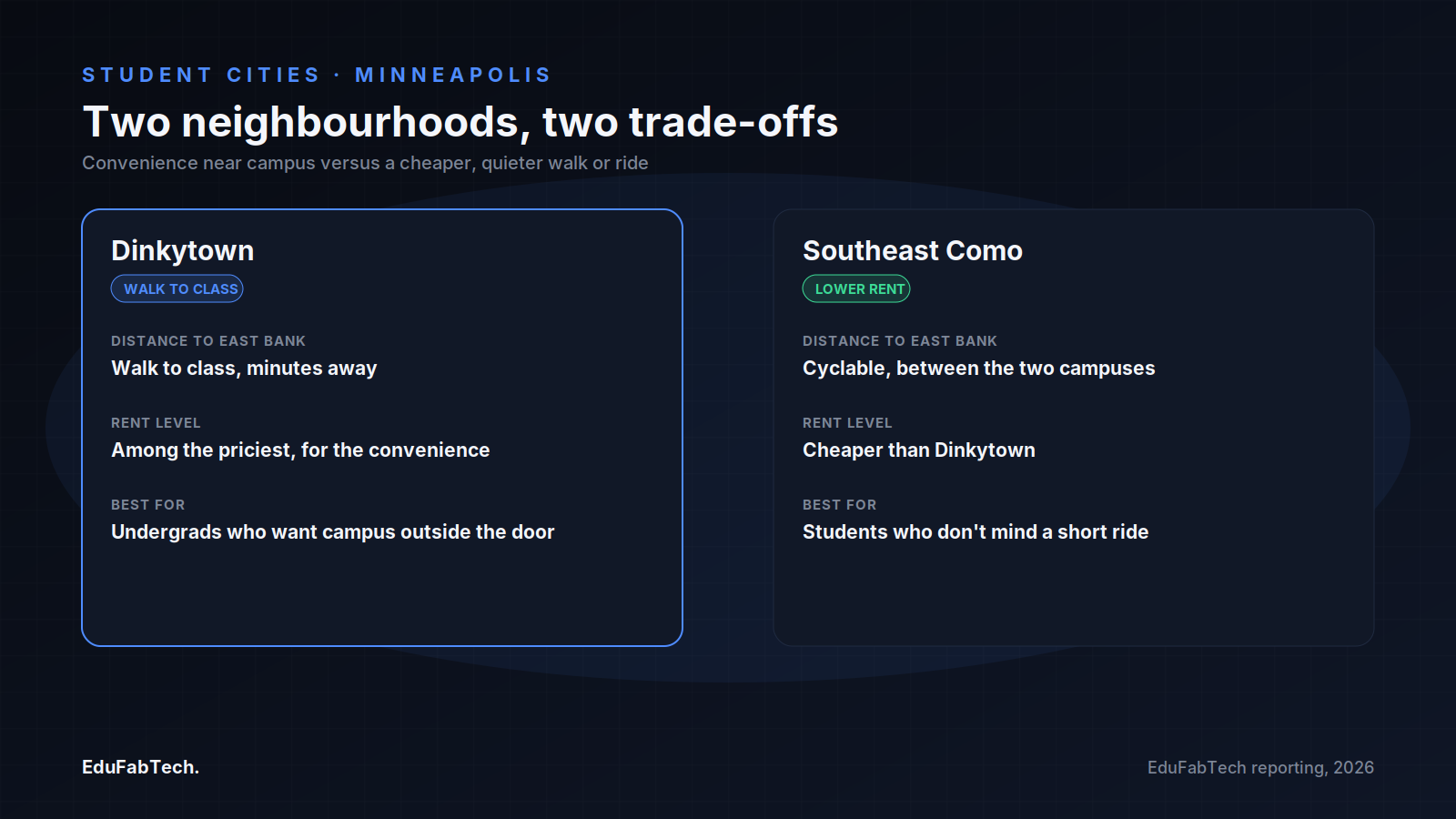
Dinkytown and Marcy-Holmes are the classic undergraduate neighbourhoods, immediately north and east of the East Bank campus. Dinkytown is a compact grid of cafés, cheap food and bookshops; Marcy-Holmes, just beside it, mixes older houses with a wave of newer purpose-built student towers. You can walk to class, which is the main attraction. It is also among the pricier pockets, precisely because of that convenience.
Stadium Village and Prospect Park sit on the other side of the East Bank, strung along the light-rail line. Stadium Village is dense and new; Prospect Park, around the landmark "Witch's Hat" water tower, is quieter and more residential, popular with graduate students who want a short ride rather than a short walk.
Cedar-Riverside and the West Bank put you next to Augsburg University and the West Bank arts buildings, with one of the most internationally diverse populations in the state and some of the more affordable older apartments near the core. Southeast Como, between the Minneapolis and Saint Paul campuses, is a low-rise student-and-family neighbourhood that tends to be cheaper than Dinkytown while still cyclable to class.
Seward and Longfellow, running south-east along the river, are leafier and more settled — co-ops, bike paths and older duplexes — and suit students who prefer a calmer base and don't mind a transit ride. Uptown and Whittier, further west around the city lakes, offer nightlife, music and vintage shopping; they are not adjacent to any campus but connect by frequent buses, and the rent can be reasonable for the character you get. Along the Green Line toward Saint Paul, the Midway district is a sensible middle ground for anyone studying at Hamline University, Concordia University St. Paul or Metropolitan State University.
Finding a room — and not being scammed
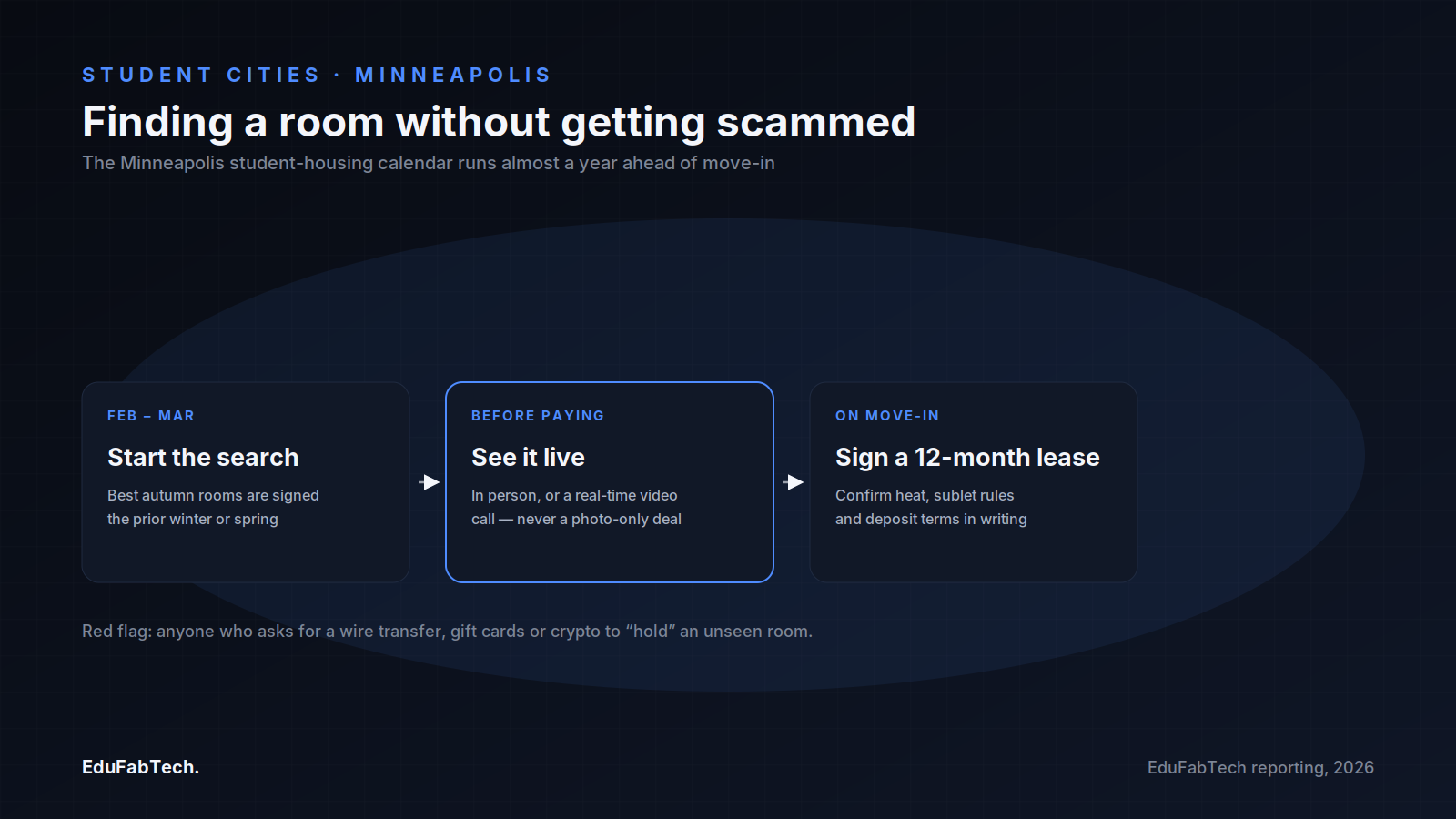
The academic year runs on a brutal calendar: much of the best student housing for autumn is signed in the preceding winter and spring, so if you are arriving in September, start looking by the previous February or March. International students who cannot view in person should line up a short-term option first and sign a 12-month lease only after they have seen the place. Before you pay anything, check the lease terms (most run a full year), who pays for heating in a city where winter heating bills are real, whether a sublet is allowed, and what the deposit rules are.
One paragraph deserves to be read twice. See the place before you pay — in person, or over a live video call where the person shows you the actual unit and answers in real time. Never wire a deposit, send a bank transfer, buy gift cards or pay in cryptocurrency to "hold" a room you have not seen; a genuine landlord will not demand an irreversible payment to a stranger. Be suspicious of prices well below the neighbourhood norm, of anyone who says they are out of the country and cannot show you in, and of pressure to decide today. Pay by a method that leaves a record, and get a signed lease. You can browse current rooms and places to stay in Minneapolis and listings near the University of Minnesota to calibrate what a fair price looks like before you commit.
Furnishing a room cheaply, and the markets worth knowing
Minneapolis has a deep second-hand culture, which is good news for an empty room. The city is known for its vintage and thrift scene, concentrated in Northeast Minneapolis, Uptown and along East Lake Street; a city visitor guide lists many named shops, from multi-vendor spaces like Time Bomb Vintage in Longfellow to the cluster of stores on 5th Street in Northeast. For food, kitchen goods and a genuine cross-section of the city, the Midtown Global Market on East Lake Street gathers dozens of immigrant-owned vendors under one roof, and the city's farmers markets — including the long-running Midtown Farmers Market, held Saturdays from May through October — are where produce is cheapest in season. For furniture and the rest, it is usually quicker and cheaper to buy locally than to ship: start with EduFabTech's second-hand listings in the city, and watch for the end-of-semester clear-outs in May, when departing students give away almost everything.
Working while you study
Rules on employment depend entirely on your immigration status, and this is not legal advice — always confirm with your university's international student office and the official source. In broad terms, students on the main study visa may generally work on campus, with the number of hours capped while classes are in session and more permitted during official breaks; off-campus work is tightly restricted and needs specific authorisation. The national guidance for international students working in the United States sets out the categories and limits, and your designated school official is the person who signs off on them. On-campus jobs — libraries, labs, dining, administration — are the usual first step, and EduFabTech lists local part-time work in Minneapolis for roles that are open to the eligible.
Getting around, and getting through winter
Minneapolis is flat, griddled and surprisingly walkable in the warmer months, and it is wrapped in a serious transit network. The METRO light rail is the backbone: the Green Line runs straight through the East and West Bank campuses along Washington Avenue, connecting downtown Minneapolis to downtown Saint Paul, while the Blue Line links downtown to the airport and the Mall of America. A regular local bus or light-rail ride is a flat US$2 at all hours, according to Metro Transit (2025). The single best deal for University of Minnesota students is the Universal Transit Pass: students who pay the transportation fee get unlimited rides on regional buses and light rail, activated by tapping their U Card (University of Minnesota Parking & Transportation Services, 2024). Check whether your own institution offers a comparable pass before you buy fares à la carte.
Then there is the winter, which no honest guide should skip. Minneapolis is one of the coldest major cities in the United States; deep sub-freezing spells and real snow are normal from roughly December to March, and the first winter is a genuine adjustment for anyone from a warmer climate. The city adapts rather than hibernates: a system of enclosed skyways connects large parts of downtown above street level, cyclists ride year-round, and transit keeps running. Budget for proper winter clothing early, before the first cold snap sells it out, and favour a home within walking distance of a frequent bus or train.
Libraries and places to study
The University of Minnesota library system is vast, with subject libraries on both banks and long hours in exam season, open to anyone enrolled there. Beyond the campus, the Minneapolis Central Library at 300 Nicollet Mall downtown is a free, public study space — with bookable meeting rooms, an assistive-technology lab, public computers and quiet reading areas (Hennepin County Library, 2026) — and it belongs to a county-wide system with branches across the city. The university seminaries and smaller colleges each have their own libraries for their students, and cafés across Dinkytown, the West Bank and Uptown function as informal study halls. If you need a reliable desk near home, EduFabTech also lists study spaces in Minneapolis.
What is good, and what is hard
The good is substantial. For its size, Minneapolis offers a lot of city — a strong music and arts scene, a chain of lakes and riverside paths inside the city limits, a real food culture and comparatively good transit — at a cost of living below the largest coastal cities. The research and job opportunities around a flagship university and a cluster of health, technology and corporate employers are deep. The hard parts are equally real: the winter is long and demands money and preparation; student-neighbourhood rents near the East Bank have risen sharply with each new tower; convenient housing is competitive and signed early; and a car-free life, while possible, means planning around transit and weather. None of this is a reason to stay away. It is a reason to arrive prepared.
A checklist for the first weeks
- Confirm your enrolment and meet your international student office before term; ask them about work eligibility and deadlines in person.
- Secure housing you have actually seen, with a signed lease and a traceable payment — never an irreversible transfer for a room you have not viewed.
- Activate your transit pass (the Universal Transit Pass if you are at the University of Minnesota) and learn the Green and Blue Line maps.
- Get a library card for the county system and scout one quiet study spot near home and one near campus.
- Furnish from local second-hand sources rather than shipping; check city listings and the May clear-outs.
- Buy real winter clothing early — a warm coat, boots, hat and gloves — before the first cold week.
- Walk your commute once before classes start, and find out who handles heating and repairs in your building.
A quick question for readers
Rate these parts of student life this term
Rate each one from 1 (very poor) to 5 (very good). Together the results show where students struggle most.
Rate 5 things →- University of Minnesota. University of Minnesota welcomes the Class of 2029. University of Minnesota Twin Cities, 2025. link
- Augsburg University. About Augsburg. Augsburg University, 2026. link
- Metro Transit. Fares. Metropolitan Council (Metro Transit), 2025. link
- University of Minnesota Parking & Transportation Services. Universal Transit Pass for Students. University of Minnesota, 2024. link
- U.S. Department of Homeland Security. Working in the United States. Study in the States, DHS, 2025. link
- Hennepin County Library. Minneapolis Central Library. Hennepin County, 2026. link
- Meet Minneapolis. The Top Minneapolis Thrift Stores for Clothing. Meet Minneapolis, 2026. link