Studying in Monroe, Louisiana: ULM, housing and student life
A practical, sourced guide to the University of Louisiana at Monroe, where students live along Bayou DeSiard, what a room costs, how the city's buses work, and the honest trade-offs of a small northeast-Louisiana college town.
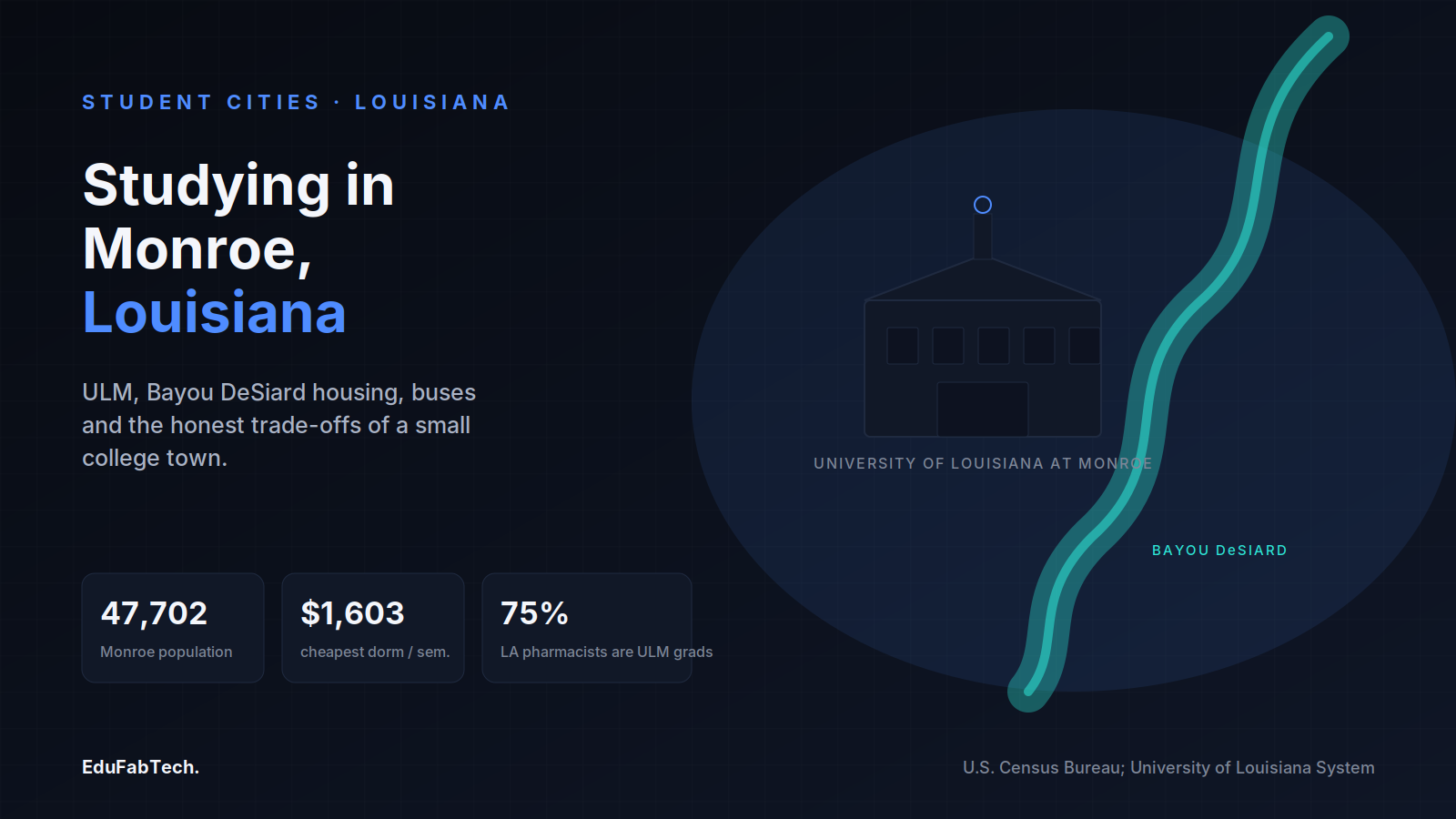
Monroe sits in the northeast corner of Louisiana, on the Ouachita River, paired across the water with its smaller twin, West Monroe. It is the commercial hub of a mostly rural region, and for students the centre of gravity is clear: the University of Louisiana at Monroe, whose campus curves along Bayou DeSiard on the city's east side. The University of Louisiana System, which governs the institution, describes it as "Located on the banks of Bayou DeSiard in Northeast Louisiana" and dates its founding to 1931, according to the system's profile of the university.
This is not a town where the university is one feature among many. Monroe is a small city — the U.S. Census Bureau's QuickFacts page records a 2020 census population of 47,702 — and ULM shapes its rhythm. If you are deciding whether to study here, from within Louisiana or from abroad, the questions that matter are concrete: what the university is strong at, where you can live, what a room actually costs, how you get around without a car, and what the city asks of you in return. This guide works through each, with the sources named so you can check them yourself.
A useful starting point for the practical side is EduFabTech's own city hub for Monroe student listings, which gathers rooms, second-hand items and jobs in one place; the sections below explain how to use that kind of information safely.
The university on the bayou: what ULM is known for
ULM is a public university and one of the eight institutions in the University of Louisiana System. Its academic identity leans heavily toward health and the sciences. The University of Louisiana System's profile calls ULM the home of "Louisiana's only public college of pharmacy," notes "the state's only accredited atmospheric sciences degree," and states that "75 percent of all pharmacists in Louisiana" are ULM alumni, on its university page. The same page records that the Edward Via College of Osteopathic Medicine operates a campus at ULM.
The College of Pharmacy is the programme most associated with the university. ULM's own College of Pharmacy overview says the college was established in 1956 and awards a four-year Doctor of Pharmacy (PharmD) degree, with combined PharmD–MBA and PharmD–PhD options. For a prospective student, the practical meaning is that pharmacy, nursing, allied health and the atmospheric and biological sciences are where ULM concentrates its reputation, its laboratories and its clinical connections — a different proposition from a university built around, say, engineering or the liberal arts. The athletics teams compete as the Warhawks, a name that also attaches to one of the student apartment complexes.
For listings tied directly to the campus — rooms, desks and short-term work within walking or cycling distance of the bayou — EduFabTech keeps a page for everything near the University of Louisiana at Monroe.
Living on campus: residence halls and what they cost
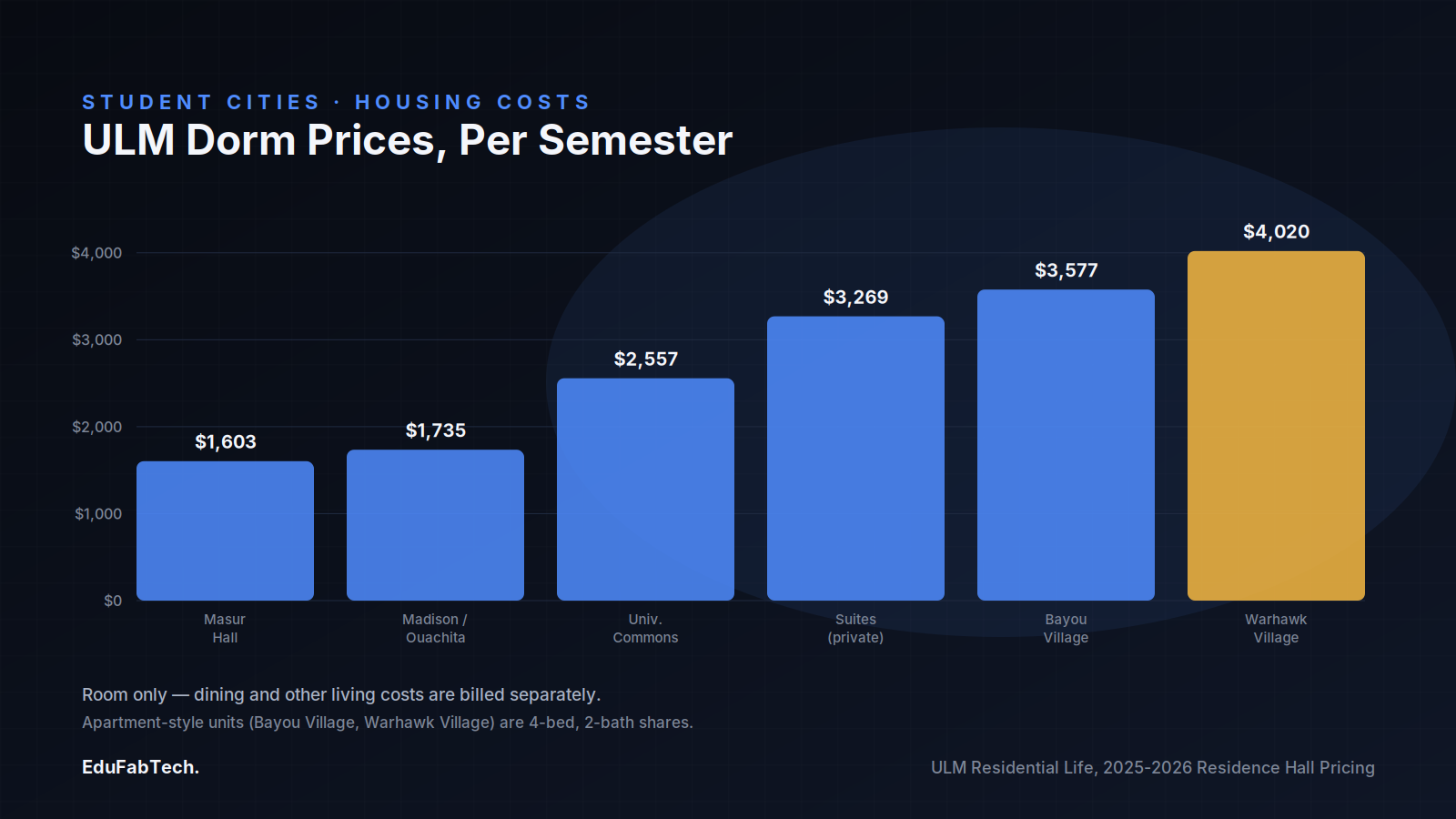
ULM's Residential Life office publishes a rate sheet, and it is the single most reliable housing figure for a new student because it is the university's own price for a fixed product. On the 2025-2026 Residence Hall Pricing page, the lowest traditional-hall rate listed is Masur Hall at $1,603 per semester for a double room. Madison Hall and Ouachita Hall are listed at $1,735 per semester for a double and $2,872 for a private room. The newer options cost more: University Commons is listed at $2,557 per semester for a double, and University Suites and Bayou Suites at $3,269 per semester for a private room. Apartment-style units are listed separately — Bayou Village four-bed, two-bath at $3,577 and Warhawk Village four-bed, two-bath at $4,020.
Two things are worth reading carefully on that page. First, read the billing period on each line: the traditional-hall and suite rates are quoted per semester, while the apartment lines mix per-semester and full-year figures, so compare like with like before you budget. Second, the posted figures cover the room only — dining and other living costs are billed separately, so treat the dormitory rate as a floor, not the total. You can start a housing application through the university's Residential Life pages.
Renting off campus, and how scams show up in Monroe
Because Monroe is spread out and comparatively inexpensive, many students move off campus after their first year into houses and small apartment complexes in the neighbourhoods east and north of the university, or across the river in West Monroe. The Census Bureau's QuickFacts page lists a median gross rent of $886 for 2020-2024 and a median household income of $40,505 for the same period, on its Monroe city profile. Those are city-wide figures, not student rents, but they tell you the order of magnitude: this is a low-cost rental market by U.S. standards, which is one of Monroe's genuine advantages.
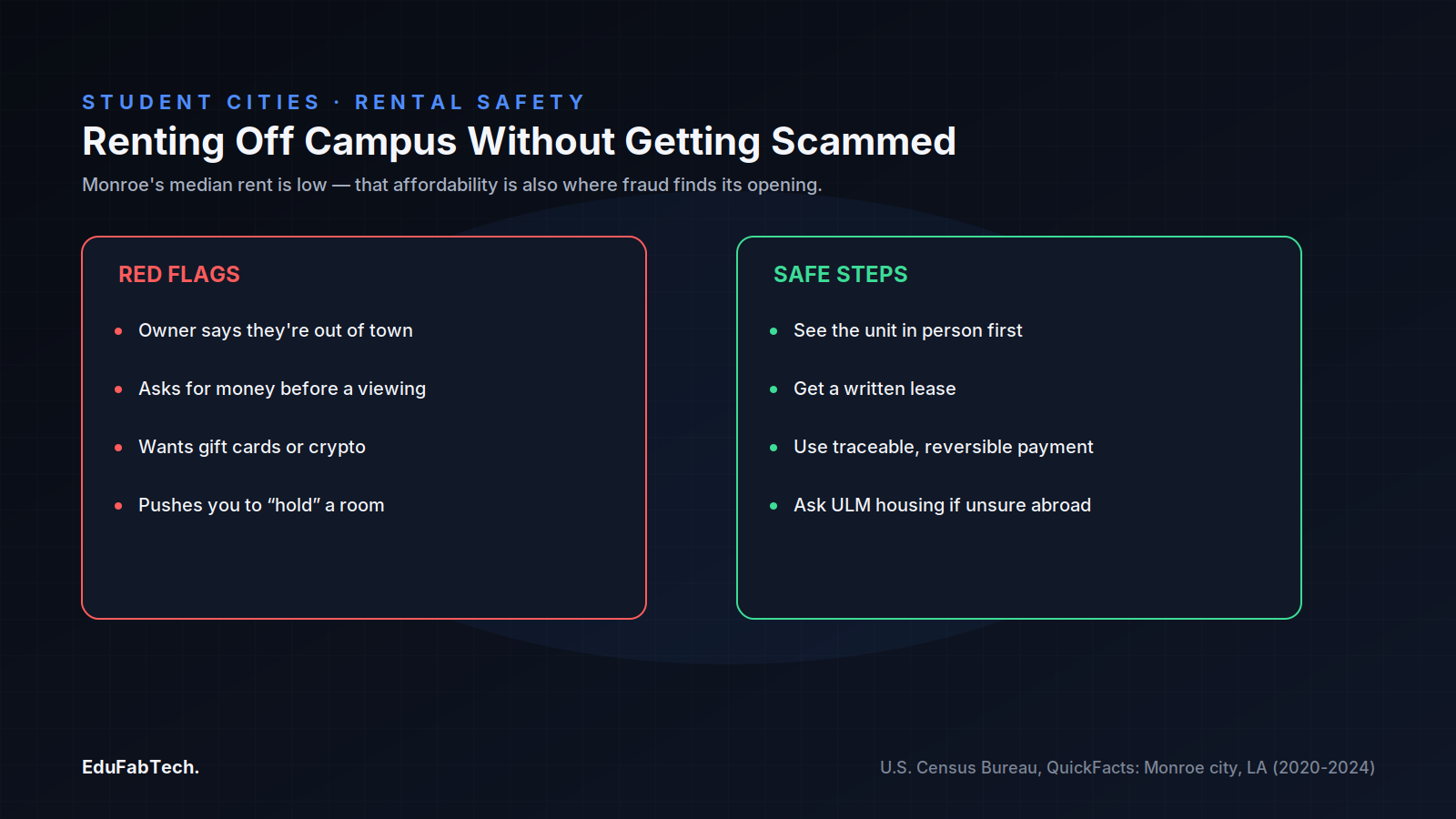
That low cost is also where fraud finds its opening. The common pattern here is the same as in other mid-sized American college towns: a listing for a house near campus at a price that looks a little too good, posted by someone who says they are out of town and asks you to send a deposit or first month's rent before you can see the place. Do not. See the property in person, or have someone you trust see it, before any money changes hands. A landlord or complex that is real will let you walk through an actual unit and will give you a written lease. Never wire a deposit, never pay with gift cards or cryptocurrency, and be wary of anyone who pushes you to "hold" a room sight unseen — those payment methods are the ones you cannot reverse, which is exactly why fraudsters ask for them. International students arriving before term, who cannot view a place first, are the most exposed; if you must commit from abroad, lean on the university housing office rather than an unverified private listing. EduFabTech's rooms listings for Monroe are a starting point for finding options, but the viewing-before-paying rule applies to every one of them.
Furnishing a room without overspending
An empty off-campus room needs a bed, a desk and a few kitchen things, and buying all of it new is the fastest way to blow a first-semester budget. Monroe and West Monroe have a dense cluster of thrift and resale shops, including Goodwill stores on both sides of the river, where used furniture, lamps and kitchenware turn up cheaply. Because individual shops change hours and even addresses from year to year, confirm a place is open before you drive out — and remember that the best student-to-student deals appear at the end of each semester, when graduating tenants give away or sell what they cannot take with them.
For that churn, EduFabTech keeps a Monroe page for second-hand things, from used furniture to items offered free. Collecting a free sofa or desk from another student is slower than buying new, but in a car-dependent city the real cost is transport: borrow a pick-up or split a short van hire with a flatmate rather than paying delivery on a cheap item.
Working part-time, and the rules for international students
Domestic students fill the usual campus and city jobs — dining halls, the library, retail, food service. For international students on an F-1 visa the rules are stricter and non-negotiable, and they are set by the U.S. federal government, not the university. The Department of Homeland Security's Study in the States guidance states that an F-1 student in on-campus employment "may not work more than 20 hours per week when school is in session," on its page about working in the United States. That page also explains that on-campus work must be arranged with your designated school official, and that off-campus employment and training such as Optional Practical Training require authorisation before you begin.
This is not legal advice, and the details of your own status can differ — so the people to ask are ULM's own advisers. The university's International Students office, the Office of Global and Multicultural Affairs, is in Sandel Hall, Suite 200, and the page says ULM hosts international students from over 50 countries. Talk to that office before you accept any job; the consequences of an unauthorised hour fall on the student, not the employer. Campus roles are the safest route because they are built around the rules. General part-time openings in the city are collected on EduFabTech's Monroe jobs page, but confirm your eligibility with the international office first.
Libraries and places to study
The central study space is the University Library, which sits on the banks of Bayou DeSiard near the east side of campus. According to the university's About the Library page, it is a five-storey building of roughly 140,000 square feet that opened on 12 April 1999 and seats 2,000 users at carrels, tables and easy chairs. During term the library's hours run from 7:30 a.m. to midnight Monday through Thursday, with shorter hours on Friday, closed on Saturday, and from noon to midnight on Sunday — so the long weekday evenings are where the serious work happens, and Saturday is not an option on campus.
Group study rooms can be reserved for small teams, and quieter floors suit solo reading, but the practical point is the schedule: plan around the midnight close and the Saturday closure rather than assuming a 24-hour library. For desks and quiet corners beyond the main building, EduFabTech lists study spaces in Monroe, which can matter in exam weeks when the library fills.
Getting around: a century-old bus system
Monroe is a car city, and it is honest to say so. If you do not drive, the public option is Monroe Transit, run by the City of Monroe and billed as the nation's oldest publicly owned transit system, operating since 1906. Its fares page lists an adult one-way fare of $1.25, a day pass at $3.00 and an adult monthly pass at $42.50. There is a specific student fare: $0.90 for a one-way ride and $8.00 for a ten-ride ticket, with the page noting that the college student rate requires an ID. Children below the fare-box height ride free, and transfers are free.
The limits are real. The City of Monroe's transit page describes buses arriving at the Downtown Terminal on a pulse system every 50 minutes, running Monday through Saturday from about 6:00 a.m. to 6:30 p.m., with no Sunday service. A University route exists, but a 50-minute headway and an early-evening finish mean the bus works for a planned commute and poorly for spontaneity or night classes. For many students the realistic answer is a cheap second-hand bicycle for the campus-and-nearby trips and a shared car for the rest.
The honest trade-offs
What Monroe offers students is affordability and a compact, low-pressure setting. Rents are low by national standards, the campus is a genuinely pretty stretch of bayou, and a health-sciences-focused university gives strong, specific programmes — pharmacy above all — more weight than its size would suggest. For a student who knows they want pharmacy, nursing, allied health or atmospheric science, ULM is a serious and inexpensive place to get it.
What is hard is the other side of a small Deep-South city. Summers are long, hot and humid, and the region sees heavy rain and occasional severe weather; the flat, river-and-bayou landscape that makes the campus attractive also makes parts of the area flood-prone. The transit system is modest and stops early, so life without a car takes planning. Nightlife and the range of shops, restaurants and cultural events are those of a city of fewer than 50,000 people, not a large metropolis, and some students find that quiet and others find it limiting. None of this is hidden, and weighing it honestly before you arrive is better than discovering it in October.
A checklist for the first weeks
- If you want to live on campus, apply early through ULM Residential Life and budget for the room rate plus dining and other living costs, using the 2025-2026 pricing page as your baseline.
- If you are renting off campus, view the actual unit before paying anything, insist on a written lease, and never send a deposit by wire, gift card or cryptocurrency to "hold" a place.
- International students: visit the Office of Global and Multicultural Affairs in Sandel Hall, Suite 200, to register in SEVIS and confirm what work, if any, you are permitted before taking a job.
- Buy a student bus ID for the $0.90 fare if you will use Monroe Transit, and check the route times against your timetable — there is no Sunday service and buses finish in the early evening.
- Furnish from Monroe's thrift shops and from departing students at semester's end; arrange your own transport for bulky items.
- Learn the University Library's term hours early — midnight close on weekdays, closed Saturday — and find a backup study spot for the gaps.
- Browse the full set of Monroe student listings to line up a room, furniture and work before term begins.
A quick question for readers
Do you work part-time while you study?
Many students work to pay the bills. See how common it is — and how many hours people really do.
Pick an answer, create a free account in a minute, and your vote counts. Already a member? Sign in
Comments 2
Comment-
The pharmacy stat is doing a lot of load-bearing work here: "75 percent of all pharmacists in Louisiana" are ULM alumni, sourced to the univ…
-
The number I'd actually hold onto is Masur Hall at $1,603 a semester, because everything else in that pricing table is quietly doing differe…
Join free to read the full comments and reply Comments are between members; an account takes a minute.
Source: University of Louisiana at Monroe
Sources (5)
- University of Louisiana System. University of Louisiana at Monroe. University of Louisiana System, 2026. ulsystem.edu ↗ · checked 3 Nov 2026
- University of Louisiana at Monroe, Residential Life. Residence Hall Pricing 2025-2026. University of Louisiana at Monroe, 2026. ulm.edu ↗ · checked 3 Nov 2026
- City of Monroe, Louisiana. Monroe Transit Fares. City of Monroe, Louisiana, 2026. monroela.us ↗ · checked 3 Nov 2026
- U.S. Department of Homeland Security. Working in the United States. Study in the States, 2026. studyinthestates.dhs.gov ↗ · checked 3 Nov 2026
- University of Louisiana at Monroe. About the Library. University of Louisiana at Monroe, 2026. ulm.edu ↗ · checked 3 Nov 2026