Studying in Montgomery: universities, housing and student life
Alabama's capital has four very different campuses, low rents by US standards, hard summers and thin public transit — a practical, sourced look at living and studying there.
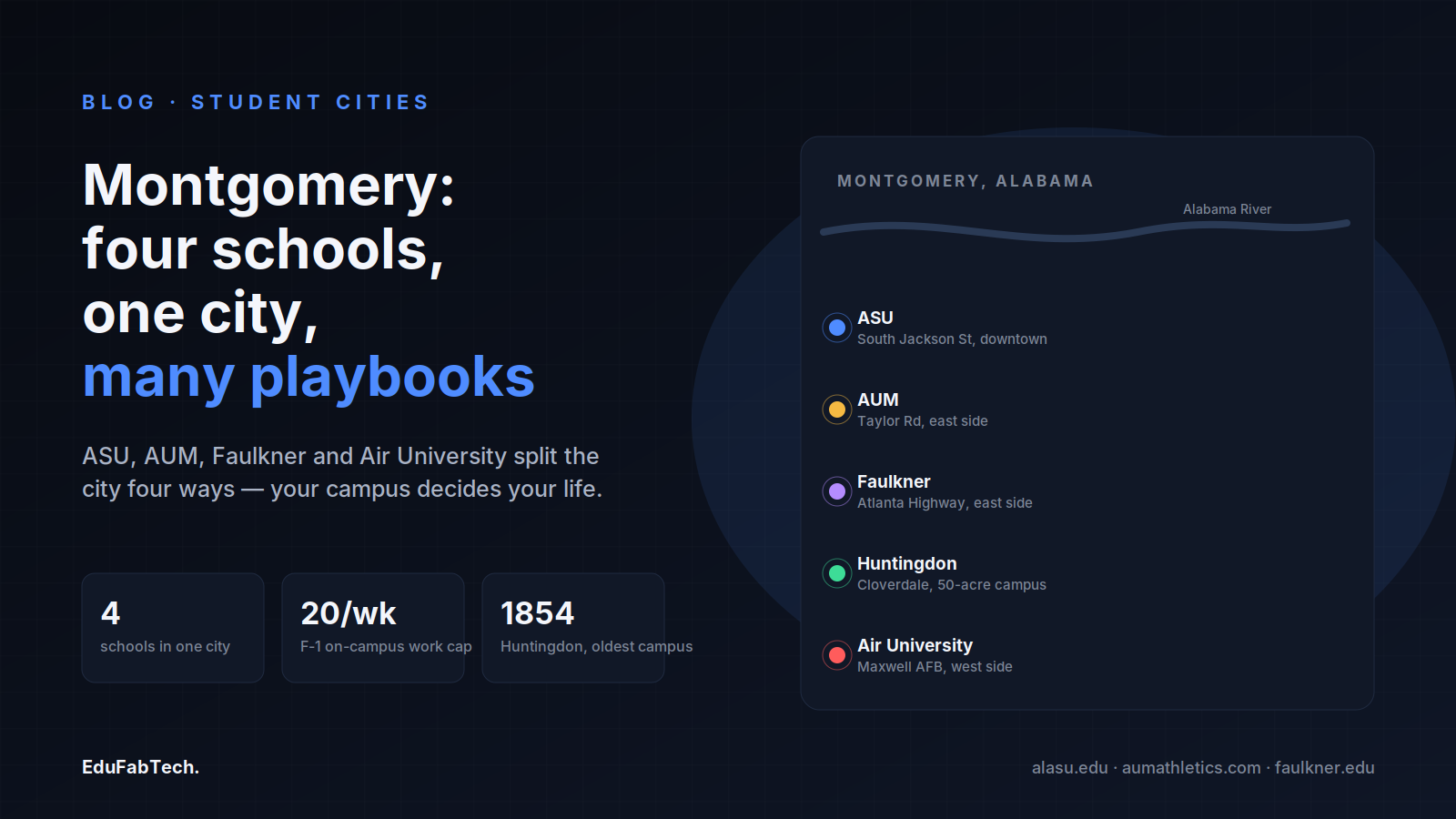
Montgomery sits on a bend of the Alabama River in the middle of the state, a mid-sized capital better known for its history than for its student population. Dexter Avenue runs from the river up to the white-domed State Capitol; a block off it stand the church where Martin Luther King Jr. preached during the 1955–56 bus boycott and, a short walk south, the Equal Justice Initiative's Legacy Museum and the National Memorial for Peace and Justice. That weight of history shapes the city a student moves into: compact and walkable at its historic core, sprawling and car-dependent everywhere else.
Unlike a classic college town built around one flagship, Montgomery spreads its students across four institutions with almost nothing in common — a public historically Black university downtown, a regional branch of the Auburn system out east, a Christian university on the highway, and a military graduate school on an Air Force base. Knowing which one you are joining decides nearly everything else: which side of town you live on, whether you need a car, and what your week looks like.
This guide is for anyone weighing a move here, whether from elsewhere in Alabama or from abroad. It names the institutions, the transit operator, the library and the market you will actually use, and it attaches a source to every number. You can browse current student listings for the city on EduFabTech's Montgomery page.
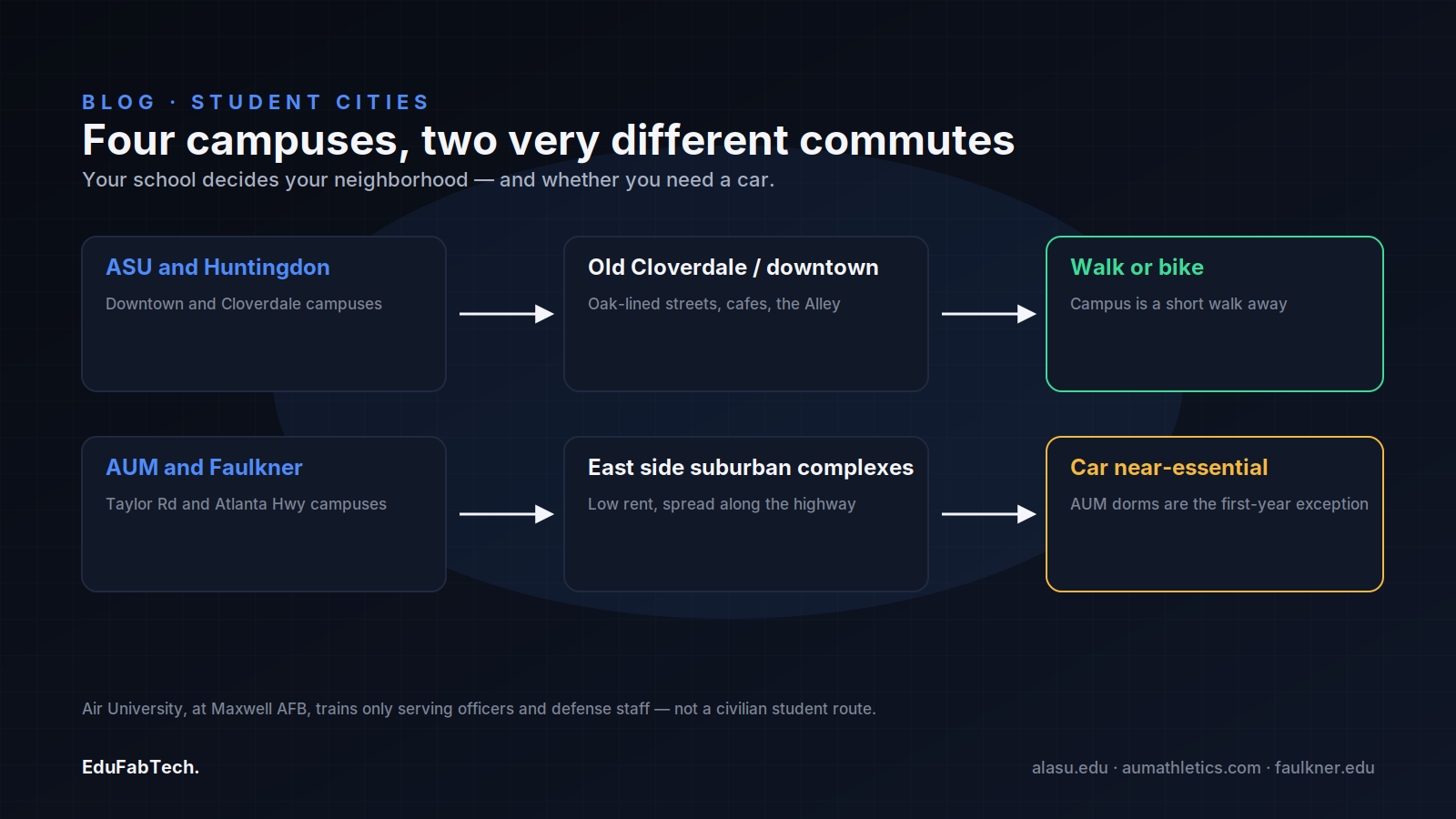
Four campuses, four different student lives
Alabama State University (ASU) is the institution most people picture when they think of studying in Montgomery. It is a public historically Black university — ASU's own site describes a 172-acre campus in historic Montgomery and lists accreditation by SACSCOC to award degrees from the baccalaureate through the doctorate (alasu.edu). Its campus runs along South Jackson Street just southeast of downtown, and the same page points to the Levi Watkins Learning Center, the university library, and the John Garrick Hardy Student Services Center as the hubs of campus life. ASU's marching band and its Division I athletics in the Southwestern Athletic Conference give the place an outsized public profile for its size.
Auburn University at Montgomery (AUM) is the other large option and feels nothing like ASU. According to AUM Athletics' quick-facts page, the university was founded in 1967, enrols roughly 5,213 students, and competes as the Warhawks in NCAA Division II's Gulf South Conference (aumathletics.com). It is a member of the Auburn University system and sits on a green, low-rise campus on the east side of the city near Taylor Road — a very different setting from the downtown grid, and one where a car or a bike is close to essential. AUM grants degrees from the bachelor's through the doctoral level across a broad spread of programmes.
Faulkner University is a private, Christian university affiliated with the Churches of Christ. Faulkner's own site records that it was founded in 1942 as Montgomery Bible College, became Faulkner University in 1985, and today enrols 3,262 students across six colleges — including the Thomas Goode Jones School of Law, which it describes as one of only three ABA-accredited law schools in Alabama (faulkner.edu). The main campus is on Atlanta Highway in the city's east, and the university also runs campuses in Mobile, Birmingham and Huntsville.
Air University is the odd one out, and worth understanding precisely so you do not waste time. It is the U.S. Air Force's professional military education institution at Maxwell Air Force Base, on the western edge of Montgomery, and it grants graduate degrees — the Air Force's fact sheet notes accreditation by the Southern Association of Colleges and Schools to award master's degrees, through schools such as the Air War College and the Air Command and Staff College (af.mil). Its students are serving officers, enlisted personnel and civilian defence staff, not school-leavers; it is not a route for a civilian undergraduate or an international applicant looking for a general degree.
Two smaller names round out the picture. Huntingdon College, a liberal-arts college of the United Methodist Church, is the city's oldest; the college's history page records a charter dating to 1854, a move to Montgomery in 1909, and a roughly 50-acre campus in the Cloverdale neighbourhood whose landscape was designed in 1908 by Frederick Law Olmsted Jr. (huntingdon.edu). The Alabama State University Historic District near the ASU campus, and Simler Hall on that campus, are part of the fabric students pass daily rather than separate schools.
Cloverdale, the east side, and where students actually end up
Where you live tracks your campus. ASU and Huntingdon students gravitate toward Old Cloverdale and the neighbourhoods just south and east of downtown: a historic district of oak-lined streets, early-twentieth-century houses and a small cluster of cafés and bars around the Cloverdale junction, close enough to walk or cycle to either campus. Downtown itself, around Dexter Avenue and the Alley entertainment district near Riverwalk Stadium, has slowly added loft and apartment conversions and suits students who want to be near the river and the nightlife.
AUM and Faulkner students, out on the east side near Taylor Road and Atlanta Highway, more often take apartments in the surrounding suburban complexes, where rents are low but almost everything requires a car. AUM operates its own on-campus residence halls and apartments, which solve the transport problem for first-years; off-campus, the east-side complexes are the default. You can scan rooms and shared places in the city on EduFabTech's Montgomery rooms listings, and filter by campus through near Alabama State University or near Faulkner University.
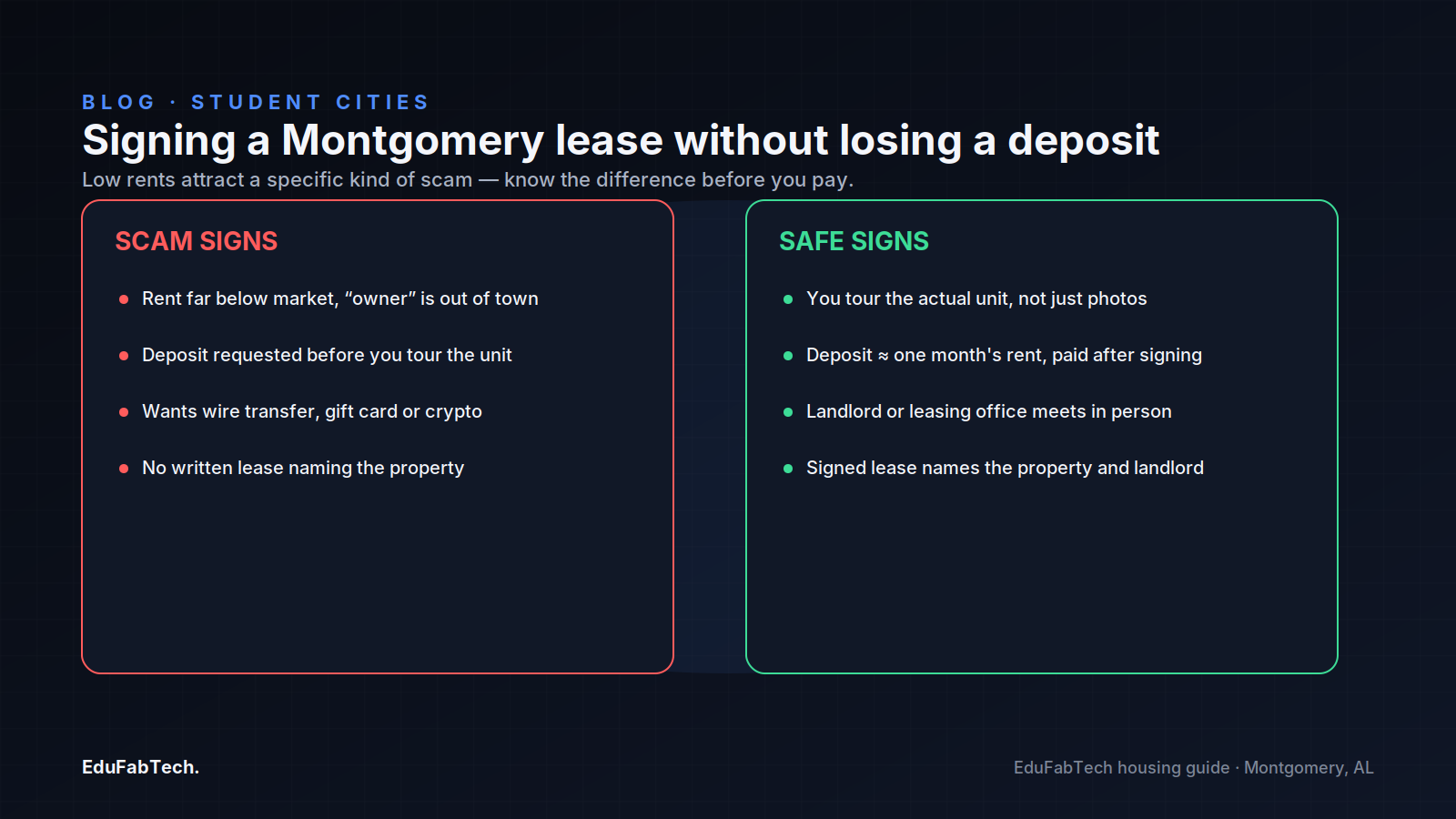
Signing a lease here without losing a deposit
Montgomery's rental market is cheap by US standards, which changes the shape of the scams. The classic one locally is a listing — often a single-family house in a desirable pocket like Cloverdale, or an apartment in a large east-side complex — posted at a suspiciously low rent by someone who claims to be an out-of-town owner and asks you to send a deposit to "hold" the place before you have seen it. A real Montgomery landlord or leasing office will let you tour the unit in person and will give you a written lease; a deposit of roughly one month's rent, paid after you sign, is normal here.
Protect yourself with a few habits specific to this city. See the actual unit, not just photos — Montgomery has a lot of near-identical complexes, and photos get reused. If you cannot visit before term, ask someone already in the city, or your university's housing office, to look. Never send money by bank wire, gift card or cryptocurrency to reserve a room, whatever urgency the "owner" invents; those payments cannot be recovered. Do not pay anything until you have a signed lease naming the property and the landlord. EduFabTech does not list private landlords or agencies; treat any off-platform listing with the same caution.
Furnishing a room: the Curb Market and the thrift circuit
Because so many students arrive by car from elsewhere in the South, Montgomery has a steady second-hand churn each August and May. The City of Montgomery runs the Montgomery Curb Market at 1004 Madison Avenue downtown, an open-air market the city lists as operating year-round, where local farmers sell seasonal fruit and vegetables cheaply rather than relying on supermarkets (montgomeryal.gov). For furniture, kitchenware and bikes, the thrift stores along the Eastern Boulevard corridor and the regular estate and yard sales in older neighbourhoods are where students kit out a room for very little.
If you would rather buy from another student who is leaving, EduFabTech carries local listings for second-hand things, used furniture and items people are giving away free — worth checking at the end of each semester, when departing students clear out desks, fridges and mattresses.
Working while you study
Local students work the usual mix of campus jobs, retail and food service. The rules are tighter for international students, and they are worth reading from the source rather than from hearsay. The U.S. Department of Homeland Security's Study in the States guidance explains that an F-1 student may take on-campus employment but may not work more than 20 hours per week while school is in session, and that off-campus work generally requires completing a full academic year plus authorisation (studyinthestates.dhs.gov). The same page is clear that the first step for any work is to talk to your Designated School Official (DSO) at the university before you start — unauthorised work can end your status.
This is general information, not legal advice; your DSO and the official DHS pages are the authorities for your specific case. For what is actually being advertised around the campuses, EduFabTech lists part-time jobs in Montgomery.
Where to read: campus libraries and a civil-rights-era landmark
On campus, ASU's Levi Watkins Learning Center is the main library, named on the university's own campus page alongside the student services centre (alasu.edu); AUM and Faulkner each run their own libraries for their students. Off campus, the Juliette Hampton Morgan Memorial Library at 245 High Street is the main branch of the Montgomery City-County Public Library and a genuine civil-rights landmark, named for a Montgomery librarian who spoke against segregation in the 1950s. Its posted autumn and winter hours run Monday to Wednesday 9am–9pm, Thursday and Friday 9am–6pm, Saturday 9am–1pm and Sunday 2pm–6pm (mccpl.lib.al.us) — useful late-afternoon desk space when campus buildings close. More study spots appear on EduFabTech's Montgomery study-spaces listings.
Getting around a car-shaped city
Montgomery was built for the car, and its public transport is thin. The city's bus operator is the Montgomery Area Transit System, branded The M. Its fare page lists a fixed-route single ride at $2.00, with a reduced $1.00 fare for students carrying a valid school ID; a 7-day pass costs $18.00 ($15.00 for students) and a 31-day pass $45.00, reduced to $25.00 for students (themtransit.com). The M also runs an on-demand micro-transit service in a defined zone covering downtown, the airport, Jackson Hospital and the Maxwell AFB visitor centre, at a promotional $1.50 per ride on weekdays from 5am to 9pm (themtransit.com).
Be realistic about what that buys you. The fixed-route network is limited and does not run late or on Sundays, so students at the east-side campuses in particular tend to keep a car or lean on lifts and ride-hailing. If you are based downtown or in Cloverdale near ASU or Huntingdon, walking and cycling cover a surprising amount, and the bus fills the gaps.
What it costs
The clearest housing figure a student can anchor to is ASU's. For the 2024–25 academic year, Alabama State University's tuition-and-costs page lists room and board at $6,050 for full-time undergraduates living on campus, alongside in-state undergraduate tuition and fees of $11,068 and out-of-state tuition and fees of $19,936 (alasu.edu). Those are a useful baseline, though they are ASU's own on-campus charges rather than a city-wide rent average; off-campus rents on the east side are generally lower than in larger US college cities, which is one of Montgomery's real advantages.
Beyond rent, the big recurring costs here are a car and its running costs — hard to avoid outside the downtown core — and summer electricity, because air-conditioning runs for months. Budget those in from the start rather than discovering them in July.
The honest ledger: cheap rent, hard summers, few buses
What is genuinely good about studying in Montgomery: it is affordable, it is small enough that you are never far from campus, and its history is not in a textbook but on the streets you walk — the boycott sites, the Legacy Museum, the Capitol. The downtown and Cloverdale cores are pleasant and walkable, the river and the newer whitewater park give you somewhere to be outdoors, and the choice of four very different institutions is unusual for a city this size.
What is hard: the summers. Montgomery has a humid subtropical climate, and Weather Spark's long-run averages put July's typical high around 92°F (about 33°C) with oppressive humidity (weatherspark.com) — months of heat that shape daily life and power bills. The transit is minimal, so most students need a car or a plan to live near campus. And the city is spread out, so the four campuses feel like separate worlds rather than one shared student scene. None of that is a reason to stay away; it is a reason to choose your neighbourhood deliberately.
A short checklist for your first weeks
- Confirm which campus you are at and pick housing around it — Cloverdale or downtown for ASU and Huntingdon, the east side for AUM and Faulkner.
- Tour any room in person (or have someone you trust do it) and sign a written lease before paying a deposit of about one month's rent. Never wire money or pay by gift card to hold a place.
- International students: meet your DSO before taking any job, and read the DHS rules on the 20-hour on-campus limit.
- If you are at an east-side campus, sort transport early — a car, a bike, or a room within walking distance.
- Get a student-reduced pass on The M if you will use the bus, and check which routes actually reach your campus.
- Furnish from the end-of-semester second-hand churn and the thrift corridor rather than buying everything new.
- Plan for the heat: understand your summer electricity cost before you sign.
Montgomery rewards students who choose their corner of it deliberately. Decide where you will study, settle nearby, and the rest of the city — its markets, its river, its history — is easy to reach. Start with the local listings for Montgomery and work outward from your campus.
A quick question for readers
Do you work part-time while you study?
Many students work to pay the bills. See how common it is — and how many hours people really do.
Pick an answer, create a free account in a minute, and your vote counts. Already a member? Sign in
Comments 0
CommentNo comments yet. Members start the conversation.
Source: Alabama State University
Sources (5)
- Alabama State University. Our Campus. Alabama State University, 2026. alasu.edu ↗ · checked 9 Oct 2026
- Alabama State University. Tuition & Costs. Alabama State University, 2025. alasu.edu ↗ · checked 9 Oct 2026
- Montgomery Transit (The M). Fares. Montgomery Area Transit System, 2026. themtransit.com ↗ · checked 9 Oct 2026
- Faulkner University. About Faulkner University. Faulkner University, 2026. faulkner.edu ↗ · checked 9 Oct 2026
- U.S. Department of Homeland Security. Working in the United States. Study in the States, 2025. studyinthestates.dhs.gov ↗ · checked 9 Oct 2026