Studying in Münster: universities, housing and student life
A practical, sourced guide to Münster's three degree-granting institutions, its tight room market, cycling culture, markets and student costs — with the figures traced to official pages.
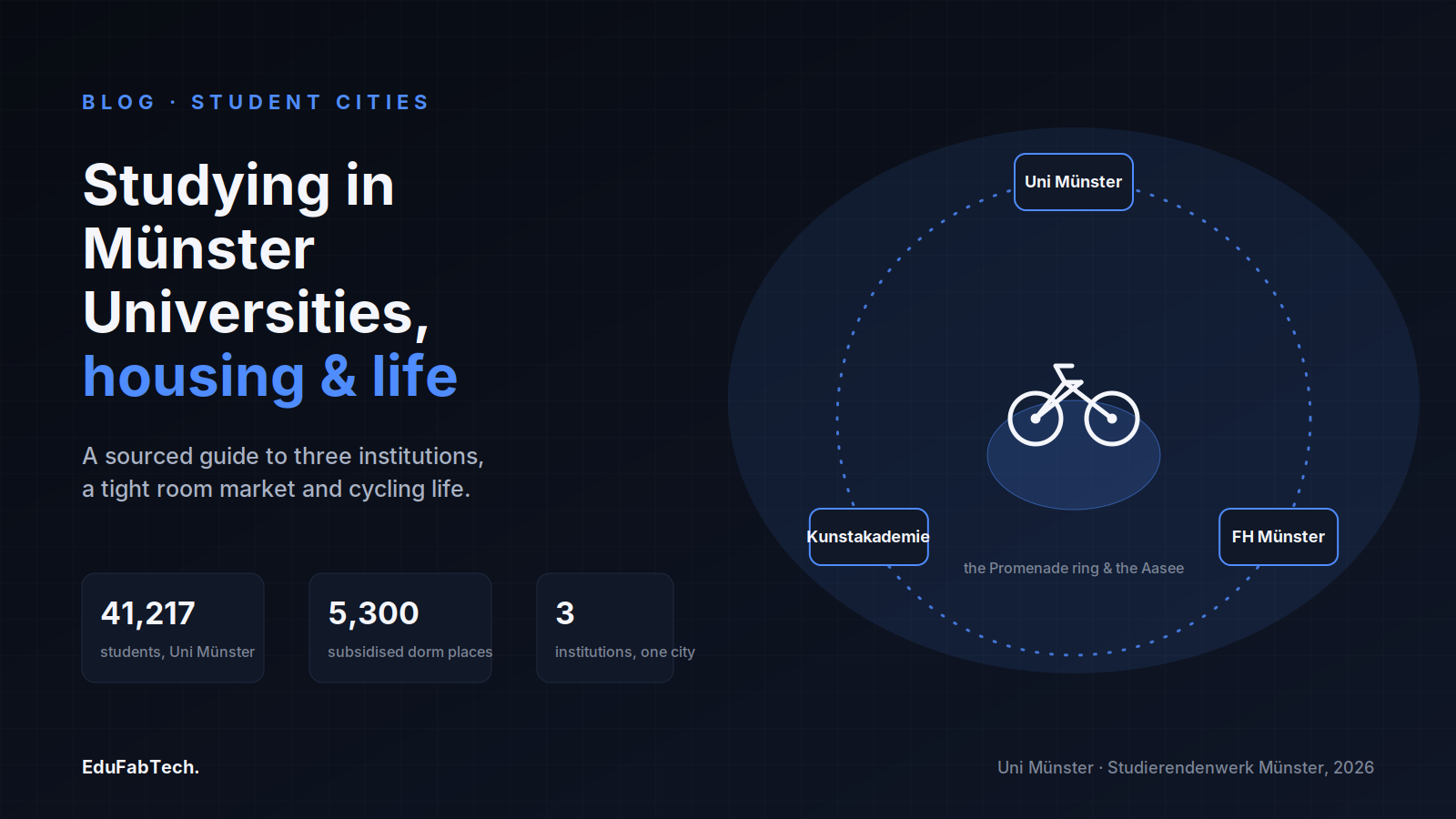
Münster sits in the flat, green Münsterland in the north-west of Germany, in the state of North Rhine-Westphalia, a city of roughly 300,000 people built around a gabled market street, the Prinzipalmarkt, and the brick cathedral on the Domplatz. A tree-lined ring road closed to cars, the Promenade, follows the line of the old fortifications and loops the historic core; just beyond it lies the Aasee, the lake where students run, row and sit out the first warm evenings of the year. The thing a newcomer notices within an hour is the bicycles. In Münster the bike is called a Leeze, and it is the way most people, students included, actually move.
Unlike a classic campus town, Münster scatters its teaching across the city. The University of Münster has no single campus: its faculties and institutes occupy the baroque Schloss (its main building), the Aa-side science quarters, the hospital district to the west and dozens of buildings in between. FH Münster, the university of applied sciences, runs sites in Münster and in nearby Steinfurt, and shares the Leonardo-Campus in the north of the city, a converted cavalry barracks, with its architecture and design schools. A third, much smaller institution, the Academy of Fine Arts, trains artists in studios on that same Leonardo-Campus.
That spread shapes daily life. Where you live determines which library you default to, how long your commute by bike is, and whether you ever see the students from the other faculties. This guide walks through the institutions, the room search and its traps, furnishing a place cheaply, work rules, study spaces, transport and costs — with the numbers tied to the pages that publish them.
Three institutions, each with its own rhythm
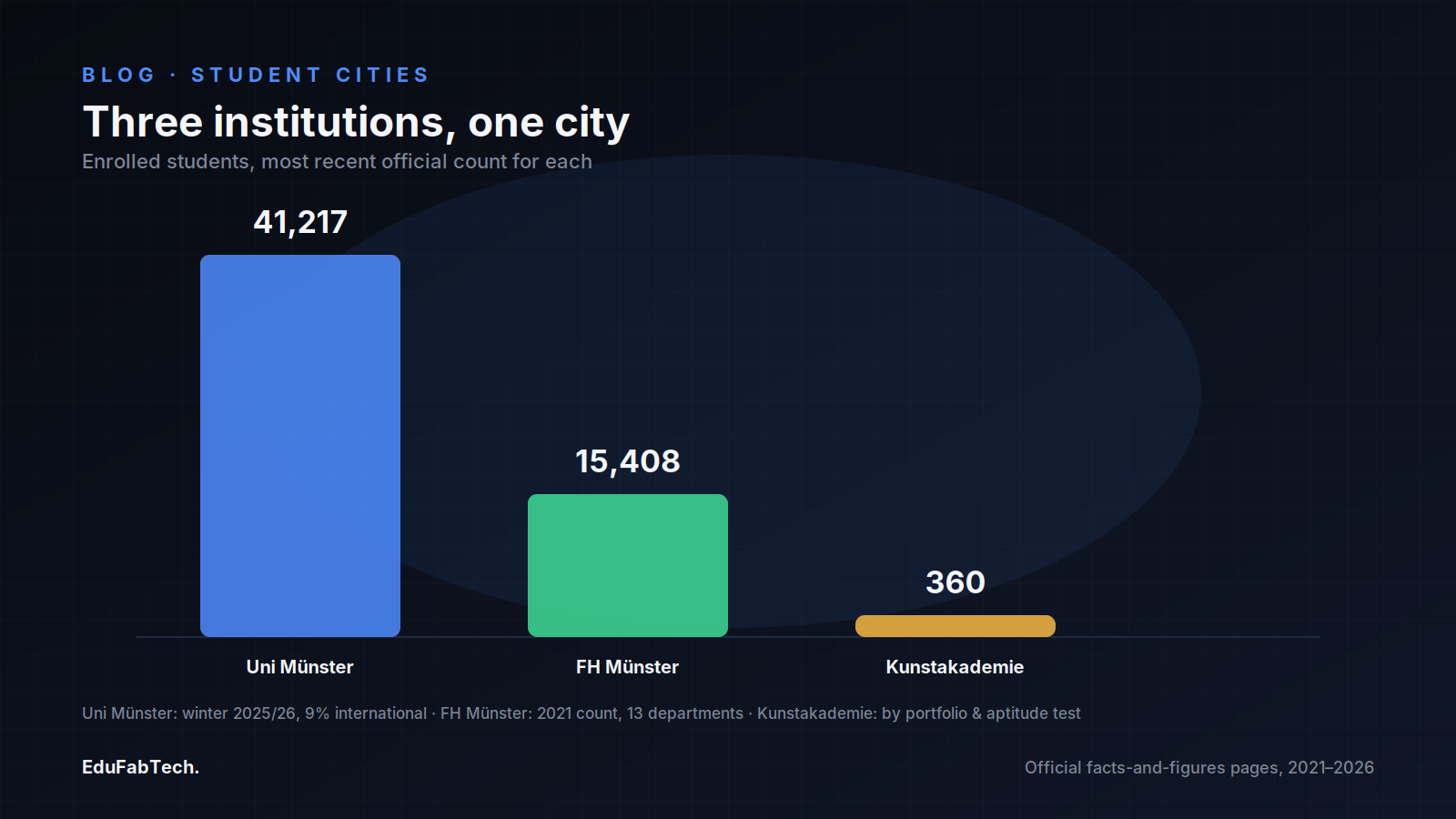
The University of Münster is the large one and the reason the city feels young. On its own facts-and-figures page the university reports 41,217 students in winter semester 2025/26, 8,559 of them first-years, with 9% international students, spread across fifteen faculties. It is a full-spectrum university — law, medicine, the sciences, theology, a well-known School of Business and Economics — and most subjects are taught in German, so a working command of the language matters for day-to-day study even where a programme is in English.
FH Münster is the applied-sciences counterpart, oriented to engineering, business, design, health and social work with a practical, project-based style and strong links to employers. In its 50-year anniversary account the institution counted 15,408 students across 13 departments in 2021, founded in 1971 and divided between its Münster and Steinfurt locations. Its architecture and design schools sit on the Leonardo-Campus, a walkable cluster of old barracks and newer buildings north of the centre that has its own café-and-courtyard student culture.
The Academy of Fine Arts Münster (Kunstakademie Münster) is the small, intense one. Its own pages describe 360 enrolled students split between a Fine Arts course that runs ten semesters and leads to the Akademiebrief (ranked at master's level), and teaching-degree programmes in art. Entry turns on a portfolio and an aptitude test rather than grades, and studios, not lecture halls, are the centre of life there.
You can browse everything EduFabTech lists for the city — rooms, jobs, second-hand goods, events — on the Münster hub, or filter by what is close to a particular institution via the pages for the University of Münster and FH Münster.
Neighbourhoods, and why the room hunt starts early
Because the university is woven through the city, students live all over it. The Kreuzviertel, with its Wilhelmine townhouses just north of the Schloss, is the postcard-pretty and much-wanted quarter; the Hansaviertel east of the station is scruffier, cheaper in parts and the hub of nightlife and left-field culture; the Südviertel and the streets around the Aasee are green and family-ish; and Gievenbeck and Mecklenbeck in the west put you near the science and medical buildings and many of the halls of residence. Nowhere in Münster is far by bike, which widens your options.
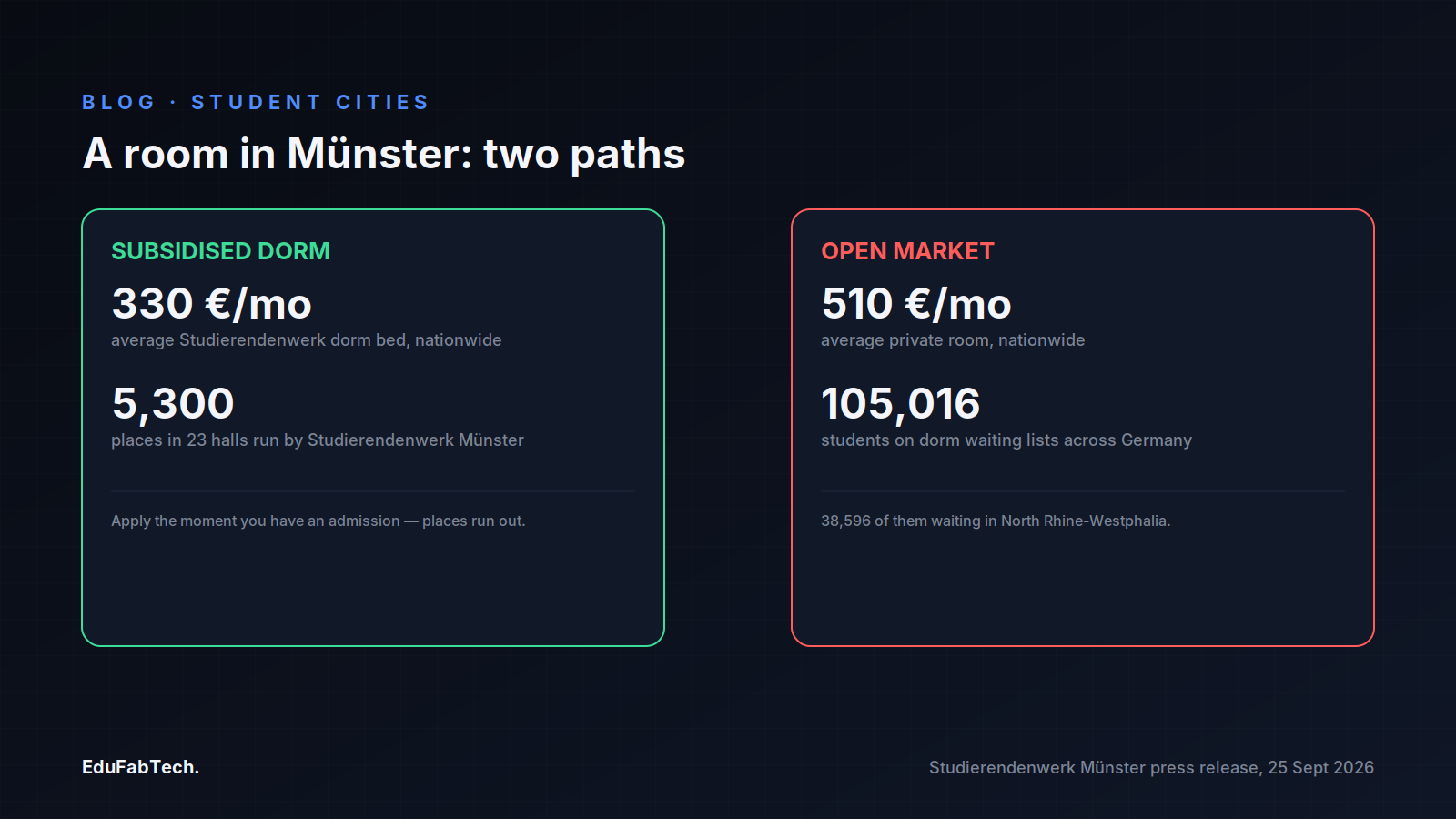
The hard part is supply. The Studierendenwerk Münster, the public body that runs subsidised halls, operates about 5,300 accommodation places in 23 residential complexes — far fewer than the student population, so a hall place means joining a waiting list, ideally the moment you have an admission. Across Germany the squeeze is national: in a press release dated 25 September 2026 the Studierendenwerk reported, citing the Deutsches Studierendenwerk, that 105,016 students were on dormitory waiting lists nationwide, 38,596 of them in North Rhine-Westphalia, with a dorm bed averaging 330 euros against 510 euros for a room on the open market. Most students rent privately in a shared flat, a Wohngemeinschaft or WG.
For a dated local figure you can check against: the Studierendenwerk Münster confirmed no general increase in warm rents as of 1 April 2026, and its Bismarckallee residence lists warm rents of 346.84 to 398.34 euros a month for single rooms of 10 to 19 square metres, utilities, electricity and internet included. That is the floor; private WG rooms in central quarters run higher.
On safety, the scam pattern in Münster is the familiar German one: a listing for an improbably cheap, well-located room from someone who is "abroad" and asks you to transfer a deposit, or send money through a transfer service, to "reserve" it before you can view it. Do not. Normal practice here is to view the room (or have a trusted person view it) and sign a written contract before any money moves; a legitimate deposit (Kaution) is paid after signing and is capped by German law at three months' cold rent. Never send a deposit by bank transfer, gift card or cryptocurrency to hold a room you have not seen. Use channels tied to the institutions — the Studierendenwerk's own application and the AStA student-union housing board — and treat EduFabTech's own Münster rooms listings the same way: see it first, pay after. Start looking well before term; the tightest months are the weeks around the October and April semester starts.
Furnishing a room: the Wochenmarkt, the Promenade flea market and second-hand
An empty German room usually means no kitchen, no wardrobe, sometimes no lamp, so furnishing cheaply is a real task. Münster's calendar helps. The Wochenmarkt on the Domplatz — the city calls it its largest weekly market, with around 150 stalls, open Wednesdays and Saturdays from 7:00 to 14:30 — is where you buy fresh food around the cathedral, and it anchors a weekly routine more than it furnishes a flat.
For the furniture itself, the city's flea-market tradition is the Promenadenflohmarkt, held several times between spring and autumn along the car-free Promenade ring between the Schloss and the Aasee, with a commercial antiques end near the Schlossplatz and a private, bric-a-brac end further along — the place to find a desk, a bike or a bookshelf for a few euros. Out of season, the exchange moves online and to the handover. EduFabTech's city pages collect what students are selling and giving away: second-hand things, used furniture and free stuff (end-of-semester giveaways from departing students are often the single best source of a working kitchen's worth of pots and a half-decent chair).
Working alongside your studies
Many students take a part-time job — in cafés, retail, warehouses, or as a studentische Hilfskraft within a faculty. The rules differ by nationality, and this is a matter to confirm officially rather than to take on trust. The DAAD sets out that students from the EU, Iceland, Liechtenstein, Norway and Switzerland have essentially unrestricted labour-market access, while students from other countries may work 140 full days or 280 half days per year, and that working more than 20 hours a week during term brings social-insurance obligations and can eat into study time. The precise conditions attached to your residence permit are decided by the Ausländerbehörde (foreigners' authority) at the City of Münster, and academic-assistant posts and compulsory internships are treated differently — check your own permit and ask the authority before committing. This is general information, not legal advice. Current openings students are posting locally sit on the Münster jobs page.
Where to actually get work done
The hub for studying is the Universitäts- und Landesbibliothek (ULB), the university and state library. Its central library at Krummer Timpen 3 is open Monday to Friday 8:00–22:00 and weekends 10:00–20:00, with hours trimmed over the summer break and extended in the exam weeks — worth knowing when seats grow scarce in January and July. Beyond it, each faculty keeps its own branch library close to its teaching, so the nearest reading room is usually a short ride away, and cafés around the Hansaviertel and the Leonardo-Campus fill with laptops. EduFabTech also keeps a running list of bookable desks and quiet corners on the Münster study-spaces page.
Getting around: the Leeze and the semester ticket
Münster earns its nickname. The City of Münster reports more than 400,000 bicycles among roughly 310,000 residents and around 4,500 kilometres of signposted cycle routes, with the Promenade functioning as a car-free ring through which cyclists pass freely. The terrain is flat, the distances short, and a reliable second-hand bike plus good lights and a solid lock is the single best transport investment you can make here. Register nothing, insure little — but lock well, because bike theft is the city's commonplace crime.
For everything a bike cannot do, there is the semester ticket, now a nationwide Deutschland-Semesterticket. The University of Münster's fee page puts the total semester contribution for winter 2026/27 at 369.50 euros, of which 226.80 euros is the semester ticket and 119.77 euros funds the Studierendenwerk; the ticket is valid on regional public transport across Germany, not just in Münster. The student union, AStA, has publicly criticised the rising cost: in a statement it noted students would pay 208.80 euros per semester from winter 2025/26, an increase it put at over 18%, driven by the national Deutschlandticket price going up rather than by any local decision.
What is good, and what is hard
The good is real and specific. Münster is compact, safe-feeling and genuinely cyclable, so you are rarely more than fifteen minutes from the Schloss, the lake or a seminar. The old town is handsome, the market and lake give the week a shape, and a student body in the tens of thousands keeps bars, sport and culture alive year-round. Distances being short, the cost and friction of commuting are low once you have a bike.
The hard is equally concrete. Housing is the chronic problem: the gap between roughly 5,300 subsidised hall places and 41,000-plus university students alone means long waits and a competitive private market, as the Studierendenwerk's own waiting-list figures show. Teaching is predominantly in German, which can isolate newcomers who arrive with little. And then there is the weather — the Münsterland is flat, grey and wet for long stretches, and the local shorthand for it, Schietwetter, is affectionate but earned. Waterproofs, not an umbrella, are what you cycle in.
A checklist for the first weeks
- As soon as you are admitted, apply to the Studierendenwerk Münster for a hall place and start the private search in parallel — do not wait for one to decide the other.
- Never pay a deposit before you (or someone you trust) have seen the room and signed a contract; a legal deposit is capped at three months' cold rent and paid after signing, never by gift card or crypto.
- Pay the semester contribution and collect your Deutschland-Semesterticket before you need to travel — it covers regional transport nationwide.
- Register your address (Anmeldung) at the city's residents' office within the deadline, and, if you are an international student, confirm your exact work conditions with the Ausländerbehörde rather than assuming the 140-day rule applies to you.
- Buy a decent second-hand bike, strong lights and a good lock in your first week; furnish from the Promenadenflohmarkt and end-of-semester giveaways rather than new.
- Find your nearest faculty library and the ULB's exam-period hours before the January or July crunch, and check the Münster events page for orientation week.
A quick question for readers
Do you work part-time while you study?
Many students work to pay the bills. See how common it is — and how many hours people really do.
Pick an answer, create a free account in a minute, and your vote counts. Already a member? Sign in
Comments 2
Comment-
The transport math here is the soft spot: 369.50 euros total, split into 226.80 for the ticket and 119.77 to the Studierendenwerk. Fine, tha…
-
The number that wants checking is AStA's 'over 18%' claim - we're told students paid 208.80 euros from winter 2025/26, but the piece never s…
Join free to read the full comments and reply Comments are between members; an account takes a minute.
Source: University of Münster
Sources (5)
- University of Münster. Facts and figures. University of Münster, 2026. uni-muenster.de ↗ · checked 15 Nov 2026
- Studierendenwerk Münster. Housing shortage: about 105,000 students are waiting for a spot in a dorm. Studierendenwerk Münster / Deutsches Studierendenwerk, 2026. stw-muenster.de ↗ · checked 15 Nov 2026
- University of Münster. Semester fee (Semesterbeitrag) winter semester 2026/27. University of Münster, 2026. uni-muenster.de ↗ · checked 15 Nov 2026
- Stadt Münster. Fahrradstadt Münster. City of Münster, 2026. stadt-muenster.de ↗ · checked 15 Nov 2026
- DAAD. Side jobs. Deutscher Akademischer Austauschdienst, 2026. daad.de ↗ · checked 15 Nov 2026