Studying in Murray, Kentucky: Murray State University, housing and student life
A practical guide to living and studying in Murray, Kentucky — the Racers' campus, where students find rooms, what housing and attendance cost in 2026-2027, and how to get around a town of about 18,000.
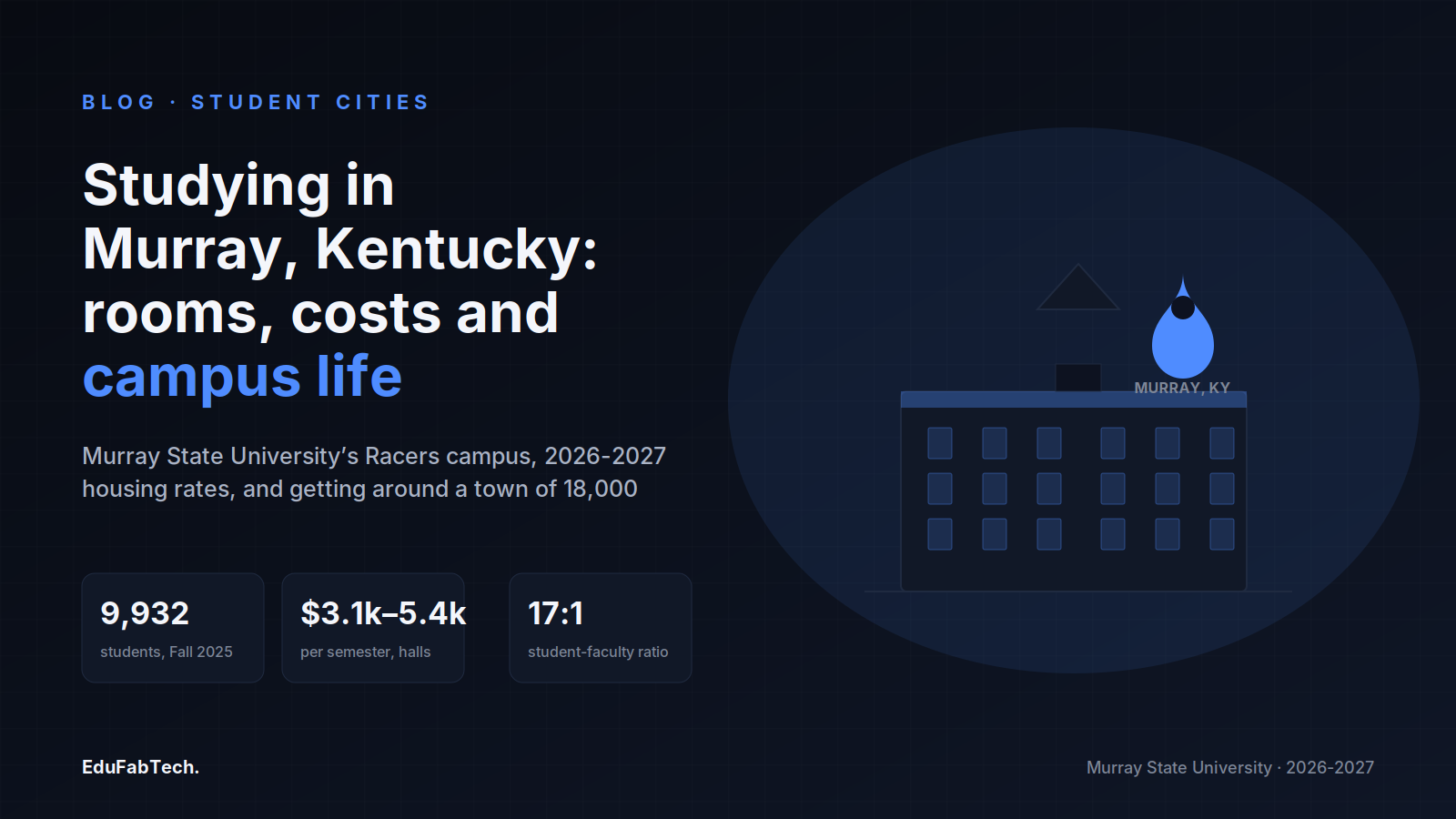
Murray sits at the far western end of Kentucky, in the flat farming country of the Jackson Purchase, about seven miles north of the Tennessee line. According to Murray State University's page about the city, the town has roughly 20,000 residents and lies 118 miles from Nashville and 166 miles from Memphis, with the Land Between the Lakes National Recreation Area about 20 miles away. The US Census Bureau's 2024 American Community Survey five-year estimates, as published by Census Reporter, put the city's population at 18,080. Either way, this is a small place, and almost everything that makes it a student town is folded into a few square miles around one campus.
That campus belongs to Murray State University, and the relationship runs deep enough that it is hard to describe the town without it. Murray State's quick-facts page records a founding year of 1922 and a total enrolment of 9,932 in autumn 2025 — 8,217 undergraduates and 1,715 graduate students — drawn from 60 countries, 49 states and 116 of Kentucky's counties, with 62% of students coming from within the state. For a university this size that international spread is unusually wide, and it shapes who you meet in a residence-hall kitchen.
If you are weighing Murray against other small American college towns, the useful questions are concrete: where will you sleep, what will it cost, how will you get around without a car, and what is genuinely harder here than the brochures admit. This guide works through those, with every figure tied to the page it came from. You can also browse current student listings for Murray on EduFabTech as you read.
Murray State University and what studying there is like
Murray State's main campus is a compact spread of Georgian-style brick buildings and tree-lined walks, and teaching is organised into six colleges, named on the quick-facts page as the Arthur J. Bauernfeind College of Business; the College of Education and Human Services; the College of Humanities and Fine Arts; the Hutson College of Agriculture; the Jesse D. Jones College of Science, Engineering and Technology; and the College of Nursing and Health Sciences. The same page lists 60 bachelor's programmes and three doctoral programmes, an average undergraduate class of 18 students and a student-to-faculty ratio of 17 to 1. Agriculture and the health sciences are among the fields the university puts forward most prominently, reflecting the farming region around it.
One feature sets Murray State apart from most public universities its size: a residential-college system. The quick-facts page records eight residential colleges on campus, and students are assigned to one much as at a few older universities elsewhere — a structure meant to give a large-feeling institution a smaller unit to belong to. The sports teams are the Racers, the colours navy and gold, and the university describes the town around it in warm terms, noting on its city page that Murray has been named a "friendliest small town" by Rand McNally and USA Today and listed among the nation's Top 50 Safe College Towns by SafeWise.
Where students live, from the halls outward
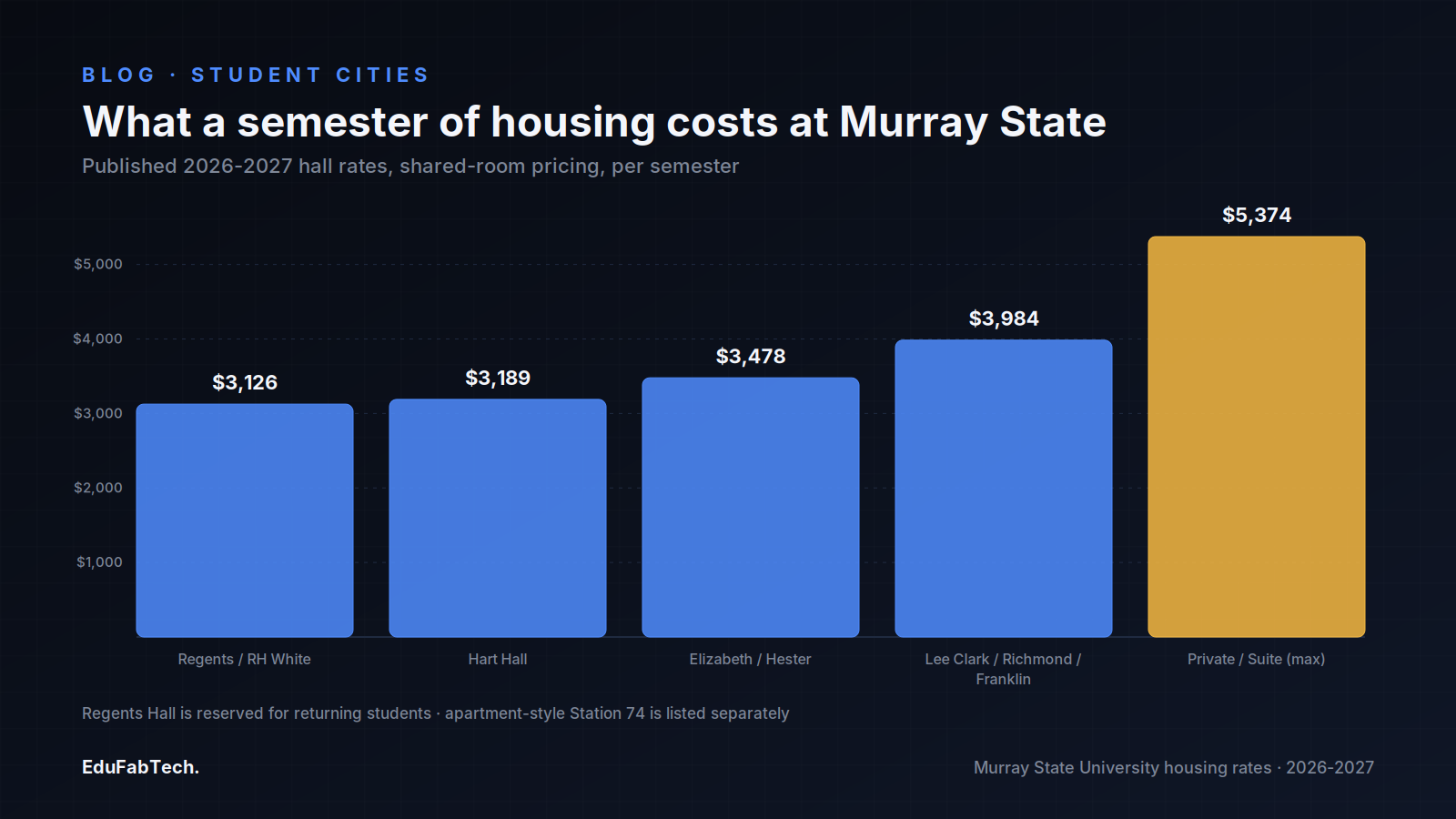
Most first-year students live on campus, and Murray State publishes its rates openly. The university's 2026-2027 housing rates page lists Regents Hall and RH White Hall at $3,126 per semester for a shared room, Hart Hall at $3,189, Elizabeth and Hester halls at $3,478, and Lee Clark, JH Richmond and HC Franklin halls at $3,984 per semester — with private and suite options rising toward $5,374. Regents Hall, the page notes, is reserved for returning students. Apartment-style units at the Station 74 complex are listed separately on the same page.
Because the town is compact, the practical geography of off-campus living is simple: students who move out of the halls mostly rent houses and small apartment buildings within a short walk or drive of campus, toward the residential streets south and east of the university and out along the main roads. There is no sprawling rental district to learn — the whole rental market is small, which is both a convenience and, as the costs section explains, a constraint.
Finding a room without getting caught out
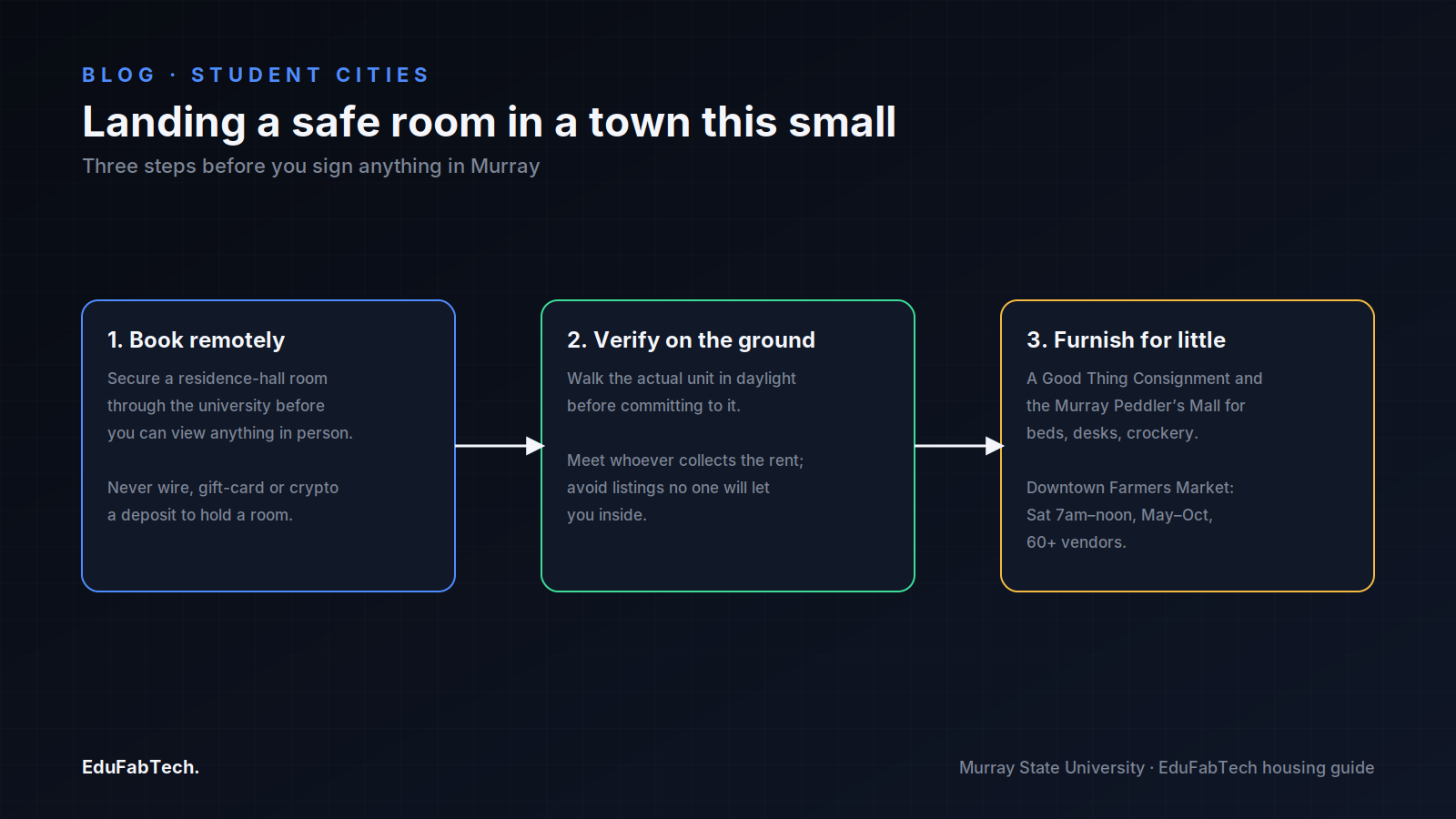
In a town this size, the safest advantage you have is proximity: nearly any room advertised near campus is one you can walk past and see in daylight before you commit. Use that. The common pattern in small college towns is listings that circulate on social-media marketplace groups and off-campus housing boards, and the ones to distrust are those where the person cannot meet you, cannot let you inside, or pushes you to "hold" a place with money before you have seen it. Insist on viewing the actual unit — not a similar one — and on meeting whoever collects the rent.
Never send a deposit by bank wire transfer, gift card or cryptocurrency to reserve a room; no legitimate landlord in Murray needs payment in those forms, and money sent that way cannot be recovered. If you are arriving from abroad before you can view anything, the lower-risk route is to book a residence-hall place through the university first and search for off-campus housing once you are physically in town. EduFabTech keeps a page of rooms and places to stay in Murray, and listings near Murray State University specifically, which you can cross-check against what you see on the ground.
Furnishing a room cheaply: thrift shops and the Saturday market
Murray has an unusually thick second-hand scene for its size, and the local tourism office keeps a guide to it. The Tour Murray thrift guide names, among others, Angel's Attic — a charity shop whose sales support Need Line and HOPE Calloway — along with A Good Thing Consignment for second-hand furniture and home décor, Trends N' Treasures for antiques and vintage furniture across 3,000 square feet, the Murray Peddler's Mall, Nik's Piks on the court square, and a Goodwill carrying clothing and furniture. For a student kitting out a first room, A Good Thing Consignment and the Peddler's Mall are the obvious starting points for beds, desks and crockery.
For food and the weekly rhythm of the town, the Downtown Farmers Market is the fixture. Tour Murray's historic-downtown page states that the market runs on the court square every Saturday from May through October, 7 a.m. to noon, with more than 60 vendors most weeks and upwards of 80 at peak in mid-June through July, and a Holiday Farmers Market downtown on the first weekend of December. It is Kentucky Proud–certified and requires craftspeople to handcraft what they sell. EduFabTech also tracks second-hand things, second-hand furniture and items people are giving away free in Murray, which fill the gaps between market days.
Part-time work and the rules for international students
Term-time jobs in Murray cluster on campus and in the shops and restaurants around the square, and for students from abroad the rules matter before the pay does. Murray State's international student employment page states that F-1 visa holders may take on-campus employment for a maximum of 20 hours per week while classes are in session, and up to 40 hours per week during university vacation periods, and that international students may work off campus only with the permission of the US Department of Homeland Security. The same page cautions that work-study positions cannot be guaranteed and should not be relied on as a source of financial support.
That is the authoritative word for your situation, and it is the one to follow — this guide is not legal advice, and the conditions attached to any visa are set by the issuing authority, not by an employer or a landlord. If you are eligible for off-campus training such as Curricular Practical Training, the university's designated school officials handle the paperwork; start with the international office rather than acting on a recruiter's assurances. For what is actually being advertised locally, EduFabTech lists jobs and part-time work in Murray.
Libraries and places to study
The academic heart of studying here is Waterfield Library on campus. Its study-room page states that the library has 10 study rooms, all on the upper floor, checked out at the circulation desk with a student ID for a maximum of four hours, with the upper level kept as a quiet zone. Beyond the bookable rooms, the library has levels for quiet and for collaborative work, plus computers and printing — the standard refuge for essay weeks.
Off campus, the Calloway County Public Library at 710 Main Street gives you a second, non-university place to read and work downtown, within walking distance of the square and its cafés. Between the two you have a genuine choice of atmospheres, which matters more than it sounds when a single reading room starts to feel like a cage in exam season. EduFabTech also collects study spaces and desks in Murray for when you want somewhere new.
Getting around without a car
Murray is walkable at its centre — campus, the square and much of the near-campus rental housing sit close together — but it is a rural town, and a car is the regional default. The public option is the Murray-Calloway Transit Authority. Its services-and-pricing page lists a Gold Route serving Murray State that runs only while the university is in session, 7 a.m. to 5 p.m. Monday to Friday, at $1.00 per ride or $125 for an unlimited pass per semester; a Community Route at $1.00; and an on-demand service at $2 for a city ride and $4 for a county ride. The authority also lists shared rides out to Paducah at $20 per person each way. That page carries no update date, so confirm the current fare before you rely on it.
For most students the honest summary is that the Gold Route and a bicycle will cover a term-time week around campus and downtown, while anything beyond the town — a trip to Paducah, a grocery run to the edge of town, a visit to Land Between the Lakes — is easier with a car or a lift from someone who has one.
What it costs, and the honest trade-offs
The sticker figures are published. Murray State's 2026-2027 undergraduate tuition page lists full-time tuition at $5,265 per semester for Kentucky residents and $7,995 for non-residents, with a regional rate of $5,544 for students from 15 named nearby states. The same page gives an annual estimated cost of attendance — tuition, fees, housing, food, books, transport and personal expenses — of $27,809 for a Kentucky resident, $28,367 for a regional student and $33,269 for a non-resident, which is the band most international students fall into. Set the residence-hall figures above alongside these when you budget.
The town's own economics are worth reading plainly. The 2024 ACS five-year estimates via Census Reporter put the median household income in Murray at $44,091 and the share of people below the poverty line at 24.1% — a figure that reflects, in part, a resident population heavy with students on low or no income. For a student, the upside of a low-cost rural market is real: rents and everyday prices are modest by the standards of a big American city, and the second-hand scene stretches a budget further.
The hard side is the flip of the same coin. The rental market is small, so good off-campus rooms near campus go quickly and choice is thin; a rural town means limited public transport and a near-assumption that you have a car; and the quiet that makes Murray restful can read as isolation if you are used to a city, with the nearest large ones — Nashville, Memphis — a drive of two hours or more away. Western Kentucky summers are hot and humid and winters can turn sharply cold. None of this is hidden, and none of it is a dealbreaker; it is simply what trading a metropolis for a friendly, inexpensive, self-contained college town actually involves.
A short checklist for your first weeks
- Sort housing before anything irreversible. If you are arriving from abroad, book a residence-hall place through Murray State first and view any off-campus room in person — the real unit — before paying; never wire a deposit or pay in gift cards or crypto to hold a place.
- Get your transport settled. Check the current Gold Route fare with the Murray-Calloway Transit Authority and decide early whether you need a bicycle or access to a car.
- Furnish from second-hand first. Hit the Peddler's Mall, A Good Thing Consignment and the Saturday Downtown Farmers Market before buying anything new; check EduFabTech's furniture and free-stuff pages.
- If you are on an F-1 visa, talk to the international office before you take any job. The employment rules are the binding word — the 20-hour in-session limit is not negotiable with an employer.
- Find your two study spots. Learn Waterfield Library's study-room system and keep the Calloway County Public Library as a downtown alternative.
- Use the town's calendar. Keep an eye on what's on in Murray — in a small place, the events are how you meet people.
A quick question for readers
Do you work part-time while you study?
Many students work to pay the bills. See how common it is — and how many hours people really do.
Pick an answer, create a free account in a minute, and your vote counts. Already a member? Sign in
Comments 2
Comment-
The detail that would stop me before the fare itself is the line admitting the transit page "carries no update date." You're building a tran…
-
The number that'd actually worry me isn't housing, it's the 24.1% poverty rate alongside a $44,091 median household income - and the article…
Join free to read the full comments and reply Comments are between members; an account takes a minute.
Source: Murray State University
Sources (5)
- Murray State University. Mission and Quick Facts. Murray State University, 2026. murraystate.edu ↗ · checked 3 Nov 2026
- Murray State University. Housing Rates 2026-2027. Murray State University, 2026. murraystate.edu ↗ · checked 3 Nov 2026
- Murray State University. International Student Employment. Murray State University, 2026. murraystate.edu ↗ · checked 3 Nov 2026
- Murray-Calloway Transit Authority. Services and Pricing. Murray-Calloway Transit Authority, 2026. murraytransit.com ↗ · checked 3 Nov 2026
- US Census Bureau (via Census Reporter). Murray, KY — ACS 2024 5-year estimates. Census Reporter, 2024. censusreporter.org ↗ · checked 3 Nov 2026