Studying in Nashville: universities, housing and student life
A practical, sourced guide to Nashville's universities, where students live, what a room costs, the bus system, markets and the honest trade-offs of a fast-growing city.
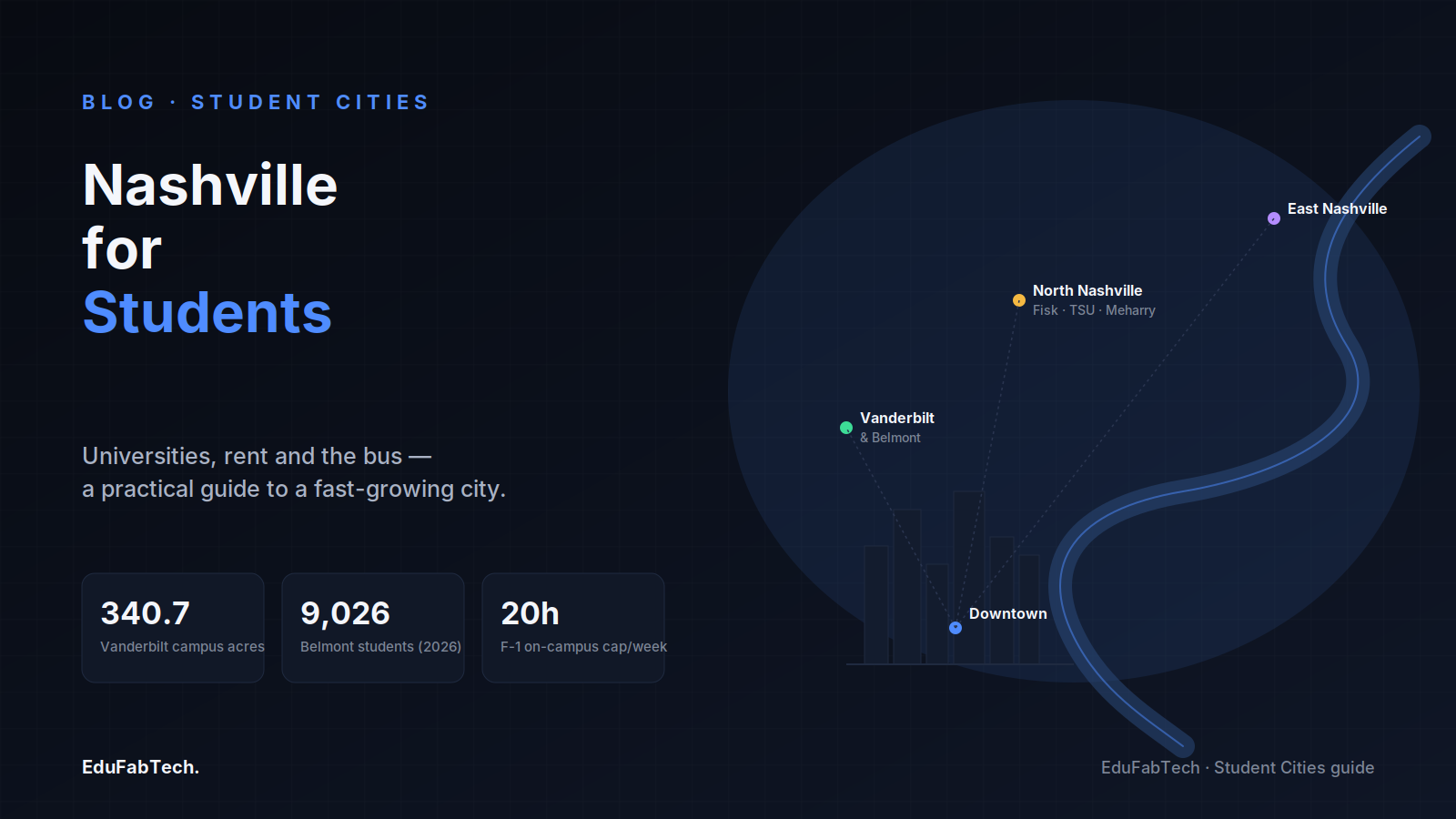
Nashville is the capital of Tennessee and sits on a bend of the Cumberland River, which loops through the middle of the city and separates downtown from the East Nashville neighbourhoods. It is best known abroad for music — the honky-tonks on Lower Broadway, the recording studios clustered along Music Row — but for a student the more relevant fact is that the metropolitan area has been one of the fastest-growing in the United States for a decade, and rents, traffic and construction have grown with it. The city and county share a single consolidated government, Metropolitan Nashville–Davidson County, so places that feel like separate towns (Madison, Antioch, The Nations) are legally part of Nashville.
That growth shapes student life more than any single campus does. Nashville has a strong cluster of universities within a few kilometres of each other, a thin but improving bus network, and a housing market that has tightened sharply. If you are arriving from abroad, the practical questions — where to live, what a room costs, whether you can work — have answers that are specific to this city.
The universities you can study at in Nashville
Vanderbilt University is the largest and most research-intensive. Its own Quick Facts page (accessed 2026) describes a 340.7-acre campus about 1.5 miles from downtown — an accredited arboretum — with 12 schools and colleges, more than 7,300 undergraduates and more than 6,200 graduate and professional students, and an 8:1 student–faculty ratio. The same page states that 80% of students live on campus for all four years, which matters when you weigh dormitory life against renting nearby. Vanderbilt is a semester-based, residential university; its graduate schools include the well-regarded Vanderbilt University School of Nursing, one of the 12 schools counted above, which grants master's and doctoral nursing degrees.
Tennessee State University is the city's public option — Tennessee's only state-funded historically Black university and, as its official history records, a land-grant institution founded in 1912. It runs two sites: a roughly 500-acre main campus in a residential part of North Nashville along the Cumberland River, and the downtown Avon Williams campus near the government and business district, which is where many evening and graduate classes meet. Fisk University, a private historically Black liberal-arts university a few streets away, describes itself on its About page as the oldest institution of higher learning in Nashville, a five-minute drive from downtown, and the home of the Fisk Jubilee Singers. North Nashville's Jefferson Street corridor ties Fisk, TSU and the medical campus together as a historically Black educational district.
Belmont University sits south of downtown, one block from Music Row — the connection is deliberate, and its Mike Curb College of Entertainment & Music Business is built around that neighbourhood of labels and studios. Belmont announced that enrollment reached 9,026 students as fall 2026 classes began, its largest first-day total, with an incoming class of 1,827 students from 50 states and 17 countries and 46% from Tennessee. It is a private Christian university; if faith-based campus culture matters to you either way, it is worth knowing in advance.
Two specialist institutions round out the list. Meharry Medical College School of Dentistry, in North Nashville, grants the Doctor of Dental Surgery (DDS); its address and degree are confirmed on the American Dental Education Association programme listing. The Middle Tennessee School of Anesthesia, in the Madison area of northern Nashville, is a graduate school dedicated solely to nurse-anesthesia education and grants the Doctor of Nurse Anesthesia Practice (DNAP), per its academics page.
The neighbourhoods students choose
Nashville is spread out and built around an interstate loop, so where you live mostly determines whether you need a car. These are the areas students gravitate to, roughly from the Vanderbilt–Belmont side outward.
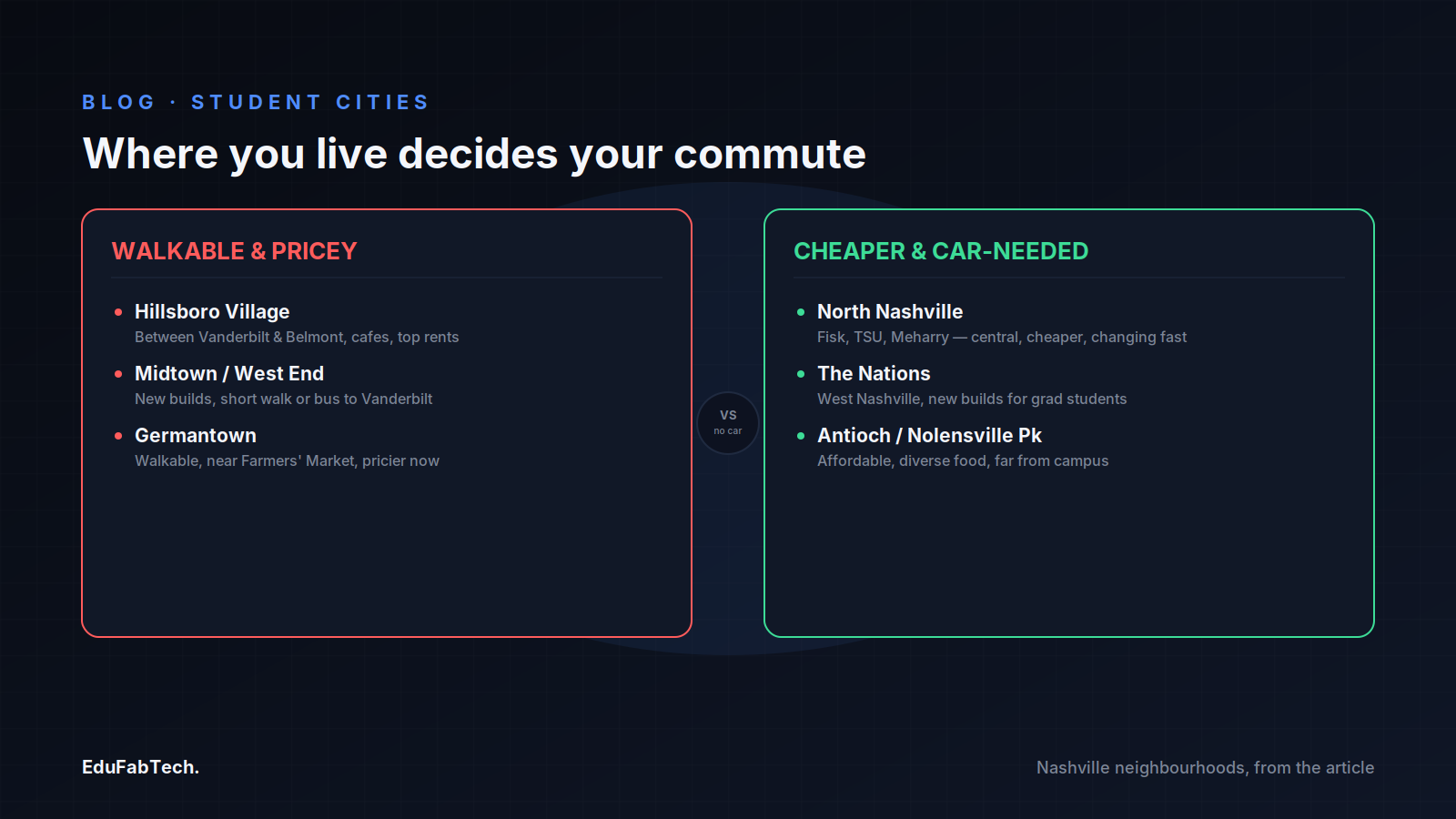
Hillsboro Village and Belmont–Hillsboro sit between the Vanderbilt and Belmont campuses — walkable, full of cafés and small shops, and in constant demand from students, which keeps rents among the highest in the city. If you want to live without a car and attend either university, this is the obvious choice and you will pay for it. Midtown and West End, immediately north and west of Vanderbilt, are denser, with newer apartment buildings and a short walk or bus ride to campus; convenient and expensive for the same reasons.
North Nashville, along Jefferson Street, is the neighbourhood around Fisk, TSU and Meharry — historically Black, central, and generally cheaper than the Vanderbilt side, though it is changing quickly as new construction pushes in. It is the natural base if you study at any of those three. Germantown, just north of downtown and home to the Nashville Farmers' Market, is compact and walkable but has become one of the pricier close-in districts.
East Nashville, across the Cumberland River, is the city's artistic, independent-minded quarter and popular with graduate students and younger renters; it is close to downtown but a longer and less direct trip to Vanderbilt. The Nations, a former industrial area in West Nashville, has filled with new townhouses and apartments aimed at young professionals and graduate students. Further out, Antioch and South Nashville along Nolensville Pike are more affordable and more diverse — with large immigrant communities and good, cheap food — but car-dependent and far from campus. Listings near the main campuses are gathered at Vanderbilt, Tennessee State and Fisk.
Renting a room, and the scams to watch for in Nashville
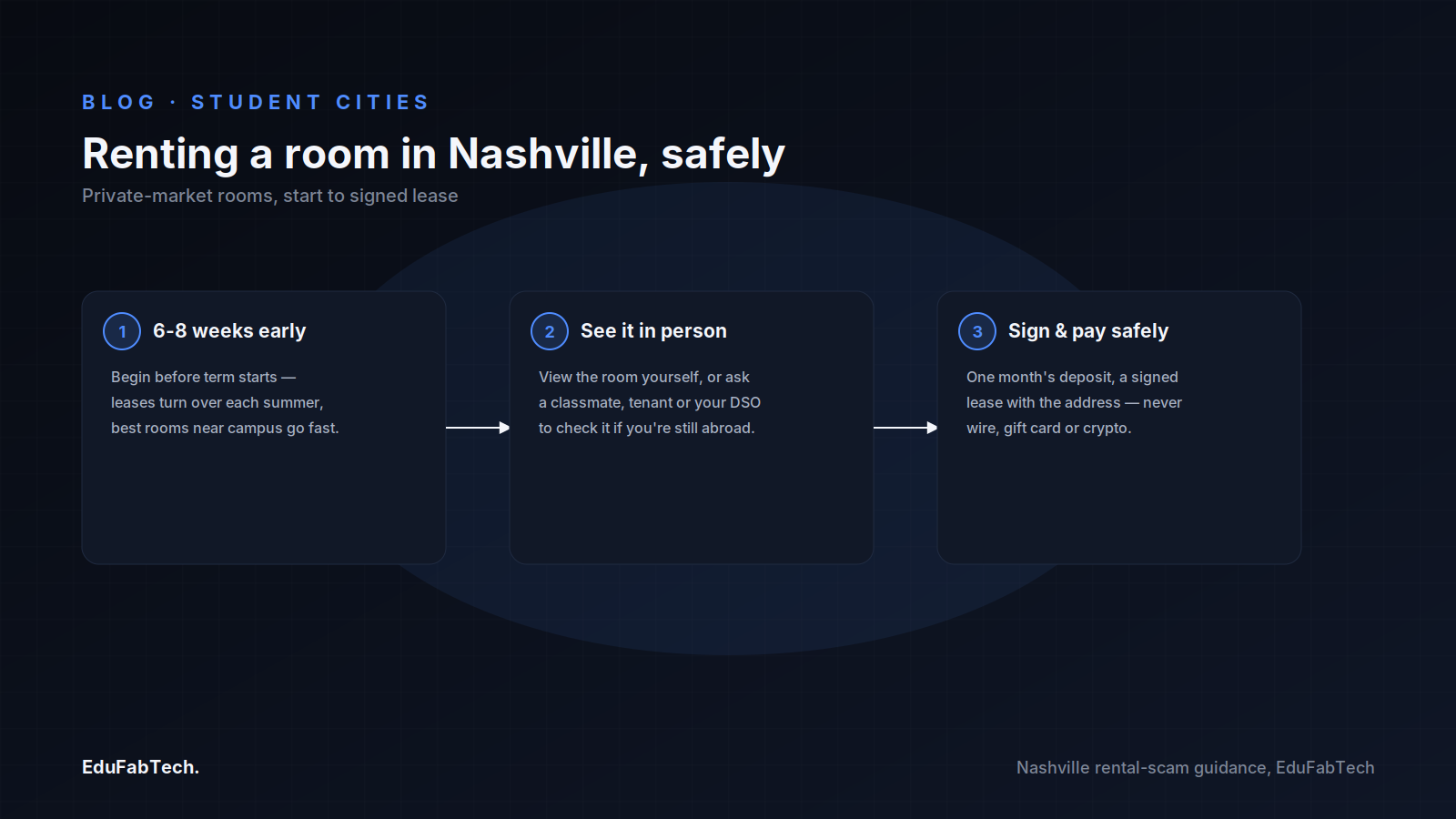
If you want university housing, apply as early as the portal opens; at Vanderbilt in particular, with most undergraduates living on campus, demand is heavy. For the private market, start looking six to eight weeks before term — Nashville's rental turnover peaks in summer as the old lease year ends, and the best shared rooms near Hillsboro Village and North Nashville go quickly. A deposit of one month's rent, sometimes plus a separate application fee, is normal here; be wary of anyone asking for several months up front to "hold" a place.
Rental scams in Nashville follow a predictable pattern: listings copied from real for-sale homes in desirable areas like East Nashville or Germantown, offered below market by someone who claims to be travelling or out of state and cannot show the unit in person. The core rule is simple and local: see the actual room, inside, before you pay anything — and if you are still abroad, ask a classmate, a current tenant or your university's housing office to view it for you. Never send a deposit or "holding fee" by bank wire, gift card or cryptocurrency; a legitimate Nashville landlord takes a normal check or card payment and gives you a written, signed lease naming the property address. Confirm who actually owns or manages the building before money changes hands. Student-posted rooms and sublets are at EduFabTech's Nashville rooms page.
Furnishing a room for very little
Nashville has an unusually good low-cost furnishing circuit. The Nashville Flea Market at the Fairgrounds runs on the fourth weekend of nearly every month (the third weekend in December), Friday and Saturday 8 a.m.–5 p.m. and Sunday until 4 p.m. — one of the larger monthly flea markets in the region, and a reliable place for cheap furniture, kitchenware and tools. For food and household basics, the Nashville Farmers' Market at 900 Rosa L. Parks Boulevard in Germantown is open daily and combines farm sheds, a food hall and a garden centre.
Beyond those, the student turnover itself is your best supply line: at the end of each term, departing tenants give away or sell furniture cheaply, especially around the Vanderbilt and Belmont neighbourhoods. EduFabTech's own local board for second-hand things is built for exactly this moment. Buy a mattress new if you can; almost everything else can be found used.
Working while you study
If you are on an F-1 student visa, the rules come from U.S. federal immigration authorities, not the university, and they are strict. According to U.S. Immigration and Customs Enforcement's guidance on F-1 employment, students may work on campus up to 20 hours per week while school is in session and full-time during periods when school is not in session. Off-campus employment — including Curricular Practical Training (CPT) and Optional Practical Training (OPT) — requires authorization, and ICE notes that general off-campus work needs case-by-case approval and, where applicable, an approved employment authorization document before you start. Always speak to your university's Designated School Official (DSO) before taking any job; this guide is not legal advice, and the ICE page is the authority to rely on. Campus jobs in Nashville — dining, libraries, labs, front desks — are the most accessible, and local openings are listed at EduFabTech's Nashville jobs page.
Libraries and places to study
Each campus has its own library: Vanderbilt's Central Library is the largest of the nine libraries in its Jean and Alexander Heard Libraries system, serving the College of Arts and Science, while TSU's Martha M. Brown–Lois H. Daniel Library on the main campus offers about 82,000 square feet of study and research space. For a study spot that belongs to no campus and costs nothing, the Nashville Public Library's Main Library at 615 Church Street downtown has reading rooms and quiet space open to everyone; its branch network spreads across the county.
Getting around
Nashville is a car-oriented city, and that is the single biggest adjustment for students arriving from places with dense transit. The public operator is WeGo Public Transit, and its buses converge on WeGo Central (the Elizabeth Duff Transit Center) downtown. WeGo's fare page lists a two-hour local pass at $2.00, a day pass at $4.00 and a 31-day pass at $65.00; riders aged 19 and younger, seniors 65 and over and others who qualify pay reduced fares — $1.00 for two hours, $2.00 a day and $33.00 a month — after obtaining a Discount ID in person at WeGo Central. The fare page does not list a separate university discount, so budget at the standard adult rate unless your campus runs its own shuttle. Routes are usable for getting between the central campuses and downtown, but service to the outer neighbourhoods thins out in the evenings, which is why many students keep a bike or a car.
Costs, trade-offs, and a first-fortnight checklist
For a concrete, dated housing figure, Vanderbilt's Student Accounts office lists, for 2025–2026, undergraduate housing at $14,760 for the full year and a first- and second-year dining plan at $8,288, alongside tuition of $67,934 — useful as a benchmark even if you rent privately. On the open market, the U.S. Department of Housing and Urban Development's Fair Market Rents for fiscal year 2025, published for the Nashville–Davidson–Murfreesboro–Franklin HUD Metro FMR Area, were $1,589 for a studio, $1,650 for a one-bedroom and $1,827 for a two-bedroom per month (HUD data via RentData.org). Splitting a two-bedroom brings the per-person figure down, which is why shared housing dominates the student market here.
The honest balance: Nashville is a lively, music-soaked, friendly city with a genuine cluster of strong universities close together, no state income tax, and food and culture well beyond its size. Against that, rents have risen steeply with the city's growth, the bus network is limited and car-dependence is real, summers are hot and humid, and spring brings a genuine risk of severe storms and tornadoes. Housing near the best-connected campuses is scarce and competitive. None of that is a reason to stay away — but arrive knowing it, so your budget and your expectations match the city you are moving to.
Your first two weeks in Nashville
- Report to your university's international office or DSO and confirm your enrolment and, if on F-1, your work limits before accepting any job.
- View any room in person — or have someone you trust view it — and sign a written lease naming the address before paying a deposit; never wire money to hold a place.
- Get a Discount ID at WeGo Central if you qualify, and work out your bus route or shuttle between home and campus before term starts.
- Register for a free Nashville Public Library card for study space and resources off campus.
- Plan one weekend around the fourth-weekend Fairgrounds flea market and the Germantown Farmers' Market to furnish and stock your room cheaply.
- Save your campus library hours, your DSO's contact, and a non-emergency transport plan for late nights.
A quick question for readers
Do you work part-time while you study?
Many students work to pay the bills. See how common it is — and how many hours people really do.
Pick an answer, create a free account in a minute, and your vote counts. Already a member? Sign in
Source: Vanderbilt University
Sources (5)
- Vanderbilt University. Quick Facts. Vanderbilt University, 2026. vanderbilt.edu ↗ · checked 4 Oct 2026
- Vanderbilt University Student Accounts. Undergraduate Tuition and Fees 2025–2026. Vanderbilt University, 2025. vanderbilt.edu ↗ · checked 4 Oct 2026
- WeGo Public Transit. Fare & Ticket Information. WeGo Public Transit (Nashville MTA), 2026. wegotransit.com ↗ · checked 4 Oct 2026
- U.S. Immigration and Customs Enforcement. Employment (SEVIS / F-1 students). U.S. Department of Homeland Security, 2026. ice.gov ↗ · checked 4 Oct 2026
- RentData.org. Nashville–Davidson–Murfreesboro–Franklin, TN FY2025 Fair Market Rent (HUD data). U.S. Department of Housing and Urban Development, 2025. rentdata.org ↗ · checked 4 Oct 2026