Studying in New Haven: universities, housing and student life
A practical guide to New Haven's eight nearby universities, where students live, what a room costs, how to get around, and the honest trade-offs of the Elm City.
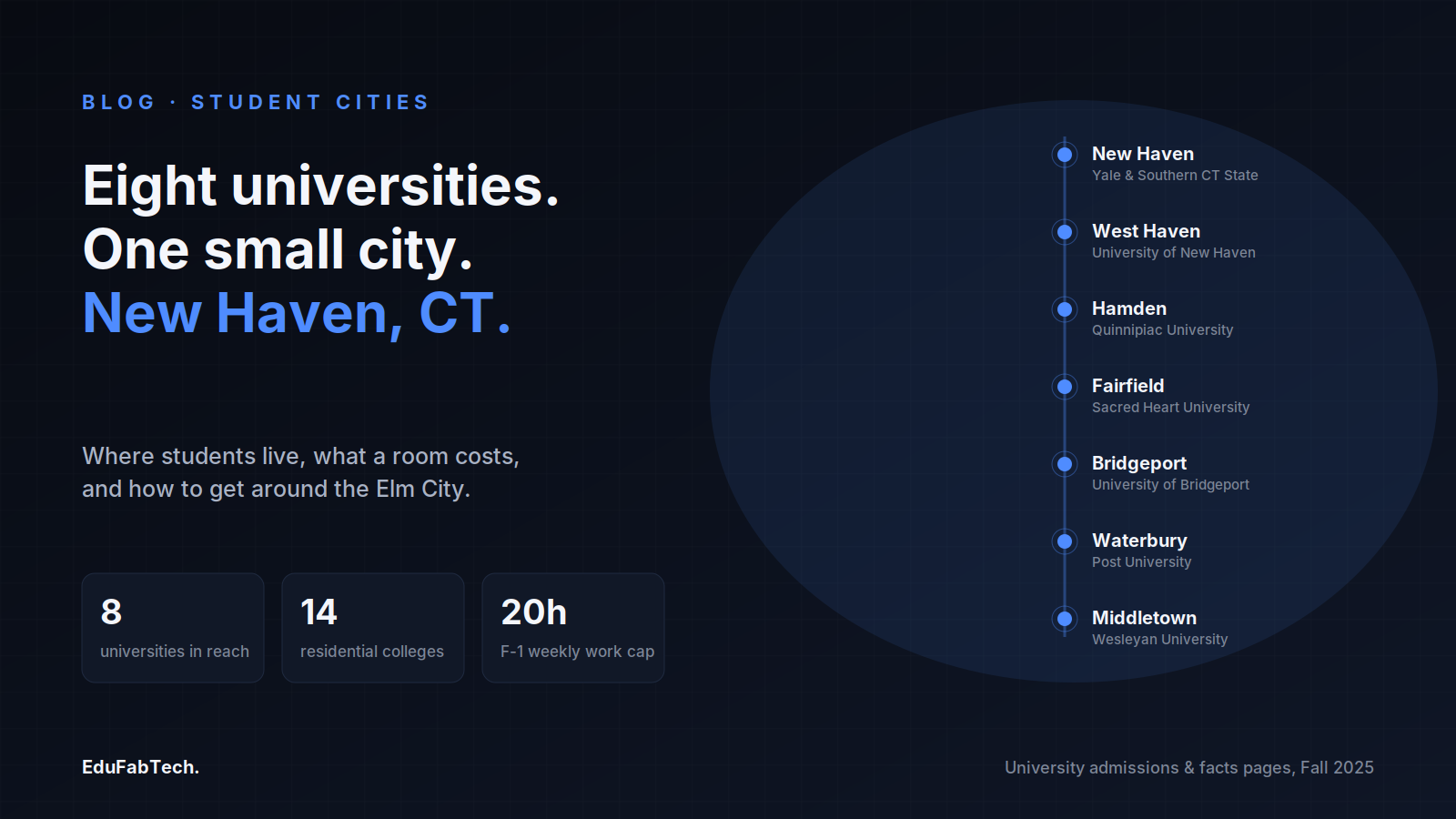
New Haven is a compact port city on Long Island Sound, roughly midway between New York and Boston on the Northeast Corridor rail line, and its downtown is laid out around a seventeenth-century town green rather than a modern grid of towers. It is often called the Elm City, and for a place of its size it carries an unusual density of universities: a short walk, bus ride or regional train connects campuses across several surrounding towns. Yale dominates the skyline and the reputation, but it is far from the only place students study here.
That matters for anyone deciding where to live. A first-year at Yale, a nursing student at Quinnipiac in Hamden, a forensic-science student in West Haven and a teacher-in-training at Southern all share the same bus routes, the same farmers' markets and, often, the same apartment hunt. This guide gathers what is useful and verifiable about studying in New Haven — the institutions, the neighbourhoods, renting safely, furnishing a room, working, studying and getting around — and keeps each number tied to the body that published it. You can also browse current New Haven student listings on EduFabTech as you read.
Eight universities within a short train ride
Yale University anchors the city, its main campus wrapped around the New Haven Green and running north up Prospect Street toward Science Hill. Undergraduates at Yale College are admitted to the college and then assigned to one of fourteen residential colleges — self-contained quadrangles with their own dining hall, library and common rooms — in a system that is now more than eighty years old, as Yale College's residential-colleges page describes. Branford, Davenport, Grace Hopper and Jonathan Edwards are among the older colleges; most first-year students live together on the historic Old Campus quadrangle before moving into their college. Listings close to the university are gathered under near Yale University.
Southern Connecticut State University is the other university inside the city itself, on Crescent Street on the western edge of New Haven; its site gives the address as 501 Crescent Street and describes a public university with more than 200 undergraduate and graduate degree programmes, per Southern's about page. Southern has long been a route into teaching, nursing and public service, and it is a short bus ride from downtown. A few miles south in West Haven, the University of New Haven sits on an 82-acre hillside campus; the university's facts page records a founding in 1920, Fall 2025 enrolment of 4,969 undergraduate and 2,693 graduate students, and schools that include the Henry C. Lee College of Criminal Justice and Forensic Sciences — the programme the university is best known for — according to its facts and figures page.
Ringing the city are four more institutions students often commute to. Quinnipiac University lies just north in Hamden, with its Mount Carmel and York Hill campuses there and a third at North Haven; Quinnipiac's quick-facts page lists 6,610 undergraduates in Fall 2025, and the university is known for health sciences, communications and its polling institute. Sacred Heart University, in Fairfield down the shoreline, reports a 1963 founding and more than 200 programmes serving over 10,000 students on its facts page. Wesleyan University in Middletown, about forty minutes inland, is a selective liberal-arts university founded in 1831 with roughly 3,000 undergraduates, a 7:1 student–faculty ratio and a well-known open curriculum, per Wesleyan's at-a-glance page. University of Bridgeport, founded in 1927 at 126 Park Avenue in Bridgeport, and Post University in Waterbury, founded in 1890 and now teaching both online and on a 58-acre campus, round out the cluster, according to the Bridgeport and Post sites.
The neighbourhoods students pick
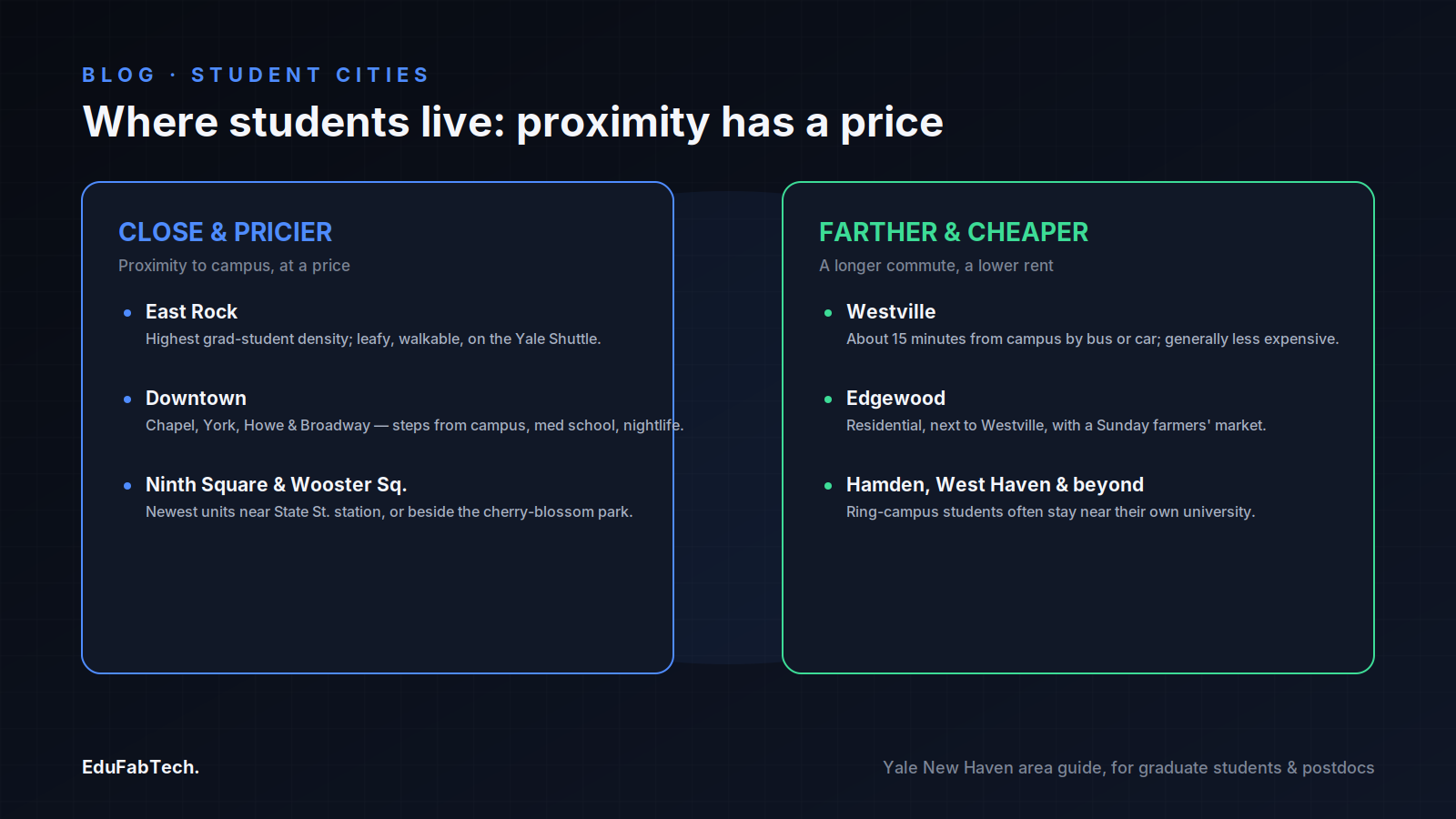
Most students who live off campus concentrate in a handful of areas, and Yale's own guidance for incoming postdocs and graduate students is a reliable map of them. East Rock, running up Orange and State Streets toward Science Hill, holds the highest concentration of graduate students; Yale describes its apartments and multifamily houses as "usually quite nice," with grocers and coffee shops, and notes it sits on the Yale Shuttle line, in the university's New Haven area guide. It is leafy, walkable and the most sought-after — and priced accordingly.
Downtown (the streets around Chapel, York, Howe and Broadway) is popular for its closeness to both the main campus and the School of Medicine, and for having stores, restaurants and nightlife at the door, the same Yale guide notes. Just east, Ninth Square holds the newest housing developments and sits very close to the State Street train station, while Wooster Square — the city's Little Italy, centred on a park famous for its spring cherry blossom and for the Wooster Street pizzerias — is within walking distance of the main campus.
Westville, to the west along Whalley Avenue, is more residential and, Yale notes, generally less expensive, about fifteen minutes from campus by bus or car; the adjacent Edgewood area hosts a Sunday farmers' market. Students at the ring campuses tend to look in their own towns — Hamden for Quinnipiac, West Haven for the University of New Haven — and Yale's guide also lists Woodbridge, Branford and East Haven among the surrounding places people choose when they want more space or a quieter street. In short: East Rock and downtown for proximity and willingness to pay for it, Westville and the outer towns for value and a commute.
Finding and renting a room safely
The New Haven rental calendar is driven by the academic year, and most leases turn over around 1 June and 1 September. For those dates, serious searching starts in late winter and early spring; the best East Rock and downtown apartments are often spoken for months ahead, while rooms can still surface close to the start of term as plans change. University housing offices and each institution's off-campus listing service are the safest first stop, and EduFabTech keeps current rooms and places to stay in New Haven.
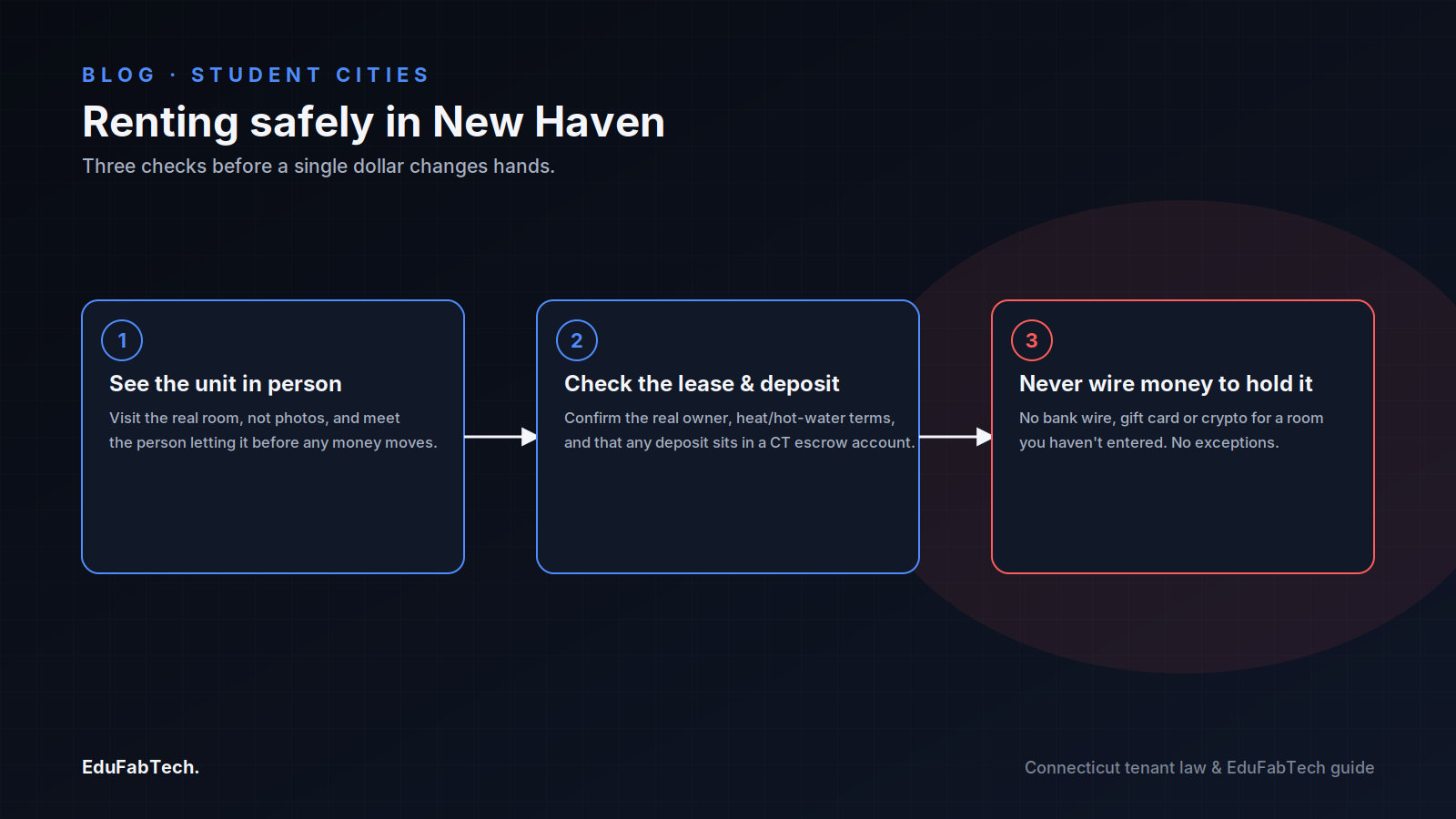
Before any money changes hands, see the actual unit — not photographs — and meet the person letting it, ideally with the current tenants present. In a multifamily city like New Haven, where triple-deckers are split into flats, confirm which floor and which entrance are yours, that heat and hot water arrangements are written down, and that the lease names the real owner. A security deposit is normal here; under Connecticut law a landlord may ask for up to the equivalent of a set number of months' rent and must hold it in an escrow account, so a demand for several months up front, or for the deposit before you have seen the lease, is a warning sign.
Rental scams in the city tend to follow the student calendar: a listing priced suspiciously low for East Rock, an "owner" who is conveniently out of town, and pressure to reserve the room immediately. The defence is simple and absolute — never send a deposit or first month's rent by bank wire, gift card or cryptocurrency to "hold" a place, and never pay anyone you have not met for a room you have not entered. No legitimate New Haven landlord needs money moved in a way that cannot be traced or reversed.
Furnishing a room and the city's markets
Furnishing a room cheaply is easiest at the turn of the lease year, when departing students shed furniture faster than anyone can take it. EduFabTech's local page for second-hand furniture in New Haven is built around exactly that churn, and the end-of-May move-out is the moment to watch.
For food and everyday supplies, New Haven is well served by CitySeed's farmers' markets. CitySeed runs a year-round Wooster Square market on Saturdays at 511 Chapel Street — moving outdoors from spring through late autumn — alongside a Sunday market at Edgewood Park (corner of West Rock and Whalley Avenues) and a Saturday market on Dixwell Avenue, as listed on CitySeed's markets page. They are a practical source of produce and a good way to learn the neighbourhoods on foot.
Working while you study
Rules on paid work depend heavily on immigration status, and international students should treat their university's international-student office as the authority. For students on an F-1 visa, the U.S. government's Study in the States service states that those with active status may work on campus but "may not work more than 20 hours per week when school is in session," and that off-campus work generally requires completing at least one full academic year and separate authorisation, as set out on the Department of Homeland Security's working-in-the-United-States page. The same page warns that unauthorised work carries serious consequences, including loss of status. This is a summary of an official rule, not legal advice: confirm your own case with a Designated School Official before you accept any job. Domestic students face no such cap, and term-time jobs around campus, downtown and in the hospital district are common; EduFabTech lists local part-time work in New Haven.
Libraries and places to read
New Haven is rich in study space. Yale's Sterling Memorial Library and the undergraduate Bass Library are free and open to all during the day, with a Yale ID required for entry after 6 p.m., as the university library's hours page notes; hours vary by day and term, so check before a late visit. Each residential college also keeps its own library and study rooms for its members.
Students without a Yale card are not short of options. The New Haven Free Public Library's Ives Main Library stands on the New Haven Green at 133 Elm Street and, per the library's branch page, opens Monday to Thursday until 8 p.m. and on Fridays and Saturdays until 5 p.m., with study and tech centres inside. Southern, the University of New Haven and Quinnipiac each run their own campus libraries for their students, and EduFabTech collects bookable study spaces and desks in New Haven for the busy periods when everyone wants a seat at once.
Getting around the Elm City and the shoreline
New Haven's local buses are run by CTtransit, and its fares are simple: a two-hour local pass costs $1.75, an all-day pass $3.50 and a 31-day pass $63.00, as listed on CTtransit's fare-options page in 2026. The reloadable Go CT Card applies fare capping so that frequent riders are not overcharged.
Students at several Connecticut public institutions ride free. The U-Pass CT programme gives eligible students unlimited rides on Connecticut buses and trains — including in-state New Haven Line and Shore Line East services — with the cost built into student fees, and CTrides lists Southern Connecticut State University among the participating schools on the U-Pass CT page; check with your own institution about eligibility, which is often limited to full-time students. Yale additionally runs its own shuttle network around campus and the medical district. For longer trips, Union Station puts New Haven on the Northeast Corridor, with regional and intercity trains south to New York and north toward Hartford and Springfield — one reason a campus forty minutes away feels close.
What housing and a term actually cost
On-campus figures are the firmest numbers available. At Southern, for the Fall 2026 and Spring 2027 semesters, a standard double in a residence hall is listed at $4,100 per semester and a standard single at $5,693, with a dining fee of $3,637 per semester for rooms without a kitchen, on Southern's residence-life costs page. At the other end of the scale, Yale set its 2025–26 charge for housing and meals combined at $20,650, within a total term bill of $90,550, according to Yale's own announcement — though Yale also reports that it covers the full cost for students from lower-income families, so sticker prices and what a given student pays can diverge sharply.
Off-campus rents are harder to pin to a single trustworthy citywide figure, and averages drift quickly, so treat any one number with caution and compare current listings instead. What is reliable is the pattern: East Rock and downtown command the highest rents, Westville and the outer towns the lowest, and splitting a triple-decker flat with housemates is the usual way students make the numbers work.
The honest balance, and a checklist for the first weeks
What New Haven does well for students is unusual range in a small, walkable footprint: several universities within one transit network, a genuine downtown rather than a campus strip, cheap and simple bus fares, major research libraries, and a food culture — from the Wooster Street pizzerias to the CitySeed markets — out of proportion to the city's size. The shoreline and the two rock parks are minutes away, and New York is a train ride.
The hard parts are real too. Housing in the desirable neighbourhoods is tight and not cheap, the spring rush rewards those who start early, and the quality of the older multifamily housing stock varies house to house, so inspection matters. Winters are cold and grey, parts of the city feel very different block to block, and students should take ordinary urban precautions after dark. None of this is unusual for a Northeastern city — but it is worth knowing before you sign.
A short checklist for your first weeks
- Register with your university's housing or off-campus office, and your international-student office if you need one, before chasing private listings.
- See any room in person and meet the landlord before paying; never wire a deposit or pay by gift card or crypto to hold a place.
- Pick up a Go CT Card, or confirm whether your institution gives you U-Pass CT, before you start paying cash fares.
- Get a library card at the Ives Main Library on the Green, and learn which campus libraries you can enter.
- Walk East Rock, downtown, Wooster Square and Westville before deciding where you want to live next year.
- Time your furniture hunt to the late-May and early-September move-outs, when the city's second-hand supply peaks.
A quick question for readers
Do you work part-time while you study?
Many students work to pay the bills. See how common it is — and how many hours people really do.
Pick an answer, create a free account in a minute, and your vote counts. Already a member? Sign in
Comments 0
CommentNo comments yet. Members start the conversation.
Source: Southern Connecticut State University
Sources (5)
- Yale College. Residential Colleges. Yale University, 2026. college.yale.edu ↗ · checked 9 Oct 2026
- Southern Connecticut State University. Costs and Eligibility to Live on Campus. Southern Connecticut State University, 2026. inside.southernct.edu ↗ · checked 9 Oct 2026
- CTtransit. Fare Options. Connecticut Department of Transportation, 2026. cttransit.com ↗ · checked 9 Oct 2026
- Study in the States. Working in the United States. U.S. Department of Homeland Security, 2026. studyinthestates.dhs.gov ↗ · checked 9 Oct 2026
- CitySeed. Farmers Markets. CitySeed Inc., 2026. cityseed.org ↗ · checked 9 Oct 2026