Studying in New Orleans: universities, housing and student life
A practical, sourced guide to the universities of New Orleans, the neighbourhoods students rent in, what a room costs, how the streetcars work, and what the city is honestly like to study in.
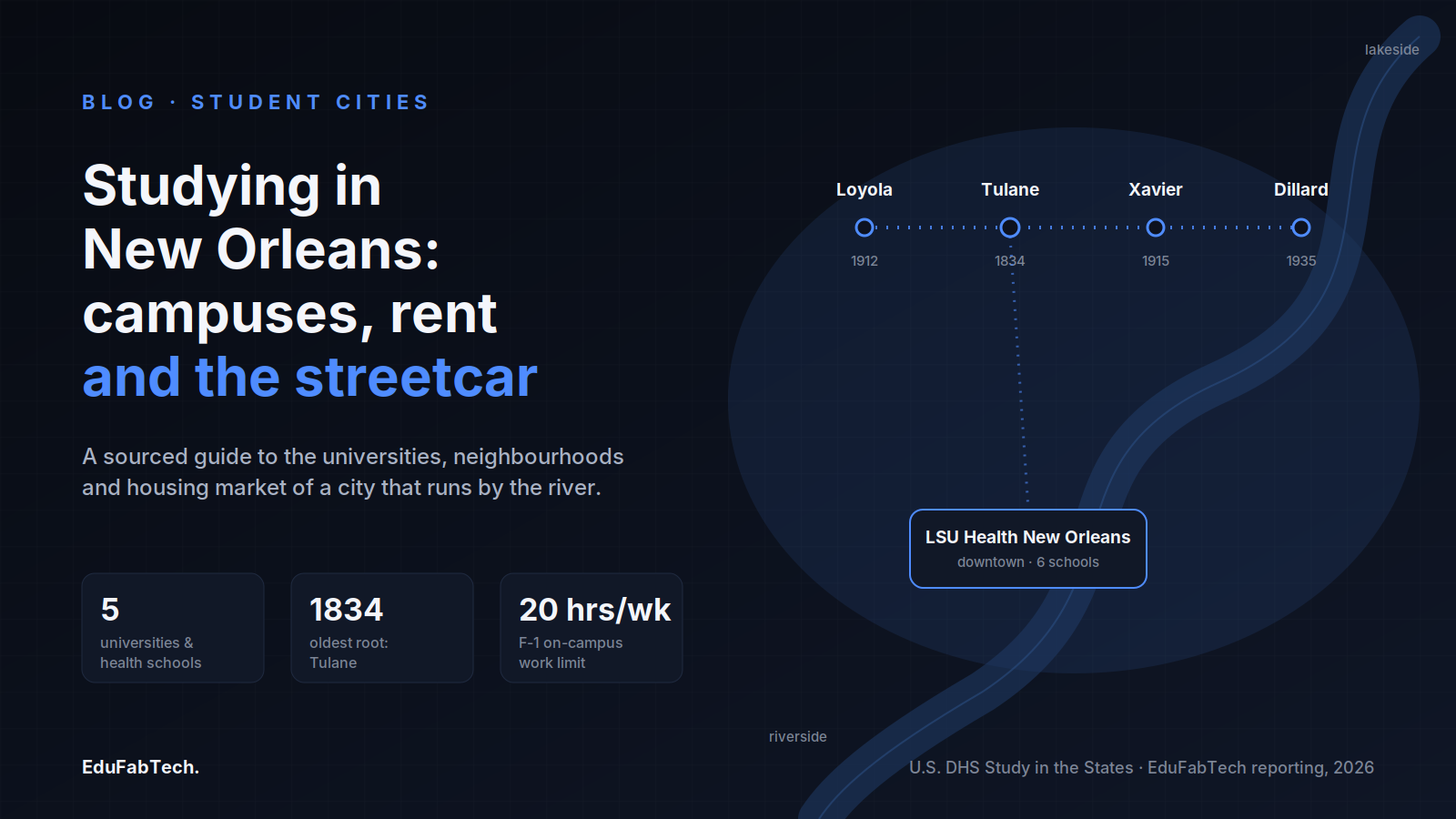
New Orleans does not use compass directions the way most cities do. The Mississippi River bends so sharply around the old city that locals navigate by the river and the lake instead: "Uptown" is upriver, "Downtown" is downriver, "riverside" and "lakeside" replace south and north. Much of the city sits below sea level, drained by pumps, ringed by levees, and laced with streetcar tracks that are older than most of the universities beside them. For a student, this geography is practical: your campus, your room and your streetcar line matter more than any map grid, and crossing the Mississippi to the suburbs of Jefferson Parish is a real commute, not a short hop.
The universities, on the avenue and downtown
The anchor Uptown is Tulane University, which traces its roots to 1834 as the Medical College of Louisiana and now occupies a 110-acre uptown campus at 6823 St. Charles Avenue organised into ten academic divisions. Among them, the Tulane University School of Science and Engineering runs the undergraduate programmes in engineering, mathematics and the physical and life sciences from that same uptown campus (based on the uptown campus off St. Charles). Not every Tulane division is uptown: the Tulane University School of Social Work moved downtown to 127 Elk Place, steps from Canal Street, while the Tulane University School of Architecture and Built Environment expanded to that fuller name in 2025 when its renovated home, Richardson Memorial Hall, reopened uptown. A few blocks along the same avenue, across from Audubon Park, sits Loyola University New Orleans, a Jesuit institution chartered in 1912 at 6363 St. Charles Avenue; the St. Charles streetcar runs directly past both front gates.
The city's two historically Black universities give it a character few American student cities share. Xavier University of Louisiana, on Palmetto Street in the Gert Town area, is the only historically Black and Catholic university in the country, which opened as a preparatory school in 1915 and became a college in 1925; it states that it graduates more African American students who go on to medical school each year than any other university in the United States, and its College of Pharmacy dates to 1927. Dillard University, in the Gentilly neighbourhood, grew from the Depression-era merger of two older institutions — New Orleans University and Straight University — and opened under its current name in 1935, as the university's own history records, with origins reaching back to 1869.
Downtown, near the medical district on Bolivar Street, LSU New Orleans — the academic health sciences centre known as LSU Health New Orleans — trains most of the region's clinicians. It comprises six schools, including medicine, nursing, public health and the Louisiana State University School of Dentistry, the only dental school in the state, and reports graduating 879 new health professionals across those schools in a single year. If you are weighing where in the city to base yourself, the EduFabTech city hub at /in/united-states/new-orleans collects local student listings in one place.
Neighbourhoods students actually settle in
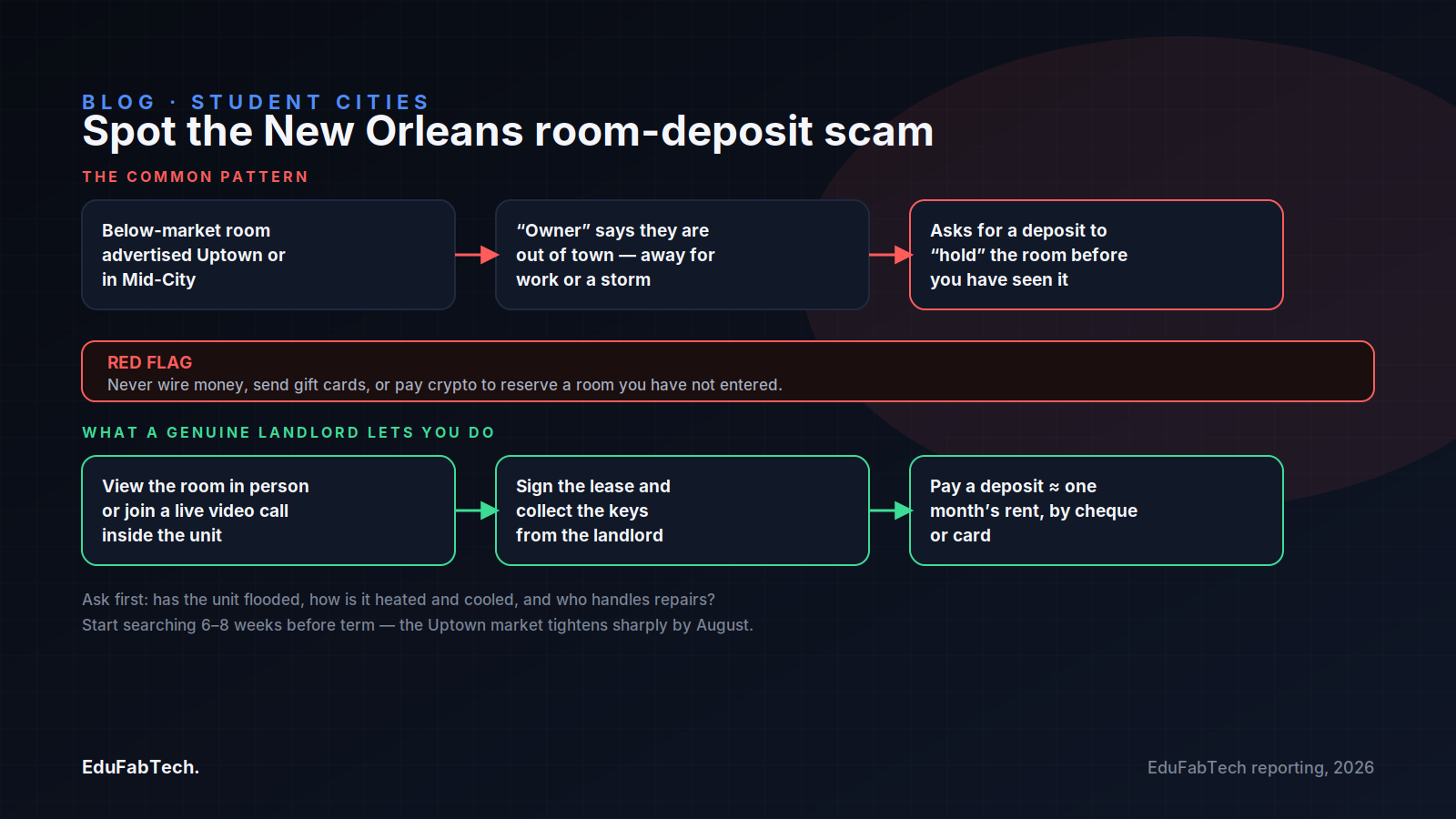
Uptown and the University area is the obvious first choice if you study at Tulane or Loyola: the streetcar, Audubon Park, Magazine Street shops and a dense band of student housing are all within walking or short-ride distance. It is also among the costlier parts of the city, and much of its rental stock is older raised houses split into flats.
Carrollton and the Riverbend, where St. Charles Avenue turns to meet the river at the far upriver end of the streetcar line, give you the same transit link for generally lower rents than the core blocks near campus, in a quieter, leafier setting. The nearby Freret Street corridor, rebuilt into a strip of cafés and bars after Hurricane Katrina, sits between Uptown and Broadmoor and is popular with students who want to be near Tulane without paying avenue prices.
Mid-City is the central, flat middle of the bowl, served by the Canal streetcar, wrapped around City Park, and full of shotgun houses and bungalows. It puts you roughly equidistant from most campuses and is one of the better-value central neighbourhoods, though parts of it took on water in past floods and sit low. Gentilly, further lakeside, is the campus neighbourhood for Dillard University and the public universities nearby; it is residential and relatively affordable, but it was among the areas worst hit by the 2005 levee failures, so ask about elevation and flood history before signing anything.
Gert Town and Broadmoor, inland near the Interstate 10 corridor, are the natural catchment for Xavier University of Louisiana — working-class, central and cheaper, with listings at /near/xavier-university-of-louisiana. Downriver, the Marigny and Bywater offer the city's best-known nightlife and music, colourful Creole cottages and an artsy crowd, but short-term holiday rentals have pushed rents up and the commute back to the uptown campuses is long; they suit downtown-based students far better than anyone studying on St. Charles.
Finding a room without losing a deposit
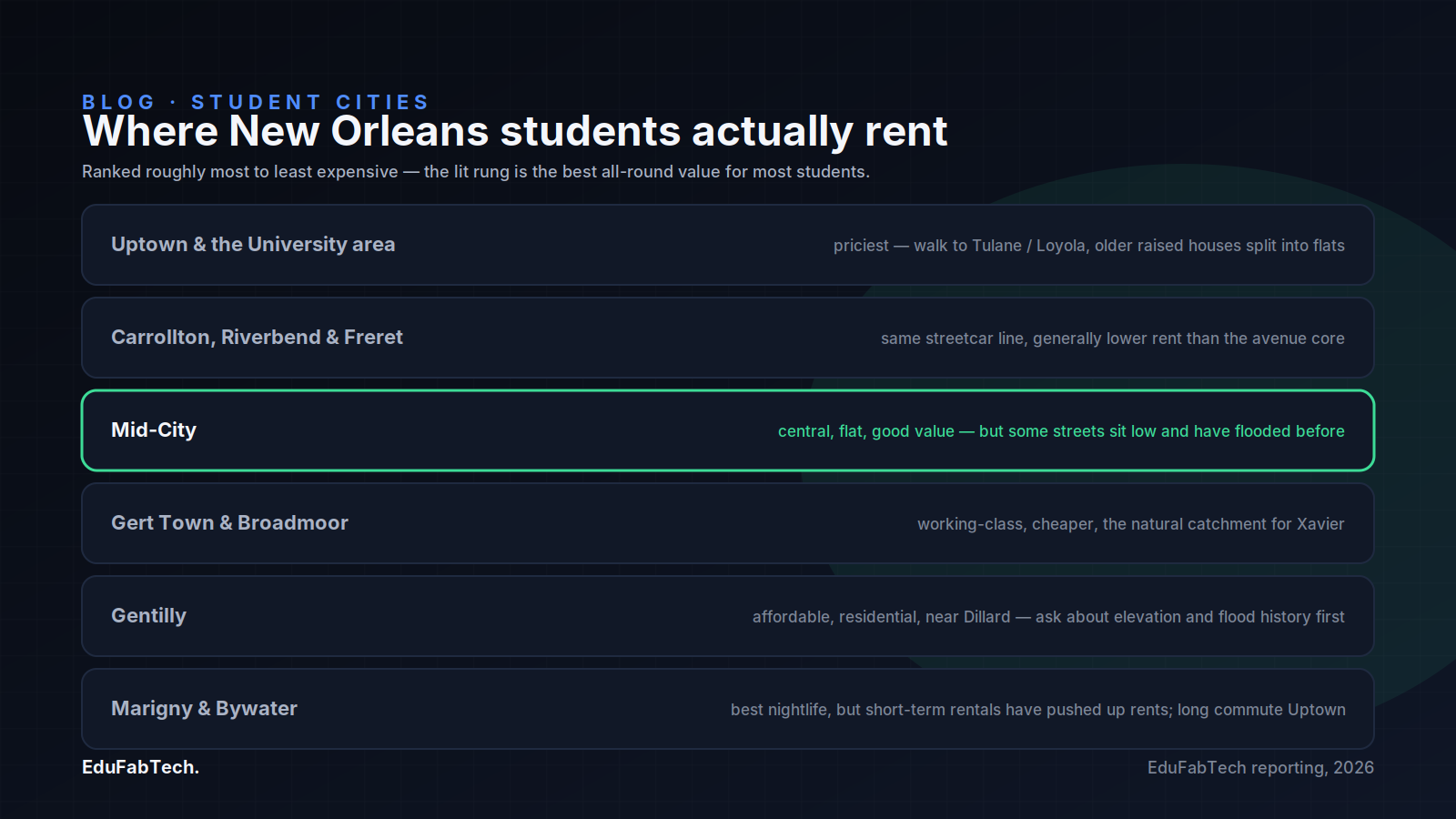
New Orleans rents are mostly handled by small landlords renting out half of a double shotgun or a converted raised house, not by large managed complexes, which makes seeing a place in person unusually important. The common scam here follows the city's housing pattern: an attractive "half of a double" Uptown or in Mid-City is advertised well below the going rate, the "owner" claims to be out of town — often said to be away for work or displaced after a storm — and asks you to send a deposit to "hold" it before you can view it. Treat that as a warning sign every time. Never send money by bank wire, gift card or cryptocurrency to reserve a room you have not entered; those payments cannot be reversed, and a genuine local landlord will let you walk the property or, at minimum, join a live video call inside the actual unit. A security deposit roughly equal to one month's rent, paid by cheque or card once you have a signed lease and keys, is normal; a large sum demanded before any viewing is not. Ask directly whether the unit has flooded, how it is heated and cooled against the humidity, and who handles repairs. You can browse rooms and sublets for the city at /in/united-states/new-orleans/rooms. Start looking six to eight weeks before term if you can; the Uptown market near Tulane and Loyola tightens sharply as August approaches.
Furnishing a room on a budget
Because so much student housing here comes unfurnished, second-hand furniture is a first-week errand, not an afterthought. The Freret Market, founded in 2007 as part of the post-Katrina revival of Freret Street, runs on the first Saturday of most months (it pauses in the peak of summer) at the corner of Freret Street and Napoleon Avenue and mixes a flea section with food and crafts, which makes it a convenient Uptown hunt for small furnishings. For larger pieces, the Bridge House charity thrift stores carry a steady supply of donated furniture across several locations, and Buffalo Exchange trades in second-hand clothing with student pricing. New Orleans also has a strong culture of putting usable things out on the kerb; keep an eye on the second-hand furniture listings at /in/united-states/new-orleans/furniture before buying anything new. When you move, remember that the city's narrow streets and lack of lifts in old houses make a borrowed pickup truck worth more than a delivery van.
Working while you study
Local students often pick up shifts in the tourism, hospitality and festival economy that runs almost year-round, from the French Quarter to the Mardi Gras and Jazz Fest seasons; EduFabTech's jobs board for the city is at /in/united-states/new-orleans/jobs. The rules are different for international students, and the authority is federal, not local. The U.S. Department of Homeland Security's Study in the States service states that an F-1 student "may not work more than 20 hours per week when school is in session" for on-campus employment, and that off-campus work is only available after at least one full academic year and under specific conditions. This is not legal advice, and rules change: before you accept any job, talk to the designated school official (DSO) in your university's international office and confirm what your visa status allows.
Libraries and places to study
Each campus has its own academic library — Tulane's Howard-Tilton Memorial Library uptown, Loyola's Monroe Library next door, and the libraries at Xavier and Dillard — and these are where most coursework actually happens. Off campus, the New Orleans Public Library runs the Main Library downtown on Loyola Avenue plus a network of branches, including the Mid-City branch on Canal Street, with free study space and meeting rooms you can reserve; a city library card is free to residents. Between the humidity and the summer heat, a reliable air-conditioned desk is a genuine consideration here, and coffee shops along Freret Street, Magazine Street and in Mid-City fill the gap in the evenings. More desks and study spaces for the city are listed at /in/united-states/new-orleans/study-spaces.
Getting around: streetcars, buses and the Jazzy Pass
Public transport is run by the New Orleans Regional Transit Authority (RTA). Its streetcar lines — most famously the St. Charles line past Tulane and Loyola, and the Canal line out toward Mid-City and City Park — are supplemented by buses and the Mississippi River ferries. According to the RTA's own fare page, a single adult ride costs $1.25 and the unlimited passes, branded the Jazzy Pass, run $3.00 for one day, $15.00 for seven days and $45.00 for 31 days (2025 fares). Note the fine print: the RTA defines its reduced youth fare for anyone "under 19 years of age" or any "Kindergarten through Grade 12 student," so most university students pay the standard adult fare rather than a student discount. Uptown and downtown are walkable and streetcar-friendly; the cross-river and far-lakeside campuses are not, and a bicycle or car becomes useful the further you live from a streetcar line.
What a room costs, and what is hard about the city
The clearest dated housing anchor comes from a university's own schedule. Tulane's Housing & Residence Life lists 2025–2026 residence-hall rates ranging from $10,774 a year for an expanded triple room at Wall Hall to $14,230 for a suite-style single with a private bath — figures that cover the room only; the agreement also requires first-, second- and third-year students to buy a dining plan at additional cost. Off-campus, rents vary widely by neighbourhood and by how recently a house was renovated, and there is no single reliable citywide student-rent figure worth quoting; the dorm schedule is the firm number to budget against, with private Uptown rooms often running higher per person once you add utilities.
Be honest with yourself about the climate and the risk. The Atlantic hurricane season runs roughly June through November, and evacuations, power cuts and disrupted terms are a real possibility, not a theoretical one — the scars of Hurricane Katrina in 2005 still shape which neighbourhoods flooded and which did not. Summers are long, hot and intensely humid; much of the housing stock is old and unevenly maintained; and short-term holiday rentals have squeezed the supply of ordinary flats in the most desirable areas. Transit thins out at night, and safety varies block by block in ways a newcomer cannot read from a map. Against all that, the upsides are specific to this city: lower rents than most coastal American metros, a compact and genuinely walkable student core on St. Charles, two historic HBCUs, and a music, food and festival culture that no other student city quite matches.
A short checklist for your first weeks
- Pin down your campus and the nearest streetcar or bus line before you choose a neighbourhood — the St. Charles line for Uptown, the Canal line for Mid-City.
- View any room in person or on a live video call from inside the unit before paying; never wire a deposit or pay by gift card or crypto to "hold" a place.
- Ask every landlord directly whether the property has flooded and how it handles heat and humidity.
- Budget against a firm number — Tulane's 2025–2026 dorm rates — and add utilities and food to any off-campus figure.
- If you are an international student, see your DSO before taking any paid work, and check the DHS Study in the States guidance.
- Buy a Jazzy Pass that matches your travel, and get a free New Orleans Public Library card for study space.
- Furnish from the Freret Market and local thrift stores rather than buying new, and line up a truck, not a van, for moving day.
A quick question for readers
Do you work part-time while you study?
Many students work to pay the bills. See how common it is — and how many hours people really do.
Pick an answer, create a free account in a minute, and your vote counts. Already a member? Sign in
Source: Tulane University
Sources (5)
- Tulane University Housing & Residence Life. Rates and Housing Agreement (2025–2026). Tulane University, 2025. housing.tulane.edu ↗ · checked 4 Oct 2026
- New Orleans Regional Transit Authority. Fares. New Orleans Regional Transit Authority (RTA), 2025. norta.com ↗ · checked 4 Oct 2026
- Xavier University of Louisiana. The Full Story. Xavier University of Louisiana, 2026. xula.edu ↗ · checked 4 Oct 2026
- Louisiana State University Health Sciences Center at New Orleans. LSU Health New Orleans. LSU Health New Orleans, 2026. lsuhsc.edu ↗ · checked 4 Oct 2026
- U.S. Department of Homeland Security. Working in the United States. Study in the States (DHS), 2026. studyinthestates.dhs.gov ↗ · checked 4 Oct 2026