Studying in New York City: universities, housing and student life
A practical, sourced guide to the universities, neighbourhoods, housing, work rules, libraries, transport and real costs of studying across New York City and its wider metro region.
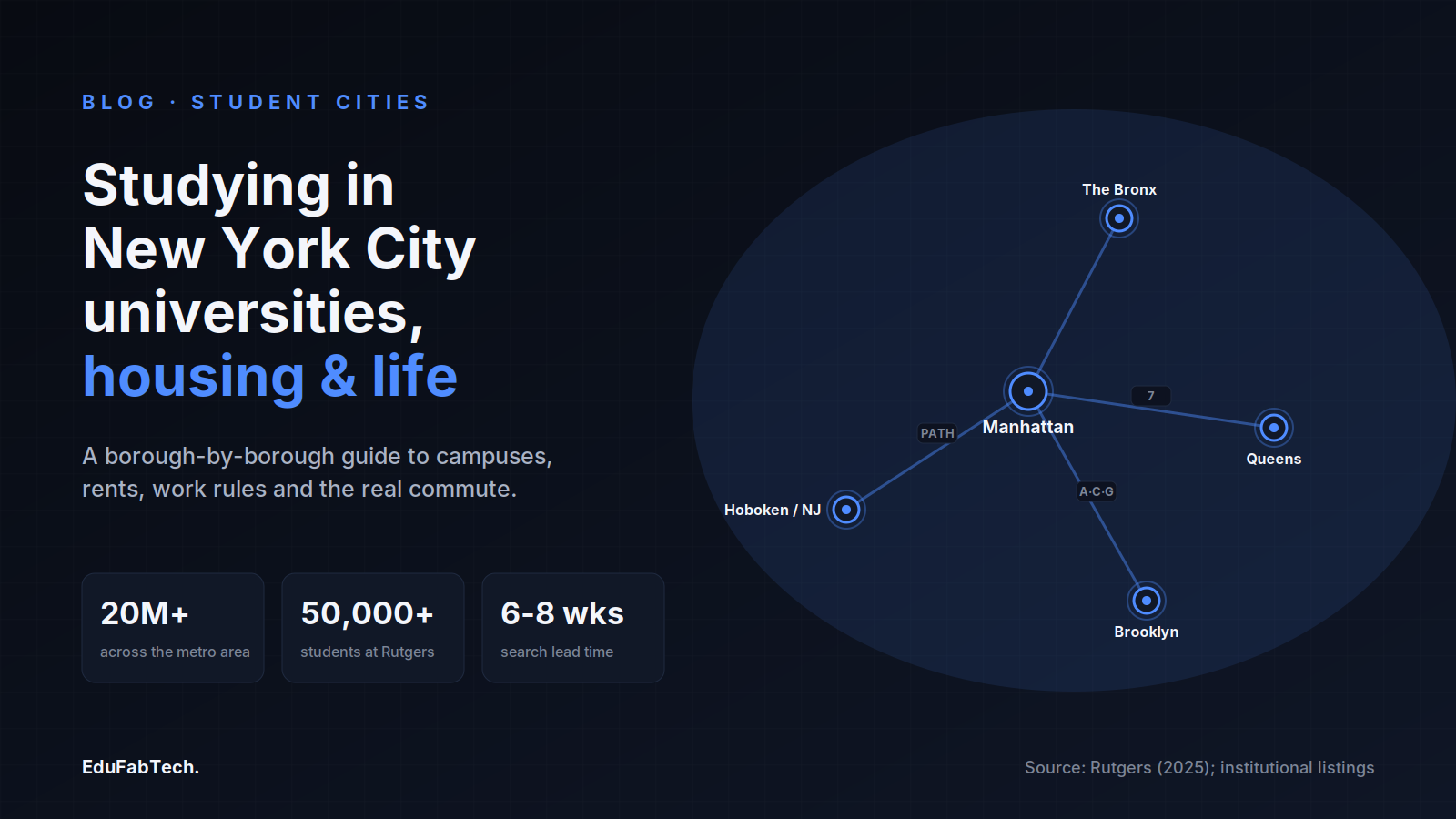
There is no single "campus" to New York City. Universities here are threaded through the fabric of a metropolitan region of more than twenty million people — up the spine of Manhattan, across the bridges into Brooklyn, Queens and the Bronx, out onto Long Island, up the Hudson into Westchester, and across the river into the dense New Jersey towns of Hoboken, Newark and Jersey City. A student's daily geography is defined less by a quadrangle than by a subway or train line. Knowing which borough your lecture hall sits in, and which one you can afford to sleep in, is the first thing anyone learns here.
That spread is also the city's gift. You can study marine engineering on a hilltop in Hoboken and be in Greenwich Village in twenty minutes; you can live in Queens, among the most linguistically diverse places on earth, and commute to a laboratory in the Bronx. This guide walks through the institutions, the neighbourhoods people actually rent in, how to find a room without being cheated, where to work and study, how to move around, and what it honestly costs.
Below, the well-known universities are described properly, then the many smaller colleges, graduate schools and specialist institutes of the region are listed with one true line each. If an institution has closed or merged, that is said plainly rather than quietly left out.
The universities, and what studying here is like
Columbia University occupies a stately McKim, Mead & White campus in Morningside Heights, upper Manhattan, and is one of the region's two Ivy-League-calibre research powerhouses. Its graduate and professional schools are effectively institutions in their own right: the School of International and Public Affairs, Columbia University, the Columbia University School of Social Work, the teacher-education wing historically known as New College, Teachers College, Columbia University, and the medical school, the Columbia University Vagelos College of Physicians and Surgeons, up at the Washington Heights health-sciences campus.
New York University is the other giant — a university without walls, built around Washington Square in Greenwich Village. Its reach is enormous: the engineering school, New York University Tandon School of Engineering, sits in downtown Brooklyn; the mathematics and computing powerhouse, the Courant Institute School of Mathematics, Computing, and Data Science, anchors its science research; and it runs the New York University Graduate School of Arts and Science, the New York University College of Dentistry, and the social-work school, the Silver School of Social Work.
The New School, also in Greenwich Village, is a progressive university best known for design and social research; the celebrated Parsons School of Design is part of it, and the largely historic École libre des hautes études, a wartime "university in exile," was founded in its orbit. Fordham University, a Jesuit institution, keeps its leafy Rose Hill campus in the Bronx alongside a Lincoln Center campus in Manhattan, and runs the Fordham Graduate School of Arts and Sciences.
The public system, the City University of New York, is the engine of social mobility here, educating hundreds of thousands across the five boroughs. Its senior colleges include the City College of New York in Harlem — home of the Grove School of Engineering and the biomedical programme once called the Sophie Davis School of Biomedical Education — plus Hunter College on the Upper East Side, the business-focused Baruch College near Gramercy, Queens College, the John Jay College of Criminal Justice, and the CUNY School of Public Health. Its two-year colleges, such as the Borough of Manhattan Community College and LaGuardia Community College, are many students' affordable entry point.
Several institutions are specialists. The Rockefeller University, a graduate-only biomedical research institution on the Upper East Side, is among the most selective science programmes anywhere. Cornell Tech, on Roosevelt Island, is a graduate campus for applied technology. Pratt Institute in Clinton Hill, Brooklyn — together with the Pratt Institute School of Information — and the School of Visual Arts in Manhattan are major art-and-design schools, as is the historic, tuition-light Cooper Union in the East Village. Pace University sits beside City Hall; St. John's University is a large Catholic university in Queens; and Touro University runs health and professional programmes across Manhattan.
Two religiously rooted universities round out Manhattan and the Bronx: Yeshiva University in Washington Heights, which includes the Azrieli Graduate School of Jewish Education and Administration, and the independent medical school historically tied to it, the Albert Einstein College of Medicine in the Bronx. The multi-campus Long Island University spans the city and the suburbs through LIU Brooklyn, LIU Post in Brookville, the study-abroad arm LIU Global, the Arnold and Marie Schwartz College of Pharmacy, and its Entrepreneurship and Technology Innovation Center. The New York Institute of Technology teaches on Long Island and at the New York Institute of Technology - Manhattan Campus.
Across the Hudson and out on the Island
New Jersey is part of the student region, not separate from it. Rutgers University — properly Rutgers University–New Brunswick, the state's flagship, founded in 1766 and enrolling more than 50,000 students according to Rutgers (2025) — anchors the southern edge of the commuter belt. Closer in are Stevens Institute of Technology on its bluff in Hoboken, the New Jersey Institute of Technology in Newark with its NJIT School of Management, Saint Peter's University and New Jersey City University in Jersey City, and, further out, Montclair State University, Drew University in Madison, Fairleigh Dickinson University, William Paterson University and Kean University.
Long Island and the northern suburbs add more: Hofstra University in Hempstead, Adelphi University in Garden City, Molloy University, the tiny and remarkable naval-architecture school Webb Institute in Glen Cove, the State University of New York at Purchase and the State University of New York at Old Westbury, plus Iona University in New Rochelle and the College of New Rochelle, which closed in 2019, Mercy University in Dobbs Ferry, and St. Thomas Aquinas College in Orangeburg. Specialist and professional schools complete the picture: the SUNY Downstate College of Medicine in Brooklyn, Saint Vladimir's Orthodox Theological Seminary north of the city, the career-focused Lincoln Group of Schools, and the long-closed Traphagen School of Fashion, once a fixture of Manhattan's garment trade and now only a historical name. You can browse current listings across all of these on the city's student page.
Neighbourhoods students actually live in
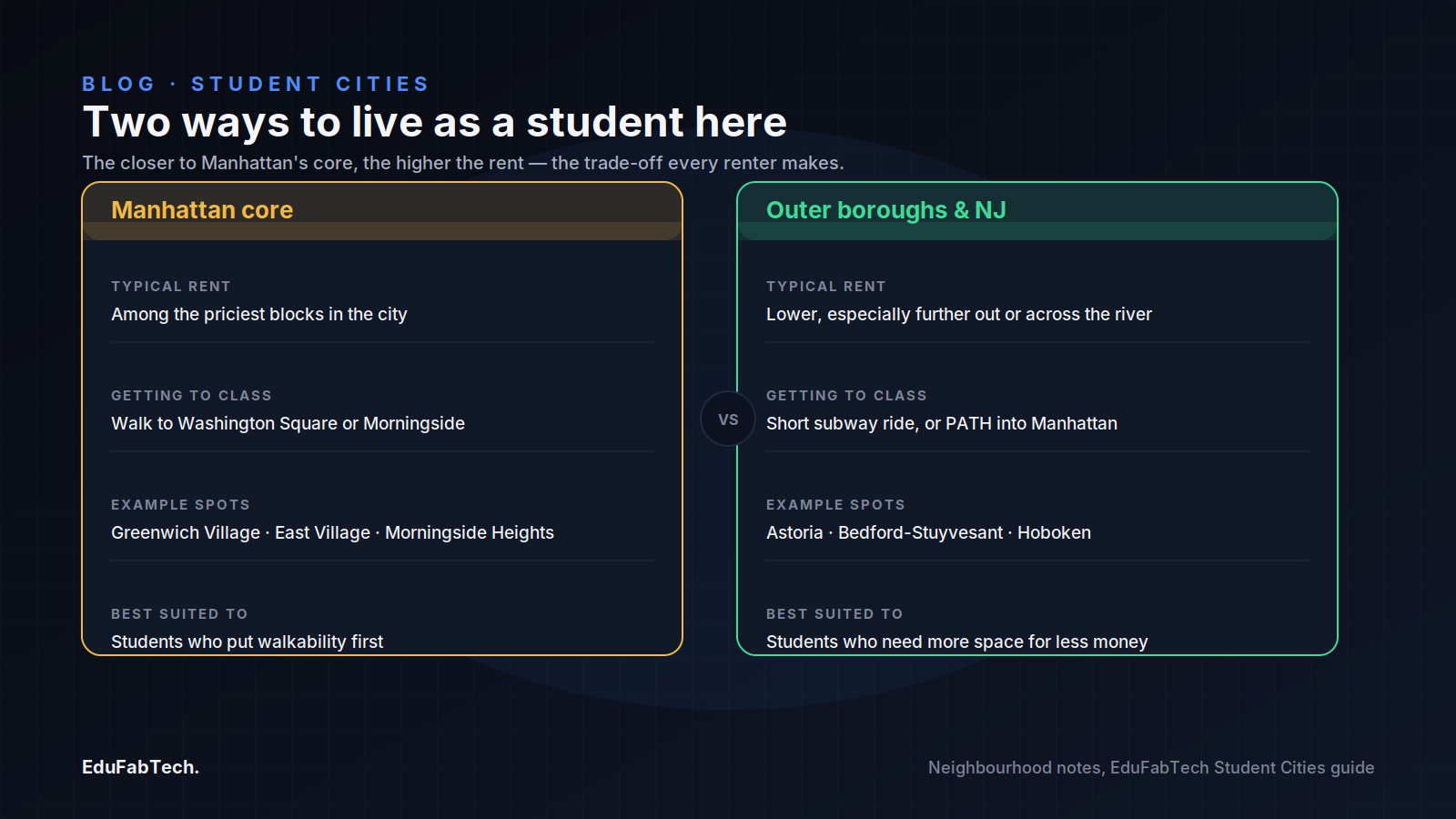
Morningside Heights and Harlem cluster around Columbia University and City College of New York. The immediate blocks are expensive and tightly held, but walk north or east into Harlem and Hamilton Heights and rooms open up, with a short walk or one subway stop to campus. Try the listings near Columbia University if this is your area.
Greenwich Village, the East Village and the Lower East Side are New York University's and The New School's backyard. Central, atmospheric and much sought-after, they are among the pricier places to rent; many students split a converted apartment to make it work, or look to the listings near New York University.
Downtown Brooklyn, Fort Greene and Bedford-Stuyvesant serve NYU Tandon and Pratt Institute. Fort Greene is handsome and green; "Bed-Stuy" is cheaper the further east you go, well connected by the A, C and G trains. Bushwick and Ridgewood, straddling the Brooklyn–Queens line, remain the classic first-apartment zone for art and design students on a budget.
Astoria and Long Island City, in western Queens, are perennial student favourites: safe, full of food from everywhere, and a handful of subway stops from Manhattan. Jackson Heights and Flushing, deeper into Queens and near Queens College and St. John's University, are cheaper still and extraordinarily diverse. In the Bronx, Fordham and Belmont put you beside Fordham University and within reach of the Albert Einstein College of Medicine.
Across the river, Hoboken and Jersey City house students at Stevens Institute of Technology, Saint Peter's University and New Jersey City University; the PATH train reaches Manhattan quickly, and rents, while not low, often undercut comparable Manhattan blocks. Newark, around the New Jersey Institute of Technology, is the most affordable of the close-in options.
Finding a room without getting burned
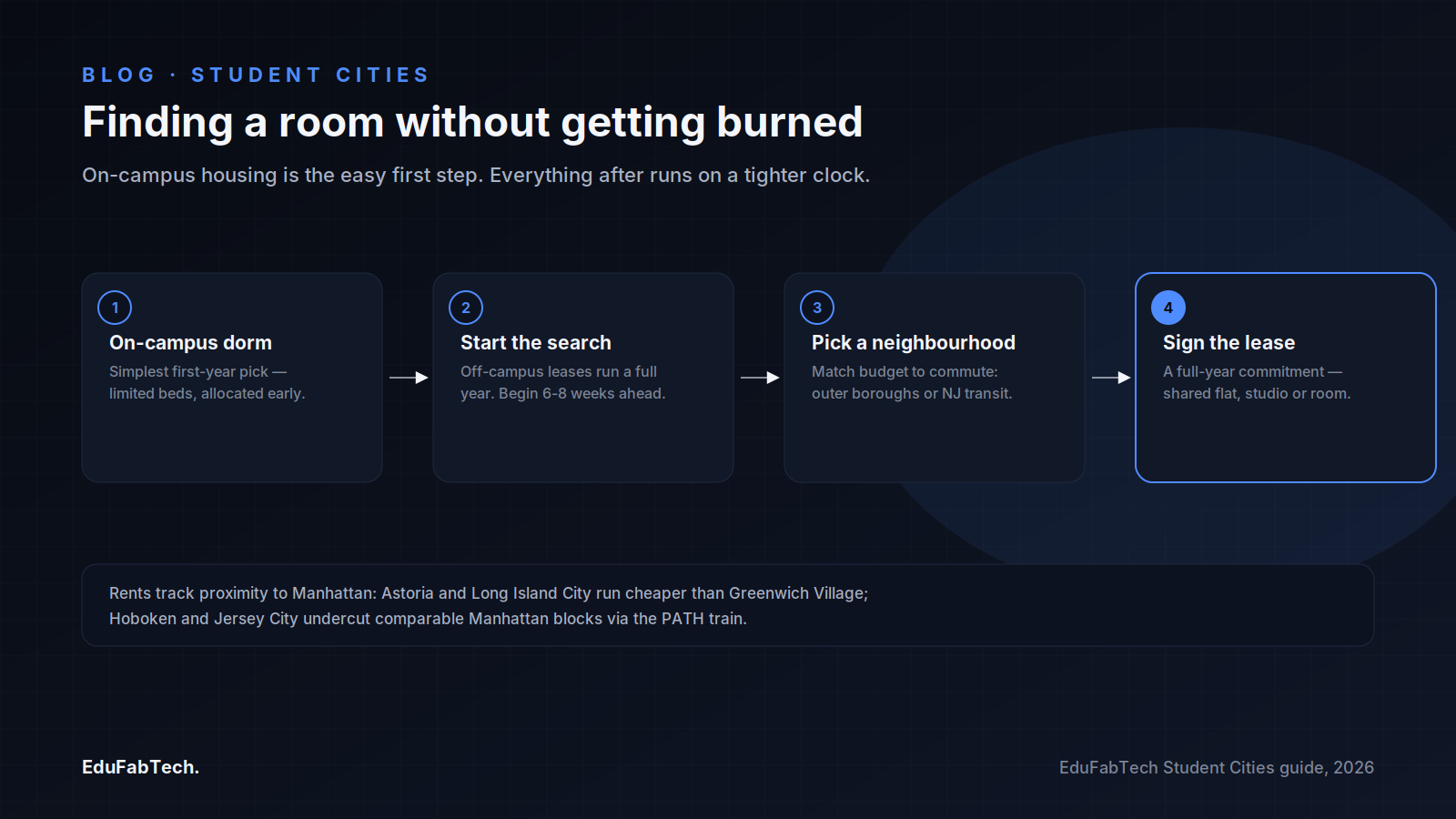
Most students rent a room in a shared apartment, a studio, or a bed in a university residence. On-campus housing is the simplest first-year choice but is limited and allocated early; off-campus, the market moves fast and leases typically run a full year. Start looking six to eight weeks before you need the room — earlier for the heavy August–September turnover — and be ready to decide within days when something good appears. Before you pay anything, confirm the exact address, see a written lease, check who else lives there, and verify that the person showing the room is actually entitled to rent it. Browse verified rooms on the city rooms page and study spaces separately if you need a desk more than a bed.
On scams — read this twice. The single most common fraud is a "landlord" who is conveniently abroad, offers a room below market, and asks for a deposit to "hold" it before you can view it. Never do this. See the place in person, or at the very least on a live video walk-through where you can ask the person to show specific things in real time. Never send a deposit or first month's rent by bank wire transfer, gift card or cryptocurrency — these are untraceable and are the hallmark of a scam. A legitimate landlord will let you sign a lease and pay by a method that leaves a record. If anything is rushed, vague about the address, or "too good," walk away.
Furnishing a room for almost nothing
New York throws out — and resells — an astonishing amount of good furniture. The city's weekend markets are the fastest way to kit out a room. Chelsea Flea, at 29 West 25th Street in Manhattan, runs every Saturday and Sunday, 8am–5pm year-round with 50–60 antiques and vintage vendors, per Brooklyn Flea (2026); the same organisation runs the warm-weather Brooklyn Flea in DUMBO. On the Upper West Side, Grand Bazaar NYC — open Sundays 10am–5pm at 100 West 77th Street and, per Grand Bazaar NYC (2026), the city's oldest curated weekly market, donating its profits to four local public schools — is excellent for household goods and curiosities.
Beyond the flea markets, thrift and charity shops across every borough sell furniture, kitchenware and clothes for a fraction of retail, and the city's informal "stooping" culture — good items left on the pavement for whoever wants them — is real and legendary. For second-hand items, swap what you no longer need, and the things neighbours give away free, EduFabTech keeps dedicated city pages: second-hand things, second-hand furniture, and free stuff.
Working while you study
Rules on employment are strict for international students and change over time, so always confirm the current position against the official source rather than hearsay. In general, students on the common study visa may work on campus — but, per the official federal guidance for international students (2025), not more than 20 hours per week while school is in session, with full-time work permitted during official breaks. Off-campus work, and practical-training work in your field, require specific prior authorisation and cannot begin until that authorisation is granted. This is guidance, not legal advice: your university's international-student office is the body that files the paperwork and should be your first stop. Local part-time listings are collected on the city jobs page.
Libraries and places to study
Beyond your own university's libraries, New York has an exceptional free public system. The New York Public Library's Stephen A. Schwarzman Building on Fifth Avenue — the great lions-flanked landmark — offers research divisions and reading rooms with free public access, including the historic Rose Main Reading Room, open for quiet study without an appointment, according to The New York Public Library (2025). Branch libraries across Manhattan, the Bronx and Staten Island, and the separate systems in Brooklyn and Queens, offer free desks, Wi-Fi and long hours. Add the city's cafés and the study-space listings on the EduFabTech study spaces page, and finding somewhere to work is rarely the problem — finding it quiet and free at exam time is.
Getting around
The subway and bus network is the reason New York works as a student city: it runs 24 hours and reaches nearly everywhere you need to go. As of January 2026 the base fare for a subway or local bus ride is $3.00, per the city's transit authority (2026). There is no general university-student transit discount, but the contactless "tap-and-ride" system now caps spending automatically: after 12 paid trips in a rolling seven-day period, further subway and local-bus rides are free, so a heavy commuter pays no more than $35 in a week — a change independent reporting by Spectrum News NY1 (2026) confirmed took effect that month. For New Jersey campuses, the PATH train and regional rail connect Hoboken, Jersey City and Newark to Manhattan; budget separately for those fares, which are set by different operators.
Costs, and the honest trade-offs
New York is among the most expensive places in the world to be a student, and almost all of that is rent. Tuition varies enormously — the public City University of New York is a fraction of the private universities' sticker price — so the figure that dominates most budgets is housing. For a sense of scale from one institution's own planning numbers, New York University estimated food and housing at $25,516 for the 2025–2026 academic year for a student in a double room with a meal plan, per New York University (2025). Live further out, share a room, cook for yourself and skip the meal plan, and you can spend considerably less; live alone near campus in Manhattan and you can spend far more. Treat any single rent figure with caution: prices swing by neighbourhood, by season and by how many flatmates you accept.
What is good is genuinely exceptional. Few places on earth concentrate this many universities, libraries, laboratories, museums and employers within one transit network, and the city's diversity means almost no one is truly foreign here. Public transport runs through the night; part-time work, internships and cultural life are abundant.
What is hard is mostly money and friction. Rent is punishing and the market is tight; the cheapest rooms come with long commutes, and an hour each way is normal. The city is crowded and loud, winters are cold and grey while summers are hot and humid, and the sheer scale can be isolating at first. The honest trade-off: New York gives you more opportunity than almost anywhere, and charges you for it in rent, time and stamina.
A checklist for your first weeks
- Register with your university's international-student office and confirm your work and status rules before doing anything else.
- Set up the contactless transit payment so your fares cap automatically; learn the two or three lines that serve your campus.
- Only sign a lease after seeing the room in person or on a live video walk-through — never pay a deposit by wire, gift card or crypto.
- Get a free public library card; scout one quiet study spot near home and one near campus.
- Furnish from flea markets, thrift shops and giveaways before buying anything new.
- Open a local bank account and keep a written record of every rent payment.
- Find your nearest grocery market and plan to cook — eating out daily is the fastest way to wreck a student budget here.
- Metropolitan Transportation Authority. Fares and tolls. Metropolitan Transportation Authority, 2026. link
- Spectrum News NY1. MTA fare and toll hikes take effect. Spectrum News NY1, 2026. link
- U.S. Department of Homeland Security. Working in the United States. Study in the States, 2025. link
- New York University. Cost of Attendance. New York University, 2025. link
- The New York Public Library. Research at the Stephen A. Schwarzman Building. The New York Public Library, 2025. link
- Brooklyn Flea. Chelsea Flea. Brooklyn Flea, 2026. link
- Grand Bazaar NYC. Mission, Goals, Values & History. Grand Bazaar NYC, 2026. link
- Rutgers University. About Rutgers University–New Brunswick. Rutgers, The State University of New Jersey, 2025. link