Studying in Newark, Delaware: universities, housing and student life
A practical, sourced guide to studying in Newark, Delaware — the University of Delaware, where students live, what rooms cost, renting safely, work rules, study spaces and getting around.
A college town in the corner where three states meet
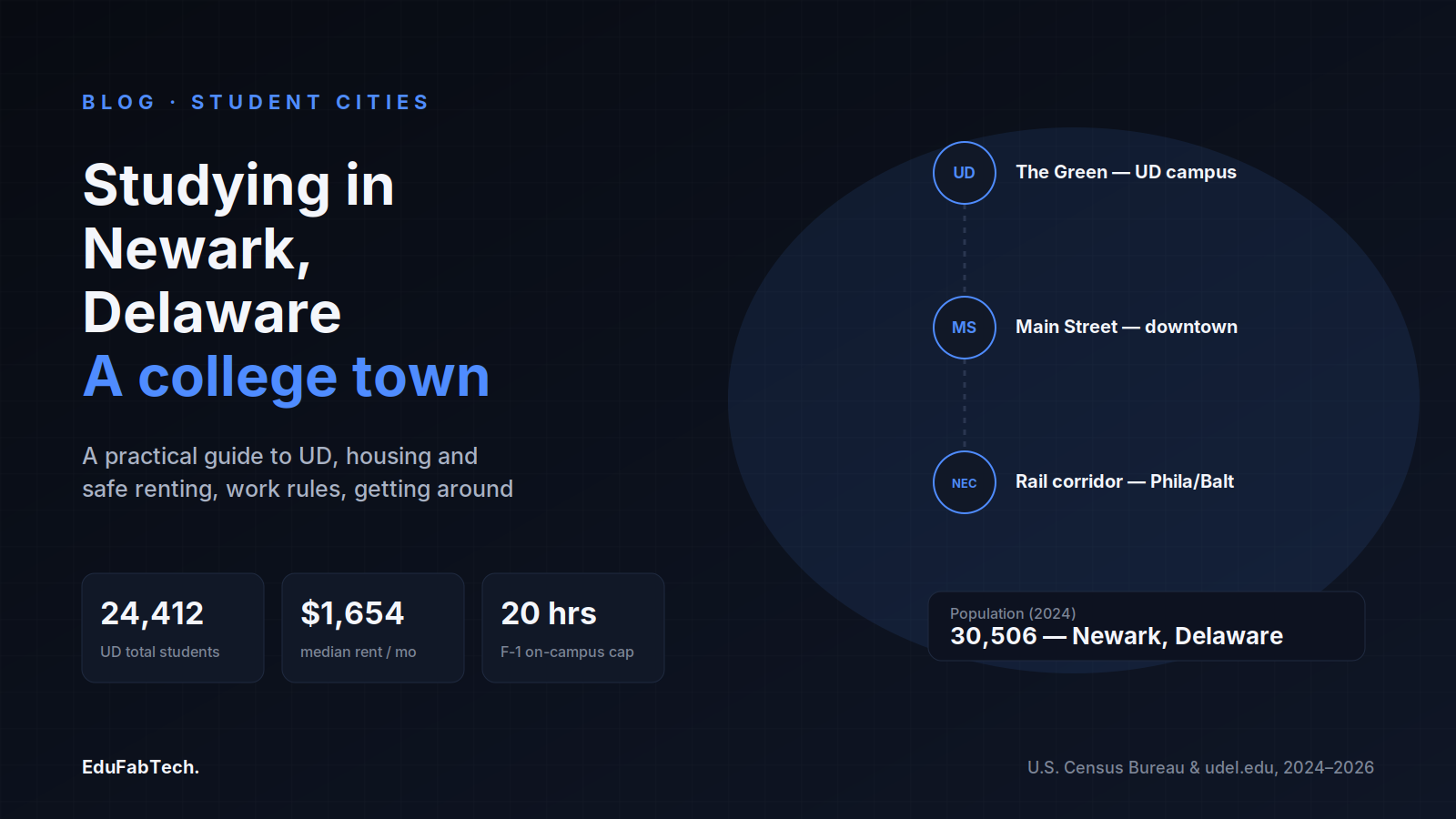
Newark sits in the northwest corner of Delaware, a short drive from both the Pennsylvania and Maryland lines, close enough to Wilmington, Philadelphia and Baltimore that a student can treat all three as weekend destinations. It is a genuine college town rather than a city with a campus bolted on: the U.S. Census Bureau's QuickFacts for Newark city, Delaware put the population at 30,506 as of 1 July 2024 (census.gov), and the University of Delaware's enrolment is large enough that in term time the students are a visible share of everyone on the street.
The spine of the town is Main Street, a long, mostly flat stretch of brick sidewalks, restaurants, coffee shops, a food co-op and the shopfronts that empty and refill with the academic year. Because the main campus runs straight into downtown along South College Avenue and The Green, most undergraduate life happens within walking or cycling distance, and a car is useful rather than essential. Anyone expecting the bigger, better-known Newark in New Jersey will find a quieter, leafier place that is pronounced locally as "NEW-ark", with each syllable given its own weight.
What that means day to day is a town whose rhythm is set by the university calendar: busy and loud from late August, emptier over the long summer, and briefly chaotic every May when thousands of students move out at once. It is small enough to cross on foot and close enough to a major rail line that you are never fully stuck, which is a reasonable summary of its appeal and its limits both.
The University of Delaware and the campuses within reach
The University of Delaware is the reason most students come to Newark. Its main campus is in Newark, it was established in 1743, and it is organised into 10 colleges and schools; the university's own facts page reports a total enrolment of 24,412, of whom 19,071 are undergraduates (udel.edu). UD is a land-grant, sea-grant and space-grant institution, which shows up in strong engineering, marine science, chemistry and health programmes, and it describes itself as the first U.S. institution to send students abroad, in 1923. The campus itself — Georgian-brick buildings around The Green — is one of the more photographed in the region.
Newark is not the only option within commuting range, and students who did not get the place or price they wanted at UD often look across the state lines. In Pennsylvania, West Chester University of Pennsylvania, about 25 miles east toward Philadelphia, is the largest state-owned university in the Commonwealth and part of the Pennsylvania State System of Higher Education (wcupa.edu). Lincoln University, near Oxford in southern Chester County, calls itself the nation's first degree-granting historically Black college and university, established in 1854 (lincoln.edu). Cheyney University of Pennsylvania, in Cheyney, was founded in 1837 and is generally recognised as the oldest HBCU in the United States (britannica.com). Neumann University, in Aston, is a private Catholic university in the Franciscan tradition founded in 1965 (neumann.edu).
Two smaller institutions are worth knowing if cost or a specific path matters. Goldey-Beacom College, just outside Newark in the Pike Creek Valley area near Wilmington, is a small private college focused largely on business. Cecil College, across the Maryland line in North East, is a community college whose lower tuition and transfer agreements make it a common first step before moving on to a four-year degree. None of these sit in Newark itself, but all are close enough that where you live and how you commute become part of the decision.
Where students live, from the residence halls to Main Street
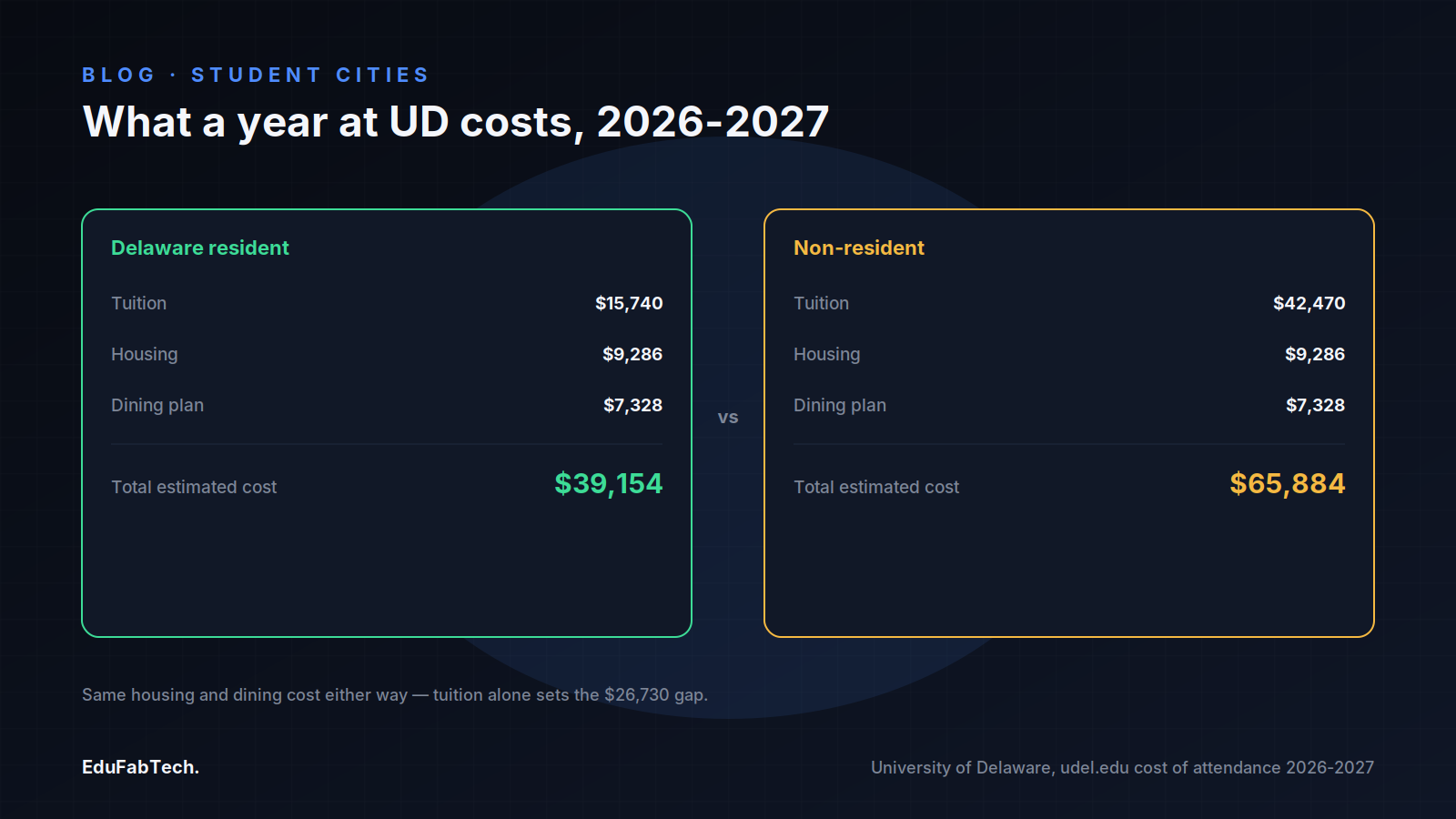
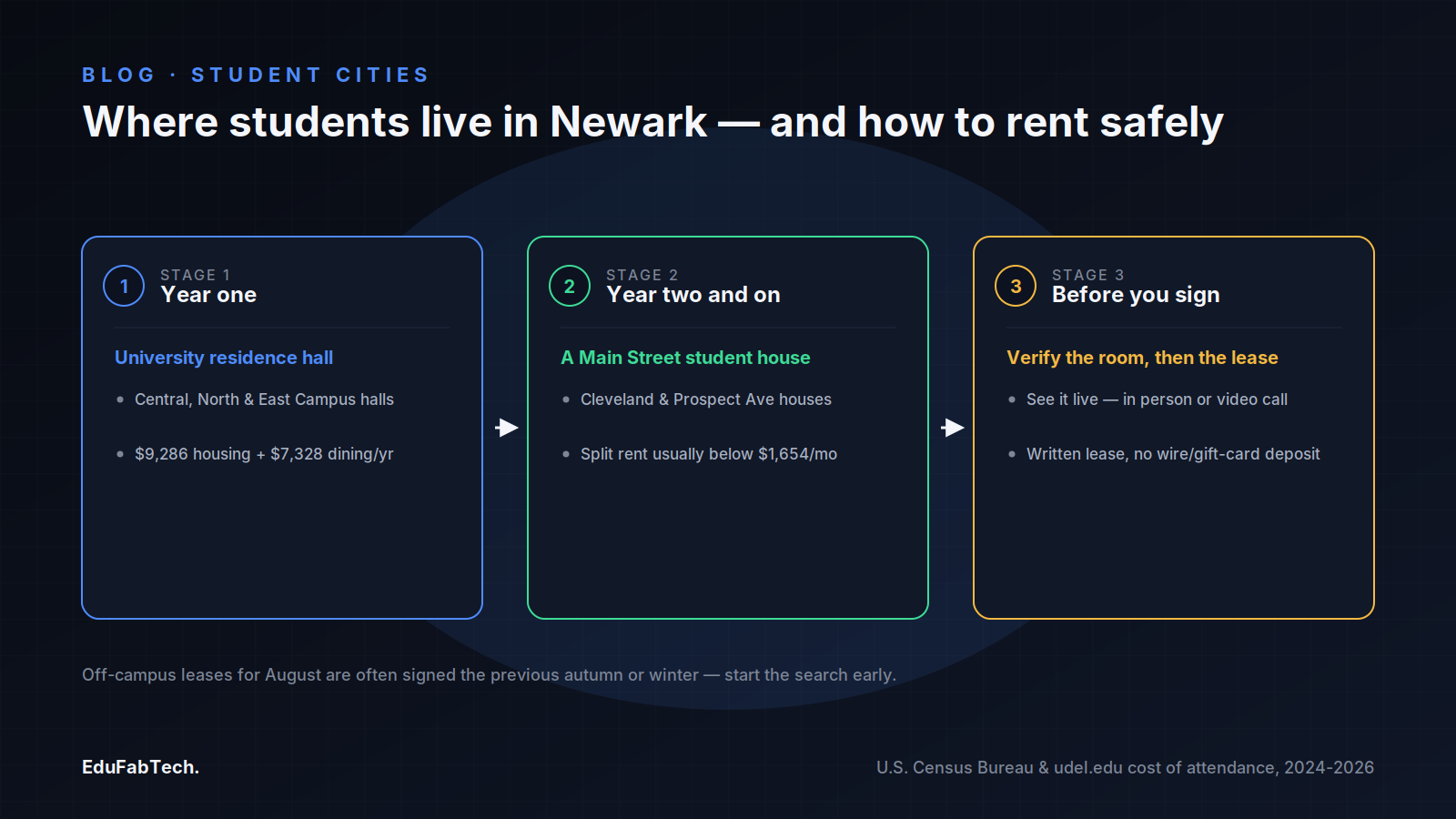
First-year undergraduates at UD generally live in university housing, and the residence halls cluster in distinct areas: the older Central Campus halls near The Green, the North Central and East Campus halls, and the newer complexes. The university's 2026-2027 cost of attendance lists housing at $9,286 and a dining plan at $7,328 for the year, inside a total estimated cost of $39,154 for a Delaware resident and $65,884 for a non-resident, the difference driven by tuition of $15,740 against $42,470 (udel.edu). Those are averages across room types; the exact figure depends on whether you land a double in an older hall or a single in a suite.
After first year, many students move off campus into the streets immediately around Main Street — the blocks along Cleveland Avenue, Prospect Avenue, and the older houses north and east of downtown — where rooms in shared student houses are the norm. For a sense of the wider rental market, the U.S. Census Bureau's QuickFacts put the median gross rent in Newark at $1,654 a month for the 2020-2024 period (census.gov); student houses split several ways usually come in below that per person, but the best-located ones near Main Street go quickly. The leasing cycle is early: much of the good off-campus stock for the following August is signed by the previous autumn or winter, so the search starts far earlier than newcomers expect.
If you are browsing what is currently available, EduFabTech keeps Newark listings together at /in/united-states/newark, with rooms and sublets gathered at /in/united-states/newark/rooms and listings grouped by campus at /near/university-of-delaware. Start there to learn the going rate before you commit to anything.
Renting in Newark without being cheated
Newark's rental scams follow the shape of the town. Because demand peaks in a narrow autumn window and students are often renting their first place from another country or another state, the fake listing — a real Main Street house, copied photos, a "landlord" who is travelling and wants a deposit to "hold" the room — is the pattern to watch. The defence is the same every time: see the actual unit, in person or via a live video call with someone standing inside it, before any money changes hands, and match the address to a real property rather than a listing photo.
A deposit of roughly one month's rent, plus the first month, is the ordinary ask in this market; a request for several months up front, or for payment before you have seen anything, is a warning sign. Never send money by bank wire, gift card or cryptocurrency to reserve a room — these are the methods scammers prefer precisely because they cannot be reversed, and no legitimate Newark landlord needs them. Get a written lease with the address and the landlord's name, and confirm the home is a properly licensed rental with the City of Newark rather than an overcrowded sublet. Treat UD's own off-campus housing resources, and the current listings EduFabTech keeps at /in/united-states/newark/rooms, as starting points for prices, not as a guarantee about any individual landlord.
Furnishing a room, and the Sunday market on Main Street
Furnishing cheaply in Newark is mostly a question of timing. Because so many leases turn over at the end of the spring term, the week around move-out in May produces a reliable flow of furniture, mini-fridges and kitchen gear put out on the curb or passed between students, and the start of term in August is when demand for all of it peaks. Arriving a little before the crowd, or staying a little after, is the cheapest way to kit out a room.
For food and local produce, the Co-op Farmers Market, run by the Newark Natural Foods Co-op, sets up at 230 E. Main Street on Sundays from May to November (nfmd.org); it accepts SNAP/EBT and is an easy walk from campus. For second-hand furniture, free giveaways and the rest of the move-out churn, EduFabTech collects Newark listings at /in/united-states/newark/furniture, worth checking repeatedly rather than once, since the useful items appear and vanish within days during the moving weeks.
Working part-time: what the rules allow
For domestic students, part-time work in Newark looks like most college towns: campus jobs in dining halls, the library, labs and offices, and service work along Main Street. UD posts student positions through its employment system, and on-campus work is the simplest to combine with classes because the schedules are built around them. Current openings that EduFabTech tracks for the city are gathered at /in/united-states/newark/jobs.
International students on an F-1 visa face firmer limits, and the rules are not something to take from a landlord or a classmate. The U.S. Department of Homeland Security's Study in the States guidance states that an F-1 student in on-campus employment "may not work more than 20 hours per week when school is in session" (studyinthestates.dhs.gov); off-campus work and practical training carry further conditions and generally require authorisation first. This is general information, not legal advice: confirm your own situation with UD's designated school official in the office for international students before you accept any job, because the consequences of getting work rules wrong fall on your immigration status.
Libraries and places to study
The centre of academic study in Newark is the University of Delaware's Morris Library, at 181 S. College Avenue on campus (library.udel.edu), which is the university's main library and the default workspace for most students, with group rooms, quiet floors and long hours during term. Smaller college libraries and study lounges across campus pick up the overflow, and cafés along Main Street fill with laptops during exam periods.
One change worth planning around: the public Newark Free Library on Library Avenue, long a quieter alternative to campus, was demolished in the summer of 2025 to make way for a larger building, with the new facility planned to open in 2027, according to the Newark Post (newarkpostonline.com). Until it reopens, the nearest New Castle County branches — such as the Bear Library a short drive south — are the public-library fallback, and UD facilities carry most of the load. EduFabTech lists desks and bookable study spots for the city at /in/united-states/newark/study-spaces.
Getting around: the UD Shuttle, DART and the train
Within Newark, the cheapest option is the UD Shuttle, a free bus service running loops around campus and out to several apartment areas; anyone with a UD identification card may ride it, and real-time positions are tracked online (sites.udel.edu). For trips beyond campus, DART First State runs the local buses; its fare schedule lists a one-zone student fare of $1.00, with a Student ID required for riders aged 17 and over, against the standard $2.00 adult one-zone fare (dartfirststate.com). Drivers do not carry change, so carry the exact cash or use the DART Pass app.
For longer journeys, Newark has its own train station on South College Avenue, served by Amtrak on the Northeast Corridor, with the SEPTA Wilmington/Newark Regional Rail line — which DART First State helps fund — running north toward Wilmington and the Philadelphia region. That rail link is the practical reason a Newark student can reach a major city for an afternoon without owning a car, and it is one of the town's quiet advantages over more isolated campuses.
What is good, what is hard — and a checklist for the first weeks
The honest case for Newark is that it is walkable, compact and anchored by a large, well-funded university, with a real downtown and a fast train to Wilmington and Philadelphia. The honest case against it is that the housing market is tight and front-loaded, so late arrivers pay more and choose from less; that for non-residents UD's sticker price is high, with total estimated costs above $65,000 a year on the university's own 2026-2027 figures (udel.edu); that the town empties noticeably in summer; and that the loss of the Newark Free Library until 2027 has thinned the off-campus study options. Winters are cold and damp rather than extreme, and the heavy May move-out can make the end of spring term feel briefly disorderly.
First weeks in Newark
- Settle housing first, and never pay a deposit by wire, gift card or crypto or before seeing the unit in person or on a live video walk-through.
- Get your UD ID card early — it is your key to the free UD Shuttle, Morris Library access and campus jobs.
- If you are an international student, meet your designated school official before taking any work, and read the DHS on-campus 20-hour rule yourself.
- Learn the Main Street walk and the UD Shuttle loops before you decide whether you need a car.
- Load small change or the DART Pass app for the $1.00 student bus fare, and locate Newark's Amtrak/SEPTA station for trips out of town.
- Check EduFabTech's Newark pages for rooms, furniture and jobs in the first week, when the move-in churn is at its peak: /in/united-states/newark.
A quick question for readers
Do you work part-time while you study?
Many students work to pay the bills. See how common it is — and how many hours people really do.
Pick an answer, create a free account in a minute, and your vote counts. Already a member? Sign in
Comments 0
CommentNo comments yet. Members start the conversation.
Source: University of Delaware
Sources (5)
- University of Delaware. Facts & Figures. University of Delaware, 2026. udel.edu ↗ · checked 28 Oct 2026
- University of Delaware Student Financial Services. 2026-2027 Cost of Attendance. University of Delaware, 2026. udel.edu ↗ · checked 28 Oct 2026
- U.S. Census Bureau. QuickFacts: Newark city, Delaware. U.S. Census Bureau, 2024. census.gov ↗ · checked 28 Oct 2026
- U.S. Department of Homeland Security. Working in the United States (F and M students). Study in the States, 2026. studyinthestates.dhs.gov ↗ · checked 28 Oct 2026
- DART First State. Fare Information. Delaware Transit Corporation, 2021. dartfirststate.com ↗ · checked 28 Oct 2026