Studying in Newcastle upon Tyne: universities, housing and student life
A practical, sourced guide to the North East's student city — its universities, the neighbourhoods students pick, what rooms cost, how the Metro works, and where to find a desk or a cheap kettle.
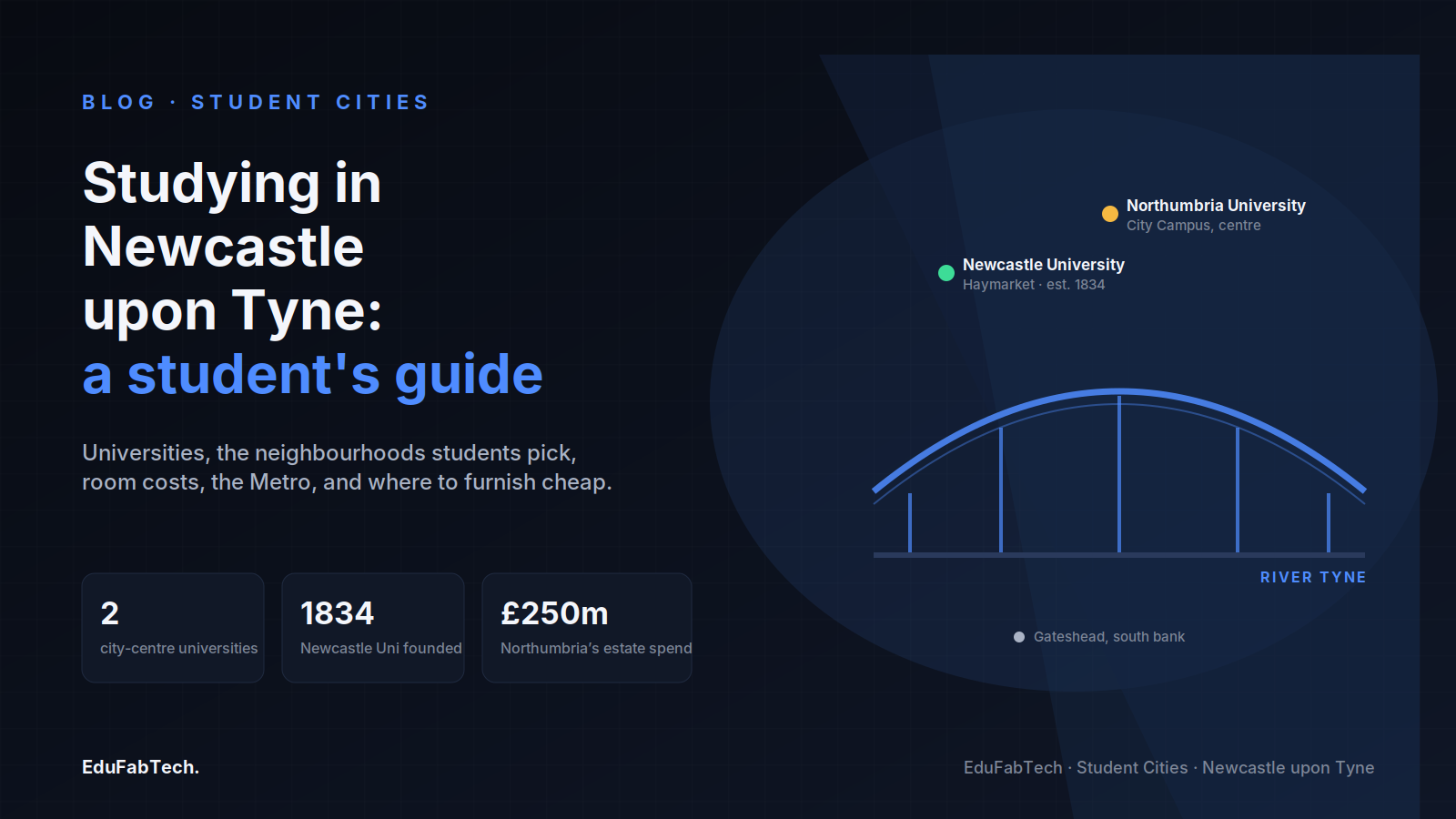
Newcastle upon Tyne sits on the north bank of the River Tyne in the North East of England, a compact and steep-sided city whose centre you can cross on foot in twenty minutes and whose bridges — the arched Tyne Bridge chief among them — drop you into Gateshead on the far bank. For students it is an unusually concentrated place: two universities teach in the middle of town, the nightlife and the shops are walkable from most lecture halls, and the Tyne and Wear Metro links the city to the coast, the airport and neighbouring towns on a single ticket.
That density shapes student life here. You are rarely far from a campus, a cheap market, a Metro stop or a stretch of Georgian terrace let to students. This guide walks through the institutions, the neighbourhoods people actually settle in, how to take a room without being cheated, what things cost with the sources attached, and the practical business of working, studying and getting around.
Newcastle University is the older of the two city-centre institutions. It traces its origins to 1834 and describes its home plainly as Newcastle, calling itself a civic university rooted in the North East with campuses also in Singapore and Malaysia. Its main site occupies the north edge of the city centre near Haymarket, a dense campus of listed buildings, laboratories and a medical school that grew out of that 1834 school of medicine and surgery.
Northumbria University is the other, newer presence in the centre. Its City Campus is, in the university's own words, in the heart of Newcastle, a couple of roads from the main shopping streets, and the university says it has invested more than £250 million in its estate over the last decade, including the award-winning City Campus East building that houses Business, Law and Design. The two universities are close enough that students treat the whole centre, from Haymarket down to the river, as one shared patch.
Two more universities lie a short train ride away and draw regional students. The University of Sunderland, roughly twenty minutes east by Metro, runs a City Campus built around its health sciences, including the Schools of Medicine and Nursing, and a riverside Sir Tom Cowie Campus at St Peter's for business, media and computing. Durham University, to the south on the East Coast Main Line, is a collegiate university whose colleges cluster on the peninsula above the River Wear; one of them, University College, occupies Durham Castle, part of the UNESCO World Heritage Site of Durham Cathedral and Castle that was inscribed by UNESCO in 1986.
Alongside the universities, the region's further-education colleges — Newcastle College and Newcastle Sixth Form College in the city, Gateshead College across the river, and New College Durham — teach vocational and access courses, and some run degrees validated by partner universities. For most readers of this guide, though, the gravity is the two city-centre universities and the streets around them.
Where the student streets are: Jesmond, Heaton and beyond
The single most sought-after student quarter is Jesmond, a grid of leafy Victorian terraces and converted flats just north of the centre. It carries the city's reputation for student nightlife along Osborne Road, and two Metro stations — Jesmond and West Jesmond — put either city-centre campus minutes away. Because everyone wants it, Jesmond is also among the pricier places a student can rent.
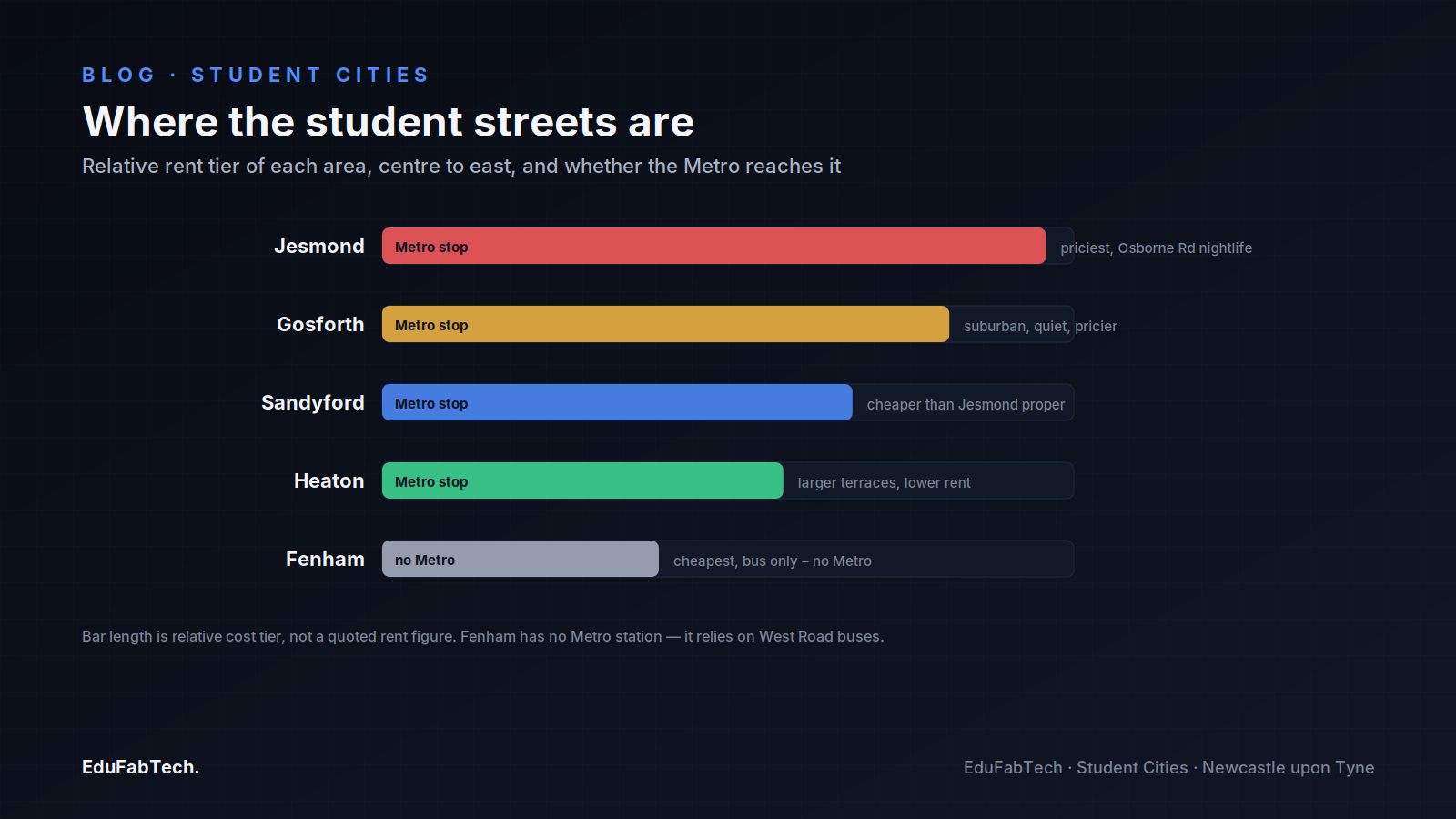
Sandyford fills the gap between the city centre and Jesmond. It is walkable to both universities, a little quieter and usually a little cheaper than Jesmond proper, and popular with students who want to be close in without paying the Osborne Road premium.
Heaton lies further east, beyond Jesmond, built around Chillingham Road with its own Metro stop, independent cafés and a long row of shops. The houses are larger terraces, rents tend to be lower than Jesmond, and it suits second- and third-years and postgraduates who want more space and a residential feel.
Shieldfield and the Ouseburn Valley sit closest to Northumbria's City Campus East, on the eastern edge of the centre. Shieldfield has clusters of purpose-built halls within walking distance of lectures; downhill, the Ouseburn is the city's creative quarter, full of music venues, breweries and studios rather than family housing.
Fenham, west of the centre toward the former General Hospital site, is a cheaper option with plenty of shared houses, but it has no Metro station — you rely on the frequent buses along the West Road, so factor the commute in. Gosforth, to the north, is more suburban and settled, favoured by postgraduates and staff who want quiet; it is pricier but well served by the Metro at South Gosforth and Regent Centre. You can browse what is currently advertised across all of these areas on EduFabTech's Newcastle listings and the rooms page.
Taking a room without losing a deposit
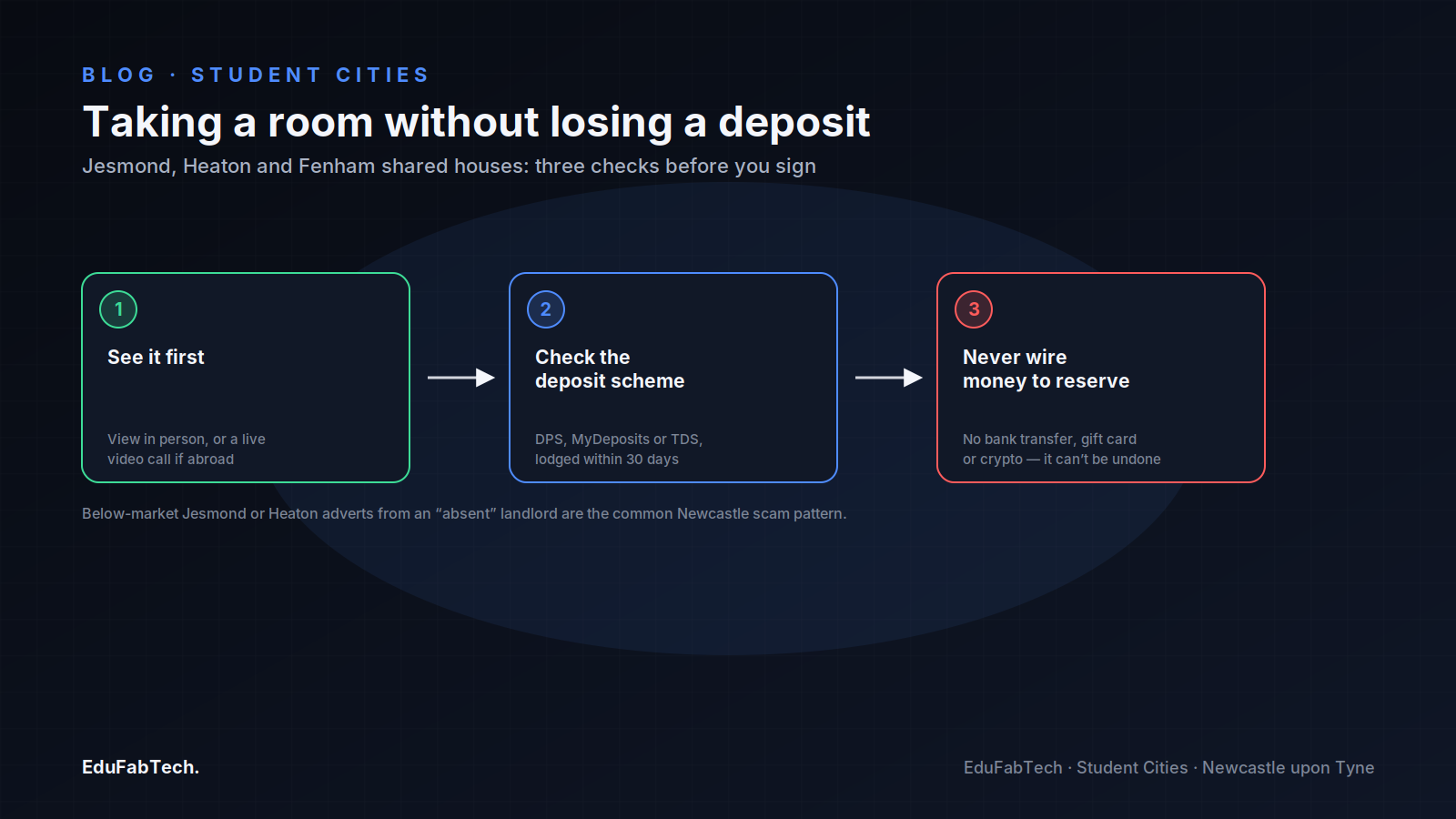
First-year undergraduates usually start in university or university-partnered halls, which remove most of the risk: you sign one contract, bills are included, and there is no landlord to vet. For later years, students move into shared houses in Jesmond, Heaton, Sandyford and Fenham, and that is where care is needed. The shared-house market for the following September tends to open from late autumn and through winter, which is earlier than newcomers expect — but the earliest adverts are not the only ones, and rushing a signature is itself a risk.
In England a landlord must protect your deposit. The government requires it to be placed in one of three approved tenancy deposit schemes — the Deposit Protection Service, MyDeposits or the Tenancy Deposit Scheme — within 30 days of receiving it. Ask which scheme holds your money and get the reference; a landlord who cannot answer is a warning sign.
The scams that appear in Newcastle follow a pattern: an advert for a Jesmond or Heaton terrace priced below the going rate, a landlord who is conveniently out of the city, and a request to wire a "holding deposit" before you can see the place. See the room in person before paying anything — or, if you are still abroad, ask someone you trust to view it on a live video call. Never send money by bank transfer, gift card or cryptocurrency to reserve a room, because those payments cannot be reversed and a genuine letting will not demand them that way.
Furnishing a room the cheap way
Newcastle is well supplied with places to kit out a room without buying new. The Grainger Market, the covered Victorian market hall on Grainger Street in the centre, is open 9am to 5.30pm Monday to Saturday and closed on Sundays and Bank Holidays; its stalls run from fruit and veg to household basics and cheap lunches. For second-hand furniture, crockery, vinyl and vintage clothes, Tynemouth Market fills the restored Victorian Tynemouth Station at the end of the Metro line and is open every Saturday and Sunday from 9:00am to 3:30pm with over 150 stalls under its glass roof.
Charity shops are thick on the ground along Chillingham Road in Heaton and Gosforth High Street, and the end of the academic year is the best time to pick up desks, lamps and kitchenware as departing students clear out. On EduFabTech you can also check the city's second-hand listings and what is being given away free before you spend anything.
Working while you study
Newcastle has a large retail, hospitality and events economy that leans on student labour, so term-time jobs are findable. International students must mind their visa first. According to UKCISA, the UK Council for International Student Affairs, most Student visa holders can work up to 20 hours a week during term time, some are restricted to 10 hours, and some have a work prohibition, with no specific weekly limit during vacations. The precise condition is printed on your own visa or eVisa, and the official overview is the UK government's Student visa pages; treat those, not a guide like this, as the authority on your situation. Current vacancies in the city are collected on EduFabTech's Newcastle jobs page.
Libraries and places to read
Newcastle University's Philip Robinson Library, its main humanities and social-science library, runs 24 hours a day in term time, with the Walton Library serving medicine and the other site libraries on shorter hours. Northumbria's University Library sits in Student Central at the core of City Campus. Beyond the universities, the public Newcastle City Library on New Bridge Street gives anyone a free, central place to work, and the city's cafés are plentiful for lighter study. EduFabTech lists bookable study spaces and desks across the city.
Getting around on the Metro and Pop
The Tyne and Wear Metro, run by Nexus, is the backbone of travel here, linking the city centre, Gateshead, the coast at Tynemouth and South Shields, Sunderland and Newcastle Airport. It is complemented by buses from several operators and the Shields Ferry across the Tyne. The region's smartcard is Pop: the pay-as-you-go card is free but must be loaded with a £5 balance, Metro fares are capped at £2.50 for any single journey and £5 for all-day travel, and the operator advertises savings of up to 51% against paper tickets. Riders aged 16 to 21 can use a Pop Blue card, and Nexus and the universities offer longer-period season products for frequent travellers. Much of central student life, though, needs no fare at all — from Jesmond or Sandyford, both campuses are a walk.
What it costs, with sources
Housing is the largest line in any student budget, and Newcastle's figures are concrete. For 2026/27 Newcastle University prices its Newgate Court rooms at £205.25 per week on a fixed 40-week contract covering the academic year. Northumbria University's own managed halls span a wider range for 2026/27, from £121.05 a week at Stephenson up to around £194 a week at newer blocks such as The Bridge. In the private market, the Office for National Statistics reported that the average monthly private rent in Newcastle upon Tyne was £1,220 in September 2026, up from £1,131 in September 2025, a rise of 7.9% — a whole-city figure that covers family homes as well as student lets, but a useful marker of direction.
One cost you can often remove entirely: in England, households where everyone is a full-time student do not have to pay Council Tax, with full-time generally meaning a course lasting at least a year and involving at least 21 hours of study a week. If even one housemate is not a full-time student, the household gets a bill, so check the make-up of any house-share before signing.
The good and the hard
What students tend to like about Newcastle is its scale and value. Everything is close; rents and nights out cost less than in London, Edinburgh or Oxford; the coast is a short Metro ride; and the city has a warm, sociable reputation. What is harder is also real. The ONS rent figures show prices climbing year on year, and the most desirable area, Jesmond, is competitive and comparatively dear. Some cheaper neighbourhoods such as Fenham have no Metro and lean on buses, so a low rent can come with a longer commute. And the North East weather is genuinely cool, wet and windy, with short, dark winter days — worth planning your study routine around rather than being surprised by. Student-heavy streets can also be noisy, which cuts both ways depending on whether you want the party or quiet for finals.
A checklist for your first fortnight
- Confirm your accommodation contract and, if you are renting privately, get the name of the deposit scheme and your reference number.
- Order a free Pop card and load the £5 minimum, or sort a season product if you will travel daily.
- Register with a local GP surgery near where you live.
- Open or activate a UK bank account and set up any standing order for rent.
- Collect your student status letter and, if your household is all full-time students, apply for the Council Tax exemption with your local council.
- If you are an international student, read your visa's work condition before taking any job, and keep the gov.uk guidance to hand.
- Walk the route from your room to your campus and your nearest Metro stop once, in daylight, before term starts.
Newcastle rewards students who settle in quickly: learn the Metro map, pick the neighbourhood that fits your budget and your tolerance for noise, and use the markets and second-hand trade that the city does well. Do that, and the compactness that defines the place starts working in your favour.
A quick question for readers
Do you work part-time while you study?
Many students work to pay the bills. See how common it is — and how many hours people really do.
Pick an answer, create a free account in a minute, and your vote counts. Already a member? Sign in
Comments 3
Comment-
The number that actually tells you something is the 7.9% year-on-year rent jump against a Metro fare that's been capped at £2.50 and a £5 da…
-
The Pop card numbers are a good example of a hard figure sitting next to a soft one. The £2.50 single/£5 day cap is concrete and checkable.…
-
The bit I'd want to poke at is the Pop card's "savings of up to 51% against paper tickets" line sitting right next to the actual caps - £2.5…
Join free to read the full comments and reply Comments are between members; an account takes a minute.
Source: Office for National Statistics
Sources (5)
- Office for National Statistics. Private rent and house prices, Newcastle upon Tyne. Office for National Statistics, 2026. ons.gov.uk ↗ · checked 5 Nov 2026
- Newcastle University. Accommodation: Newgate Court. Newcastle University, 2026. ncl.ac.uk ↗ · checked 5 Nov 2026
- Northumbria University. Newcastle City Campus. Northumbria University, 2026. northumbria.ac.uk ↗ · checked 5 Nov 2026
- UKCISA. Navigating work and study with a Student visa. UK Council for International Student Affairs, 2026. ukcisa.org.uk ↗ · checked 5 Nov 2026
- Nexus / Travel North East. Pop. Nexus (Tyne and Wear Passenger Transport Executive), 2026. travelnortheast.uk ↗ · checked 5 Nov 2026