Studying in Norwich, Connecticut: universities, housing and student life
A practical guide to living as a student in Norwich — where the degree-granting campus actually sits, what a room costs, how to get around, and what the city gets right and wrong.
Norwich sits at the head of the Thames River in southeastern Connecticut, where the Yantic and Shetucket rivers meet and a third, the Quinebaug, joins the Shetucket a few miles upstream. The old mills and granite civic buildings along the water earned the city a long-standing nickname, the Rose of New England, used in travel writing including a National Geographic feature on the town. For a prospective student, though, the first thing to understand about Norwich is geographic: the public university most people connect with this corner of the state does not stand in Norwich at all.
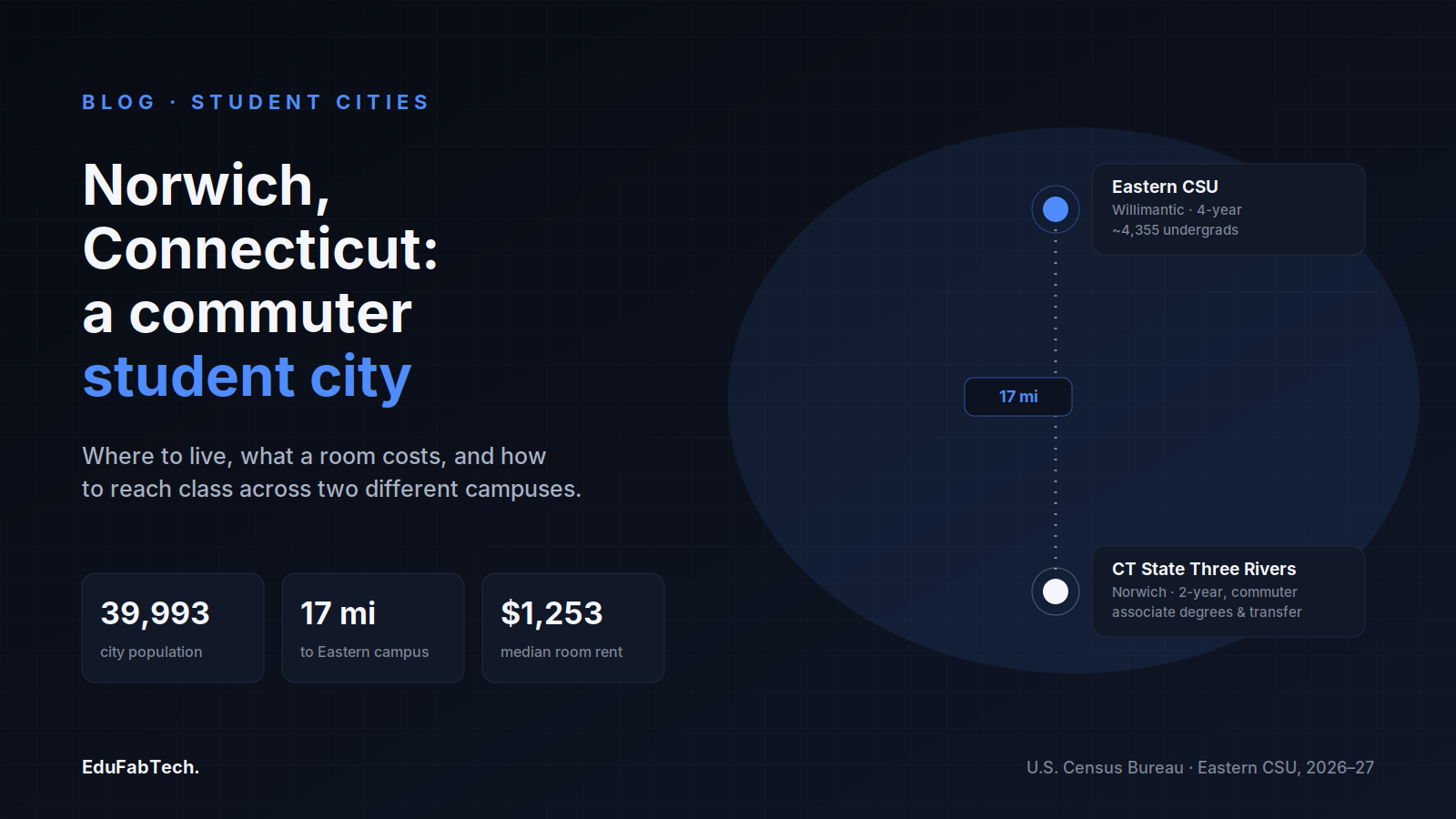
Eastern Connecticut State University is in Willimantic, roughly 17 miles northwest up Route 32, about a half-hour drive. Inside Norwich itself, the degree-granting institution is CT State Community College's Three Rivers campus, which awards associate degrees and certificates. So "studying in Norwich" usually means one of two things: commuting from a cheaper Norwich room to Eastern's Willimantic campus, or enrolling at Three Rivers in the city and perhaps transferring onward. This guide treats both honestly, because the housing maths and the commute are very different depending on which one you are doing.
The U.S. Census Bureau's QuickFacts page for Norwich city, Connecticut puts the July 1, 2024 population estimate at 39,993, with a median household income of $65,024 for the 2020–2024 period — modest for Connecticut, which is part of why rooms here undercut the shoreline towns to the south. What follows covers the campuses, where to live and how to vet a room, furnishing it cheaply, part-time work rules, libraries, transport, the real cost figures, and the trade-offs you only notice once you have signed a lease.
The two places you would actually enrol
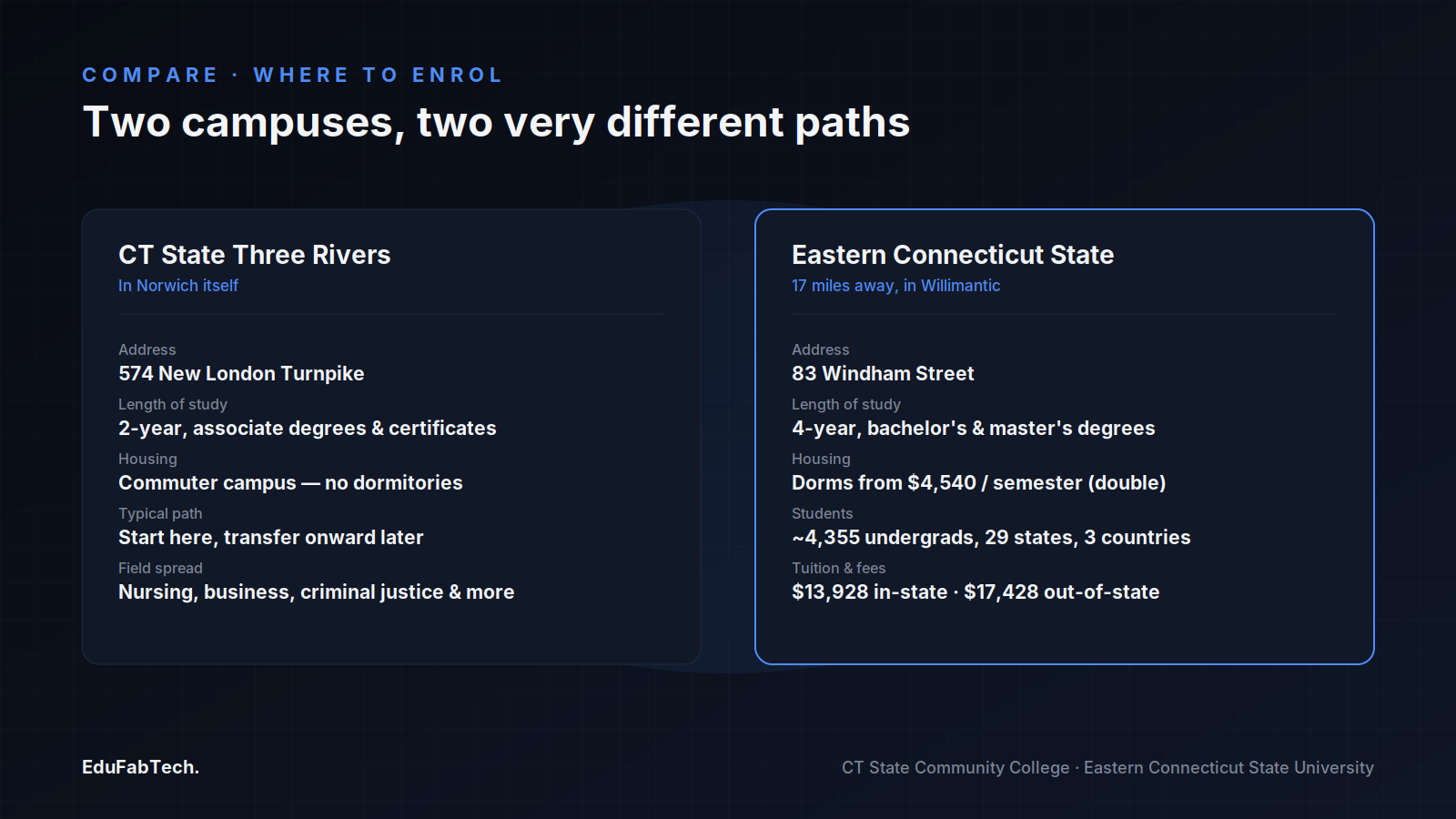
Eastern Connecticut State University describes itself on its own homepage as "a public university with a private college atmosphere" and as Connecticut's public liberal arts university; the site notes it belongs to the Council of Public Liberal Arts Colleges (COPLAC). Eastern's homepage lists about 4,355 undergraduates drawn from 29 states and 3 countries, and the campus address is 83 Windham Street, Willimantic. The grounds split into a historic South Campus and a newer North Campus that holds the library, student centre and fine-arts building. If you are coming from abroad or from another state, Eastern is the four-year, bachelor's-and-master's option in this area, and the one whose housing and fee pages are used for the numbers later in this guide.
Because Eastern is in Willimantic, living in Norwich while studying there means a daily car commute — there is no single quick local bus between the two towns, so budget for a vehicle or a Willimantic room if the commute does not suit you. Listings near the campus are gathered on EduFabTech's page for Eastern Connecticut State University, which is worth scanning before you decide whether to base yourself in Norwich or closer to the university.
Within Norwich, CT State Community College Three Rivers sits at 574 New London Turnpike and grants associate degrees and certificates across a wide spread of fields, from nursing to business to criminal justice; it became part of the single statewide CT State Community College in the 2023 consolidation of Connecticut's community colleges. It is a commuter campus — there are no dormitories — so Three Rivers students live in the surrounding neighbourhoods and towns. For many people in Norwich, the practical route is to start at Three Rivers and transfer, which keeps the first two years cheap and local.
Where a Norwich room really is, and when to start
Norwich is a town of distinct pockets rather than one dense student quarter. Downtown Norwich, around Main and Franklin streets near the harbour, has the oldest building stock — walk-up apartments above storefronts and converted mill and commercial buildings — and the lowest rents. Away from the centre, neighbourhoods such as Greeneville, Taftville and Thamesville (old mill villages now part of the city) and the quieter streets toward Norwichtown offer the two- and three-family wooden houses common across eastern Connecticut, where a single floor is rented as a flat. Because Three Rivers and Eastern are both commuter-heavy, there is no purpose-built student-housing strip; you are renting in an ordinary residential market and sharing buildings with families and long-term residents.
Start looking earlier than you think. The most affordable downtown flats turn over quickly in July and August, and a September enrolment date means competing with everyone else arriving for the term. Begin a serious search six to eight weeks out, and see the EduFabTech rooms listings for Norwich and the city's full student listings alongside whatever you find elsewhere.
On deposits and scams, keep it concrete to Norwich. A legitimate landlord here will let you walk the actual unit — many are on upper floors of older downtown buildings or in a two-family house where the owner lives on the other floor, so an in-person viewing is normal and easy to arrange. Expect to put down something like first month's rent plus a security deposit; under Connecticut law a security deposit is capped (one month's rent for tenants aged 62 and over, two months for everyone else), so a demand for more than that is a warning sign. The scams that appear in this market are the ordinary ones: a "landlord" who is conveniently out of state, a mill-conversion loft advertised well below the others, pressure to reserve it sight-unseen. Never send money by bank wire, gift card or cryptocurrency to "hold" a room, and do not pay a deposit before you have stood inside the unit and seen a written lease with a real local address. If a listing cannot be viewed in person, treat that as the end of the conversation, not a hurdle to work around.
What it costs, with the figures attached
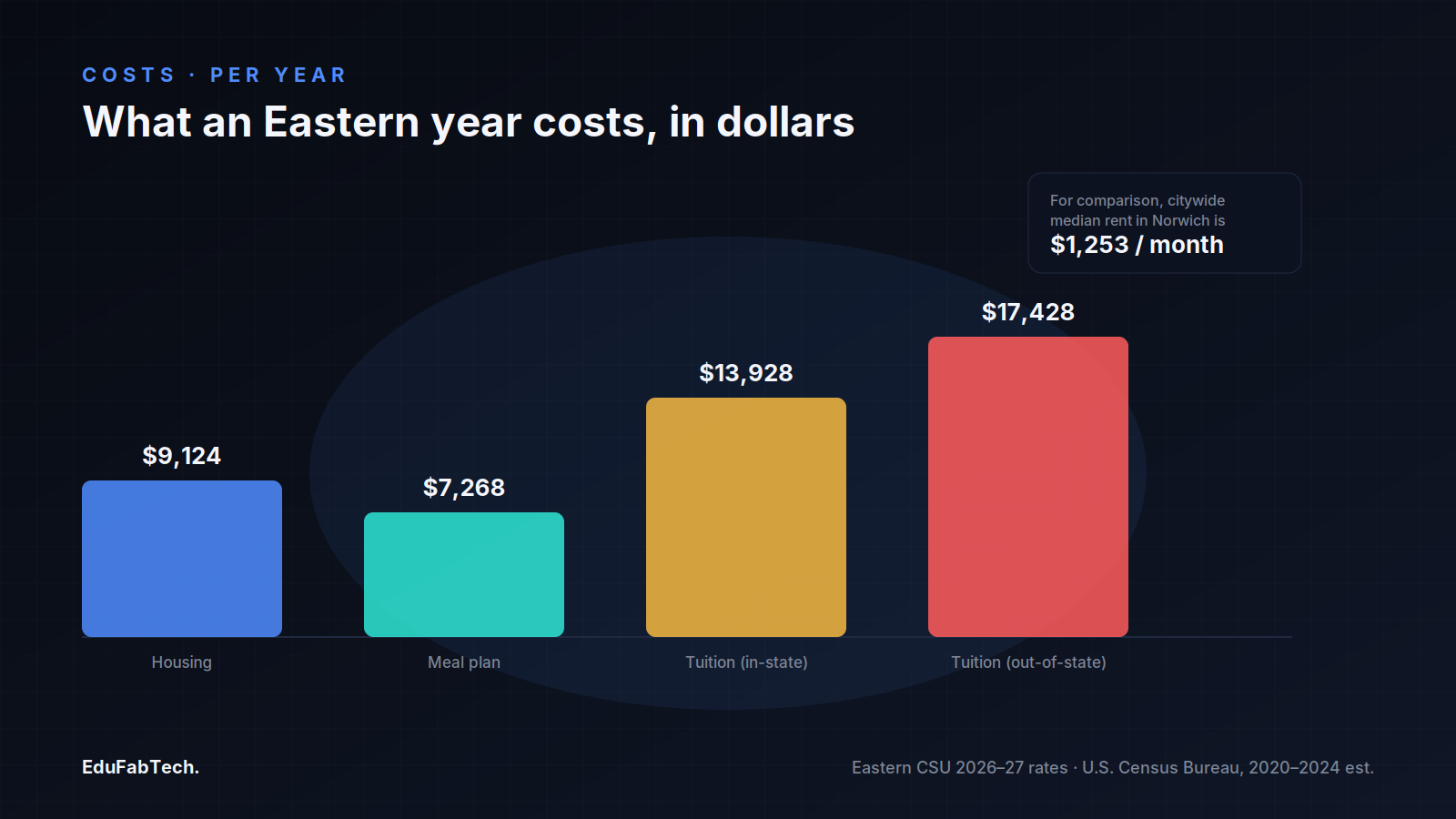
For an anchored, dated housing number, use Eastern's own pages. Eastern Connecticut State University's 2026/2027 housing rates list a traditional double in the first-year halls (Burnap, Burr and Crandall) at $4,540 per semester, with singles and suites rising through the range to a Shafer Hall studio single at $6,536 per semester; the rates exclude a $22 social fee per semester, and first-year halls require the Silver Plus meal plan, which costs $3,634 per semester (it includes $125 in dining dollars). Eastern's 2026–27 tuition-and-fees page gives the annual on-campus housing charge as $9,124 and the Silver meal plan as $7,268, on top of tuition and fees of $13,928 for in-state and $17,428 for out-of-state students.
For the private market in Norwich itself, the U.S. Census Bureau's QuickFacts (2020–2024 estimate) puts the median gross rent in Norwich city at $1,253 a month. That is a whole-unit figure across all sizes, so a room in a shared flat typically runs below it — but it is the most reliable dated benchmark for the city, and it sits well under what comparable shoreline towns command. Treat the dormitory rate as the number you can plan a budget around, and the Census rent as the ceiling to measure any shared-flat offer against.
Furnishing a room without buying new
Norwich's affordability extends to kitting out a room, if you are patient. The Downtown Norwich Farmers' Market runs on Wednesdays from 10am to 2pm at Howard T. Brown Memorial Park on Chelsea Harbor Drive, from July to October, according to the City of Norwich's Happenings page — useful for cheap produce early in the autumn term, though it closes for the winter. For furniture, kitchenware and the rest of a room, the move-out weeks in late spring and the start of term are when the most gets given away or sold cheaply by departing residents.
Rather than name individual shops, which open and close, use the EduFabTech second-hand things in Norwich page, which gathers furniture, kitchenware and free giveaways and is kept current. A desk and a chair you can sit at for hours are worth more than almost anything else you will buy; prioritise those and let the rest accumulate.
Working part-time: the rules, and where to confirm them
If you are an international student on an F-1 visa, the firm rule from the U.S. Department of Homeland Security's Study in the States guidance is that for on-campus employment "you may not work more than 20 hours per week when school is in session." Off-campus work is not something you can simply take: DHS states you must first get a recommendation from your school's Designated School Official, then file Form I-765 with USCIS, and that "you cannot begin to work while the Form I-765 is pending" — you work only after the Employment Authorization Document is issued. This is official policy, not advice, and the categories (on-campus, CPT, OPT) have conditions that change; verify your own situation with your DSO and the DHS Study in the States page before you accept any job.
Practically, on-campus roles at Eastern or Three Rivers are the simplest to hold within the rules. For the local off-campus picture in Norwich — retail, the hospitality around the casinos a short drive east, seasonal work — browse the EduFabTech Norwich jobs listings, but line up the immigration side first.
Libraries and places to read
Norwich's public library is the Otis Library at 261 Main Street, in the heart of downtown. Its contact page lists hours of 9am–7pm on Monday and Wednesday, 9am–5pm on Tuesday and Friday, 9am–2pm on Thursday and Saturday, and closed on Sunday — generous on two weekday evenings but tight at weekends, so plan around those windows. It is a genuine quiet-study option in the city centre and within walking distance of downtown flats.
On campus, Eastern's J. Eugene Smith Library on North Campus keeps much longer hours during the semester — the library's posted term hours run 7:45am to midnight Monday through Thursday during the fall semester — which is the real advantage of basing study time at the university rather than in town. Three Rivers has its own campus library for enrolled students. Because the city's public hours are limited, EduFabTech's Norwich study-spaces listings are worth checking for cafés and desks when the libraries are shut.
Getting around Norwich — and up to Willimantic
Local buses in Norwich are run by the Southeast Area Transit District (SEAT), which serves Norwich, New London, Groton and the surrounding towns. SEAT's fares page lists a one-ride Regular Pass at $1.75, a 1-Day Unlimited Pass at $3.50, a 10-Ride Pass at $17.50 and a 31-Day Unlimited Pass at $40.00, with a reusable SEAT Smart Card at $4.00. There is no student discount — SEAT's own FAQ states plainly that it does not currently offer one — so a student pays the same adult fare as anyone else, and the cheapest way to commute daily within the network is the 31-day pass.
SEAT's network is oriented toward Norwich and the shoreline, not toward Willimantic. There is no quick, direct SEAT run between Norwich and Eastern's campus, so students attending Eastern while living in Norwich should assume they need a car for the roughly 17-mile trip up Route 32. Within Norwich, the bus is usable for getting downtown and across to the New London Turnpike area where Three Rivers sits, but headways are not frequent, so check the timetable against your class schedule rather than assuming a bus will be there when you want it.
What Norwich gets right, and what is hard
The honest case for Norwich is cost and character. Rents here, with the Census median gross rent at $1,253 for 2020–2024, are low for Connecticut; the downtown has real history and a waterfront rather than strip-mall anonymity; and Three Rivers gives a cheap, local on-ramp to a degree. The city is also well placed between two bigger poles — it lies roughly midway between Boston and New York — so weekend travel is feasible.
The hard parts are equally real. The flagship four-year university is not in the city, so anyone enrolled at Eastern faces a car-dependent commute and a transit system that will not carry them there. SEAT is affordable but infrequent and gives students no discount. Norwich's housing stock is older mill-era building, which can mean charm and can equally mean draughty winters and uneven maintenance — eastern Connecticut winters are cold and grey, and heating an old flat is a line in the budget. And because there is no student quarter, the social centre of gravity is wherever your campus is, not the city itself; a Norwich room can feel quiet if your classmates all live near Willimantic. Weigh the cheaper rent against the commute honestly before you commit.
A checklist for the first weeks
- Confirm which campus you are at, then choose where to live: if you are at Eastern, a Norwich room means a daily drive to Willimantic — decide whether the lower rent is worth it before signing.
- See the unit in person before paying anything, and never wire a deposit or pay by gift card or crypto to "hold" a place; check the lease shows a real local address.
- Know the deposit cap: Connecticut limits a security deposit to two months' rent (one month if you are 62 or over) — more than that is a red flag.
- If you are on an F-1 visa, talk to your Designated School Official before taking any job, and read the DHS Study in the States work page; on-campus work is capped at 20 hours a week while school is in session.
- Set up transport: if you will use SEAT, buy a Smart Card and a 31-Day pass; if you are commuting to Eastern, sort out a car and parking.
- Map your study hours: note Otis Library's limited weekend hours and lean on Eastern's J. Eugene Smith Library, open to midnight on weeknights in term, for late sessions.
- Furnish from the second-hand flow during move-out and start-of-term weeks, prioritising a proper desk and chair; use the EduFabTech Norwich second-hand page.
A quick question for readers
Do you work part-time while you study?
Many students work to pay the bills. See how common it is — and how many hours people really do.
Pick an answer, create a free account in a minute, and your vote counts. Already a member? Sign in
Comments 2
Comment-
The gap that jumps out is the car. The piece nails every other cost to the dollar - $1,253 median gross rent, $9,124 a year for Eastern's do…
-
The deposit cap detail is the one worth underlining: a two-month maximum (one month if you're 62+), and anything above that is a flag before…
Join free to read the full comments and reply Comments are between members; an account takes a minute.
Source: Eastern Connecticut State University
Sources (5)
- Eastern Connecticut State University. Housing Rates 2026/2027. Eastern Connecticut State University, 2026. easternct.edu ↗ · checked 3 Nov 2026
- Eastern Connecticut State University. Tuition & Fees — Yearly Expenses (full-time undergraduates). Eastern Connecticut State University, 2026. easternct.edu ↗ · checked 3 Nov 2026
- U.S. Census Bureau. QuickFacts: Norwich city, Connecticut. U.S. Census Bureau, 2025. census.gov ↗ · checked 3 Nov 2026
- Southeast Area Transit District. Fares. Southeast Area Transit District, 2026. southeastareatransitdistrict.com ↗ · checked 3 Nov 2026
- U.S. Department of Homeland Security. Working in the United States. Study in the States (DHS), 2026. studyinthestates.dhs.gov ↗ · checked 3 Nov 2026