Studying in Norwich, United Kingdom: universities, housing and student life
A practical, sourced guide to the two universities, where students live, renting safely, second-hand Norwich, part-time work, study spaces, buses and what it all costs.
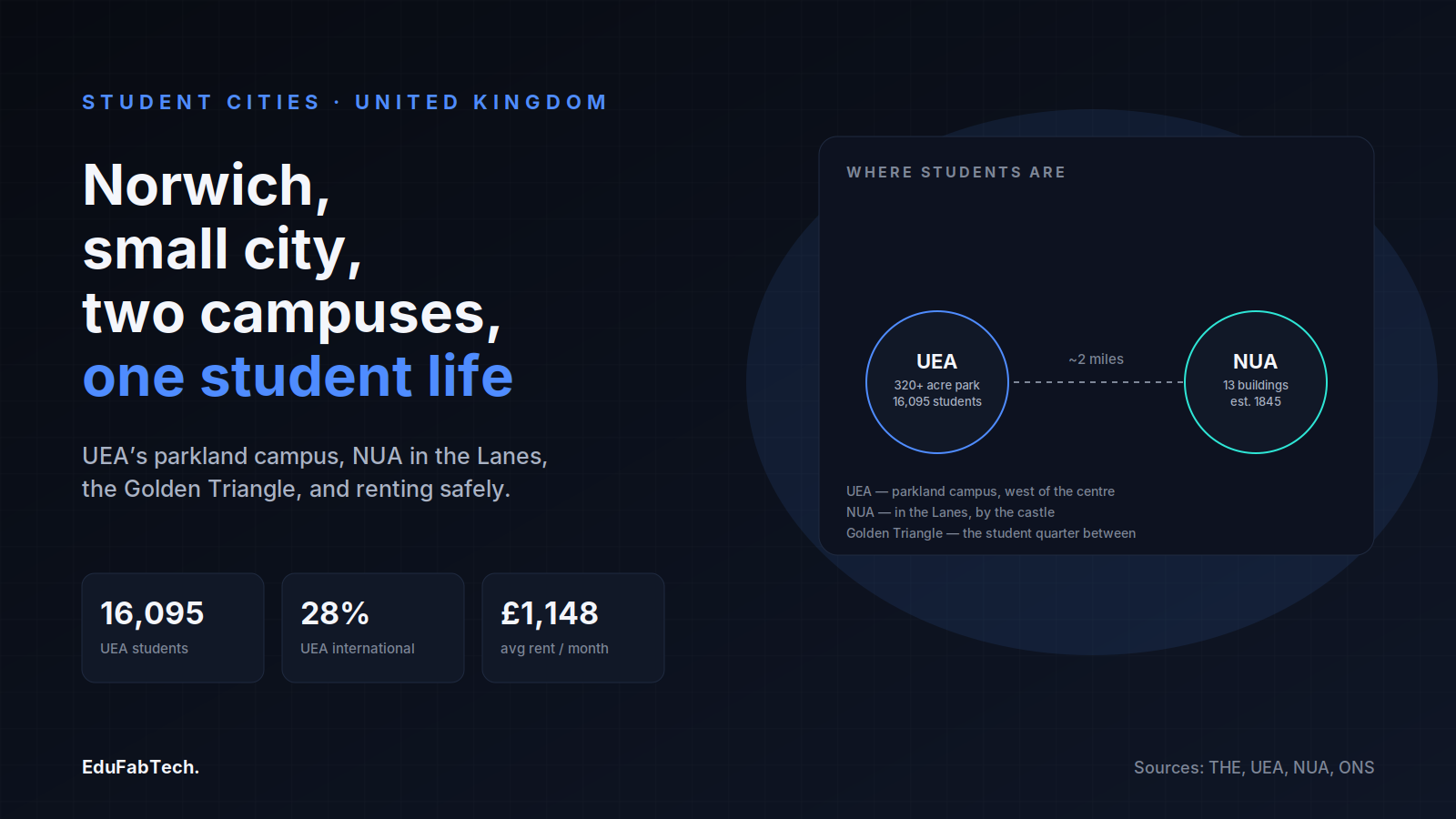
Norwich sits in the bulge of East Anglia, further from any other large English city than most students expect: it is the end of a railway line, not a stop on the way to somewhere bigger. That geography shapes student life here. The city turns inward on a dense medieval core of flint churches, lanes and a Norman castle, and it is small enough to cross on foot in twenty minutes. Its two universities pull in opposite directions from that core — one out to parkland in the west, one woven through the old streets themselves — and where you study largely decides where you look for a room.
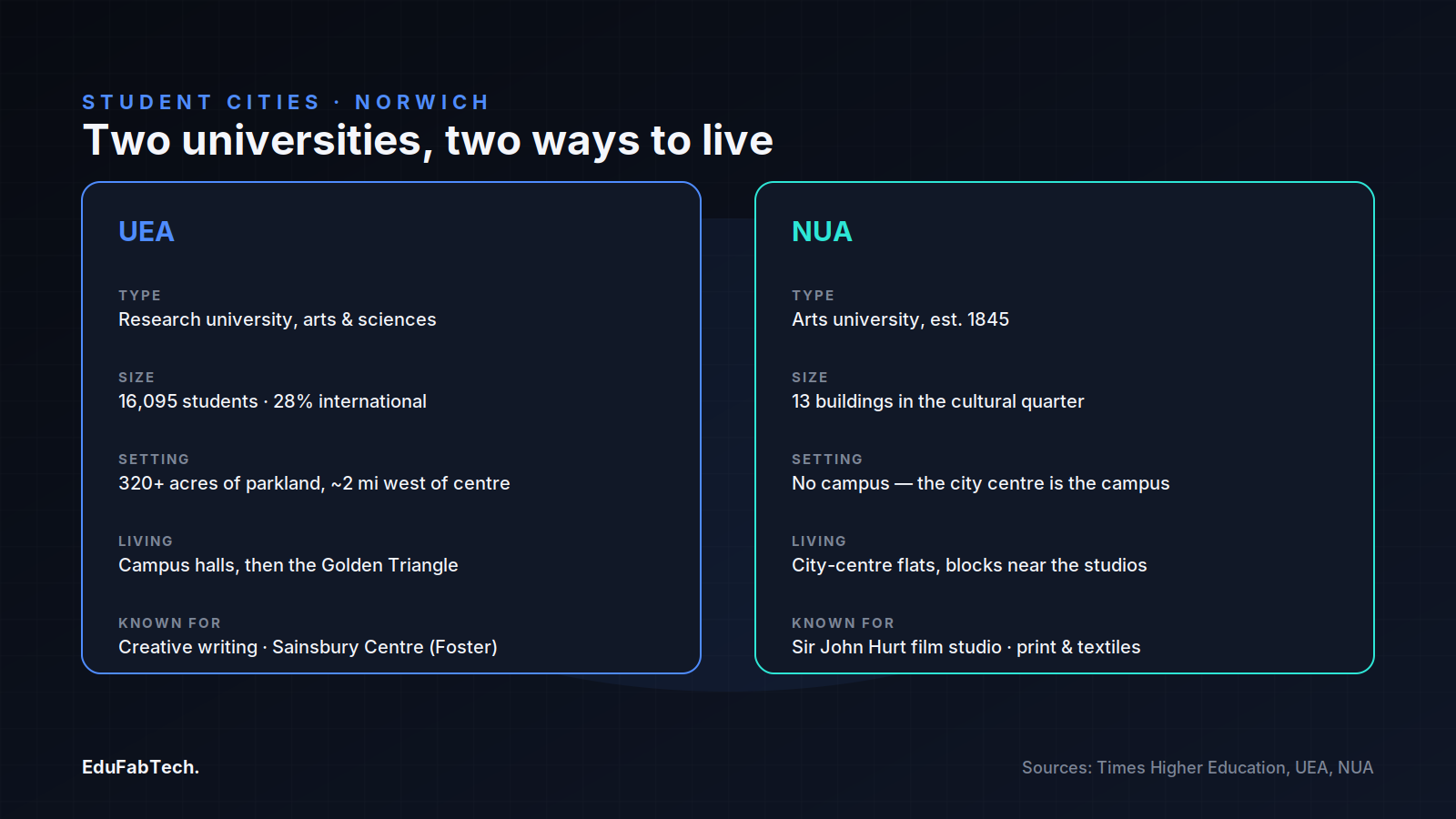
The University of East Anglia (UEA) is the larger of the two. A profile by Times Higher Education describes UEA as set in more than 320 acres of parkland and lists 16,095 students, 28 per cent of them from outside the UK, in its profile of the university. The campus lies roughly two miles west of the centre, grouped around a lake and the Brutalist concrete terraces that give it its look. It is a self-contained place: residences, shops, a sports park and a library all within a short walk, and the Norman Foster–designed Sainsbury Centre art gallery on its edge. UEA is a research university — the adjoining Norwich Research Park concentrates plant, food and health science — and it is also known for the arts, with a long-running reputation in creative writing.
Norwich University of the Arts (NUA) is the other, and it is almost the inverse of UEA. NUA says it was established in 1845, growing out of the city's nineteenth-century school of design, and today its campus is spread across 13 buildings in the cultural quarter near the castle and the Lanes — a film studio named after the actor Sir John Hurt, print and textile workshops, photography studios and digital labs tucked into buildings that run from medieval to modern. There is no out-of-town campus; NUA students live in the city because the university is the city. Alongside the two universities, City College Norwich on Ipswich Road is the area's large further- and higher-education college, and Great Yarmouth College sits about 20 miles east on the coast.
The Golden Triangle and the campus residences
First-year UEA students mostly take a room in the campus residences, named after Norfolk places and painters — Constable Terrace, Nelson Court, the Ziggurat terraces, and the Village across the main entrance. After first year, the centre of gravity shifts to the Golden Triangle, the wedge of Victorian terraces between Earlham Road, Unthank Road and Newmarket Road to the south-west of the centre. It is the classic Norwich student quarter: corner shops, launderettes, takeaways and pubs, within walking distance of the centre and a short bus ride from UEA. Streets off Dereham Road and Earlham Road are cheaper and busier; the Avenues and the roads nearer Unthank Road are quieter and pricier.
NUA students tend to stay in or near the centre — around the Golden Triangle too, but also in city-centre flats and purpose-built student blocks within walking distance of the studios, since the point of being at an arts university woven into the Lanes is being able to walk to a workshop in the evening. Wherever you aim, you can browse what is currently available in the city on EduFabTech's Norwich rooms listings, and the listings near UEA and near NUA pages narrow it to each campus.
Renting safely when the good houses go early
Norwich is a small rental market, and in a small market good shared houses in the Golden Triangle go early — a lot of second- and third-years sign for the following September before the previous Christmas. That pressure is exactly what rental scams exploit. The usual trap in a university city like this is a listing for a room in a desirable student street at a slightly-too-good price, posted by someone who claims to be away and asks you to transfer a deposit or a "holding fee" before you can view it.
The defence is simple and local. View the actual house in person, or send a flatmate or friend already in Norwich to view it for you, before any money changes hands — the Golden Triangle is compact and genuinely lettable houses can be seen. Never send a deposit, holding fee or first month's rent by bank transfer, gift card or cryptocurrency to "secure" a room you have not stood inside. In England a tenancy deposit on an assured shorthold tenancy must by law be protected in a government-approved scheme, so ask which scheme holds it and get the paperwork. If a landlord or "agent" resists a viewing or pushes for an instant irreversible payment, walk away.
Second-hand Norwich: the market and summer clear-outs
Norwich is an unusually good city for second-hand, partly because it has a real market at its heart rather than a car park of chain stores. Norwich Market, run by Norwich City Council, is one of the UK's oldest open-air markets; the council lists over 190 stalls trading Monday to Saturday, 8:30am to 5:30pm, selling everything from street food to vintage fashion, so the city's cheapest kitchenware, plants and second-hand clothes are a five-minute walk from the castle. Charity shops cluster along the streets leading off the centre and up towards the student areas, and house-share turnover in the Golden Triangle each summer means furniture, lamps and bikes change hands constantly.
Before buying anything new for a room, it is worth checking what other students are selling or giving away locally: EduFabTech lists second-hand things in Norwich, and much of the best stock appears in late June and July as graduating tenants clear out.
Working part-time while you study
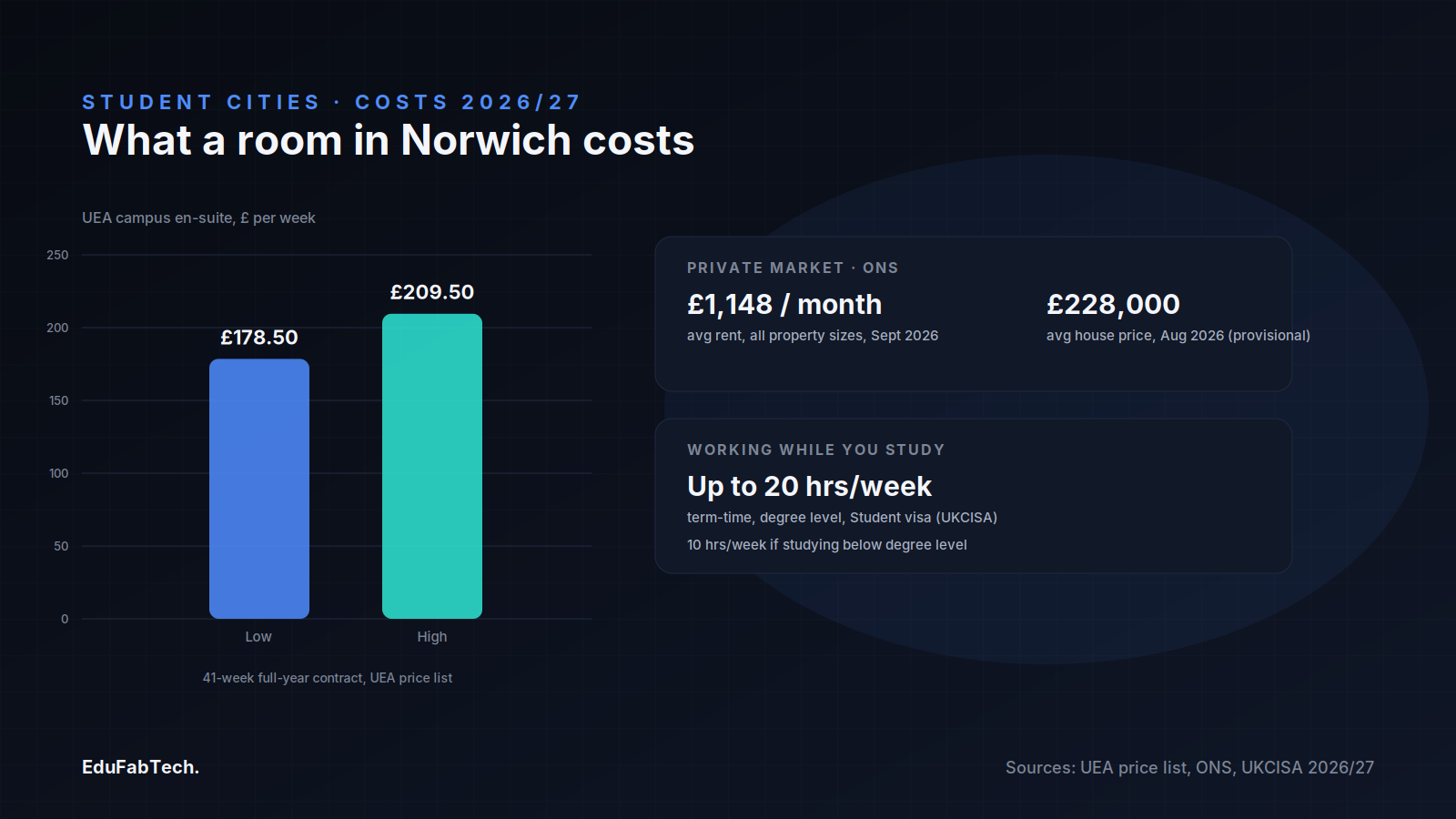
A compact centre with a six-day market, independent cafés, bars and shops means term-time jobs exist, and Norwich's size keeps the commute to them short. If you are an international student, the hours you may work are set by your visa, not by your employer, so check the rule before you accept anything. UKCISA, the UK Council for International Student Affairs, states that a Student visa holder studying at degree level or above can work up to 20 hours a week in term time, and up to 10 hours a week below degree level, with those limits applying where the sponsoring university has a compliant record; UKCISA also warns that self-employment and most freelance work are not permitted on the route. This is general information rather than legal advice — confirm your own conditions against your visa and the official guidance, and see current openings on EduFabTech's Norwich jobs page.
Study spaces: the Millennium Library and the campuses
Study space in Norwich is split between campus and city. UEA's library sits at the centre of its campus with the usual run of desks, group rooms and silent floors; NUA's facilities include its own library and a large Project Hall alongside the studios and workshops, which matters when your course is studio-based and you need somewhere to lay work out.
In the centre, the Norfolk and Norwich Millennium Library in The Forum — the glass building on Millennium Plain, a short walk from NUA — is a public reference and lending library open to anyone, which gives city-centre students a neutral place to work that is not tied to either university. Cafés in the Lanes and around the market fill the gaps between lectures. EduFabTech keeps a running list of study spaces and desks in the city.
Getting around: small enough to walk, flat enough to cycle
Much of student Norwich works on foot. The centre is walkable end to end, and the Golden Triangle is within walking distance of both the shops and, at a push, the bus into UEA. For the UEA commute most students use the bus: First Bus is the main operator, and it sells students dedicated tickets. For 2026/27 First Bus lists a one-term "UEA Solo Norwich" ticket at £171 and an annual Norwich ticket at £380, bought through its app, with term dates running from 1 September 2026. The same operator offers discounted student tickets for Norwich University of the Arts and City College Norwich students on its student-travel pages. Norwich is also flat, which makes cycling realistic; a second-hand bike bought through the market or a house-share clear-out is often the cheapest way to move between the Golden Triangle, the centre and campus.
What it costs — and what is hard
Housing is the figure that moves most. UEA's own price list for 2026/27 sets campus en-suite rooms between £178.50 and £209.50 per week depending on the residence, on a 41-week full-year contract. In the private market, the Office for National Statistics reported that the average monthly private rent in Norwich was £1,148 in September 2026 across all property sizes — a whole-home figure, so a room in a shared student house costs a fraction of it, but it is the honest benchmark for the local market. The same ONS page put the provisional average house price in Norwich at £228,000 in August 2026, which gives a sense of why the city is often described as more affordable than the south-east of England without being cheap.
The honest trade-offs follow from the geography. Norwich is compact, walkable and, by UK-city standards, calm — Times Higher Education's profile notes the city was named the UK's Best Place to Live by The Sunday Times in 2026. But its isolation is real: it is a long way from other big cities, and the rail journey to London is slow by the standards of better-connected university towns, so weekend trips cost time and money. The rental market is small, which means the good Golden Triangle houses are gone early and latecomers compete for what is left. The winters are grey and the east-coast wind is cold. And the split between a parkland campus two miles out and an arts university in the centre means the city has no single student district — which some find charming and others find diffuse. For most students the balance tips positive: a cheap, safe, human-scale city with a genuine culture of its own. It is worth knowing the hard parts before you arrive, not after.
A checklist for your first weeks
- Confirm your term dates and, if you are at UEA, work out your bus commute: price the one-term and annual First Bus tickets against how often you will actually travel in.
- If you are house-hunting for next year, start early — view every property in person before paying anything, and never transfer a deposit to hold a room sight unseen.
- Ask which government-approved scheme protects your deposit, and keep the paperwork.
- Furnish from the market, charity shops and other students' summer clear-outs before buying anything new; check the local second-hand listings first.
- Join the Millennium Library in The Forum for a study space that is not on either campus.
- If you are an international student, read your own visa work conditions and the official UKCISA guidance before taking a term-time job.
- Walk the centre, the Lanes and the Golden Triangle early — the fastest way to understand Norwich is on foot, and it is small enough to learn in an afternoon.
A quick question for readers
Do you work part-time while you study?
Many students work to pay the bills. See how common it is — and how many hours people really do.
Pick an answer, create a free account in a minute, and your vote counts. Already a member? Sign in
Comments 2
Comment-
The bus fares undercut the "honest benchmark" framing in the rest of the piece. £380 a year for an annual Norwich First Bus ticket against a…
-
The rent numbers are the useful bit, but notice how carefully hedged they are: ONS's £1,148 monthly average is a whole-home figure explicitl…
Join free to read the full comments and reply Comments are between members; an account takes a minute.
Source: Office for National Statistics
Sources (5)
- University of East Anglia. Accommodation Price List 2026/27. University of East Anglia, 2026. assets.uea.ac.uk ↗ · checked 8 Nov 2026
- Office for National Statistics. Housing prices in Norwich (Price Index of Private Rents). Office for National Statistics, 2026. ons.gov.uk ↗ · checked 8 Nov 2026
- UKCISA. Working as an international student. UK Council for International Student Affairs, 2026. ukcisa.org.uk ↗ · checked 8 Nov 2026
- Norwich City Council. Discover Norwich Market. Norwich City Council, 2026. norwich.gov.uk ↗ · checked 8 Nov 2026
- First Bus. University of East Anglia (UEA) student bus tickets. First Bus, 2026. firstbus.co.uk ↗ · checked 8 Nov 2026