Studying in Oakland: universities, housing and student life
A practical, honest guide to studying in Oakland, California — the campuses within reach, where students live, what a room costs, how to get around, and the trade-offs of basing yourself in the East Bay.
A city on the east shore, with its own pull
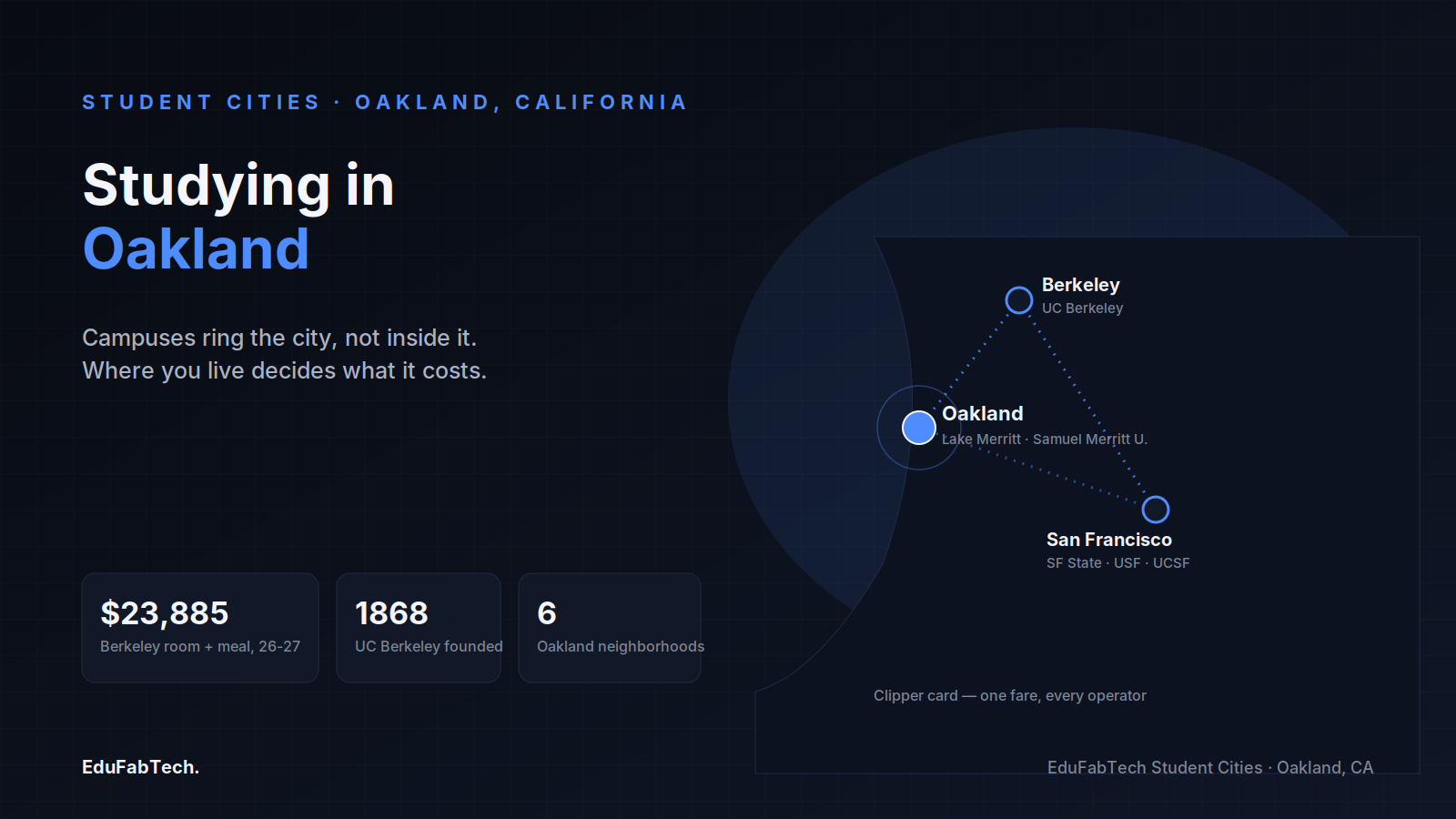
Oakland sits on the eastern side of San Francisco Bay, looking across the water at San Francisco and connected to it by the Bay Bridge and by the tunnels of the regional rail network. Its centre wraps around Lake Merritt, a tidal lagoon that doubles as the city's outdoor living room; its working waterfront is one of the largest container ports on the West Coast; and its land tilts from flat shoreline neighbourhoods up into the Oakland Hills. For a student, the first thing to understand is that Oakland is not a dormitory suburb of San Francisco. It is a large city in its own right, with its own campuses, its own culture, and — usefully — rents that tend to run below the ones directly across the bay.
The second thing to understand is geographic. Studying "in Oakland" often means living in Oakland and commuting out of it, because the region's best-known universities ring the city rather than sit inside it. That arrangement works precisely because the Bay Area is stitched together by rail and bus, and because a single contactless fare card — Clipper — works on nearly every operator you will touch. Where you choose to live, and how far your daily commute runs, will shape your budget more than almost anything else.
The flip side is cost. This is an expensive part of the United States to rent in, and no amount of local knowledge makes that disappear entirely. What local knowledge does is help you spend less than the sticker price: the right neighbourhood, a shared flat instead of a studio, a second-hand kitchen, and a transit pass instead of a car.
The universities in and around Oakland
Oakland's own degree-granting institutions are smaller than the giants across the water. Samuel Merritt University, in Oakland's Pill Hill medical district, is a health-sciences university best known for nursing, with programmes that range from an accelerated bachelor's degree through doctoral tracks. Lincoln University is a small private university with business and diagnostic-imaging programmes near downtown. Oikos University is a small Christian university in East Oakland, and the Academy of Chinese Culture and Health Sciences trains students in acupuncture and Chinese herbal medicine. Oakland was for decades also home to the California College of the Arts; its Oakland campus closed in 2022, and the college's own transition page states that CCA "will close by the end of the 2026–27 academic year" (CCA student FAQs), with teach-out partners taking on students who have not graduated by then.
A short ride north, in Berkeley, is the University of California, Berkeley, the public research university whose parent system, the University of California, dates its founding to 1868 (UC Berkeley); its graduate schools include the Goldman School of Public Policy. Berkeley also holds a cluster of smaller religious and graduate institutions: Zaytuna College, a Muslim liberal-arts college; the Graduate Theological Union, a consortium of seminaries and centres; the Institute of Buddhist Studies; and Pacific Lutheran Theological Seminary.
Across the bay in San Francisco, within reach by rail or Transbay bus, are the University of California, San Francisco (a health-sciences campus with no undergraduates), San Francisco State University, the University of San Francisco, the University of California College of the Law, San Francisco, the Academy of Art University, Golden Gate University, and the California Institute of Integral Studies. To the south, in Hayward, California State University, East Bay serves the inner East Bay. One caution if you are researching from older lists: several colleges that once operated here have shut down or merged in recent years, so confirm that any school you are counting on is still enrolling students before you build plans around it.
Where students settle
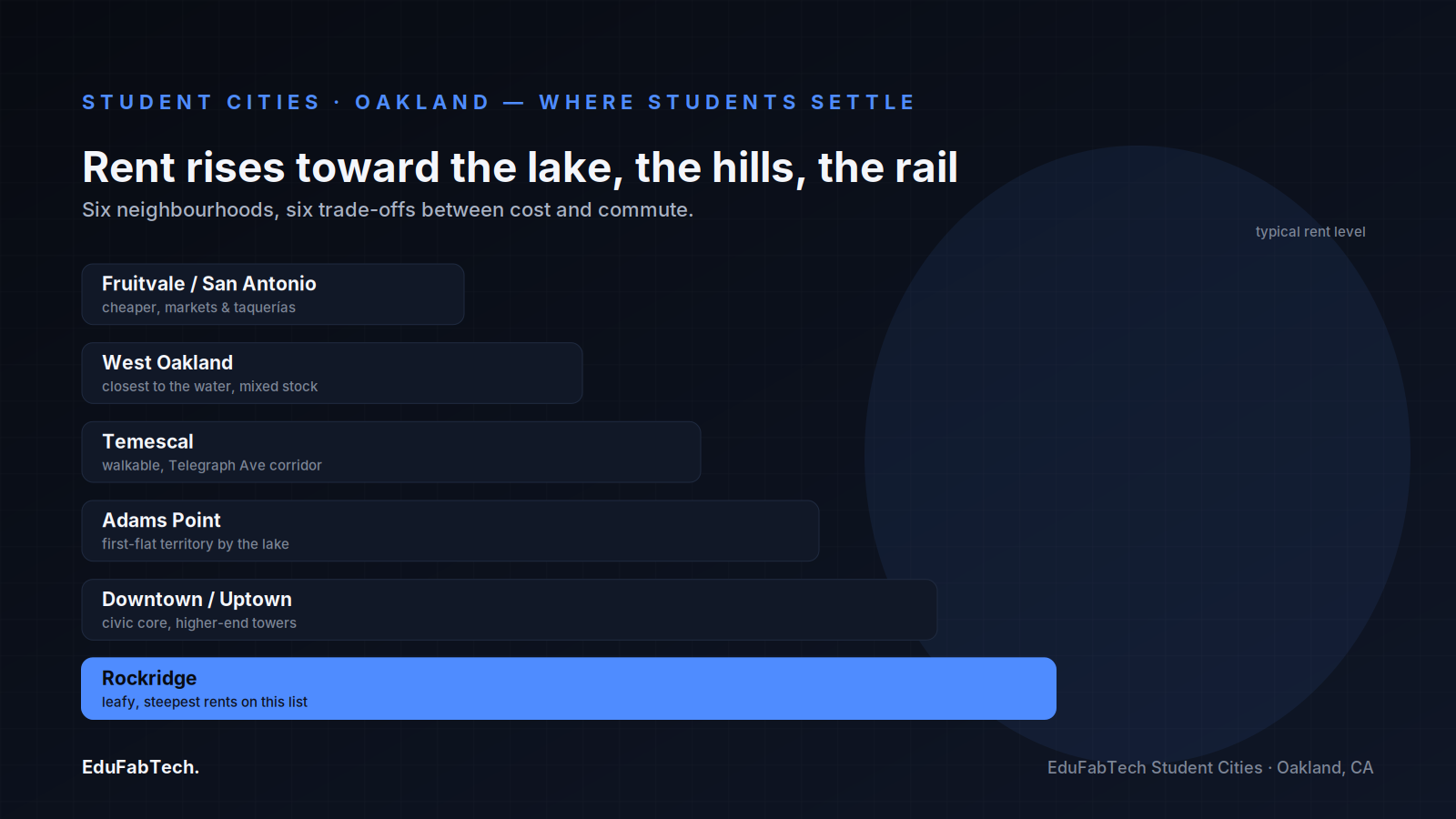
Because campuses are scattered, Oakland students cluster in the neighbourhoods with the best transit and the most shared housing rather than around a single quad. A few are worth knowing by name.
- Adams Point and the Lake Merritt shore — dense blocks of older apartment buildings a walk from downtown and from Samuel Merritt. This is classic first-flat territory: smaller units, lots of turnover, and a lake you can run around in the morning.
- Downtown and Uptown — the civic and nightlife core, with the 12th Street and 19th Street rail stations. Newer apartment towers sit next to theatres and restaurants; convenient and central, usually at the higher end of local rents.
- Temescal — along Telegraph Avenue, a food-heavy, walkable corridor popular with students and young workers, with good bus links and the MacArthur rail station at its edge for the hop to Berkeley or San Francisco.
- Rockridge — leafier and quieter around College Avenue, with its own rail station and an easy run to the Berkeley campus. Rents here tend to be among the steeper ones on this list.
- Fruitvale and the San Antonio district — the heart of Oakland's Latino community around the Fruitvale station, generally cheaper, with some of the city's best markets and taquerías.
- West Oakland and Jack London Square — closest to the water and to the fastest rail links toward San Francisco; a mix of warehouse conversions, newer builds and older homes, changing block by block.
Rent broadly falls as you move away from the lake, the hills and the rail stations, and rises as you move toward them. Spend a day walking a couple of these neighbourhoods before you commit to one on a map.
Finding a room without losing a deposit
Most students here rent a room in a shared flat or house rather than a whole unit, because sharing is what makes the numbers work. The academic year drives the market: the tightest competition is in the weeks before the autumn term, so if you can start looking in early summer you will see more and pay less. For a fixed, furnished room with a single contract, university housing is the simplest first stop — but supply is limited, and in Oakland's case the picture is shifting, with California College of the Arts winding down and some older residences gone.
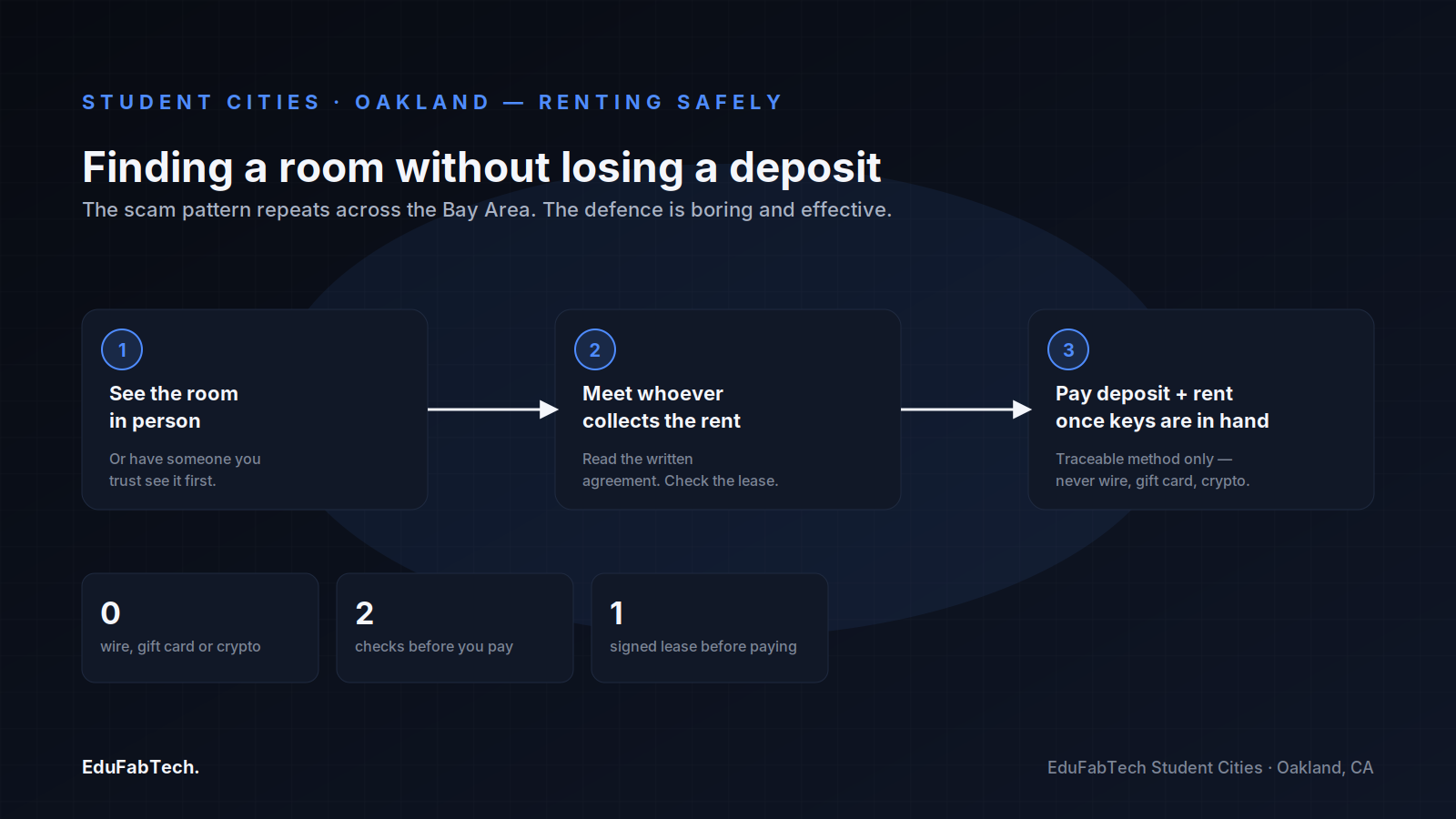
The scam pattern in Oakland is the same one that recurs across expensive Bay Area markets: a listing with photographs that look too good for the price, a "landlord" who is conveniently out of town, and pressure to send a holding deposit before you have seen the place. The defence is boring and effective. See the actual room in person, or have someone you trust see it, before any money moves. Meet whoever is collecting rent. Read the written agreement and check who is on the lease. And never send a deposit or first month's rent by bank wire, gift card or cryptocurrency to "hold" a room — those payments are designed to be irreversible, and a genuine landlord does not need them. A normal move-in here is a deposit plus the first month's rent, paid by a traceable method once you have keys and a signed agreement in hand. EduFabTech keeps city listings you can browse without pressure: rooms in Oakland and the broader set of Oakland student listings.
Furnishing a room for almost nothing
Oakland is a good town for second-hand, and two fixtures stand out. The Laney College Flea Market runs every Sunday in the parking lots at Laney College, near Lake Merritt, and is one of the busiest street markets in the East Bay — a place to find tools, bikes, kitchenware and furniture cheaply, with a food scene attached. The White Elephant Sale, run by the Oakland Museum Women's Board for the Oakland Museum of California, is a large annual rummage sale held in a 96,000-square-foot Oakland warehouse; the museum says the 2026 edition opens with a preview sale on 25 January and runs on selected warehouse days through 21 February, followed by a clearance weekend on 28 February and 1 March, and that the sale has raised nearly $34 million for the museum since it began (Oakland Museum of California, 2026). Between those dates, local resale and give-away channels do the same job: browse the city's second-hand listings on EduFabTech for furniture and household kit, and for items other students are passing on free. Furnishing a room from these sources, rather than buying new, is the single easiest saving a new arrival can make.
What it costs
The clearest dated figure within reach of Oakland students comes from university housing across the border in Berkeley. The University of California, Berkeley lists a standard double room in a traditional residence hall at a projected $23,885 for the 2026–27 academic year — $17,000 for the room and $6,885 for its Blue & Gold meal plan — and notes that these are projected rates based on anticipated occupancy (Cal Housing, 2026). That is one of the more affordable campus options in the area, which tells you how the private market feels. A shared room in a flat is usually cheaper per month than a campus single, but Oakland is still an expensive city to rent in, and a studio or one-bedroom of your own will cost far more than a room in a shared house. Treat any single advertised rent as a starting point, not a budget, and build your numbers around sharing plus transit rather than solo living plus a car.
Getting around: Clipper, AC Transit and BART
Two operators cover almost all of a student's travel. AC Transit runs the East Bay's buses, including the Transbay lines that cross the Bay Bridge into San Francisco; BART runs the regional rail that links Oakland to Berkeley, San Francisco, the airport and the wider region. Both are paid with the Clipper card — a single contactless fare card that also works on most other Bay Area systems — so one card and one app cover nearly everything.
On fares, AC Transit raised its local adult cash fare to $2.75 and its Transbay cash fare to $6.50 effective 1 July 2025, in an announcement dated June 2025 (AC Transit, 2025), and says youth, seniors and riders with disabilities can get 50% off its fares (AC Transit fares). BART's fares are distance-based, so the price depends on how far you ride. There is no blanket university-student discount on either system; the discounts that matter are the youth fare for riders under 19 and the income-based Clipper START programme. BART reports that its Clipper START discount rose to 50% off on 1 January 2024, for Bay Area residents aged 19 to 64 whose income is less than 200% of the federal poverty level (BART, 2023). If you qualify, applying is the biggest single cut you can make to your commuting bill.
Libraries, study space and part-time work
Your campus library will be your main workspace, but Oakland has a strong public system to fall back on. The Oakland Public Library's Main Library at 125 14th Street, downtown, is open Monday to Thursday from 10:00 to 20:00, Friday from 12:00 to 17:30, and Saturday and Sunday from 10:00 to 17:30 (Oakland Public Library) — long evening hours on weekdays make it a genuine option for quiet study, not just book borrowing, and the branch network spreads study space across the city. For desks and rooms beyond the libraries, EduFabTech lists study spaces in Oakland.
On work, international students should rely on official rules rather than second-hand advice. The U.S. Department of Homeland Security's Study in the States service states that an F-1 student participating in on-campus employment "may not work more than 20 hours per week when school is in session", and that off-campus employment is only available to F-1 students who have completed at least one full academic year of their programme and meet specific conditions (Study in the States, DHS). Your Designated School Official is the person who authorises on-campus work and who you should ask before accepting any job. This is a summary, not legal advice; check the DHS pages and your own school's international office for your exact status. For locally advertised openings, EduFabTech keeps a board of part-time jobs in Oakland.
The honest trade-offs
What is good about Oakland for a student is real: a central position in a region thick with universities, a transit network that lets you live in one city and study in another, a deep food and music culture, and milder winters than most of the country. What is hard is mostly money and distance. Rents are high, the best-value rooms go early, and a lot of student life involves a commute across a bridge or under the bay rather than a walk across a campus. The weather has its own catch — summer days on the bay can turn grey and cold when inland California is baking, so the warm clothes you packed for a stereotype of California may sit unused while a windproof jacket earns its place. None of this should put you off; it should shape how you plan.
A short checklist for the first weeks
- Get a Clipper card or set one up in your phone's wallet before your first trip, and check whether you qualify for Clipper START.
- Map your real commute from any room you are considering — time it at the hour you will actually travel, not at noon.
- See a room in person before paying, meet whoever collects the rent, and never wire a deposit to "hold" a place.
- Furnish from the Laney College Flea Market, the White Elephant Sale in season, or local give-away listings before buying anything new.
- If you are on an F-1 visa, talk to your Designated School Official before taking any job, and read the DHS work rules yourself.
- Get a library card and learn the Main Library's evening hours as a backup workspace near downtown.
- Keep browsing Oakland listings and, if you study in Berkeley, the set of rooms near UC Berkeley.
A quick question for readers
Do you work part-time while you study?
Many students work to pay the bills. See how common it is — and how many hours people really do.
Pick an answer, create a free account in a minute, and your vote counts. Already a member? Sign in
Comments 3
Comment-
The campus-housing figure undercuts the article's own point. $23,885 a year at Berkeley gets cited as 'one of the more affordable campus opt…
-
The number that stands out is the UC Berkeley residence hall figure: $23,885 for 2026-27, and the piece itself calls that "one of the more a…
-
The number that undercuts the "Oakland is cheaper" framing is the Clipper START detail: it's only a 50% discount for Bay Area residents aged…
Join free to read the full comments and reply Comments are between members; an account takes a minute.
Source: University of California, Berkeley Housing
Sources (5)
- Cal Housing. 2026–27 Residence Hall Rates. University of California, Berkeley, 2026. housing.berkeley.edu ↗ · checked 22 Oct 2026
- AC Transit. New AC Transit Fares Take Effect July 1. Alameda-Contra Costa Transit District, 2025. actransit.org ↗ · checked 22 Oct 2026
- BART. BART's Low-Income Fare Discount to Increase to 50% on Jan. 1. San Francisco Bay Area Rapid Transit District, 2023. bart.gov ↗ · checked 22 Oct 2026
- Study in the States. Working in the United States. U.S. Department of Homeland Security, Student and Exchange Visitor Program, 2026. studyinthestates.dhs.gov ↗ · checked 22 Oct 2026
- Oakland Museum Women's Board. Oakland's Popular White Elephant Sale Returns. Oakland Museum of California, 2026. museumca.org ↗ · checked 22 Oct 2026