Studying in Oceanside: universities, housing and student life
A practical, honest guide to studying from Oceanside, California — the campuses nearby, where students live, renting safely, markets, transport, work rules and what it costs.
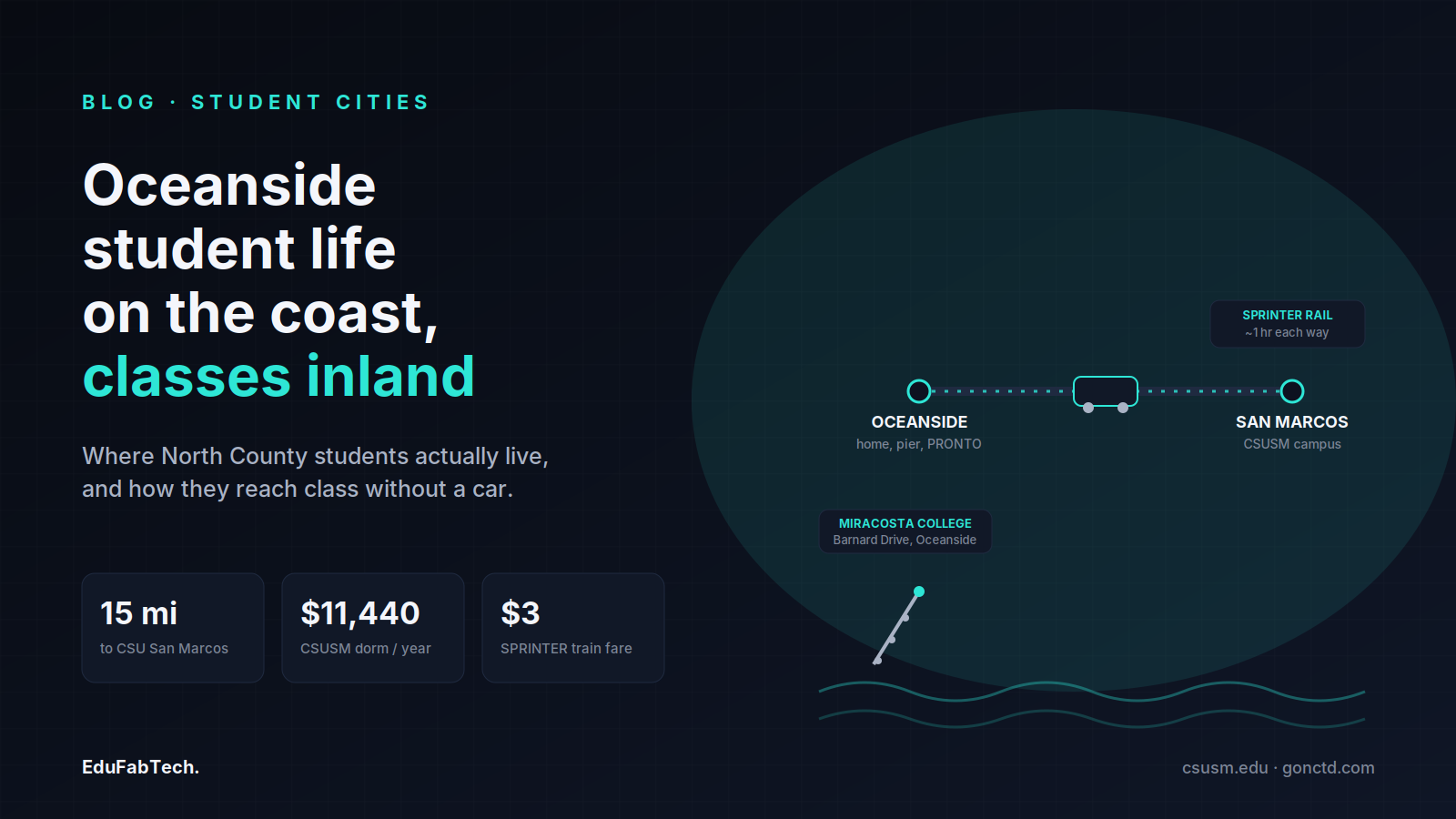
Oceanside sits at the northern edge of San Diego County, where the coastline runs up against Marine Corps Base Camp Pendleton and the inland valleys open toward San Marcos and Escondido. It is a genuine beach town — a long pier, a small-boat harbour, surf breaks off The Strand — but it is also a working city with a train station, a Mission, and freeways that carry commuters south to San Diego and inland to the colleges. For a student, that geography is the whole story: Oceanside is less a campus town than a coastal base from which you reach the universities of North County by rail and bus.
That matters because most of the degree-granting institutions a student will actually enrol in are a short train ride away rather than in Oceanside itself. The city's own four-year options have thinned over the decades, so the practical question is not "which Oceanside university?" but "where do I live, and how do I get to class?" This guide answers that with figures and rules you can trace to their source.
The campuses a student in Oceanside commutes to
The large public university within reach is California State University San Marcos, about fifteen miles inland. Its own campus history records that the university was founded in 1989, when Governor George Deukmejian signed Senate Bill 365, and that it opened in August 1990 with 448 juniors and seniors in rented office space before moving to a 306-acre hillside overlooking San Marcos; the same page describes it as the only public four-year comprehensive university serving North San Diego, Southwest Riverside and South Orange counties (csusm.edu). It is a commuter-heavy campus with strengths in business, education, nursing and the health sciences, and it is reachable from Oceanside without a car — the SPRINTER rail line has a stop named Cal State San Marcos station.
In Oceanside proper, the institution that grants degrees is MiraCosta College, a public community college. Its catalog lists the Oceanside campus at 1 Barnard Drive and states that the college awards associate degrees, associate degrees for transfer and bachelor's degrees, including what it calls California's first community college Bachelor of Science in Biomanufacturing (catalog.miracosta.edu). The same page notes further district locations — a San Elijo campus in Cardiff, a Community Learning Center in Oceanside and a Technology Career Institute in Carlsbad. For many students, MiraCosta is the affordable first two years before transferring to a CSU or UC; its transfer-degree tracks are built for exactly that.
Neighbourhoods, and the choice between coast and campus
Oceanside is spread out, and where you live shapes your commute far more than in a compact college town. Downtown, around the pier and the Oceanside Transit Center, is the most walkable and the best connected to transit, but also the priciest and busiest, especially in summer. South Oceanside — "South O" — along Coast Highway near Cassidy Street is quieter, with small cafés and a more residential feel. Inland, the San Luis Rey valley and neighbourhoods such as Fire Mountain, Loma Alta and Rancho del Oro are cheaper per room and closer to the freeways, but you will lean on a bus or a car to reach the beach or the station.
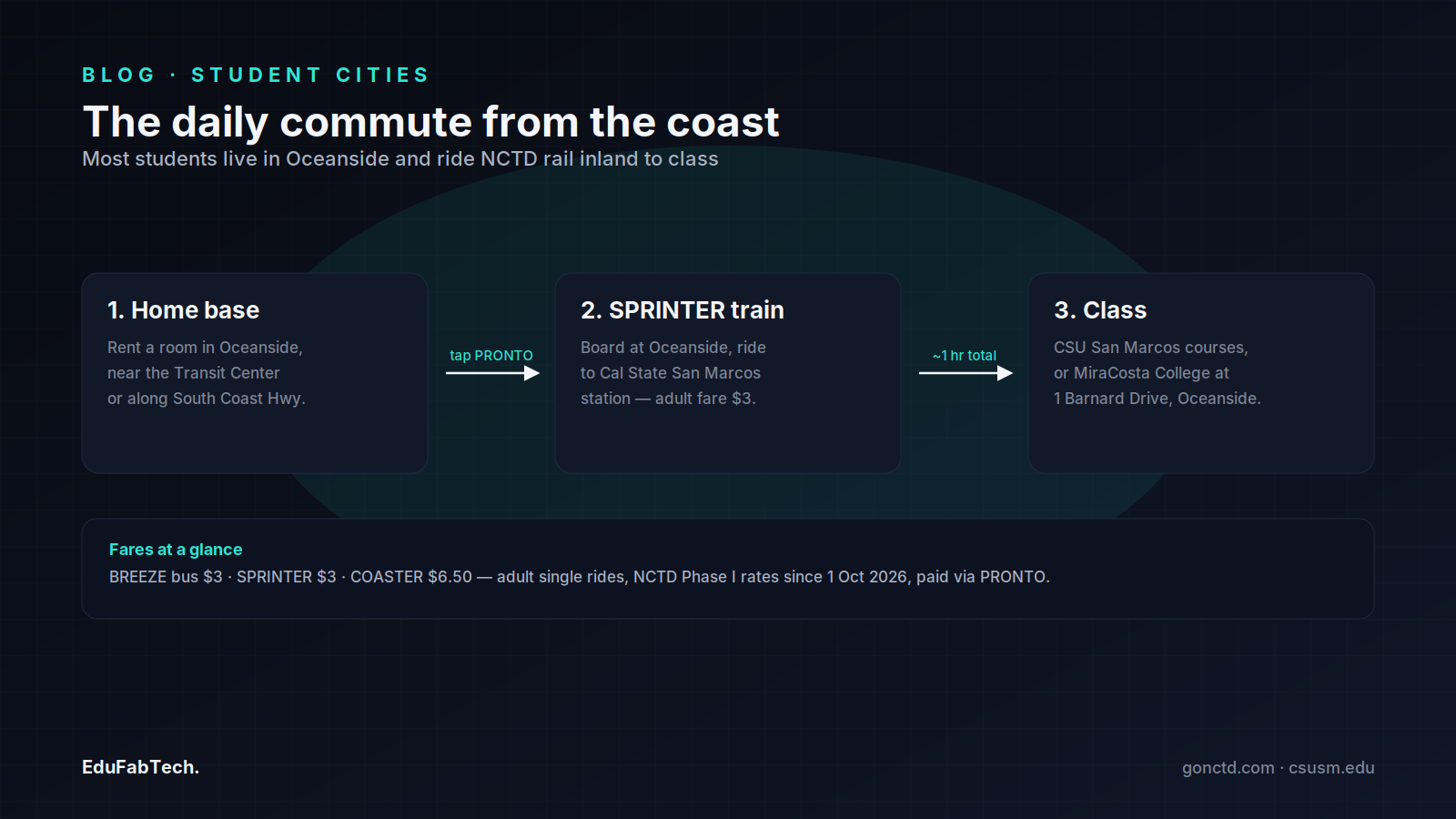
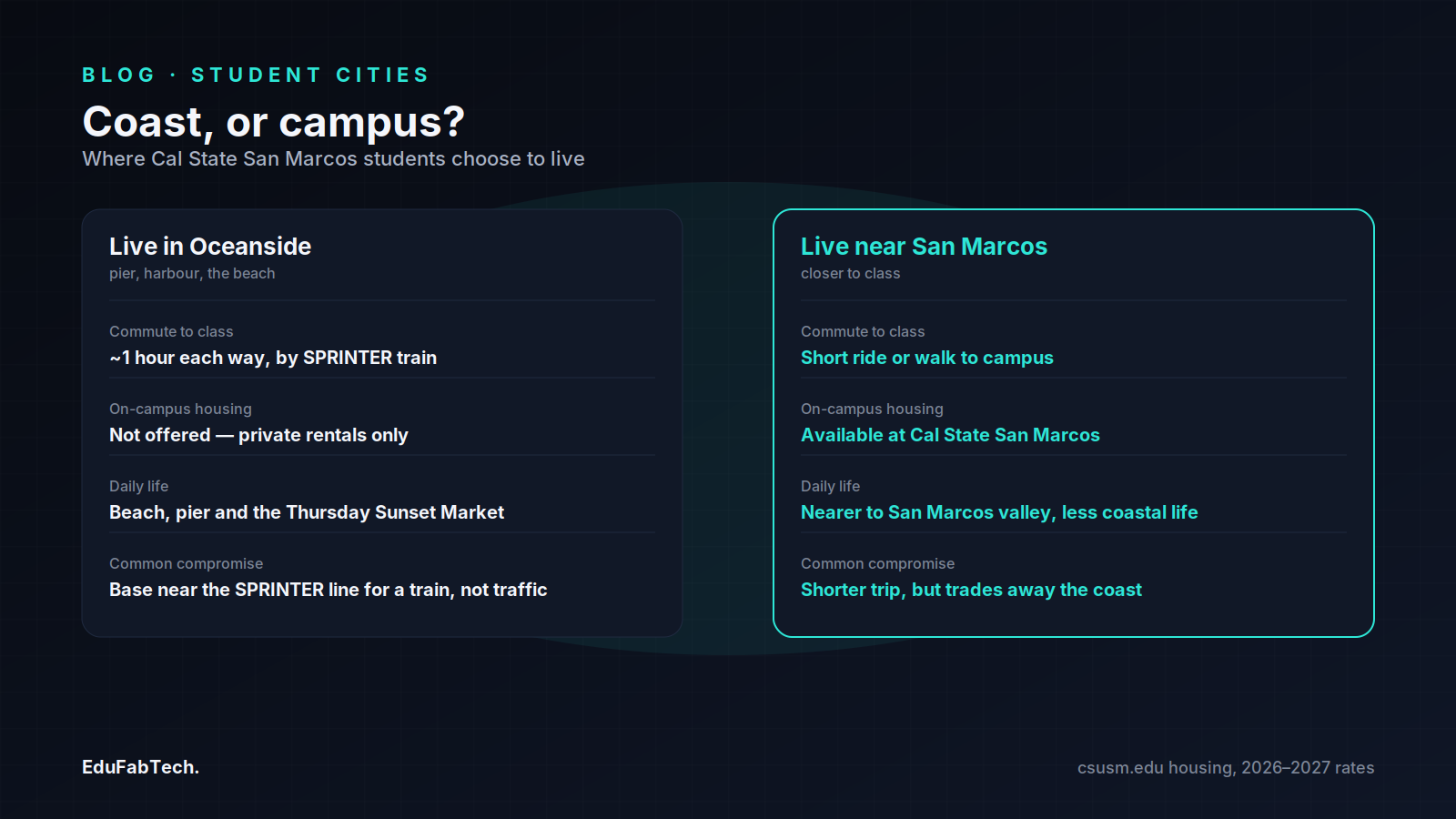
If you study at Cal State San Marcos, you face a real decision: live in Oceanside and commute inland, or live near the San Marcos campus. Living on the coast buys you the beach, the harbour and the train, at the cost of a daily ride of roughly an hour each way. Living in San Marcos shortens the commute but trades away the things that make Oceanside worth the trouble. Many students split the difference by basing themselves near the SPRINTER line so the inland trip is a train rather than a traffic jam on Highway 78.
On-campus housing is an option at Cal State San Marcos but not in Oceanside itself, so a student set on living by the sea is almost always renting on the private market. That makes the mechanics of renting — deposits, viewings, who you pay — the part worth getting right.
Renting safely in a beach town without losing a deposit
Rooms in Oceanside turn over fastest before the autumn term and again in early summer, when short-term holiday lets free up. Start looking four to eight weeks ahead; coastal listings move quickly, and the closer to the pier, the faster. Under California law a landlord may ask for first month's rent plus a security deposit, and since a change that took effect on 1 July 2024 the cap on that deposit for most tenancies is one month's rent (a small landlord who owns no more than two properties may ask up to two months, except from service members) — useful to know when someone quotes you two or three months "to hold" a place.
The scams here follow the local pattern: listings that recycle photos of Oceanside beach bungalows or harbour-view flats at a suspiciously low rent, a "landlord" who is conveniently out of town — often said to be posted elsewhere with the military, which plays on the Camp Pendleton connection — and a request to wire a deposit before you can see the place. Treat any of that as a stop sign. See the room in person, or have someone you trust see it; confirm the person collecting rent is tied to the actual address; and get a written, signed lease before any money changes hands. Never send a deposit by bank transfer, gift card or cryptocurrency to "reserve" a room you have not stood inside — those payments cannot be recovered, and a real local landlord will not demand them. EduFabTech's own rooms listings for Oceanside and the wider city page are a place to start, but the same in-person rules apply wherever you find a room.
On cost, the cleanest figure anyone can actually source is the university's own. California State University San Marcos lists 2026–2027 academic-year housing rates of $11,440 for a University Village Apartments double room, $15,960 for a QUAD single and $10,872 for a Black Oak Hall double, all described on its housing page as inclusive of utilities and as tentative and subject to change, on top of a non-refundable $100 Administrative Fee due when you apply (csusm.edu). Private rents in coastal North County run higher than inland California, but no Oceanside-specific official rent figure could be confirmed here from a primary source, so treat the dorm rates as your anchor and verify any private quote against what you see in person.
Kitting out a room: Thursday markets and second-hand
Furnishing a room cheaply in Oceanside leans on the city's markets and on second-hand goods passed between students. The standing fixture is the Sunset Market, which MainStreet Oceanside runs on Thursday evenings from 5 to 9 p.m. year-round across five blocks of Pier View Way in downtown Oceanside, with up to 240 food and retail booths; the organiser says it has run since 2007 (mainstreetoceanside.com). It is more street food and crafts than flat-pack furniture, but it is the easiest way to learn the downtown and meet the people selling locally.
For the actual desk, lamp and kettle, second-hand is the sensible route in a town where students cycle through rooms every year. Look for things being given away at the end of each term, when leases end and people leave the county fast. EduFabTech keeps Oceanside-specific pages for used furniture and things given away free, which spare you from carrying a mattress on the SPRINTER. Check that electricals work before you take them, and measure your room first — coastal studios are small.
Where to study: city libraries and campus desks
Beyond your campus library, Oceanside's public library gives you free, quiet desks close to where you live. The Oceanside Public Library runs two branches — the Civic Center Library at 330 North Coast Highway, near the Transit Center, and the Mission Branch Library at 3861-B Mission Avenue, out toward the San Luis Rey valley — and posts current opening hours and closures on its hours-and-locations page (oceansidelibrary.org). Hours shift around holidays, so check before you plan a long study session. If you are enrolled at MiraCosta or Cal State San Marcos, your student card also opens the campus libraries and their group-study rooms, which keep longer hours in exam weeks. EduFabTech lists additional study spaces around Oceanside for the days you want neither home nor campus.
Moving around North County: PRONTO, the SPRINTER and the COASTER
Public transport in Oceanside is run by the North County Transit District (NCTD), and the system hinges on the Oceanside Transit Center, where buses, the SPRINTER, the COASTER and Amtrak all meet. Fares are paid through PRONTO, the regional contactless system shared with San Diego's MTS; you tap a PRONTO card or the PRONTO app at validators on buses and trains. NCTD's fare page lists adult single rides, under its Phase I rates in effect since 1 October 2026, at $3 on BREEZE buses, $3 on the SPRINTER and $6.50 on the COASTER (gonctd.com).
Two parts of that network matter most to students. The SPRINTER light-rail line runs inland from Oceanside through Vista and San Marcos to Escondido, with a stop called Cal State San Marcos station — the reason you can study at CSUSM from the coast without a car. The COASTER commuter train runs south along the shore from Oceanside toward downtown San Diego. On discounts, the same NCTD fare page lists a monthly college pass at $57.60 for students at Cal State San Marcos, MiraCosta College and Palomar College, and a Youth Opportunity Pass giving free rides to those aged 18 and under through June 2027 (gonctd.com). Confirm your eligibility and the current price on that page before buying, as fares are in a phased change.
Working while you study, and the rules for international students
Part-time work in Oceanside tends to be in hospitality, retail and the summer tourist trade along the pier and harbour, plus on-campus jobs at the colleges. For students on a visa, the rules are not local — they are federal, and they are strict. The U.S. government's Study in the States site, run by the Student and Exchange Visitor Program, states that an F-1 student who takes on-campus employment "may not work more than 20 hours per week when school is in session" (studyinthestates.dhs.gov). Off-campus work, and training programmes such as Curricular Practical Training and Optional Practical Training, have their own conditions and usually require authorisation first.
This is not legal advice, and the details change: before you accept any job, confirm what your visa allows with your school's international student office and with the official Study in the States guidance, and keep your enrolment full-time. EduFabTech's Oceanside jobs listings can show what local work looks like, but your immigration status, not a listing, decides what you may take.
Honest trade-offs for students
What is good about Oceanside is plain: the climate is mild and dry, the beach and harbour are genuinely yours rather than a tourist postcard once term starts, and the Transit Center ties you into a rail network that reaches both a university inland and a major city to the south. The downtown has filled in with cafés and the Thursday market, and the city is large and diverse enough not to feel like a single-industry college town.
What is hard is mostly cost and distance. Coastal San Diego County is an expensive place to rent, and the cheapest rooms are inland, away from the beach that drew you. If your campus is Cal State San Marcos, you are committing to a daily commute of roughly an hour each way by train — manageable, but real. Summer brings tourists and traffic; Highway 78 and Interstate 5 clog at peak times; and the military presence of Camp Pendleton gives the north of the city a particular character that suits some students more than others. None of this is a reason to stay away — but go in knowing you are choosing a coastal base with a commute, not a campus at your doorstep.
A checklist for your first weeks
- Set up a PRONTO account (card or app) and check whether you qualify for the $57.60 monthly college pass or a free Youth Opportunity Pass on the NCTD fare page.
- If you are at Cal State San Marcos, ride the SPRINTER from Oceanside Transit Center to Cal State San Marcos station once before term to time your real commute.
- View any room in person — or send someone you trust — and sign a written lease before paying; never wire a deposit or pay by gift card or crypto to "hold" a place.
- Register for your campus library and the Oceanside Public Library, and note the Civic Center and Mission branches' current hours.
- Furnish from the end-of-term giveaways and second-hand pages before buying new; measure the room first.
- If you are on a student visa, confirm exactly what work you may do with your international student office and the Study in the States guidance before taking any job.
- Walk the downtown on a Thursday evening during the Sunset Market to get your bearings and meet people.
A quick question for readers
Do you work part-time while you study?
Many students work to pay the bills. See how common it is — and how many hours people really do.
Pick an answer, create a free account in a minute, and your vote counts. Already a member? Sign in
Comments 3
Comment-
The part that reads as spin rather than analysis is the cost section leaning on dorm rates - $11,440 to $15,960 a year, sourced and dated -…
-
The admission buried in the cost section is the most honest line in the piece: no Oceanside-specific private rent figure exists, so the CSUS…
-
The number that actually undercuts the pitch is the commute: roughly an hour each way by train if you're coastal and at Cal State San Marcos…
Join free to read the full comments and reply Comments are between members; an account takes a minute.
Source: California State University San Marcos
Sources (5)
- California State University San Marcos. Campus History. California State University San Marcos, 2026. csusm.edu ↗ · checked 25 Oct 2026
- California State University San Marcos. Housing Options & Cost (2026–2027). California State University San Marcos, 2026. csusm.edu ↗ · checked 25 Oct 2026
- North County Transit District. Fares and Passes. North County Transit District, 2026. gonctd.com ↗ · checked 25 Oct 2026
- MiraCosta College. District & Campus Information. MiraCosta College, 2026. catalog.miracosta.edu ↗ · checked 25 Oct 2026
- U.S. Department of Homeland Security. Working in the United States. Student and Exchange Visitor Program (Study in the States), 2026. studyinthestates.dhs.gov ↗ · checked 25 Oct 2026