Studying in Olean: St. Bonaventure University, housing and student life
A practical, sourced guide to studying in Olean, New York — the one university that grants degrees here, where students live, what a dorm room costs, work rules for international students, and the honest trade-offs of a small Allegheny-foothills city.
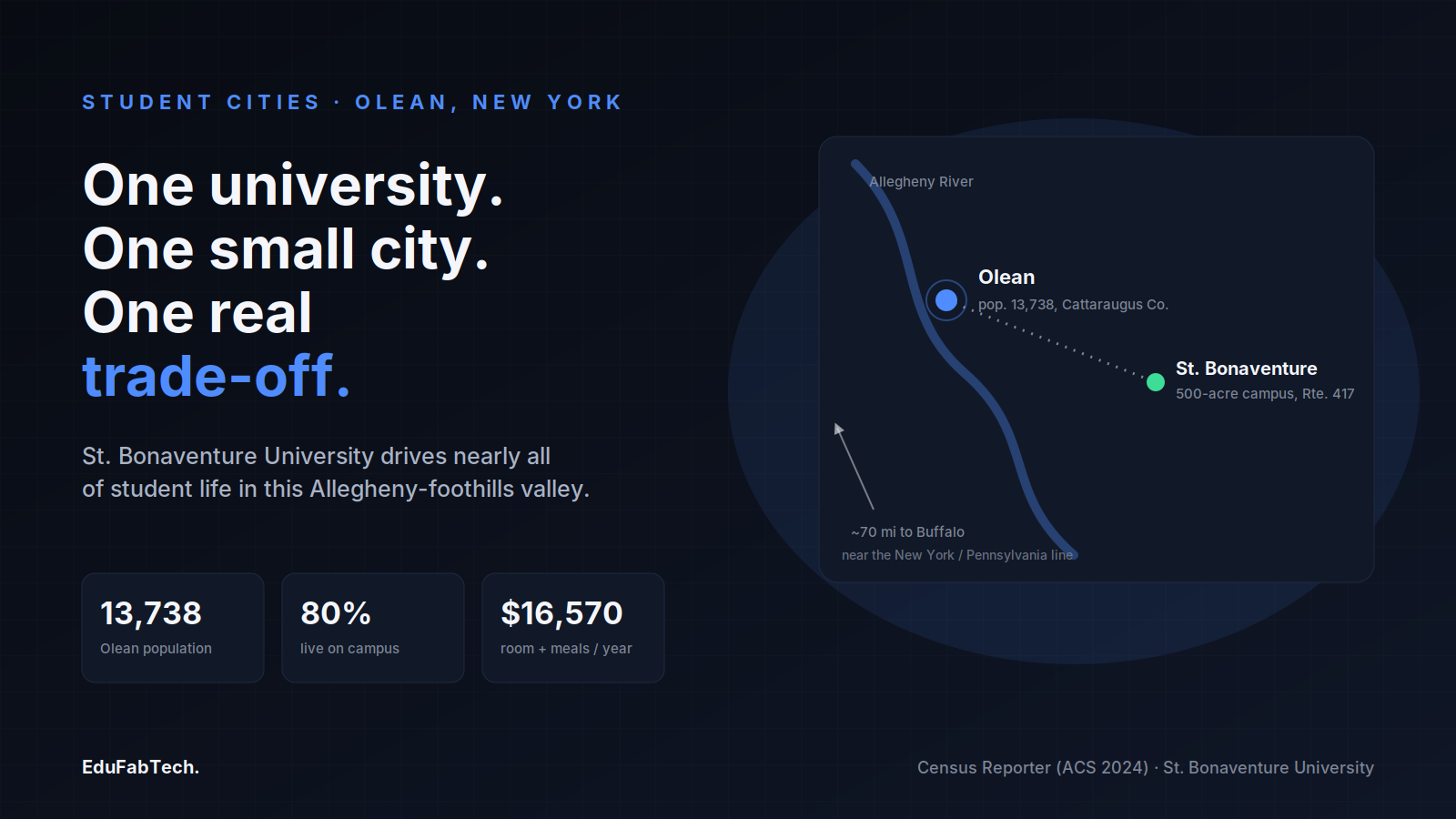
Olean sits in the southwest corner of New York State, in Cattaraugus County, in a valley the Allegheny River cut through the foothills. It is close to the Pennsylvania line and a long way from the parts of New York that most people picture — roughly 70 miles south of Buffalo, the nearest big city. According to Census Reporter's compilation of American Community Survey 2024 five-year estimates, Olean had a population of 13,738, a median age of 39, and a median household income of $51,261. That is the scale to keep in mind: this is a small, working city, the largest in its county, not a university town that happens to have a city attached.
For students, almost everything turns on one institution a short drive east of the city centre. The university's address is not in Olean proper at all but in the adjacent hamlet of St. Bonaventure, between the city and the village of Allegany. In practice students treat Olean as their city — its shops, its library, its bus, its weekend market — while living and studying on a campus in the fields just outside it. This guide tries to be honest about what that arrangement gives you and what it costs.
If you are arriving from abroad, the thing to adjust early is distance. Olean is not somewhere you pass through; you choose it. The reward is a quiet, affordable base with real seasons and a genuine Franciscan campus culture. The price is a car-shaped town where getting around without one takes planning.
St. Bonaventure University, the one place that grants degrees here
St. Bonaventure University is a private Catholic university in the Franciscan tradition, and it is the only degree-granting university in the immediate area. Its own catalogue records that friars came from Italy in 1854 and that the institution was formally dedicated on 4 October 1858, the Feast of St. Francis, taking the name of St. Bonaventure of Bagnoregio. The same source describes a campus spread over 500 acres in a valley surrounded by the Allegheny foothills, on Route 417 between Olean and Allegany and about two miles from Exit 24 of the Southern Tier Expressway, I-86.
The university lists 2,134 undergraduate and 919 graduate students, a 15:1 student-to-faculty ratio, and more than 60 undergraduate majors on its facts page, along with 21 graduate programmes, 16 of which it says run fully online. Undergraduates are organised into five schools — Arts and Sciences, Business, Education, Health Professions, and the Jandoli School of Communication — according to the general information section of the catalogue, with a School of Graduate Studies that houses the Franciscan Institute. The university describes that institute on its facts page as the premier Franciscan resource library in the Americas, which gives a sense of where its scholarly identity sits. The Jandoli School is the programme the university is best known for regionally; journalism and communication students run campus media and feed into a large sports-information tradition.
Two figures matter for anyone deciding whether to apply: St. Bonaventure reports an 83% first-year retention rate and a six-year graduation rate of 69% on that same facts page. Those are the numbers to weigh, rather than any ranking, which this guide does not cite because the university does not publish one in these sources.
Living on campus, and the rule that pushes you there
Olean is one of those places where the housing question is largely answered before you ask it. St. Bonaventure states that 80% of all students, and 96% of first-year students, live on campus. For undergraduates that is close to the default rather than a choice, and the small size of the surrounding rental market reinforces it.
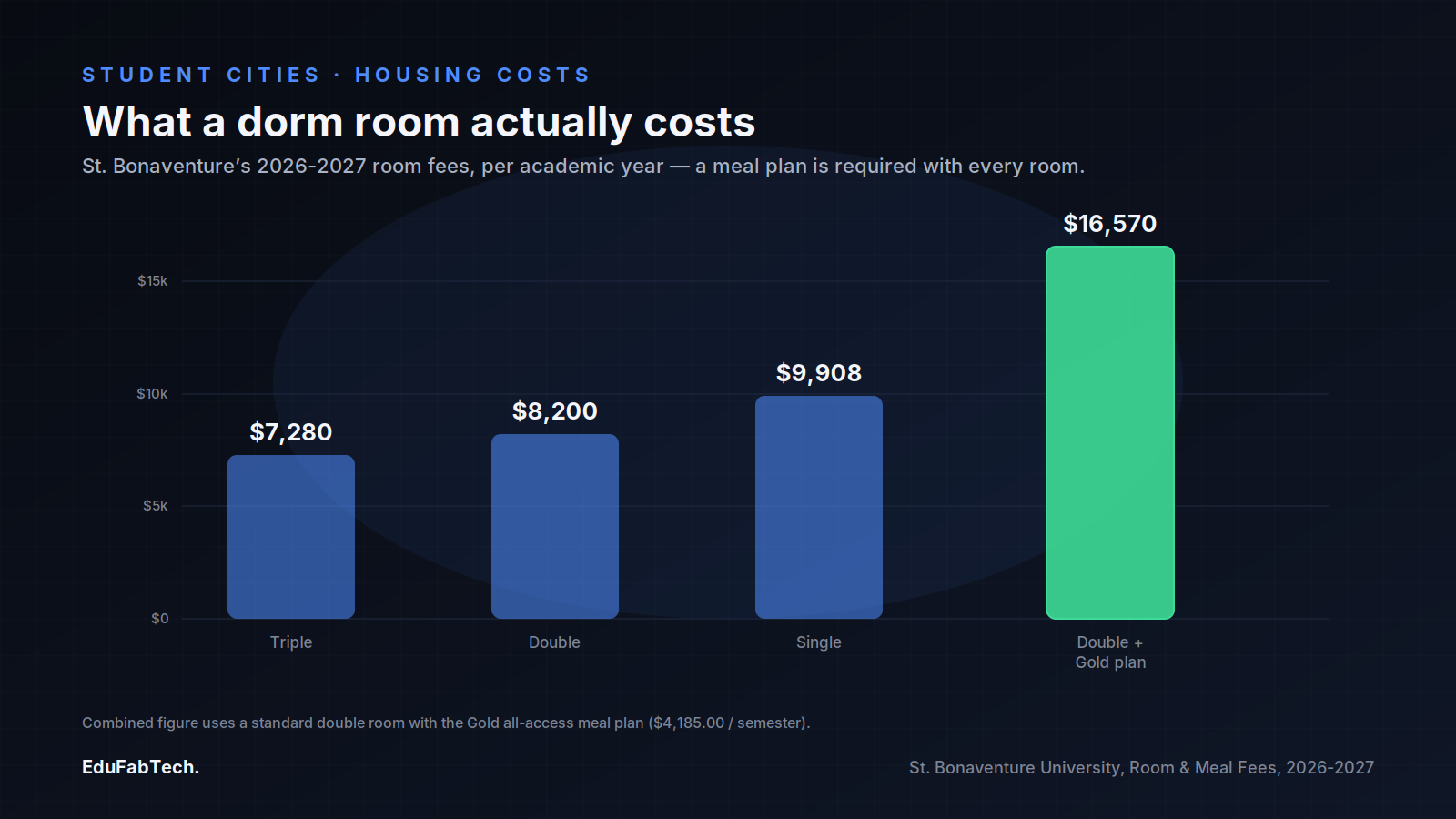
The university's own rates are the clearest dated housing figure available. For the 2026-2027 academic year, the Room and Meal Fees page lists a standard double residence-hall room at $4,100.00 per semester ($8,200.00 for the year), a standard triple at $3,640.00 per semester ($7,280.00 for the year), and a single at $4,954.00 per semester ($9,908.00 for the year). A meal plan is required with every room. The three all-access plans for 2026-2027 are priced per semester on that page at $4,435.00 (Platinum), $4,185.00 (Gold) and $3,985.00 (Silver). Combining a standard double with the Gold plan, the university's page gives an annual room-and-meals figure of $16,570.00 for 2026-2027. Those are the numbers to budget from; tuition is separate and listed elsewhere on the university's affordability pages.
What the on-campus figure buys, beyond a bed, is proximity. The campus is self-contained — library, dining, chapel and halls within a walk — which matters in a valley where winter arrives early. The trade-off is that a dorm contract ties your housing to the academic calendar and to the meal plan, so the sticker price is not negotiable the way a lease might be.
Renting off campus in a thin market
Off-campus rooms in Olean exist, but the supply is small and oriented toward the city rather than the campus, so upper-year and graduate students are the ones who usually look. The city itself — not the campus — is where the rental stock sits, in the older houses on the gridded streets north and west of the downtown. Because the market is thin, good rooms go through word of mouth and the university's own channels well before a semester starts; begin looking a season ahead, not a few weeks before.
The safety advice for Olean is specific to how a small market behaves. Listings that appear are few, so a too-good, too-cheap room advertised to international students who cannot visit is exactly where a scam fits. Insist on seeing the actual unit in person, or have someone you trust see it, before any money changes hands. A normal arrangement here is a modest security deposit plus the first month's rent, paid when you sign and can collect keys. Never wire a deposit, buy gift cards, or send cryptocurrency to "hold" a place for you — a genuine local landlord in Olean does not need an untraceable transfer, and any demand for one is the signal to walk away. Confirm who actually owns or manages the property before you commit, and keep every payment on a record you can trace.
You can browse what is currently available through EduFabTech's listings for the city at rooms and places to stay in Olean, the general Olean student listings, and what is posted near St. Bonaventure University. Treat any listing as a starting point for a visit, not a reason to pay in advance.
Furnishing a room: North Union Street thrift and a Saturday market
A near-empty off-campus room is cheapest to fill second-hand, and Olean's charity shops cluster conveniently on North Union Street, the city's main commercial spine. The St. Vincent de Paul Society runs a thrift store and food pantry at 441 North Union Street; the community resource directory 211 WNY lists its store hours as Monday to Friday, 10am to 2:45pm, with general clothing and household goods. The Salvation Army operates nearby on the same street, and a Goodwill store sits out on NYS Route 417 toward the campus. Those short weekday hours are worth noting: the thrift shops here are not open late, so furnishing trips need planning around a bus or a lift.
For food and local produce, the Olean Area Farmers Market runs on Saturdays. The Cattaraugus County agricultural listing gives the 2026 season as Saturdays from 9AM to 1PM, starting 16 May 2026 and running through 24 October 2026, at Lincoln Park, 100 E State Street. That is a seasonal market, so for most of the academic year the supermarkets and the downtown shops are what you will actually use.
EduFabTech keeps separate local boards for this kind of thing: second-hand items, second-hand furniture, and things people are giving away free in Olean. In a town this size, a graduating student clearing a flat is often the fastest route to a desk or a mattress.
Part-time work and the F-1 limit
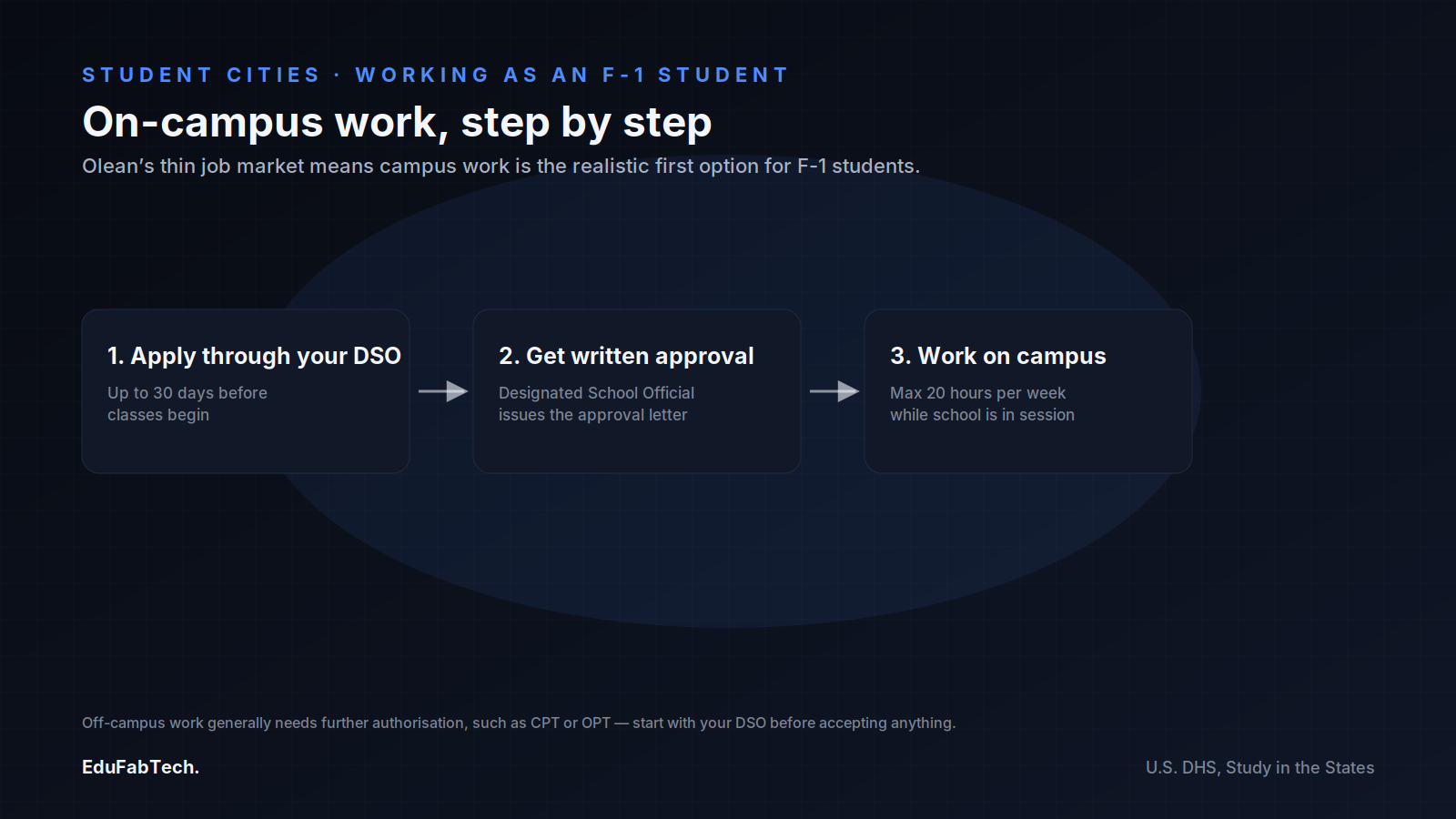
For international students, the first job to understand is the one on campus, because it is the one open to you without separate federal approval. The U.S. Department of Homeland Security's Study in the States service states plainly that an F-1 student may not work more than 20 hours per week when school is in session, that you apply through your Designated School Official (DSO) who issues a letter of approval, and that you may apply for on-campus employment up to 30 days before classes begin. This guide cannot give you legal advice; the DHS page and St. Bonaventure's own international-student office are the authorities to follow for your specific status.
The practical reading for Olean is that the campus is where most student jobs are anyway — dining, the library, residence life, athletics — because the surrounding city is small and off-campus work for F-1 students generally requires further authorisation such as CPT or OPT, which the DHS pages explain. Start with your DSO before you accept anything. Current openings posted locally are collected on EduFabTech's Olean jobs board.
Libraries and places to study
On campus, the Friedsam Memorial Library is the main study building and sits beside the Franciscan Institute the university describes as its premier Franciscan collection. Off campus, the Olean Public Library gives residents a second, calmer option downtown. Its own site lists the library at 134 N. 2nd Street with hours of Monday to Thursday 9:00am to 9:00pm, Friday 9:00am to 6:00pm, Saturday 10:00am to 5:00pm, and closed Sunday, plus digital lending through Libby and Kanopy. For a change of desk from the campus, the public library's long weekday evenings are the useful hours.
EduFabTech also indexes bookable desks and quiet rooms shared by students at study spaces in Olean, which is worth checking in exam weeks when the campus library fills.
Getting around, and the winter
Public transport in and around Olean is the Olean Area Transit System, known as OATS, a demand-aware route service rather than a dense city network. The City of Salamanca's public-transportation page, covering the same regional system, lists the OATS fares as a regular one-way fare of $1, a to/from Salamanca fare of $2, half fare for disabled riders and seniors aged 60 and over, free travel for children 6 and under, and a 30-day pass for $30.00. No separate student discount is advertised on that fare list, so budget the standard fare unless the operator tells you otherwise. Fares on this kind of rural service are typically cash with exact change, and the system's reach is limited in the evenings and on Sundays — plan errands and the thrift-shop runs around that.
Within the city, downtown is walkable by design. Empire State Development's account of the Walkable Olean project describes rebuilding streets around North Union Street and converting a four-lane layout toward a narrower, median-divided street with wider sidewalks — part of a multi-phase effort to make the centre friendlier to people on foot. The campus itself is compact and walkable. What is not walkable is the gap between the two: the roughly two-mile stretch between the city centre and the university along Route 417 is a drive or a bus ride, not a stroll, and that is the single biggest daily-logistics fact of student life here.
Then there is the climate. Olean's winters are long, cold and snowy, in the way southwestern New York's uplands generally are; snow and overcast skies dominate from roughly December into March. For a student from a warmer country this is the part to prepare for physically and mentally — proper boots, a real coat, and a plan for how you reach campus when the roads are white.
The honest balance for a student
What is good about Olean is concrete. It is cheap by U.S. standards — the median household income in the 2024 ACS five-year estimates was $51,261, a figure that signals a low-cost local economy — and the on-campus model at St. Bonaventure means most students arrive into ready-made housing and a close community rather than a housing scramble. The campus is handsome and self-contained, the public library is good, and the pace is quiet in a way that suits serious study.
What is hard is equally concrete. The rental market off campus is thin, so your realistic choice for a first year is a dorm at the 2026-2027 rates above, meal plan included and non-negotiable. The city and campus are two miles apart with modest bus service between them, so life without a car takes organisation. Winters are demanding. And Olean is genuinely remote — the nearest large city is well over an hour away — which is peace to some students and isolation to others. Be honest with yourself about which you are before you commit.
A checklist for the first weeks
- Confirm housing through the university first. If you are an incoming undergraduate, expect to live on campus; read the room-and-meal fee page so the required meal plan is no surprise.
- If you look off campus, see the room before you pay. A deposit plus first month's rent on signing is normal; a demand for a wire transfer, gift cards or crypto to "hold" a place is the sign to stop.
- International students: see your DSO before working. On-campus work is capped at 20 hours per week while school is in session and needs DSO approval; do not accept off-campus work without checking your status.
- Sort out transport early. Learn the OATS fares and routes between the city and campus, and keep small cash for the fare.
- Furnish second-hand. The charity shops on North Union Street keep short weekday hours; plan a trip, and check EduFabTech's free-stuff and furniture boards.
- Get a public-library card. The Olean Public Library downtown is a second study home with long weekday evenings and free digital lending.
- Buy for winter immediately. Boots and a warm coat are not optional here from December onward.
- Find your people. Check what is on through EduFabTech's Olean events listings in your first fortnight, while everyone is still looking for a group.
A quick question for readers
Do you work part-time while you study?
Many students work to pay the bills. See how common it is — and how many hours people really do.
Pick an answer, create a free account in a minute, and your vote counts. Already a member? Sign in
Comments 1
Comment-
The Walkable Olean project gets a nice paragraph about narrowing a four-lane street and widening sidewalks around North Union, but that's so…
Join free to read the full comments and reply Comments are between members; an account takes a minute.
Source: St. Bonaventure University
Sources (5)
- St. Bonaventure University. SBU Facts. St. Bonaventure University, 2026. sbu.edu ↗ · checked 3 Nov 2026
- St. Bonaventure University. Room and Meal Fees 2026-2027. St. Bonaventure University, 2026. sbu.edu ↗ · checked 3 Nov 2026
- U.S. Census Bureau. Olean, NY — American Community Survey 2024 5-year estimates. Census Reporter, 2024. censusreporter.org ↗ · checked 3 Nov 2026
- U.S. Department of Homeland Security. Working in the United States. Study in the States, 2026. studyinthestates.dhs.gov ↗ · checked 3 Nov 2026
- City of Salamanca, New York. Public Transportation — OATS fares. City of Salamanca, 2026. salamancany.gov ↗ · checked 3 Nov 2026