Studying in Orlando: universities, housing and student life
A practical, sourced guide to studying in Orlando — its universities, the neighbourhoods students settle in, renting safely, markets, work rules, study spaces, transport and costs.
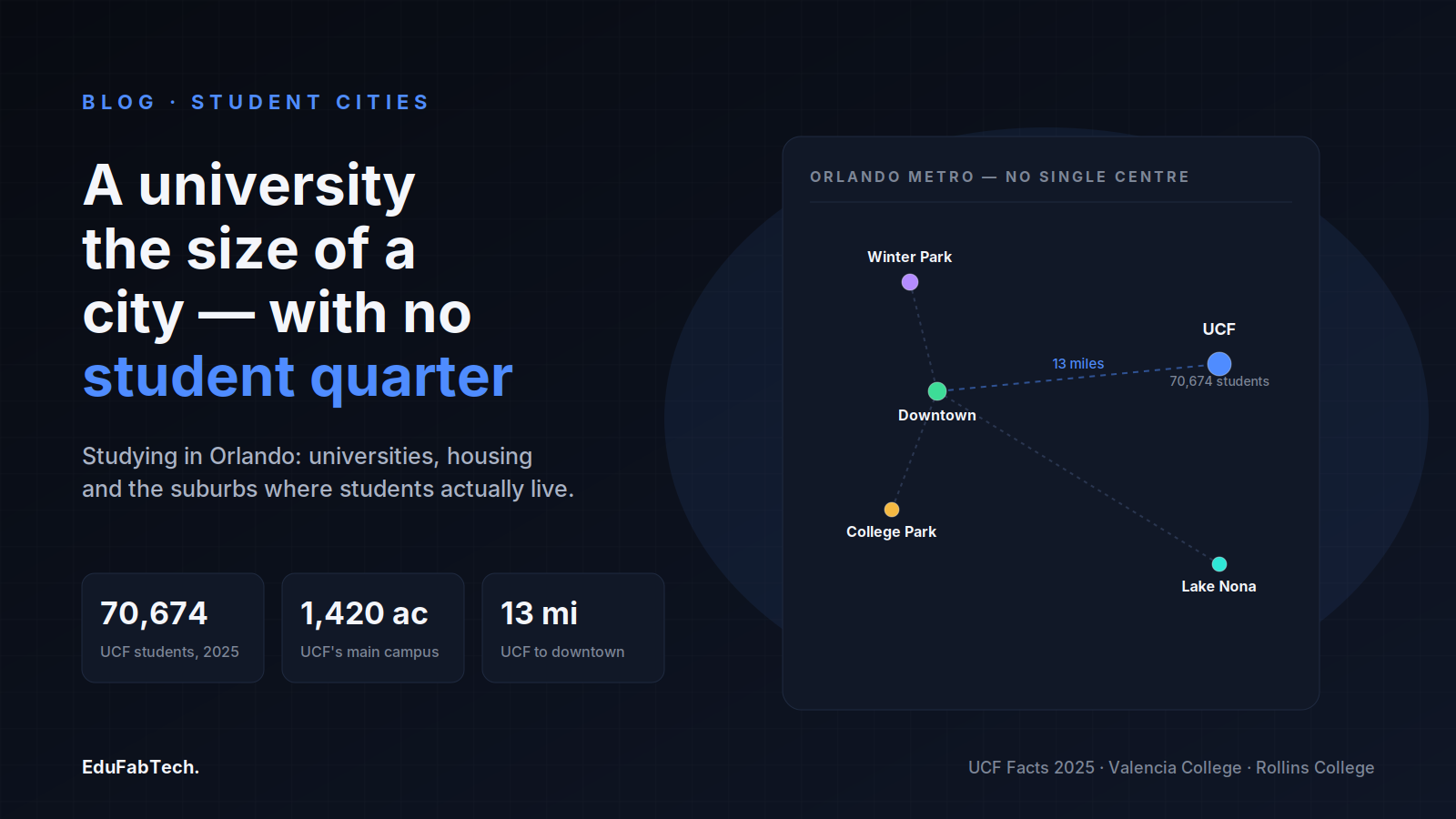
Orlando is a city most people picture from the air, as a ring of theme parks south-west of downtown. For a student the shape that matters is different: a low, spread-out metropolitan area stitched together by six-lane roads, where the main university sits a long way from the city centre and the rest of academic life is scattered across suburbs and small incorporated towns. There is no single student quarter. There is UCF's enormous campus out east, a cluster of specialised schools in Winter Park to the north, and a compact downtown that has only recently acquired a university presence of its own.
That geography shapes everything that follows — where you can afford to live, how long your commute is, and whether you will need a car. Summers are long, humid and punctuated by afternoon thunderstorms; the hurricane season runs through the autumn term. None of this is a reason to avoid Orlando, but it is worth knowing before you sign a lease twelve months long on the strength of photographs.
This guide names the institutions that grant degrees in and around the city, walks through the neighbourhoods students actually end up in, and gives figures for rent, dorms, fares and work rules that you can trace to the body that published them. Where a number cannot be sourced to a primary page, it is left out.
The universities and colleges
The gravitational centre is the University of Central Florida, whose main campus sits about 13 miles east of downtown. By its own count, UCF enrolled 70,674 students in autumn 2025, including 60,083 undergraduates, and its facts page describes this as the largest enrolment of any university in Florida. The 1,420-acre campus carries 250 degree programmes and is home to the Burnett Honors College, a smaller admitting unit within the university. UCF is a research institution with strengths in optics and photonics, engineering, hospitality and simulation; its scale is the first thing newcomers notice, and the reason the surrounding Alafaya area is ringed with purpose-built student apartments.
North of the city, in the suburb of Winter Park, two very different institutions sit within a few miles of each other. Full Sail University awards certificates and associate, bachelor's and master's degrees in entertainment media and emerging technology — film, animation, game development, audio and the business of all three — and its academic catalog lists accreditation by the ACCSC. Rollins College, on the shore of Lake Virginia, is a private liberal-arts college that describes itself as the first recognised college in Florida, founded in 1885; it is small, residential and selective, the opposite of UCF in almost every way.
Another degree-granting institution in the city is International Vedic Hindu University, now operating as International Hindu University, a small Orlando institution offering online graduate credentials in Vedic studies, Sanskrit, yoga and philosophy; its own description presents it as recognised by the Florida Department of Education rather than regionally accredited, which places it on a different footing from the others here. Two for-profit career schools, Florida Technical College and Southern Technical College, also operate Orlando campuses focused on trades, business and allied-health training.
For many students the real entry point is a two-year college. Valencia College runs seven campuses around Orlando and, by its own account, offers more than a hundred programmes plus a handful of bachelor's degrees, with a guaranteed transfer route into Florida's public universities — the path many take to reach UCF, whose downtown campus shares the Creative Village site with Valencia. North in Sanford, Seminole State College of Florida opened its Sanford/Lake Mary campus in 1966 on more than 200 acres and offers associate degrees, certificates and bachelor's degrees, some run jointly with UCF, according to its campus page. You can browse all of EduFabTech's Orlando student listings at /in/united-states/orlando.
Which neighbourhoods students end up in
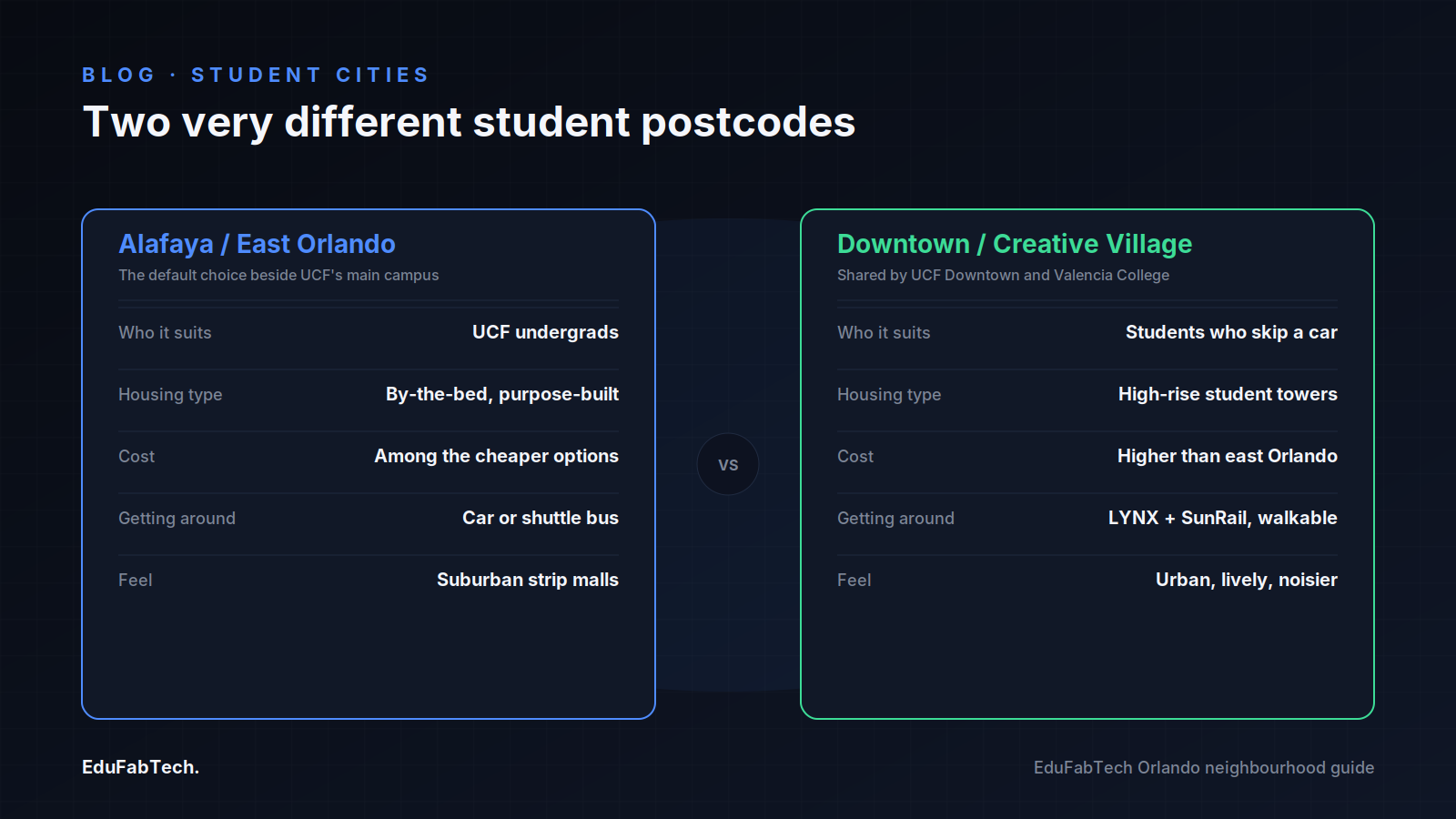
Alafaya and East Orlando is the default for UCF undergraduates. The stretch of Alafaya Trail and McCulloch Road beside the campus is dense with by-the-bed apartment complexes, strip malls and chain restaurants; rooms here are among the cheaper student options and many buildings run shuttle buses to campus, but the area is car-oriented and can feel like a suburb rather than a city. Neighbouring Oviedo and Union Park offer slightly quieter, often cheaper rooms a short drive away. Listings near the main campus are collected at /near/university-of-central-florida.
Downtown and the Creative Village is the choice for students who would rather not own a car. UCF Downtown and Valencia's downtown campus share this district, high-rise student housing has gone up around them, and it is walking distance to Lake Eola, LYNX Central Station and a SunRail stop. It is livelier and more urban than anywhere near the main campus, with the nightlife and noise that come with that.
Winter Park suits Rollins and Full Sail students. It is leafy, affluent and walkable around Park Avenue, has its own SunRail station, and keeps a small-town feel. Rooms tend to be in older houses and modest complexes, and rents run higher than out east. Listings near the two Winter Park campuses sit at /near/rollins-college and /near/full-sail-university.
College Park, just north-west of downtown along Edgewater Drive, is a settled neighbourhood of 1920s bungalows, independent cafés and small shops. It draws graduate students and young professionals who want somewhere quiet and central rather than cheap, and the commute east to UCF can be long in rush hour.
Mills 50, the Milk District and Audubon Park, east of downtown, form Orlando's creative belt — Vietnamese restaurants and street art in Mills 50, bars and a weekly community market around Audubon Park, older and often cheaper rentals throughout. The mix appeals to Full Sail students and anyone who wants Orlando's independent side rather than its chains.
Lake Nona, far to the south-east, is the newest option: a master-planned "Medical City" built around UCF's College of Medicine and other health-science facilities. It is modern, pricey and well kept, but it is isolated from the main campus and from downtown, and it is firmly a driving neighbourhood.
Finding a room — and the deposit you should never wire
Most student housing in Orlando is leased by the bed in large complexes, with a separate individual lease for each tenant and, for many international students, a requirement for a co-signer or guarantor. Leases typically run a full twelve months rather than the length of the academic year, and the busy season is spring and early summer for an autumn move-in; the best-located rooms near UCF go first. If you are arriving from abroad, it is normal to book a first term in university housing or a short sublet and search in person once you are on the ground.
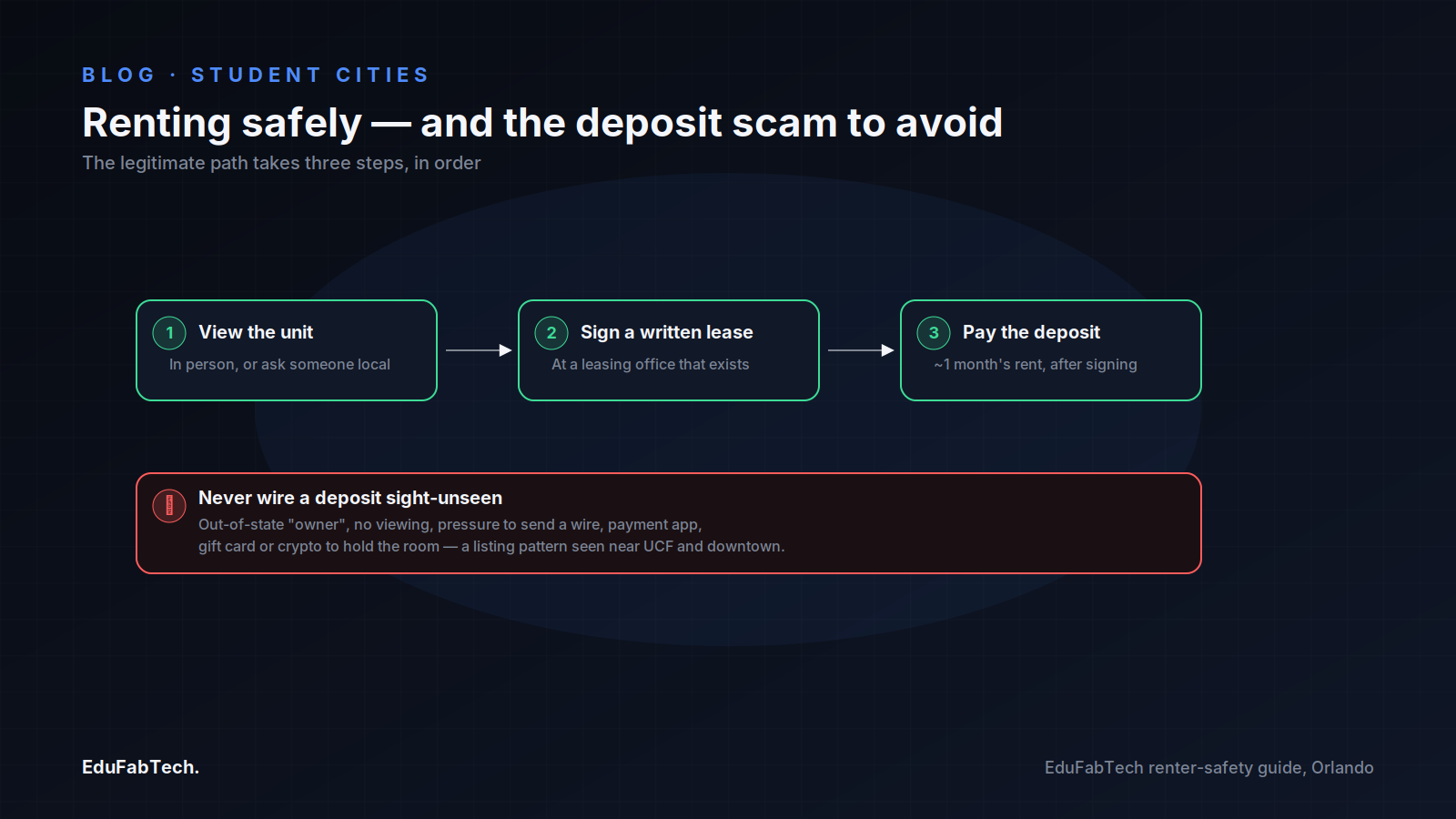
The scams that target Orlando students follow a pattern. Fake listings appear for apartments along the Alafaya corridor near UCF and for rooms downtown, usually priced a little below the market, with an "owner" who is conveniently out of state and cannot show you the unit. The request is always the same: send a deposit or first month's rent to hold it. Treat any such request as a warning sign. Never send money by bank wire, payment app, gift card or cryptocurrency to reserve a room you have not seen — those transfers cannot be reversed, and a legitimate leasing office in Orlando takes an application fee and a security deposit (commonly around one month's rent) only after you have viewed the unit and signed a written lease. See the place yourself, or ask someone already in the city to view it for you, and confirm the leasing office physically exists before paying anything. Rooms and sublets posted by students are at /in/united-states/orlando/rooms.
Furnishing a room: Orlando's markets and second-hand
A by-the-bed apartment often comes furnished, but a private room or an older house will not, and buying new is the expensive way to fix that. Orlando's weekend markets are a good starting point for small things and a sense of the city: the City of Orlando runs the Orlando Farmers Market every Sunday from 10am to 3pm in the south-east corner of Lake Eola Park, and it has done so since 1987, while the Winter Park Farmers' Market fills Central Park on Saturday mornings. For furniture and kitchen kit, thrift stores and charity shops across the metro — including Habitat for Humanity's ReStore outlets — are where most students actually furnish a room cheaply. On EduFabTech you will find second-hand goods at /in/united-states/orlando/second-hand, larger items at /in/united-states/orlando/furniture, and things being given away at /in/united-states/orlando/free-stuff — move-out weeks at the UCF complexes are the best time to pick up a desk or chair for nothing.
Working while you study
Rules on work depend on your immigration status, and this is guidance, not legal advice. For international students on an F-1 visa, the US Department of Homeland Security's Study in the States site states that on-campus employment is permitted but may not exceed 20 hours a week while school is in session, and that off-campus work generally requires separate authorisation. The practical step is to talk to your university's Designated School Official before accepting any job and to apply for a Social Security Number once work is approved; the official guidance is the source to follow, not a recruiter or a landlord. Domestic students face no such cap, and Orlando's hospitality, retail and theme-park economy means term-time jobs are relatively easy to find. Part-time openings posted locally are at /in/united-states/orlando/jobs.
Libraries and places to concentrate
On the UCF campus, the John C. Hitt Library, beside the reflecting pond at the heart of the main campus, offers quiet and silent study floors, small and large group study rooms, and the Knowledge Commons — a 24,800-square-foot space with mixed seating and desktop workstations. Off campus, the Orange County Library System's main Orlando Public Library, at 101 East Central Boulevard downtown, is one of the largest public library buildings in the state and is open to anyone, with free Wi-Fi, bookable rooms and the Melrose Center's studios; EduFabTech's own list of desks and study spaces is at /in/united-states/orlando/study-spaces. Winter Park, College Park and the downtown branches add quieter neighbourhood libraries if the main campus is far from where you live.
Getting around a car-first city
Orlando is built for driving, and most students who can afford a car keep one. Public transport exists but is thin by the standards of denser cities. The bus network is run by LYNX (the Central Florida Regional Transportation Authority), centred on LYNX Central Station downtown; its fare store lists an all-day pass at $4.50, a 7-day pass at $16.00 and a 30-day pass at $50.00. Its reduced fares — a 30-day pass at $25.00, for example — are limited to youth aged 7 to 18 (or still in high school) and to eligible seniors and disabled riders under LYNX's AdvantAge programme, so most university students pay the full adult rate. The SunRail commuter train runs north–south through downtown, linking Winter Park, Sanford and other suburbs; its fares page lists $2.00 for a one-way trip within a single county, $3.75 for a one-county round trip and $56.00 for a one-county monthly pass, with the 50% discount applying to riders aged 7–18, seniors and disabled riders rather than to university students generally. SunRail does not run on Sundays or late at night, which limits its use for social trips, and neither network reaches the main UCF campus directly.
What it costs
The clearest sourced figures come from UCF itself. For the 2026-2027 year, UCF's housing office lists on-campus rates from $2,766 a semester for a shared bedroom in the Apollo community up to $5,863 a semester for a private bedroom in a Towers at Knights Plaza apartment, with the newer NorthView private-bedroom apartments falling just below that. UCF's own 2026-2027 cost-of-attendance budget sets tuition and fees at $5,954 for a Florida resident undergraduate and $24,960 for a non-resident, and allows $8,750 for housing and $6,170 for food across the year — useful benchmarks whether you live on campus or not. Off-campus rents vary widely by neighbourhood, and a by-the-bed room near UCF is often cheaper per person than a whole apartment downtown; the honest answer is that there is no single reliable citywide student-rent figure, so treat UCF's housing allowance as the best dated anchor. Add transport and the picture is complete: for a student without a car, a $50 monthly LYNX pass or occasional SunRail trips; for one with a car, fuel, insurance and parking that the university budget does not fully capture.
The honest trade-offs
What is good about Orlando for a student is real. There is no state income tax in Florida; the hospitality economy makes part-time and seasonal work plentiful; UCF's scale means a vast range of courses, clubs and facilities; and the city is young, growing and comparatively affordable against Miami or the big north-eastern cities. The weather allows an outdoor life for most of the year.
What is hard is equally real. The metropolitan area is spread out and car-dependent, and public transport will not get you everywhere you need to go, especially to the main campus; without a car, your choice of neighbourhood narrows sharply. Rents have risen with the region's rapid growth. Summers are intensely hot and humid, the autumn term overlaps hurricane season, and the tourist economy means traffic and crowds that locals plan around. The student experience is less concentrated than in a classic college town — Orlando is a real city first and a university town second.
A checklist for your first weeks
- Sort housing before chasing anything else, and never pay a deposit for a room you or someone you trust has not seen in person.
- Decide early whether you will have a car; if not, weight your neighbourhood choice toward downtown, Winter Park or a complex with a UCF shuttle.
- If you are on an F-1 visa, meet your Designated School Official before taking any job, and follow the DHS guidance on hours and authorisation.
- Get a LYNX pass or set up SunRail if you will use transit, and check which discounts you actually qualify for — most university students pay full fare.
- Register for a free Orange County Library System card for study space and Wi-Fi beyond campus.
- Furnish from markets, thrift stores and move-out giveaways rather than buying new, and check local listings at /in/united-states/orlando.
- Learn the hurricane-season basics — how alerts work and what your building expects of you — before the first storm watch.
A quick question for readers
Do you work part-time while you study?
Many students work to pay the bills. See how common it is — and how many hours people really do.
Pick an answer, create a free account in a minute, and your vote counts. Already a member? Sign in
Source: University of Central Florida
Sources (5)
- University of Central Florida. UCF Facts 2025-2026. University of Central Florida, 2025. ucf.edu ↗ · checked 7 Oct 2026
- UCF Housing and Residence Life. 2026-2027 Housing Rates. University of Central Florida, 2026. housing.ucf.edu ↗ · checked 7 Oct 2026
- SunRail. Fares. Florida Department of Transportation (SunRail), 2026. sunrail.com ↗ · checked 7 Oct 2026
- Central Florida Regional Transportation Authority (LYNX). Store: Passes and Fares. LYNX, 2026. golynx.com ↗ · checked 7 Oct 2026
- U.S. Department of Homeland Security. Working in the United States. Study in the States, 2025. studyinthestates.dhs.gov ↗ · checked 7 Oct 2026