Studying in Osnabrück: universities, housing and student life
A practical, honest guide to studying in Osnabrück — its two universities, where students find rooms, the markets and social shops that furnish them cheaply, transport, libraries and real costs.
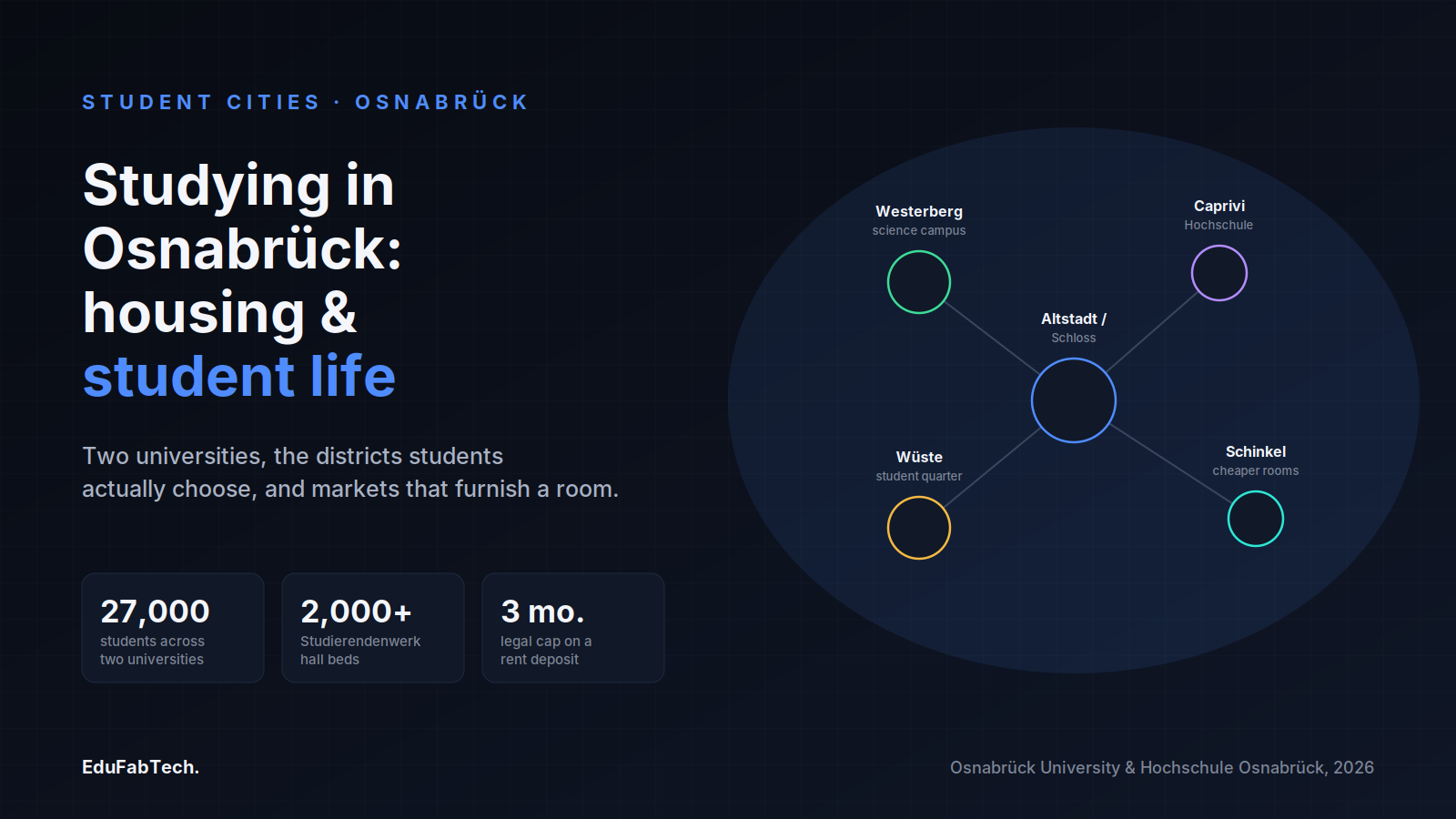
Osnabrück sits in the far west of Lower Saxony, in the lowland between two ranges of wooded hills — the Wiehengebirge to the north and the Teutoburg Forest to the south — close enough to the North Rhine-Westphalia border that trains to Münster and the Ruhr take under an hour. It is a compact city built around a medieval Altstadt, two Gothic churches and a baroque castle, and it carries the title Friedensstadt, the city of peace, from its part in ending the Thirty Years' War in 1648. For students the practical consequence of all this is a walkable centre, green edges, and a cost base below the big German cities most international applicants think of first.
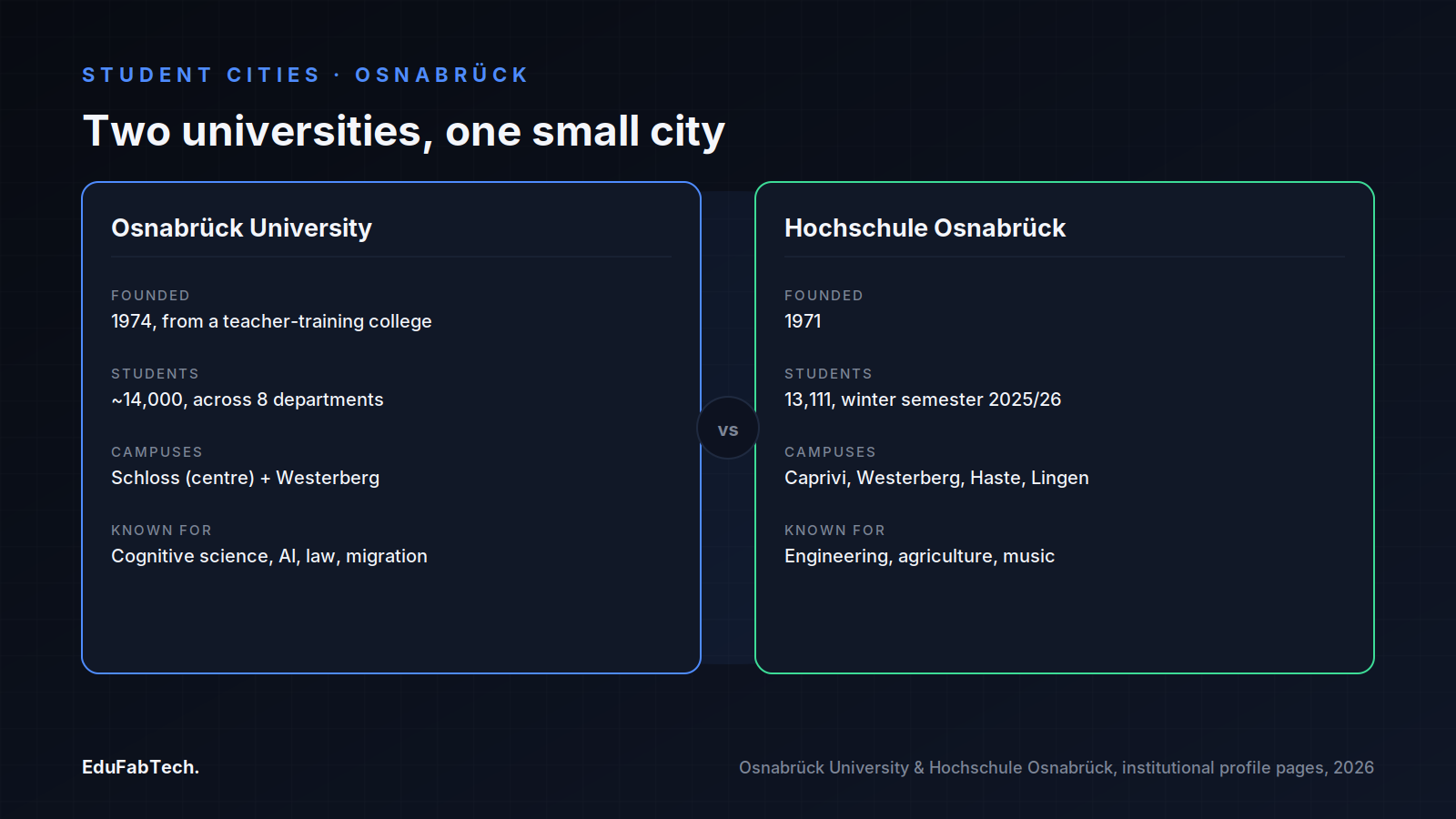
The student population is substantial for a city this size. Osnabrück University describes itself on its own profile page as home to around 14,000 students across eight departments and roughly 180 study programmes (Osnabrück University, 2026), while Osnabrück University of Applied Sciences reported 13,111 students for the winter semester 2025/26 on its figures page (Hochschule Osnabrück, 2026). Together that is a lot of young people concentrated in a centre you can cross on foot in twenty minutes, which shapes everything from how fast rooms go to how full the libraries get in exam weeks.
This guide walks through where to study, where to live, how to furnish a room without spending much, how to get around, and what a semester realistically costs — with the numbers traced to the institutions that publish them. If you want to browse current local listings alongside it, EduFabTech keeps city pages for Osnabrück.
Four places to study, two of them in Osnabrück itself
Osnabrück University is the larger name and the more classically academic one. It grew out of the Adolf-Reichwein teacher-training college and was established in 1974, and it is split between two areas of the city: the baroque Schloss in the centre, which houses administration, law, the humanities and social sciences, and the Westerberg campus to the west, which holds the natural sciences. Its profile page lists research strengths including cognitive science, artificial intelligence, membrane biology, comparative law and migration research (Osnabrück University, 2026). Cognitive science in particular gives Osnabrück a reputation out of proportion to the city's size.
Osnabrück University of Applied Sciences (Hochschule Osnabrück) is the practice-oriented counterpart, founded in 1971. Its own figures page shows it spread across several sites: the Caprivi campus for business and social sciences, Westerberg for engineering and computer science, Haste on the northern edge for agricultural sciences and landscape architecture, plus the Institute of Music — and a separate campus in the town of Lingen, about 50 kilometres away, for management, culture and technology (Hochschule Osnabrück, 2026). The Haste campus, with its farmland and glasshouses, is unusual for a German university and worth knowing about if you study anything to do with food, plants or land.
Two more institutions belong to the wider region rather than the city. The University of Cooperative Education Melle (Berufsakademie Melle), in the town of Melle east of Osnabrück, runs state-recognised dual Bachelor's programmes that alternate study blocks with paid work in a partner company, concentrated in wood and furniture technology, window-and-façade technology and social work. And Bielefeld University, the large research university in Bielefeld, lies around 50 kilometres south-east across the hills in North Rhine-Westphalia — a realistic commute by regional train and the reason some Osnabrück residents are enrolled there. If you are weighing campuses, EduFabTech has listings near Osnabrück University, near Osnabrück University of Applied Sciences and near Bielefeld University.
Where students actually settle
Because the Schloss is in the Altstadt and the science and engineering campuses are on the Westerberg, the most convenient postcodes cluster to the west and north-west of the centre. The Wüste, a dense grid of late-19th-century apartment blocks south-west of the station, is the classic student quarter: shared flats, small bakeries, cheap lunch spots, and a short cycle to either the castle or Westerberg. Westerberg itself is leafier, quieter and a little pricier, and puts you next to the science buildings and the botanical garden. Weststadt and the streets around the Heger Tor sit between the two and are popular for the same reason.
For cheaper rooms, look east and north. Schinkel, across the tracks to the east, is the traditionally working-class, multicultural district where rents run lower and where a lot of first flats get taken; Haste and Dodesheide to the north make sense if you are at the agricultural campus. The inland Hafen (harbour) north of the centre is the hub of the city's nightlife and live-music scene rather than a place most people live. Nowhere in Osnabrück is far from anywhere else, so the choice is really about price and atmosphere, not commute length. You can filter current rooms in Osnabrück on EduFabTech to see where availability actually is.
Renting safely: the Studierendenwerk, deposits and scams
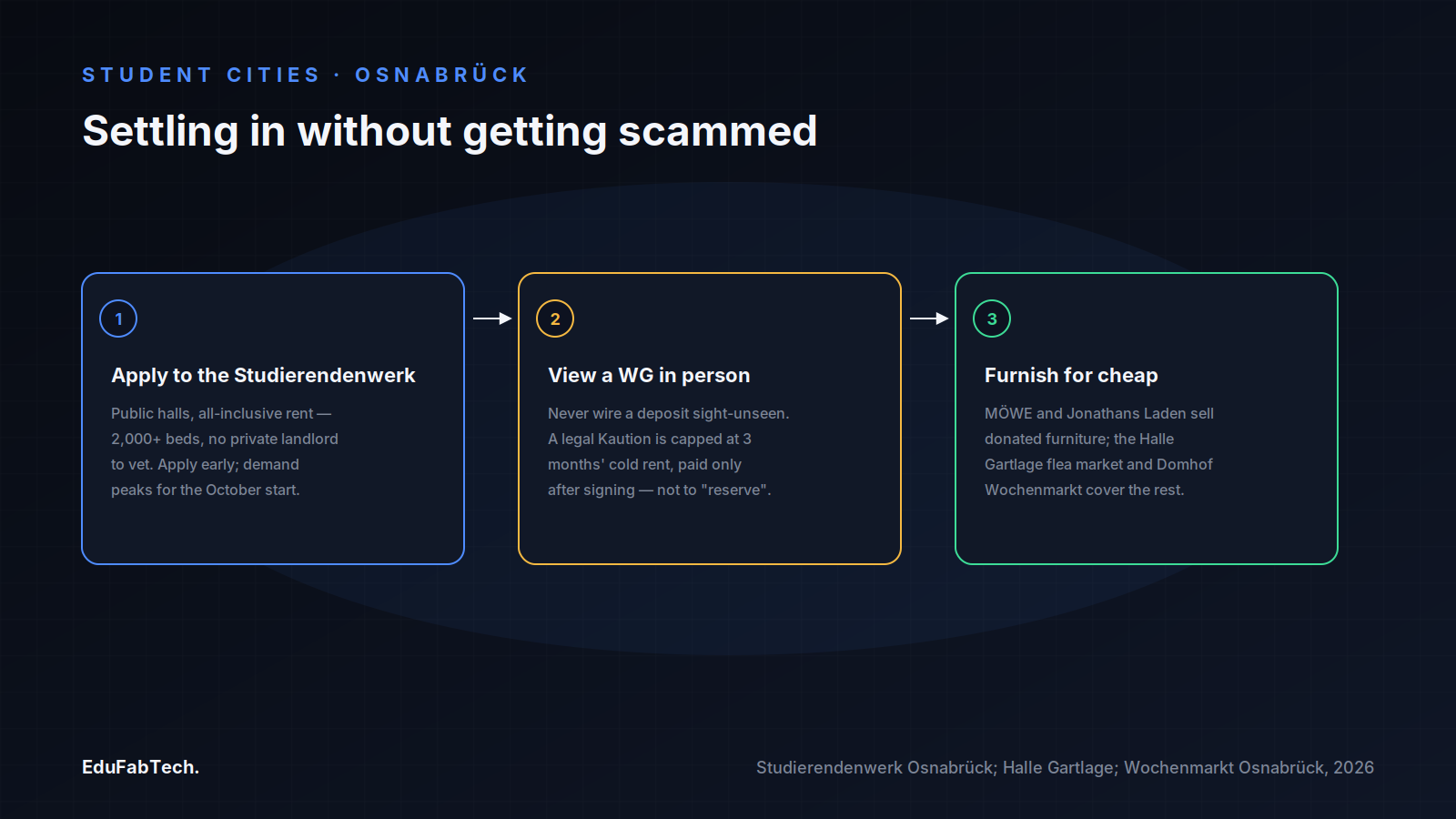
The single most useful first step is the Studierendenwerk Osnabrück, the public student-services body that runs the halls of residence. It houses more than 2,000 students in residences in Osnabrück and in nearby Lingen and Vechta, in a mix of shared flats, single apartments and family housing (Studierendenwerk Osnabrück, 2026). Halls are the safest option for anyone arriving from abroad because the contract is with a public institution, the rent is all-inclusive, and there is no private landlord to vet. Apply online as early as you can — places are limited and demand peaks around the October start — and treat a hall room as the fallback that lets you look for a private shared flat (a WG, Wohngemeinschaft) at your own pace once you are in the city.
On the private market, the rules are the ones that apply across Germany but the scam pattern is local and predictable: fake listings for rooms in the Wüste or near the Westerberg, priced slightly below the going rate, posted by someone who claims to be abroad and asks you to transfer a deposit or the first month's rent to "reserve" the room before you can view it. Do not do this. A genuine deposit (Kaution) in Germany is capped at three months' cold rent, is paid only after you sign a contract, and for halls is handled by the Studierendenwerk directly. Never send money by bank transfer, gift card or cryptocurrency to hold a room you have not seen. View the place in person or over a live video call, meet the current tenants, and be wary of any "agent" who cannot. If you cannot travel before term, a Studierendenwerk room first and a WG search afterwards is the sane sequence.
Furnishing a room, and the markets worth knowing
A bare room in Germany often means exactly that — sometimes no kitchen, sometimes no lamps — so second-hand is how most students fill one. Osnabrück has a cluster of social department stores that sell donated furniture and household goods cheaply: MÖWE, the Soziale Kaufhaus on Hauswörmannsweg, carries used furniture, appliances, kitchenware and bikes, and its city-centre shop Jonathans Laden on Johannisstraße runs a bicycle workshop alongside the household goods. These are ordinary shops open to anyone, and they are the fastest way to kit out a room for a fraction of new prices. EduFabTech also lists second-hand items, used furniture and things given away free in the city.
For the fun version of the same thing, the flea market at the Halle Gartlage on Schlachthofstraße runs on scheduled dates through the year, listed on the venue's own calendar (Halle Gartlage, 2026) — the place to find a desk, a bike or a bookshelf for a few euros. For food and daily shopping, the Wochenmarkt at the Domhof, in the shadow of the cathedral in the Altstadt, sells produce, cheese, bread and flowers on Saturday mornings from 7 to 14, as listed on the Osnabrück weekly-market information page (Wochenmarkt Osnabrück, 2026). Both are genuinely part of the city's week rather than tourist set-pieces.
Libraries and places to work
Study space is one thing Osnabrück does well. The Osnabrück University library is split to match the campuses: the Bibliothek Alte Münze in the centre for the humanities and social sciences, the Bereichsbibliothek Heger-Tor-Wall for law and economics, and the Bereichsbibliothek Westerberg for the sciences. The hours are generous — the university library's own page lists the central branches open Monday to Friday until 22:00, with the law-and-economics branch open on weekends too, including Sundays (Universitätsbibliothek Osnabrück, 2026). The Hochschule runs its own library at Caprivi for its students. In exam periods seats fill fast, so arriving early or working in the quieter Westerberg branch is the usual tactic. EduFabTech lists additional study spaces in Osnabrück when the reading rooms are full.
Moving around on the semester ticket
Local transport in Osnabrück is run by the municipal utility's transit arm under the VOS fare brand, and it is almost entirely buses — there is no tram or U-Bahn. The decisive thing for students is that the semester contribution already includes the Deutschland-Semesterticket, the student version of the nationwide Deutschlandticket, which lets you use regional trains and local buses across the whole country, not just the VOS area. That turns weekend trips to Münster, Bremen, Hannover or the North Sea coast into something you have already paid for. The ticket is held digitally and tied to your enrolment; the student committees publish the current details each semester (AStA Universität Osnabrück, 2026). The flat centre and the short distances mean most students cycle day to day and keep the ticket for longer journeys.
What a semester costs, and what is hard
There are no tuition fees at the public institutions; what you pay each term is the semester contribution, which bundles administration, student-services and student-union charges with the transport ticket. Osnabrück University of Applied Sciences set its contribution at €442 for the summer semester 2027, of which €223 is the Deutschland-Semesterticket, on its study-organization page (Hochschule Osnabrück, 2027); Osnabrück University sets its own, broadly comparable, figure separately. On the housing side, the Studierendenwerk lists rooms in its Kommenderiestraße 78/80 residence at €360–367 a month including gas, water and electricity, with a studio flat at €368, as shown on its housing page confirmed in November 2026 (Studierendenwerk Osnabrück, 2026). Older or smaller halls run cheaper; the private market is usually dearer.
The honest balance: Osnabrück is cheaper and calmer than Hamburg, Cologne or Munich, the centre is walkable, the transport ticket is excellent value, and the two universities give it a real student density for its size. Against that, the room shortage around the October intake is real — the same squeeze every German university town feels — so arriving without accommodation sorted is stressful. The nightlife is concentrated and will feel small if you come from a metropolis. The weather is north-German: mild, grey and wet for much of the year, with little drama and not much sun. And the city's convenience as a rail hub cuts both ways — it is easy to leave at weekends, which some students do often enough that the place can feel quiet.
On earning money alongside study, the rules depend on your nationality. EU and EEA students work on broadly the same footing as German students; non-EU students face an annual limit on working days and some restrictions on self-employment. These rules change, and this is not legal advice — confirm the current limits with the federal "Make it in Germany" portal run by the German government and with the Ausländerbehörde (immigration office) in Osnabrück before you take a job. EduFabTech lists student jobs in Osnabrück to start from.
A checklist for the first weeks
- Apply to the Studierendenwerk Osnabrück for a hall room as early as possible, and keep a private WG search going in parallel rather than instead.
- Register your address (Anmeldung) at the city's Bürgeramt within the first weeks — you need it for almost everything that follows, including a bank account.
- Activate your Deutschland-Semesterticket once enrolled, and buy or find a second-hand bike early; the two together cover almost all your travel.
- Furnish from MÖWE and the Halle Gartlage flea market before buying anything new; a desk, a lamp and a bike cost very little second-hand.
- Scout the libraries in your first week — the Alte Münze, Heger-Tor-Wall and Westerberg branches — and note which one has seats when you need them.
- Never transfer a deposit for a room you have not seen in person or on a live call, whatever the story and however good the price.
- If you are not an EU/EEA national, check your permitted working days with the Ausländerbehörde before taking any paid work.
Osnabrück rewards students who arrive organised: sort the room and the Anmeldung, lean on the Studierendenwerk and the second-hand economy, and the rest of it — a walkable peace city with cheap trains to half of northern Germany — is easy to enjoy. You can keep an eye on what's on in Osnabrück once you are settled.
A quick question for readers
Do you work part-time while you study?
Many students work to pay the bills. See how common it is — and how many hours people really do.
Pick an answer, create a free account in a minute, and your vote counts. Already a member? Sign in
Comments 3
Comment-
The cost section quietly splices two different calendars together. The €442 semester contribution is explicitly the summer 2027 figure from…
-
The cognitive science point is the one bit of real signal in here, but the piece doesn't back it with anything — no ranking, no publication…
-
The gap I'd flag is the non-EU work-limit bit — the piece correctly says there's an annual day limit and tells you to check with the Ausländ…
Join free to read the full comments and reply Comments are between members; an account takes a minute.
Source: Studierendenwerk Osnabrück
Sources (5)
- Osnabrück University. Profile: Uni Osnabrück. Osnabrück University, 2026. uni-osnabrueck.de ↗ · checked 18 Nov 2026
- Hochschule Osnabrück. WIR in figures. Osnabrück University of Applied Sciences, 2026. hs-osnabrueck.de ↗ · checked 18 Nov 2026
- Hochschule Osnabrück. Study organization: semester contribution. Osnabrück University of Applied Sciences, 2027. hs-osnabrueck.de ↗ · checked 18 Nov 2026
- Studierendenwerk Osnabrück. Housing complexes. Studierendenwerk Osnabrück, 2026. studentenwerk-osnabrueck.de ↗ · checked 18 Nov 2026
- Universitätsbibliothek Osnabrück. Öffnungszeiten. Osnabrück University, 2026. uni-osnabrueck.de ↗ · checked 18 Nov 2026