Studying in Oxford, United Kingdom: universities, housing and student life
A practical, sourced guide to Oxford's two universities, where students live, what a room costs, and the honest trade-offs of a small, expensive, bike-friendly city.
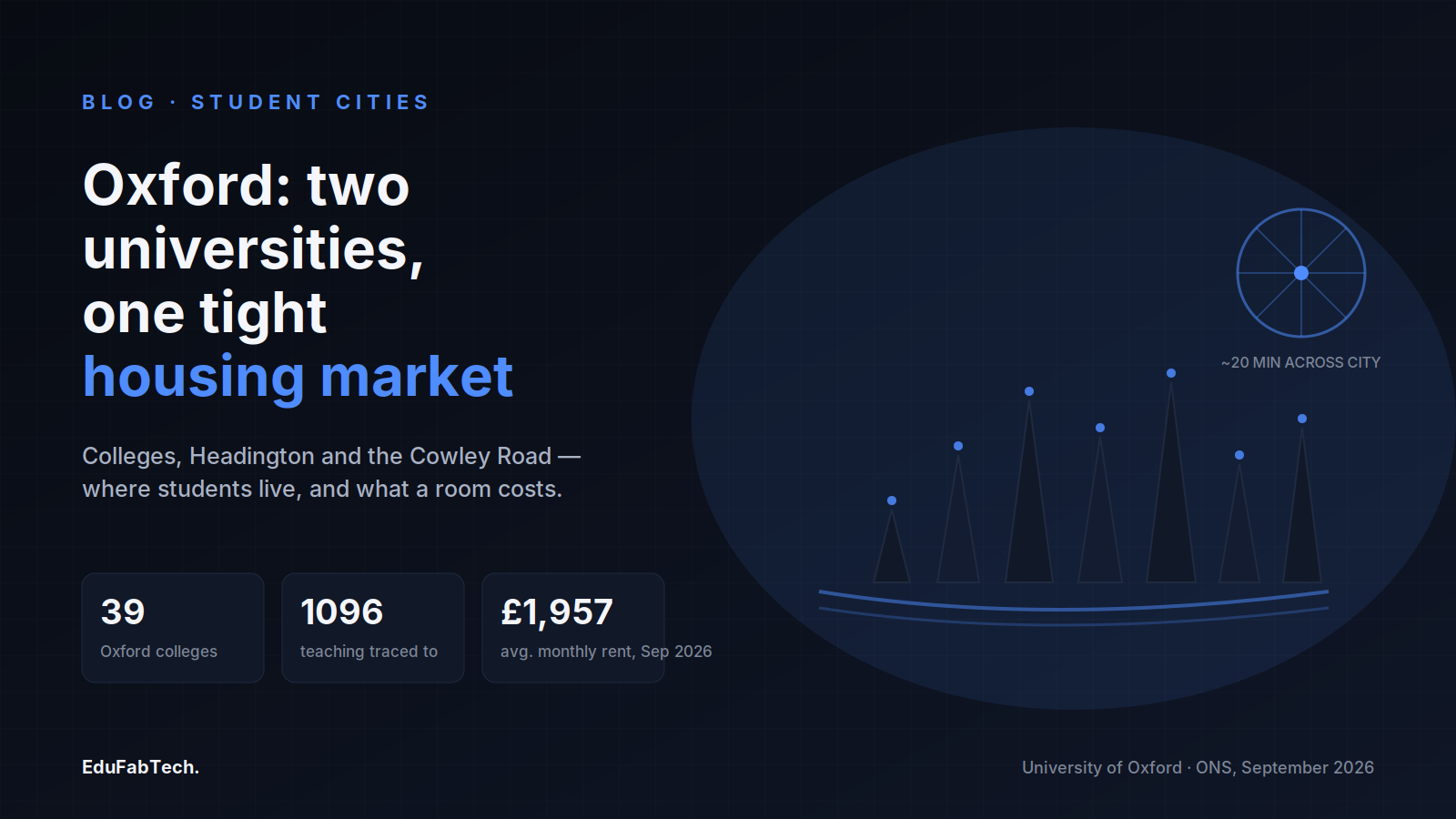
Oxford fits two universities, a web of medieval colleges and a car factory into a city small enough to cross by bike in about twenty minutes. The historic centre sits at Carfax, hemmed in by the Thames (called the Isis as it runs through town) and the Cherwell; the ground rises east towards Headington, where most of the hospitals and the second university sit on the hill. For students this geography matters, because almost everything — colleges, cheap rooms, markets, the bus routes — is squeezed into a few square miles that a lot of people want to live in at once.
That pressure produces a two-tier housing world. Students at the University of Oxford are usually housed by their individual college for at least part of their degree, which shelters them from the open market in a way few other UK cities offer. Everyone else — Oxford Brookes undergraduates, postgraduates, partners and later-year students who have moved out of college — competes for private rooms in a city where rents are among the highest outside London.
The result is a student experience that is genuinely split: one group organised around dining halls, tutorials and college libraries; another commuting up the hill on a bus pass, sharing a Victorian terrace off the Cowley Road. Both are real Oxford. This guide covers both.
Two universities, and the smaller colleges around them
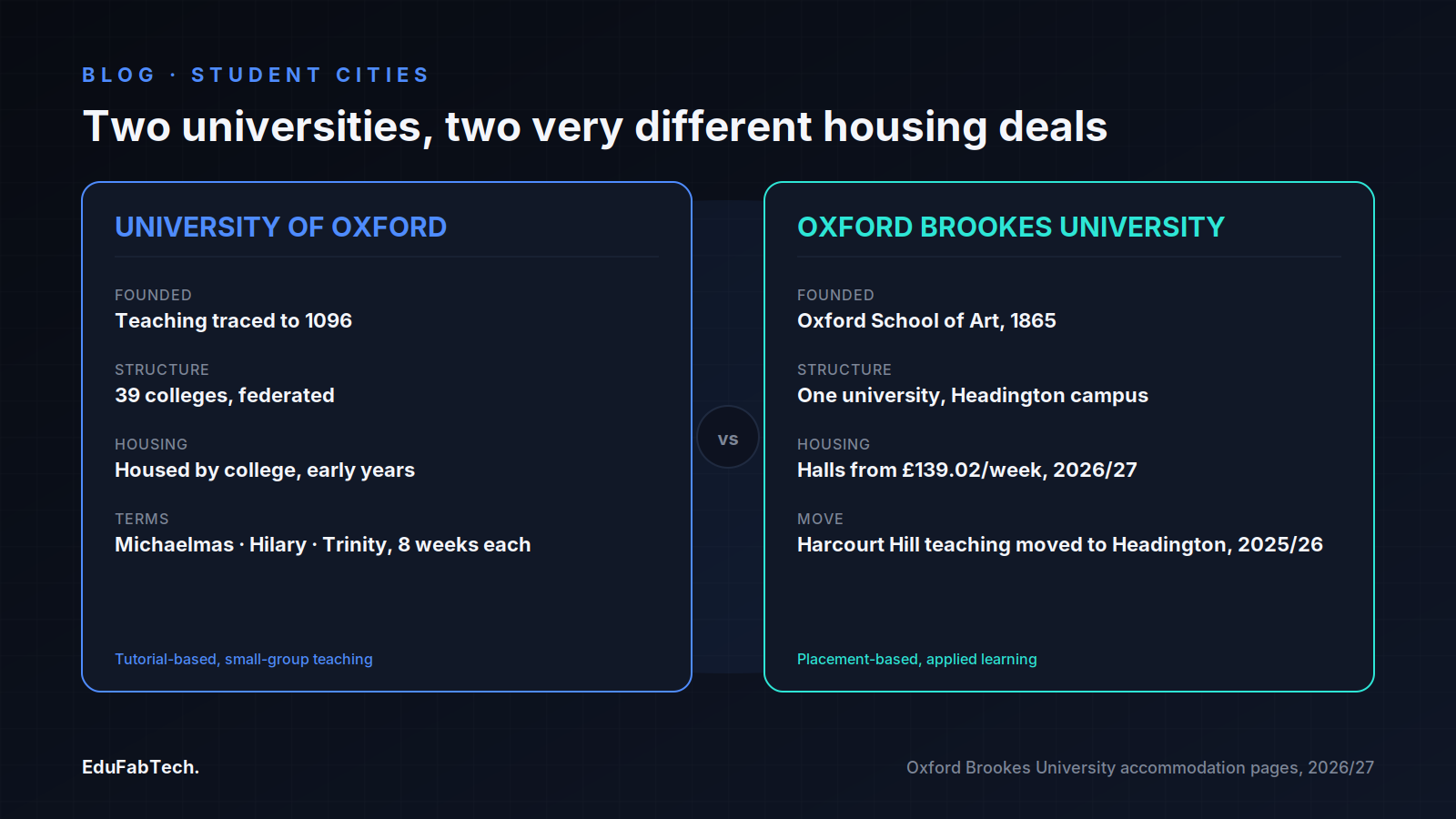
The University of Oxford describes itself as the oldest university in the English-speaking world, with teaching traced to at least 1096, and it has no single campus: it is a federation of 39 colleges and a handful of permanent private halls scattered across the centre, which is how it presents its structure on its institutional pages. You apply to and live in a college, but your degree and most lectures come from the central university and its departments. Teaching runs on three eight-week terms — Michaelmas, Hilary and Trinity — far shorter and more intense than most courses elsewhere, built around weekly one-to-one or small-group tutorials.
Several named parts of the University of Oxford recruit their own students but grant Oxford degrees. The Blavatnik School of Government, on Walton Street, runs the Master of Public Policy and related programmes; the Department of Economics, University of Oxford teaches within the economics and the philosophy-politics-economics degrees rather than admitting undergraduates separately. These are divisions of the collegiate university, not standalone institutions.
Oxford Brookes University is the city's other full university, with roots in the Oxford School of Art founded in 1865 and a teaching style organised around work placements and applied learning, and a long-established School of Architecture. Brookes is centred on its Headington campus — the Gipsy Lane, Headington Hill and Marston Road sites — and moved all teaching and library services from its Harcourt Hill campus to Headington for the start of 2025/26, though it still provides student accommodation at Harcourt Hill.
Beyond the two universities sit smaller, specialist providers. Ruskin College, long associated with adult and trade-union education and now based at Dunstan Road in Old Headington, offers its own honours degrees in law, business and social sciences alongside Access to Higher Education diplomas. Magna Carta College is an independent Oxford business school that delivers MBA and other degrees in partnership with a validating university. Further out, the University of Buckingham — about 25 miles north, in the town of Buckingham, on a campus centred on Hunter Street — is a small private university that pioneered the UK's two-year undergraduate degree; and the Buckinghamshire College Group, a further-education provider in Aylesbury, is a realistic option for vocational and access courses rather than a research university. If you are weighing these up, our listings near the University of Oxford and near Oxford Brookes University show what is around each.
The housing year, and why timing decides everything
If your college houses you, read your college's accommodation office pages first: single rooms, often with meals available in hall, and you are largely insulated from what follows. For a dated benchmark on provided rooms, Oxford Brookes University's halls for 2026/27 run from £139.02 a week for a room with a shared bathroom to £255.43 a week for a studio, on 38- or 50-week contracts, according to the university's accommodation pages. Brookes guarantees halls to many first years, which is the single biggest reason to sort your offer early.
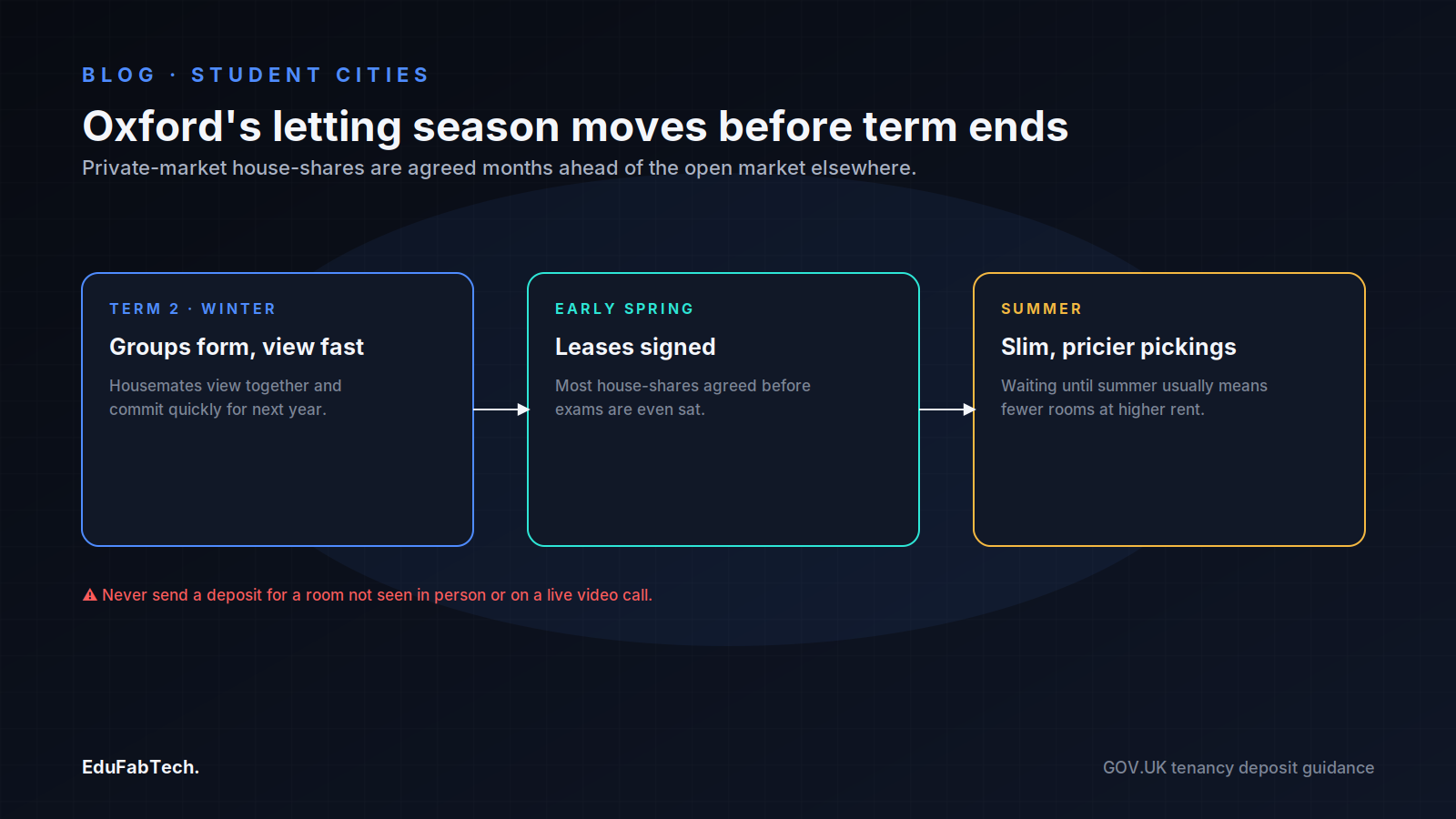
The private market is where Oxford gets hard. The city has a short, fierce letting season: house-shares for the next academic year are often agreed by late winter or early spring, long before you have sat an exam, because demand far outstrips the small stock of student terraces. Groups form in the second term, view together, and commit quickly. Leaving it until summer usually means slimmer, pricier pickings.
Do not send money to hold a room you have not seen in person or by a live video walk-through. Oxford's scams tend to surface where the pressure is highest — rooms advertised on social-media housing groups and marketplace sites at suspiciously low rents, with a "landlord" who is abroad and asks for a deposit by bank transfer, gift card or cryptocurrency to secure it before a viewing. A genuine let in England comes with a written tenancy agreement, and once you are a tenant your deposit must by law be placed in a government-approved tenancy deposit scheme, as GOV.UK sets out; a holding deposit paid before signing converts into that protected deposit once the tenancy starts. If someone wants an irreversible payment to a personal account before you have keys or paperwork, walk away. Our rooms listings for Oxford are a safer starting point than cold-messaging a stranger.
Neighbourhoods, from the Cowley Road to the top of Headington hill
East Oxford and the Cowley Road are the heart of out-of-college student life: a long, multicultural strip of independent cafés, bars, an arthouse cinema and food from half the world, lined by streets of shared Victorian terraces. It is flat, a short cycle into the centre over Magdalen Bridge, and popular with both universities' students and recent graduates. Rents reflect the demand.
Headington, up the hill to the east, is the natural base for Oxford Brookes and for anyone working at the John Radcliffe or Churchill hospitals — the University of Oxford's medical research also clusters here at its Old Road Campus. Expect large Victorian and Edwardian houses, a busy high street, and the famous fibreglass shark embedded in a roof on New High Street. It is further from the centre, so the bus or a longer bike ride is part of the deal.
Jericho, north of the centre by the canal and the Oxford University Press, is small, pretty and central, with the Phoenix Picturehouse and the cafés of Walton Street; its artisan cottages are desirable and priced accordingly. Marston, across the river and the University Parks, is quieter and often cheaper, favoured by postgraduates and staff who want a calmer street and a quick cycle in. Summertown, further north along the Banbury Road, is leafier and more affluent, with good shops and frequent buses but higher rents. Iffley and the streets off the Iffley Road — home to the running track where the first sub-four-minute mile was run — are residential and calm, handy for the sports grounds and a manageable ride from town.
Across all of them, the city-wide picture is expensive: the Office for National Statistics put the average monthly private rent in Oxford at £1,957 in September 2026 in its local rent and house-price data. For a student that figure is a whole-property average, not a room price, but it signals why sharing is the norm and why timing and location are worth real effort.
Furnishing a room: the Covered Market, Gloucester Green and a city built on charity shops
Oxford is an unusually good city for kitting out a room second-hand, partly because it effectively invented the modern charity shop. Oxfam was founded in Oxford in 1942 as the Oxford Committee for Famine Relief and opened its first permanent shop on Broad Street, as the charity records in its own history; the city still has a dense run of charity and second-hand shops, with the Cowley Road and St Michael's Street especially well stocked for furniture, kitchenware, books and clothes.
For markets, the Covered Market off the High Street has traded since the 1770s and now houses over 50 independent traders selling food, gifts, flowers and crafts, per the market's own account — more a place to eat and browse than to furnish a flat, but part of the texture of student life. The open-air Gloucester Green market, run by the city council, operates on Wednesdays, Thursdays, Fridays and Saturdays according to Oxford City Council, mixing general stalls with street food — a realistic hunting ground for cheap bric-a-brac, crockery and books. For bigger items, start with our second-hand listings for the city.
Earning while you study
Work rules depend on your immigration status, and you should confirm yours against the official source rather than any guide. For students on the UK Student visa, the UK Council for International Student Affairs states that term-time work is capped at up to 20 hours a week for a qualification at degree level or above, and up to 10 hours a week below degree level, with unrestricted hours outside term time, on its student work page. The exact conditions attached to your own visa are the ones that bind you, and the Home Office sets out what a Student visa does and does not permit on GOV.UK. This is general information, not legal advice; check your visa, your sponsor's term dates and your right to work before you start a job. Oxford's hospitality, retail, tutoring and the colleges themselves (bar, catering and event work) are the usual sources of student jobs — see our Oxford jobs listings.
Libraries and desks, from the Bodleian to the Westgate
The University of Oxford's research library, the Bodleian, is one of the oldest in Europe and a legal-deposit library entitled to a copy of every book published in the UK; its reading rooms, including the circular Radcliffe Camera, are open to members of the university, so access depends on your card. Oxford Brookes students have their own libraries on the Headington campus. For everyone, including residents and students from any institution, the Oxford Westgate Library — the county's central public library, run by Oxfordshire County Council and sitting on an upper floor of the Westgate shopping centre — offers quiet study areas, laptop-friendly seating and free wi-fi. Cafés around Cowley Road and Jericho fill the gaps, and our study-spaces listings point to bookable desks when the free seats run out in exam season.
Buses, bikes and the hill
Oxford runs on two bus operators — the Oxford Bus Company (with its Thames Travel network) and Stagecoach — plus a well-used Park & Ride ring and, above all, bicycles; the flat centre and short distances make a bike the fastest way around for most students. On fares, Oxford Brookes students can buy a discounted annual CityZone bus pass from the Oxford Bus Company for £270, which the university describes as a 63% saving on the standard £732 price, or a semester pass for £135, with single fares cut to £2.00, according to Brookes' travel pages; those passes cover Oxford Bus Company and Thames Travel services but not Stagecoach. If you live up in Headington or out towards Marston, that pass does real work; if you live in East Oxford or Jericho, a bike and good lights may serve you better and cost almost nothing to run.
What it costs, and what wears you down
Oxford is expensive, and the official estimates say so. The University of Oxford's living-costs guidance for 2026-27 entry puts likely costs at £1,405 to £2,105 a month, of which £825 to £990 is accommodation, on its living-costs page. Set that beside the ONS city rent figure above and the shape of the problem is clear: housing is the cost that dominates, and it is the hardest to control.
The honest pros: the city is compact and walkable, the libraries and museums are extraordinary and many are free, East Oxford's food and music scene is genuinely good, and the countryside and London are both close. The honest cons: rents and the tight letting season punish anyone who organises late; the private stock of student housing is small and competition is intense; the hill up to Headington turns a cheap room into a daily commute; and the collegiate split means the two universities' students can live quite separate lives. The climate is grey and damp more often than not, and term dates — especially Oxford's eight-week sprints — leave little slack. None of this is a reason to stay away; it is a reason to plan.
A checklist for the first few weeks
- If a college or Brookes halls place is on offer, accept and read the contract dates before chasing the private market.
- Form a house-sharing group early — Oxford's lettings move in late winter and spring, not summer.
- Never pay a deposit to "hold" a room before an in-person or live video viewing; confirm the deposit will sit in a government-approved scheme.
- Get a bike, lights and a solid lock; register it, and learn the flat cycle routes before relying on buses.
- Decide on a bus pass only after you know where you live — it pays off up the hill, less so in the centre.
- If you are an international student, confirm your own visa's work conditions on GOV.UK before taking any job.
- Furnish from the charity shops, Gloucester Green and the city's second-hand listings rather than buying new.
- Find your study base early — your college or Brookes library, or the Oxford Westgate Library — so you are not hunting for a desk in exam term.
A quick question for readers
Do you work part-time while you study?
Many students work to pay the bills. See how common it is — and how many hours people really do.
Pick an answer, create a free account in a minute, and your vote counts. Already a member? Sign in
Comments 3
Comment-
The living-costs guidance (£1,405-£2,105/month, £825-£990 for housing) and the ONS city-wide average of £1,957 for a whole property are doin…
-
The ONS average cited here is £1,957 a month for a whole property, which the piece is honest about not being a room price — but then it gets…
-
The line that'd make a good classroom example of "always ask when," is that £1,957 ONS average sitting right next to the university's own £8…
Join free to read the full comments and reply Comments are between members; an account takes a minute.
Source: Office for National Statistics
Sources (5)
- Office for National Statistics. Private rent and house prices, UK: Oxford (local area data). Office for National Statistics, 2026. ons.gov.uk ↗ · checked 5 Nov 2026
- Oxford Brookes University. Halls for prospective students. Oxford Brookes University, 2026. brookes.ac.uk ↗ · checked 5 Nov 2026
- UK Council for International Student Affairs. Working: student work. UKCISA, 2026. ukcisa.org.uk ↗ · checked 5 Nov 2026
- GOV.UK. Tenancy deposit protection. UK Government, 2026. gov.uk ↗ · checked 5 Nov 2026
- Oxford Covered Market. Our Story. Oxford Covered Market, 2026. oxford-coveredmarket.co.uk ↗ · checked 5 Nov 2026