Studying in Paderborn: universities, housing and student life
A practical, sourced guide to the University of Paderborn and the Detmold music and design campuses — rooms, the Studierendenwerk, markets, work rules, the semester ticket and the honest trade-offs.
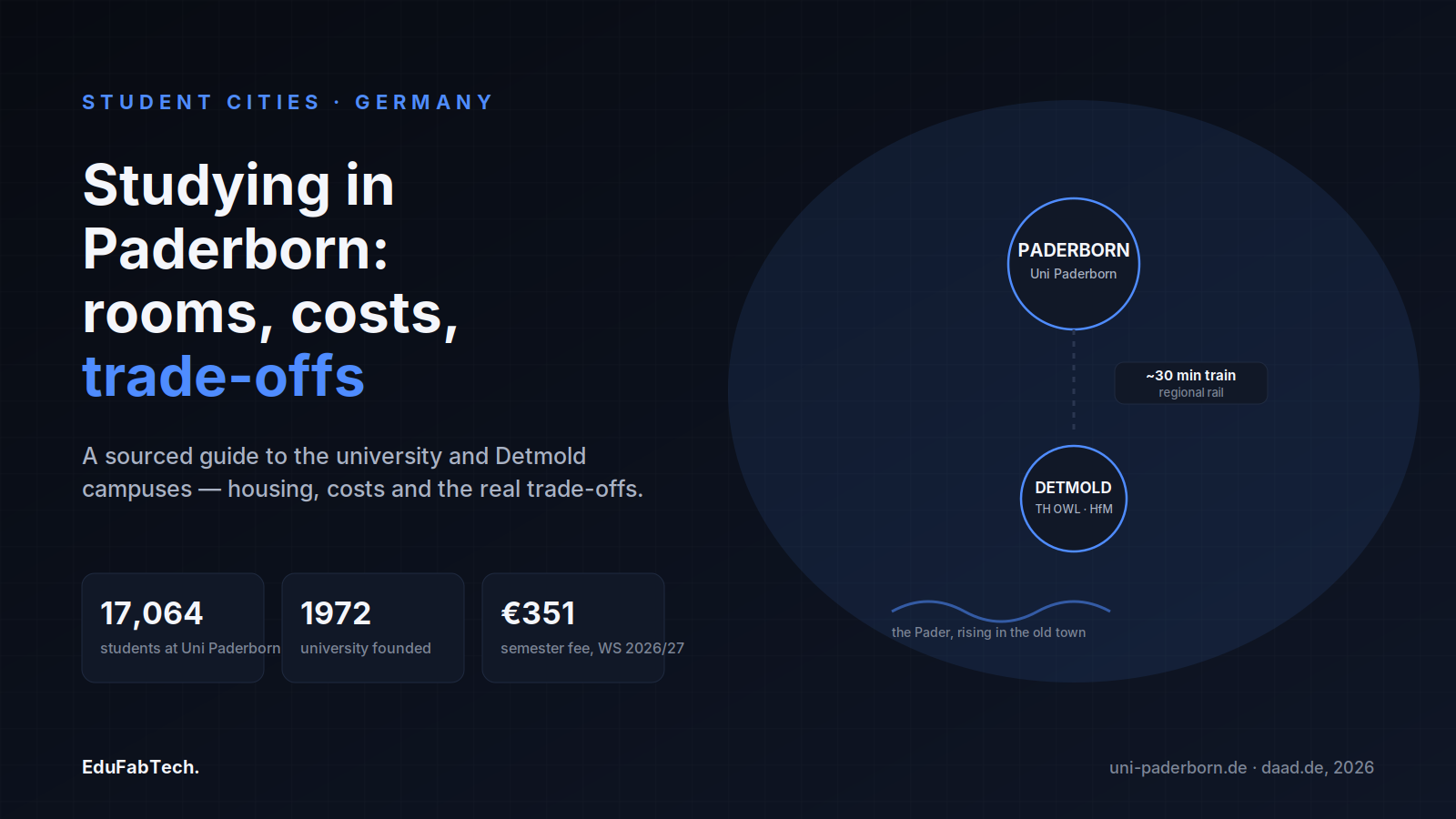
Paderborn sits in the east of North Rhine-Westphalia, in the region locals call Ostwestfalen-Lippe (OWL), roughly between Bielefeld and Kassel. It is a mid-sized city built around water: the Pader rises from karst springs in the old town, a few steps from the pedestrian shopping streets, and runs only a short way before joining the Lippe out at Schloss Neuhaus. The cathedral (Dom) anchors the centre, the market squares sit in its shadow, and almost everything a first-year needs is within cycling distance. It is not a metropolis, and students who arrive expecting one are usually surprised by how quickly the city becomes legible.
For a reader deciding whether to come here, the useful facts are concrete: which institutions actually grant degrees, where rooms turn up, what a semester costs, and where Paderborn is easy or hard to live in. This guide keeps each of those to figures that can be traced to a named source and the year it was published.
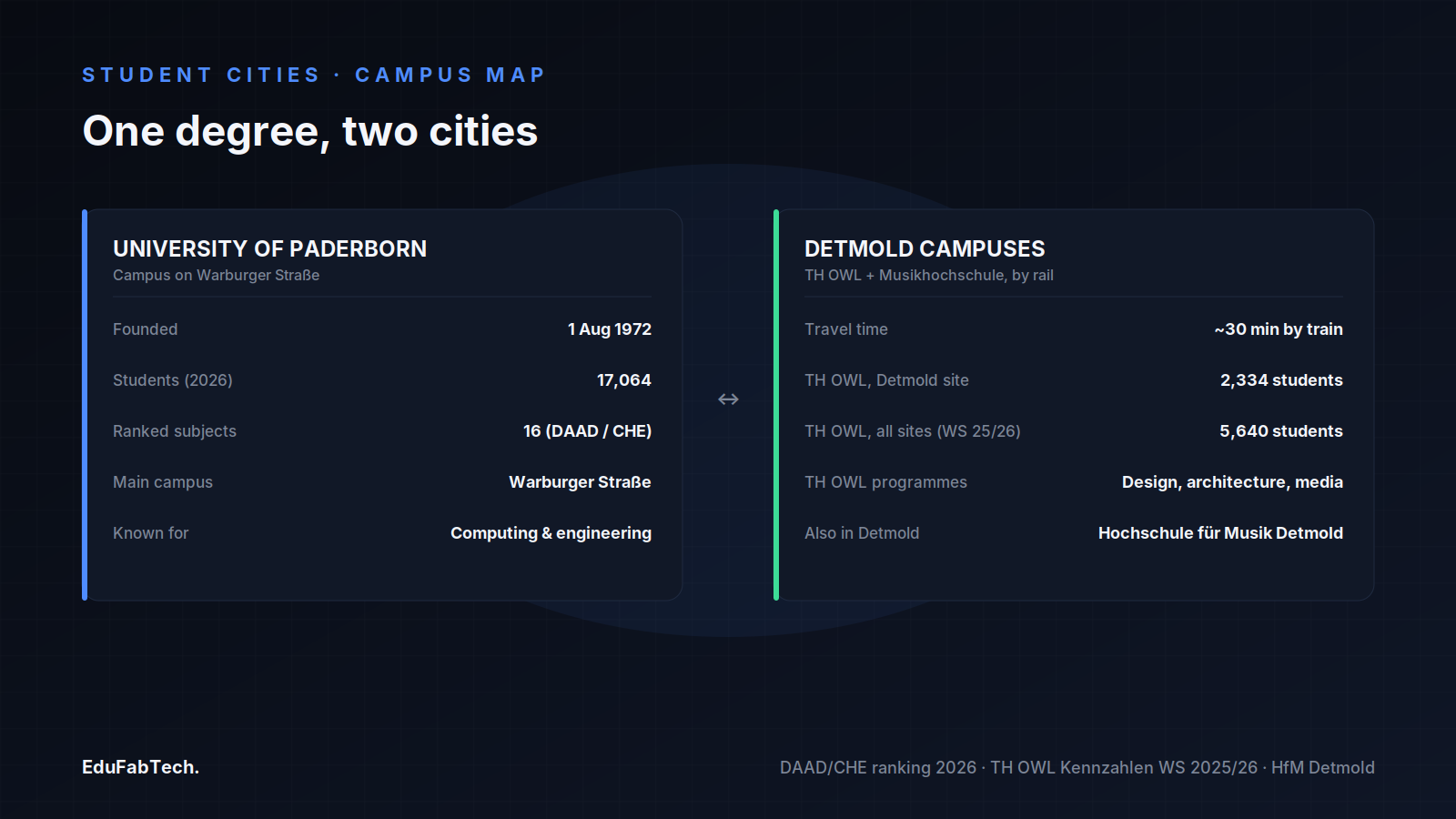
The Universität Paderborn (University of Paderborn) carries a strong reputation in computing and engineering. It was founded on 1 August 1972 as a Gesamthochschule (comprehensive university). Its main teaching campus is on Warburger Straße, with a second site on Fürstenallee that the institution's history page says was built up with the ZM1 (2010) and ZM2 (2020) research buildings into a centre for innovation and research, and is home to its computer-science work and the Heinz Nixdorf Institute (uni-paderborn.de).
The universities: Paderborn, and the campuses down the line in Detmold
The University of Paderborn is the main reason most students are here. It is a campus university: the bulk of teaching happens on one connected site on Warburger Straße at the south-east edge of the city, with the library, canteens and lecture halls a few minutes' walk apart. The DAAD's CHE university ranking lists 17,064 students at Paderborn (2026), spread across 16 ranked subjects including computer science, the engineering disciplines, business, mathematics and the sciences; by share of enrolment the humanities and social-science faculties are in fact the largest, though the university is most strongly associated beyond the city with computing and engineering (daad.de). The Fürstenallee site, about five kilometres away, is reached by the university bus line.
Two further degree-granting institutions named with Paderborn sit in Detmold, a separate town roughly half an hour away by regional train — worth knowing before you sign a lease, because studying there usually means living there, not in Paderborn. The Technische Hochschule OWL (TH OWL) runs its design, architecture, construction and media programmes on the "Kreativ Campus Detmold"; on its own table of figures the university counted 5,640 students across all its sites in winter semester 2025/26, of whom 2,334 were in Detmold (th-owl.de). Its main campus is in Lemgo, with a third site in Höxter. The Hochschule für Musik Detmold is a conservatory at Neustadt 22 in Detmold, offering bachelor's and master's degrees in instrumental and vocal performance and related music disciplines (hfm-detmold.de).
One more institution appears on the city's education map without granting academic degrees: the Westfalen-Kolleg Paderborn is a college on the second-chance education route (zweiter Bildungsweg) where adults work toward the Abitur rather than a university degree — relevant if you need the qualification to enrol, not as a place to read for a degree.
Finding a room: the Studierendenwerk and the private market
Housing in Paderborn is tight at the start of each winter semester, when a few thousand people enrol within weeks of each other, and loosest in late spring. Two routes exist. The first is the Studierendenwerk Paderborn, which runs the public halls of residence — buildings on Mersinweg, Vogeliusweg, Uhlandstraße, Peter-Hille-Weg, Alois-Fuchs-Weg and Pohlweg, most within reach of the campus. Its own price list shows rooms in shared flats (WG) from about €330 to €430 a month and single studios around €420 to €445, quoted as warm rent including internet, with a security deposit of €500 listed for the Pohlweg studios (studierendenwerk-pb.de, accessed November 2026). Apply through the Studierendenwerk directly; places are limited and allocated by waiting time.
The second route is the private market — shared flats and small apartments advertised online. Start early, ideally before you arrive, and treat the first months as the hard part. You can browse local rooms on EduFabTech's Paderborn rooms listings while you compare options. If you are aiming for the halls, apply to the Studierendenwerk in parallel rather than instead.
Handing over a deposit without being cheated
The scam that catches newcomers in Paderborn is the same one that circulates wherever demand spikes each October: an attractive room, a "landlord" who is conveniently abroad or too busy to meet, and a request to wire a deposit or the first month's rent to "hold the key" before you have seen anything. Do not. The honest signals are simple: for the public halls, money is paid to the Studierendenwerk only after a contract, and the deposit is a few hundred euros (€500 for the Pohlweg studios, for example), not a four-figure sum demanded up front. For a private room, view it in person, or have someone you trust view it, before you transfer a cent. Never send money by bank transfer, gift card or cryptocurrency to reserve a place you have not stood inside — a request structured that way is the warning, not the exception. A genuine landlord will let you see the flat and sign a written tenancy (Mietvertrag) first.
Furnishing a room cheaply: markets and second-hand
An unfurnished room is normal in Germany, so budget for a bed, a desk and a kitchen. The cheapest path is second-hand. The city of Paderborn runs its weekly market (Wochenmarkt) on Wednesdays and Saturdays from 7:00 to 13:30 on the Markt- und Domplatz beneath the cathedral, selling mainly regional food rather than furniture (paderborn.de) — good for groceries once you have a kitchen. For the kitchen itself, flea markets (Flohmärkte) around the city and in the Schloss Neuhaus district appear through the warmer months, and students regularly pass on desks, shelves and crockery as they move out.
Rather than buy new, check what other students are selling or giving away nearby: EduFabTech lists second-hand furniture in Paderborn, general second-hand items, and things given away free. End-of-semester, around late July and late February, is when the best items circulate, because leases turn over and people need their rooms empty.
Working while you study
Many students take a part-time job, and for internationals the rules are set nationally. The DAAD states that students from non-EU countries may work 140 full days or 280 half days per year; working as an academic assistant (HiWi) at the university is exempt from that annual cap, though the foreigners' office must still be told (daad.de). This is general information, not legal advice: your own permit conditions are what count, and the authority that issues and interprets them locally is the Ausländerbehörde (foreigners' office) at the city of Paderborn — confirm your limits with them before committing to hours. Student jobs on and around campus, plus local openings, show up on the Paderborn jobs listings.
Libraries and places to read
The Universitätsbibliothek Paderborn on Warburger Straße 100 is the central study space, open to students and the public. Its opening-hours page lists Monday to Friday 7:30 to 24:00 and weekends 9:00 to 20:30 (ub.uni-paderborn.de) — long enough that it absorbs most of the exam-period crowd, though seats still thin out in the weeks before deadlines. Because the campus is compact, the library, faculty reading rooms and the canteen are all within a short walk, which makes it easy to settle in for a full day. If the main building is full during revision season, it is worth scouting quieter faculty spaces and bookable desks; EduFabTech collects study spaces in Paderborn to compare.
Getting around, and what a semester costs
Local transport is run by PaderSprinter, the municipal bus operator, which covers the city with day and weekend night lines. Students do not buy single tickets for most journeys: the enrolment fee includes the Deutschlandsemesterticket, which PaderSprinter describes as a discounted nationwide student ticket valid for unlimited second-class travel on local and regional public transport across Germany (padersprinter.de). That is a real benefit: it covers not just the Paderborn buses but regional trains, including the run to Detmold for TH OWL and music students.
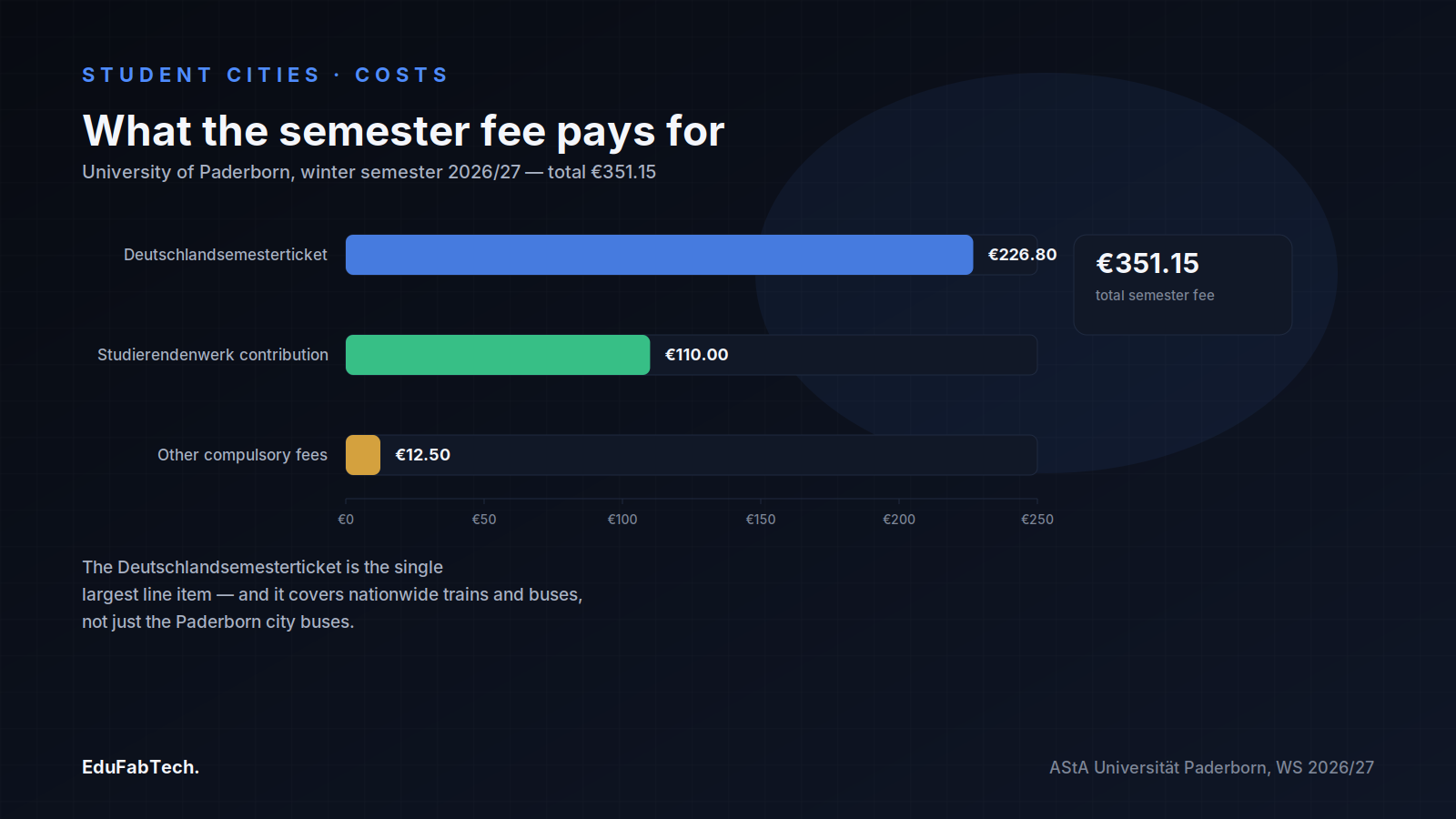
The cost sits inside the compulsory semester fee. For winter semester 2026/27 the AStA of the University of Paderborn puts the total semester fee at €351.15, of which €226.80 is the Deutschlandsemesterticket, €110.00 the Studierendenwerk social contribution, €12.50 the general AStA fee and €1.85 a cultural ticket (asta.uni-paderborn.de). On top of that comes rent — roughly the €330 to €445 a month the Studierendenwerk charges for its rooms and studios — plus food and insurance. Paderborn is not a cheap-rent outlier, but it is well short of Munich or Frankfurt, and the semester ticket removes transport as a running cost once paid.
The good, the hard, and a first-weeks checklist
What is good: Paderborn is compact and walkable, the campus is a single site so you are not commuting between faculties, the Studierendenwerk halls give a sourced, honestly priced housing option, and the semester ticket pays for travel well beyond the city. What is hard: it is a smaller city, so the nightlife and cultural scene are modest next to Cologne or Berlin, and some students find the winters grey and the city quiet; music and design students at the Detmold campuses face a real commute or a move away from Paderborn itself; and rooms are genuinely scarce in the October rush, which is when scams appear. Weigh those against your own priorities before deciding.
- Apply to the Studierendenwerk Paderborn for a hall place as early as you can, and keep searching the private market in parallel.
- Never transfer a deposit before viewing a room in person (or having someone view it for you); for the public halls the deposit is a few hundred euros, paid only after a contract.
- Enrol and pay the semester fee (€351.15 for winter 2026/27) — this activates your Deutschlandsemesterticket for travel.
- Register your address at the city's Bürgerbüro, open a bank account, and arrange German health insurance before term starts.
- If you are a non-EU student planning to work, confirm your day limit with the Paderborn Ausländerbehörde before taking a job.
- Furnish from flea markets and student give-aways around move-out season rather than buying new; check local second-hand listings first.
- Get a bike — in a city this size it is faster than waiting for a bus, and the campus is built for it.
A quick question for readers
Do you work part-time while you study?
Many students work to pay the bills. See how common it is — and how many hours people really do.
Pick an answer, create a free account in a minute, and your vote counts. Already a member? Sign in
Comments 3
Comment-
What stands out to me is the quiet mismatch between two of the article's own recommendations. It tells you to get a bike because the campus…
-
The one unsourced claim in a piece otherwise obsessed with citations is the enrolment split. We get 17,064 students, 16 ranked subjects, exa…
-
The detail I'd flag for a non-EU student is the HiWi carve-out: work 140 full days or 280 half days a year is the normal cap, but working as…
Join free to read the full comments and reply Comments are between members; an account takes a minute.
Source: Studierendenwerk Paderborn
Sources (5)
- Studierendenwerk Paderborn. Wohnformen und Preise. Studierendenwerk Paderborn, 2026. studierendenwerk-pb.de ↗ · checked 21 Nov 2026
- AStA der Universität Paderborn. Semesterbeitrag (semester fee). AStA Universität Paderborn, 2026. asta.uni-paderborn.de ↗ · checked 21 Nov 2026
- DAAD. Side jobs: working while studying in Germany. Deutscher Akademischer Austauschdienst, 2026. daad.de ↗ · checked 21 Nov 2026
- Technische Hochschule OWL. Table of figures. Technische Hochschule Ostwestfalen-Lippe, 2026. th-owl.de ↗ · checked 21 Nov 2026
- Stadt Paderborn. Wochenmarkt in der Kernstadt. Stadt Paderborn, 2026. paderborn.de ↗ · checked 21 Nov 2026