Studying in Passau: universities, housing and student life
A practical guide to the University of Passau and the three-rivers city around it — where students live, what rooms cost, how the bus pass works, and what is genuinely hard.
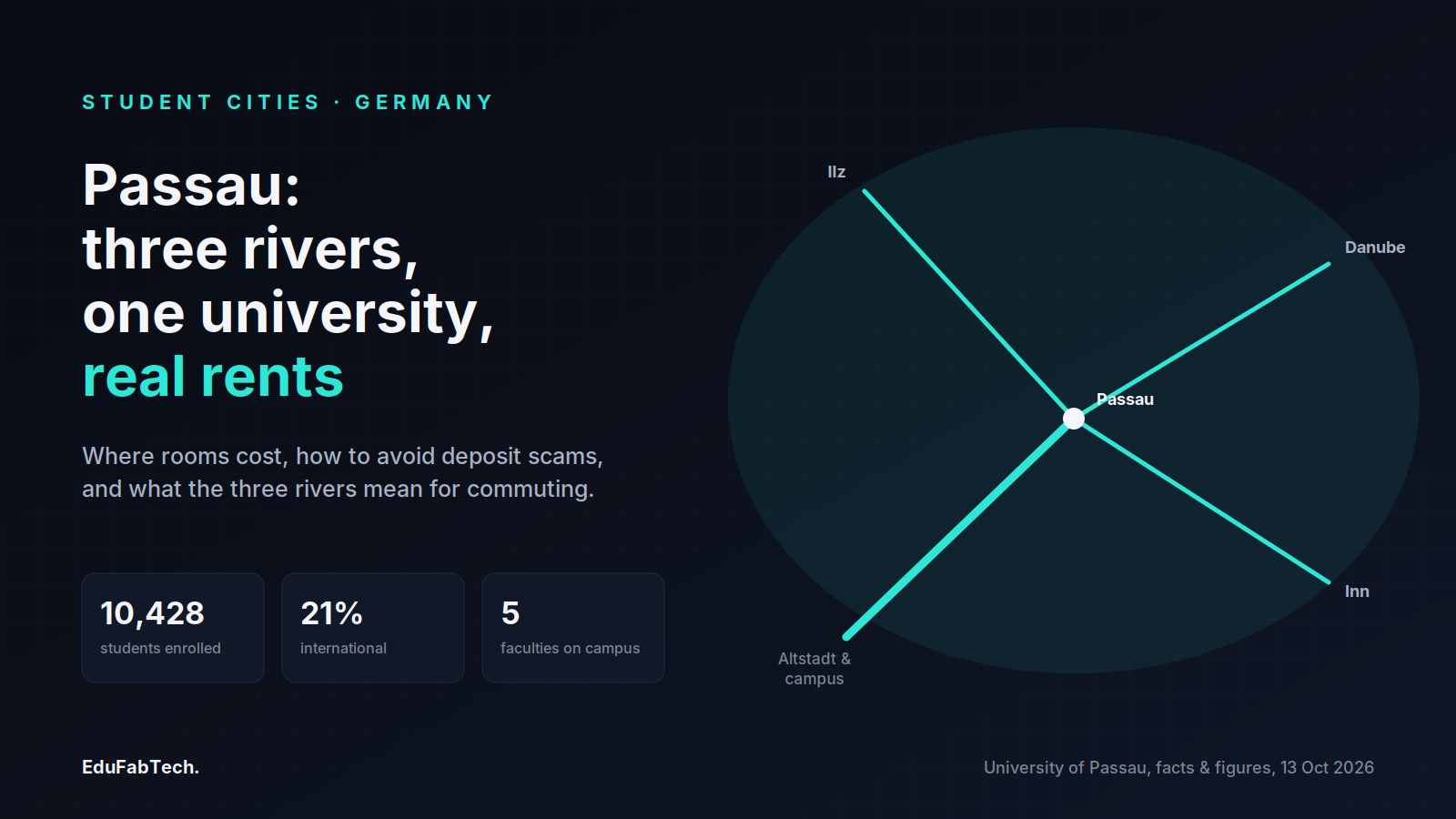
Passau sits in the south-eastern corner of Bavaria, a short distance from the Austrian border, on a narrow tongue of land where the Danube, the Inn and the small Ilz come together. The old town is pressed between two of those rivers, so streets end at the water and the pedestrian lanes are steep and tight. For students this geography is the whole character of the place: everything is walkable, the setting is unusually pretty, and the flat land for building is scarce — which is also why rooms can be hard to come by.
There is one university here, and it defines student life more completely than in a big city with several institutions. According to the University of Passau's own facts and figures page, the university opened on 9 October 1978 with 463 students in its first semester, and as of 13 October 2026 it had 10,428 students, of whom 2,214 (21.23%) were international. That makes Passau a compact university town rather than a metropolis: large enough to feel lively in term time, small enough that the campus, the old town and most halls of residence are within a bus ride or a bike ride of each other.
This guide walks through the practical side — where people live, what rooms cost, how to avoid a rental scam, how part-time work rules apply, where to study, and how to get around — with every figure linked to the page it came from. You can also browse current local listings on EduFabTech's Passau page.
The University of Passau
The University of Passau is a single, modern campus that stretches along the bank of the Inn, a few minutes on foot from the historic centre. The facts and figures page lists five faculties — Law; Business, Economics and Information Systems; Computer Science and Mathematics; Humanities and Cultural Studies; and Social and Educational Sciences — and partnerships with more than 327 universities abroad. Law, business and the language-heavy cultural and media programmes are among the best known, and the same page lists teaching in languages from Chinese and Czech to Thai and Vietnamese, which gives the cultural-studies and international programmes their particular flavour.
Because the campus is one connected site rather than scattered buildings across a city, daily life is concentrated: lecture halls, the mensa, the library and the riverside lawn (the Innwiese) are all a short walk apart. If you want to see current student listings tied to the campus itself, EduFabTech keeps a page for everything near the University of Passau.
Where students live, by district
The university's own guide to Passau's districts is the most honest map of where to look. The neighbourhoods immediately next to the campus — St. Nikola, Haidenhof Süd and the Altstadt (old town), with Innstadt just across the Inn — are where demand for student rooms is highest and prices are steepest. A short bike ride out, Haidenhof Nord, Auerbach, Hacklberg (across the Danube, known for its brewery), Ilzstadt and Grubweg (beyond the river near the Veste Oberhaus) tend to be cheaper and quieter. Further out, places like Hals, Kohlbruck, Heining and Schalding mean a longer bus commute but more space for the money.
The trade-off is specific to Passau's shape: the old-town districts are beautiful and central but constrained by the rivers and the hills, so rooms there are few and go quickly. Living across a river — in Innstadt or Grubweg — can mean a bridge crossing and a climb, but the city bus is free with your student card, so distance matters less than it would elsewhere. EduFabTech lists rooms and places to stay in Passau if you want a sense of what is currently on offer.
Student halls, the private market, and not losing a deposit
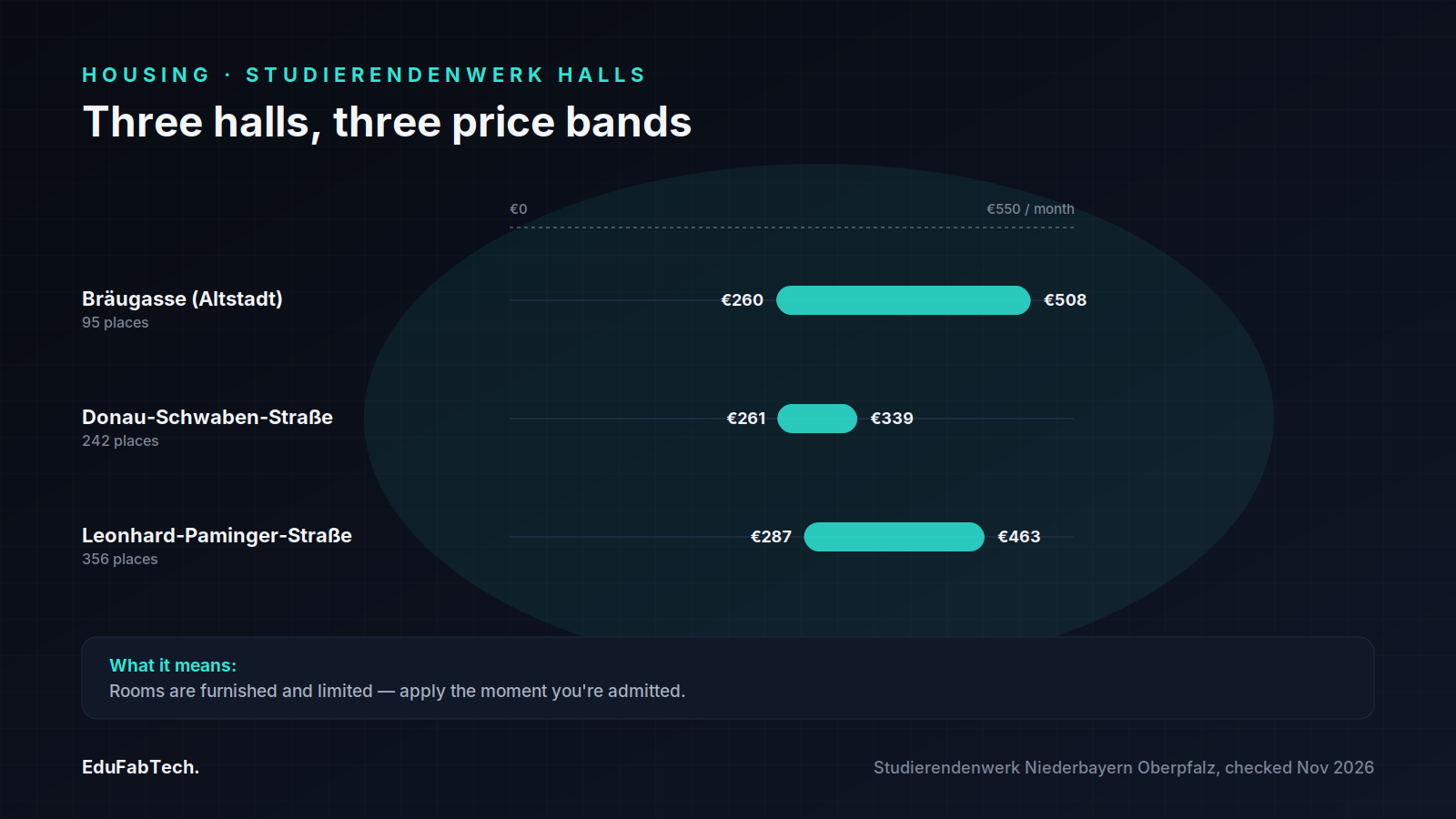
The cheapest reliable rooms are the halls run by the Studierendenwerk Niederbayern Oberpfalz, the regional student-services body. There are three residences in the city. The Bräugasse hall, right in the old town, has 95 places; according to its Studierendenwerk page (checked November 2026), rent runs from €260 to €508 a month depending on the type and size of room. The Donau-Schwaben-Straße complex has 242 places at €261 to €339 a month, and the larger Leonhard-Paminger-Straße site has 356 beds at €287 to €463 a month. Rooms are furnished and utilities are usually included.
Places in halls are limited and not guaranteed. The university's accommodation service states that rooms it allocates cost roughly €250 to €400 a month with utilities and internet usually included, that a €50 administration fee is charged on a successful allocation, and that rent is charged for full months with no pro-rata refunds. For exchange students it sets application deadlines of 15 December for the summer semester and 15 June for the winter semester — and warns in plain terms that applying before the deadline does not guarantee a room, especially for the winter intake. Treat halls as your first attempt, not your safety net, and start the moment you are admitted.
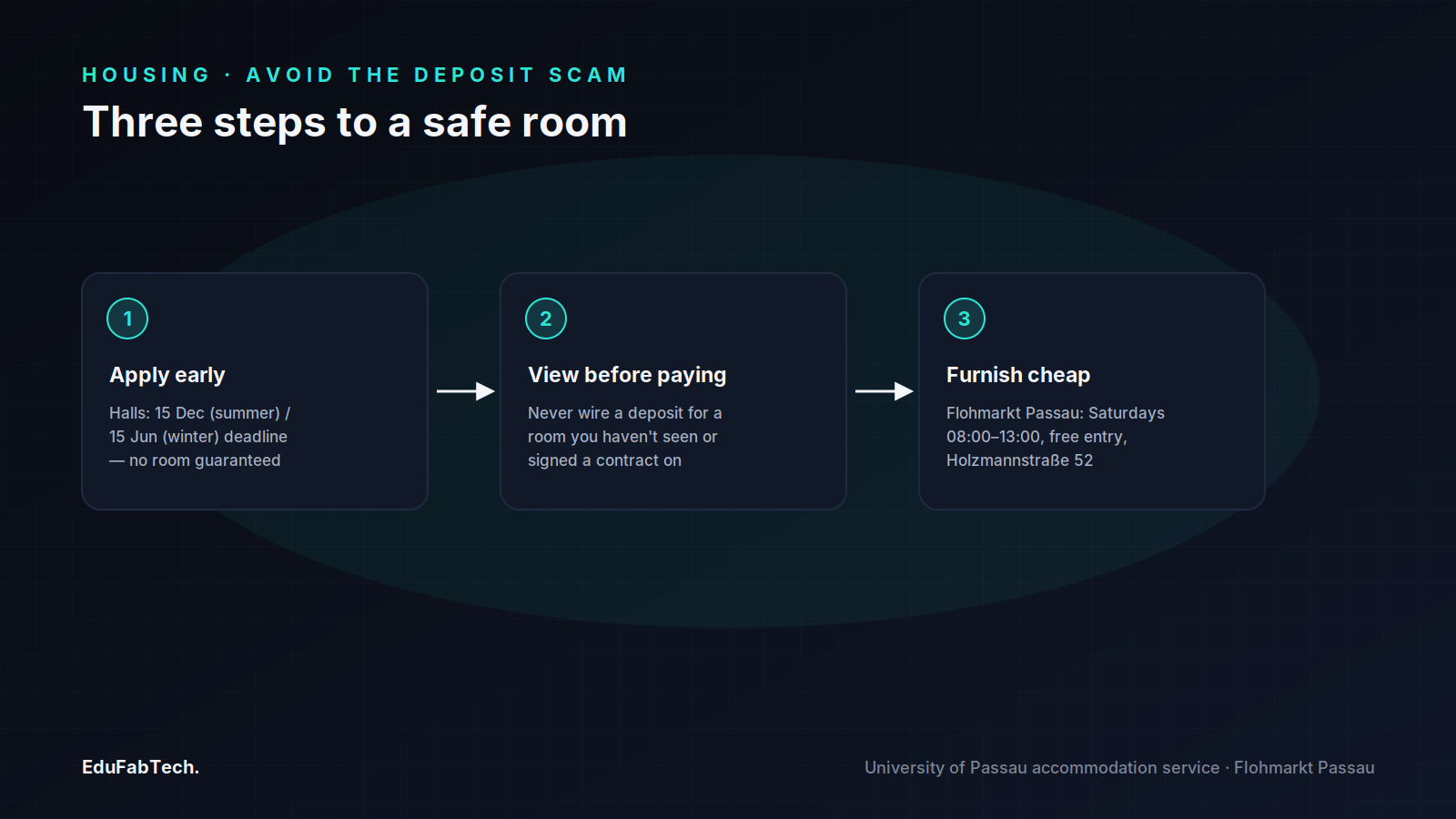
If you end up on the private market, the main risk in a town this size is the classic room scam: a listing with cheap rent and good photos, a "landlord" who is conveniently abroad and asks you to wire a deposit or buy vouchers to "reserve" the room before you can view it. The safe rule in Passau is simple — never send money, by bank transfer, gift card or cryptocurrency, to hold a room you have not seen, and never before you have a signed contract. See the place in person, or ask someone already in Passau to view it for you; meet the landlord; and expect a normal deposit (a Kaution) of up to a few months' cold rent, paid after signing, not a "holding fee" paid to a stranger. If you arrive before you have found something, the accommodation service points new arrivals to short-term help through Tourist Information Passau at Rathausplatz 3. EduFabTech's Passau rooms page is another place to look while you search.
Furnishing a room: markets and second-hand
An empty room needs filling cheaply, and Passau has a steady weekly flea market for exactly this. The Flohmarkt Passau runs every Saturday from 08:00 to 13:00 at the meinReal car park on Holzmannstraße 52, with free admission; it is a well-attended market with the usual mix of furniture, crockery, records and household odds and ends — the kind of place a crate of plates and a desk lamp cost a few euros. For food and a feel of the town, the Wochenmarkt on the Domplatz trades on Saturdays from 07:00 to 14:00 (it moves to the Residenzplatz while the Christkindlmarkt occupies the cathedral square in December).
Students also pass furniture along directly, especially at the end of each semester when halls empty out. EduFabTech runs local boards for second-hand things, used furniture and items given away free in Passau, which is often the quickest way to kit out a room without a car — handy in a hilly old town where carrying a wardrobe up a lane is its own problem.
Working alongside your degree
Many students here take term-time jobs in the cafés, shops and tourism trade of a town that sees a lot of river-cruise visitors. The rules depend on where you are from, and the clearest official summary is the DAAD's side jobs page. It states that students from the EU, Iceland, Liechtenstein, Norway and Switzerland have essentially unrestricted access to the German labour market. Students from other countries may work 140 full days or 280 half days per year; working more requires approval from both the employment agency and the foreigners' office, granted only in cases of special financial need. Work as an academic assistant at the university is exempt from the day limit, though you must still notify the foreigners' office.
This is a summary, not legal advice, and the details of your own residence permit govern what you may do — check the DAAD page and ask the university's International Office or the local Ausländerbehörde before you commit to a job. For what is currently on offer locally, EduFabTech lists jobs and part-time work in Passau.
Libraries and places to study
The University Library is the default study space, and it keeps long hours. Its opening-hours page gives the Central Library as open Monday to Friday 08:00–22:00 and weekends 10:00–18:00 for the period 12 October to 22 December 2026, with specialist reading rooms — the Juridicum for law, the business and economics room, the Nikolakloster and the computer-science and mathematics library — on their own, generally shorter, schedules. Beyond the library, the campus mensa and the cafés of the old town fill up with laptops in term time; EduFabTech also keeps a page of study spaces and desks in Passau.
Getting around, and what it costs
Passau is small enough to walk or cycle across, and the local bus fills the gaps. The city buses are run by the Verkehrsbetriebsgesellschaft Passau (VBP), a subsidiary of Stadtwerke Passau. As the university's semester bus pass page explains, your validated CampusCard works as a bus ticket on nearly all VBP services within the city limits once it shows the VBP logo — you carry photo ID alongside it. The pass does not cover the tourist Oberhausbus up to the castle, nor regional buses that run beyond the city. A Deutschlandticket can be added as a digital subscription on top of the semester bus pass for travel beyond Passau; the add-on is sold through a booking platform run in cooperation with the Regensburg transport association (RVV) rather than by Stadtwerke Passau directly.
On costs, the most reliable figures are the dorm rents above: Studierendenwerk rooms in the city currently (November 2026) range from about €260 up to €508 for the largest Bräugasse rooms, per the Studierendenwerk's residence pages, and the university's accommodation service puts the rooms it allocates at roughly €250 to €400 a month with utilities included. Private rooms in the central, in-demand districts cost more than halls; rooms across a river or further out cost less. A further running cost is the semester contribution, which every student pays on re-registration and which includes the bus pass — the Studierendenwerk publishes the current amount in its statutes. Rather than quote living-cost totals that vary person to person, treat rent plus the semester contribution as your fixed base and budget food, insurance and phone on top.
The good and the hard
What is good about Passau is unusually easy to name. It is genuinely beautiful — the baroque old town, the river confluence, the hill paths to the Veste Oberhaus — and it is compact, so you lose little time commuting and the student scene is concentrated rather than diluted across a sprawling city. The free city bus and the walkable centre keep transport cheap. The border setting makes trips into Austria and the Bavarian Forest simple.
What is hard is mostly the flip side of the same facts. A town hemmed in by rivers and hills has limited room to build, so housing is tight and the central districts the university itself flags as most in demand can be slow and expensive to crack, especially for the winter intake. With one university and a modest population, the nightlife and job market are smaller than in a big city, and some students find Passau quiet out of term. The old town's charm comes with steep lanes, river crossings and the occasional reminder that it sits in a flood-prone valley. None of this is a reason to stay away — but go in knowing that securing a room early is the single thing that makes or breaks the start.
Your first weeks: a checklist
- Apply for a Studierendenwerk hall as soon as you are admitted, and keep the private search running in parallel — do not rely on a hall place being offered.
- Never pay a deposit or "reservation fee" for a room you have not seen; view it or have someone view it, sign a contract, then pay a normal Kaution.
- Register your address at the city's residents' office and, if you are from outside the EU, sort your residence permit and check the work rules on the DAAD side-jobs page before taking a job.
- Validate your CampusCard so it shows the VBP logo and works as a city bus pass; decide whether you need the Deutschlandticket add-on.
- Furnish cheaply at the Saturday flea market and through local second-hand and free-stuff boards before buying anything new.
- Learn the library's hours early, and check EduFabTech's Passau events page to find your way into the term's social life.
A quick question for readers
Do you work part-time while you study?
Many students work to pay the bills. See how common it is — and how many hours people really do.
Pick an answer, create a free account in a minute, and your vote counts. Already a member? Sign in
Comments 1
Comment-
Odd thing about this piece: it'll give you a student count to four significant figures - 10,428 total, 2,214 international, worked out to 21…
Join free to read the full comments and reply Comments are between members; an account takes a minute.
Source: University of Passau
Sources (5)
- University of Passau. Facts and figures. University of Passau, 2026. uni-passau.de ↗ · checked 19 Nov 2026
- Studierendenwerk Niederbayern Oberpfalz. Bräugasse student residence, Passau. Studierendenwerk Niederbayern Oberpfalz, 2026. stwno.de ↗ · checked 19 Nov 2026
- DAAD. Side jobs. Deutscher Akademischer Austauschdienst, 2026. daad.de ↗ · checked 19 Nov 2026
- University of Passau. Using your CampusCard as a bus pass. University of Passau, 2026. uni-passau.de ↗ · checked 19 Nov 2026
- University Library. Opening hours. University of Passau, 2026. ub.uni-passau.de ↗ · checked 19 Nov 2026