Studying in Peoria: universities, housing and student life
A practical, sourced guide to studying in Peoria, Illinois — Bradley University and Methodist College, where students find rooms, what it costs, how CityLink works, and the honest trade-offs of a river-bluff city.
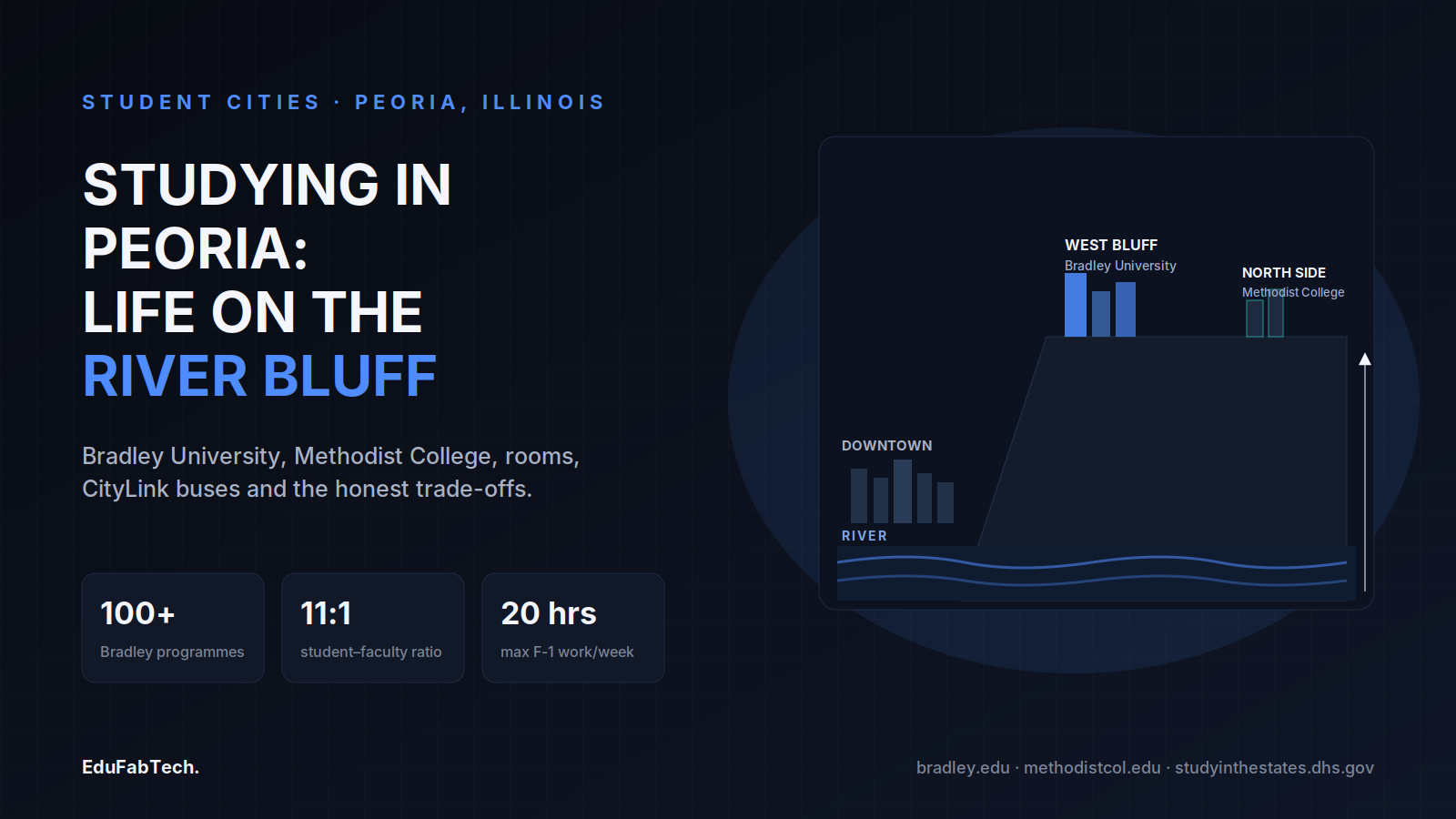
Peoria sits on a wide bend of the Illinois River in central Illinois, where the land climbs away from the water in a series of bluffs. Downtown and the riverfront hold the low ground; the residential neighbourhoods and the university rise behind them on the West Bluff. For a student, that geography is the first thing to understand, because almost everything about where you live, how long your walk is and which bus you catch follows from whether you are up on the bluff or down by the river.
This is not a college town in the sense of a small place built around one campus. Peoria is a working mid-sized city with a hospital economy, a river port and a downtown of its own, and the universities are woven into it rather than dominating it. That shapes student life: you share the city with everyone else, which means more going on than in a campus village, but also a quieter, more spread-out student scene than you would find somewhere smaller and denser.
Below is a practical account of the institutions, where people live, how to rent without being cheated, what it costs, and the honest advantages and frustrations of being a student here. Local listings for the city are collected on EduFabTech's Peoria page.
The universities on and around the bluff
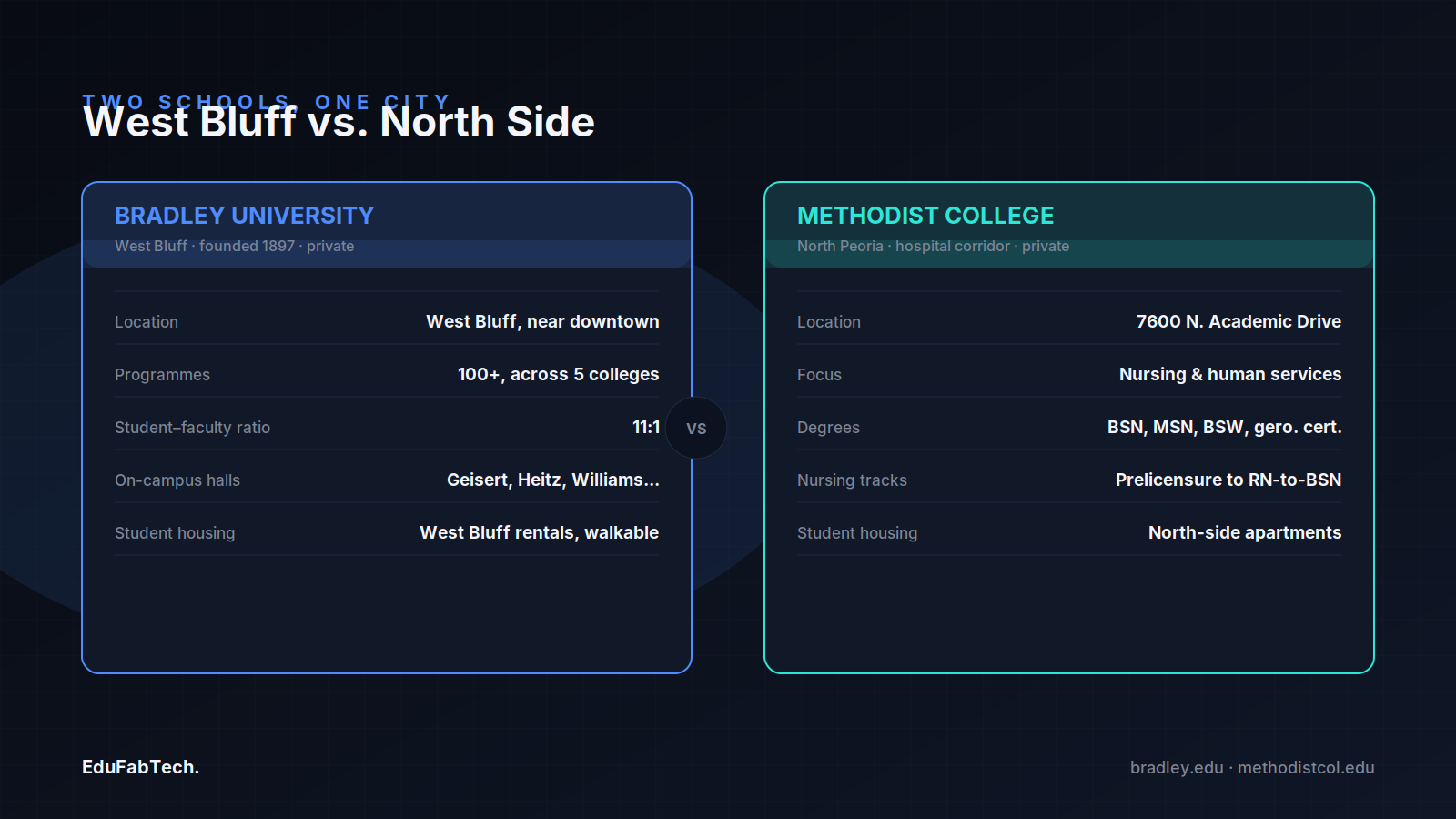
Bradley University is the anchor. Its own site describes it as a private university in Peoria offering more than 100 programmes across business, communication, education, engineering, fine arts, health sciences, liberal arts and sciences, and technology, with a student-to-faculty ratio of 11:1, according to bradley.edu. The campus occupies a compact patch of the West Bluff a short distance west of downtown, which is why the surrounding streets are the heart of the city's student housing. Bradley traces its founding to 1897, when Lydia Moss Bradley established it as Bradley Polytechnic Institute, as its catalogue records on the university's founding page. Listings near the campus are gathered at /near/bradley-university.
Methodist College is the city's other degree-granting institution, a small private college at 7600 N. Academic Drive in north Peoria that specialises in nursing and human services. Its own academics pages list a Bachelor of Science in Nursing in several tracks (prelicensure, accelerated, LPN-to-BSN and RN-to-BSN), master's options in nursing, a Bachelor of Social Work and a gerontology certificate, per methodistcol.edu. It sits well north of Bradley, near the hospital corridor rather than the West Bluff, so its students live in a different part of town.
Eureka College is not in Peoria but worth knowing about if you are weighing central Illinois options: it is a small liberal arts college in the town of Eureka, roughly a half-hour drive east, and it is the college Ronald Reagan graduated from in 1932 — a fact he recounted himself in a 1984 speech on campus archived by the Ronald Reagan Presidential Library. It is a residential college with its own town around it, so Peoria's housing market is not really relevant to Eureka students.
Living on the bluff, and renting safely
For Bradley students, the default is the West Bluff. The university's residence halls — Geisert, Heitz, University and Williams Halls, plus the singles complex of Wendle, Elmwood and Lovelace — cluster on and immediately around the campus, with nearby apartment options such as St. James Apartments and Main Street Commons listed on the same page, as set out on bradley.edu/campus/housing-dining. The university treats living on campus as a central part of the Bradley experience, and the halls are where many students, especially first-years, start out.
The interesting choices come after that. The streets of the West Bluff — the grid of older houses north and west of campus — are full of divided-up homes and small apartment buildings rented to students within walking distance of lectures. It is cheap by national standards and convenient, but the housing stock is old and varies enormously house to house, so two flats on the same block can be very different in condition. Further out, the neighbourhoods toward Peoria Heights and the north side are quieter and better kept but assume you have a car or are willing to depend on the bus. Methodist College students, up near the hospitals, tend to look at the north-side apartments rather than the student-dense West Bluff. Rooms across the city are collected at /in/united-states/peoria/rooms.
A realistic timeline: if you want a specific West Bluff house for the autumn term, the better places are spoken for over the preceding spring, because the student rental cycle here runs well ahead of the academic year. Leave it to August and you will be choosing from what is left.
That small, local market cuts both ways. There are fewer large anonymous operators to deal with, but the listings you find online — especially anything advertised only through social media groups or a classified post with no verifiable address — are exactly where fake-listing scams appear. The pattern is consistent: a West Bluff house priced noticeably below its neighbours, a landlord who is conveniently out of town, and a request to wire a deposit to "hold" it before you can see inside.
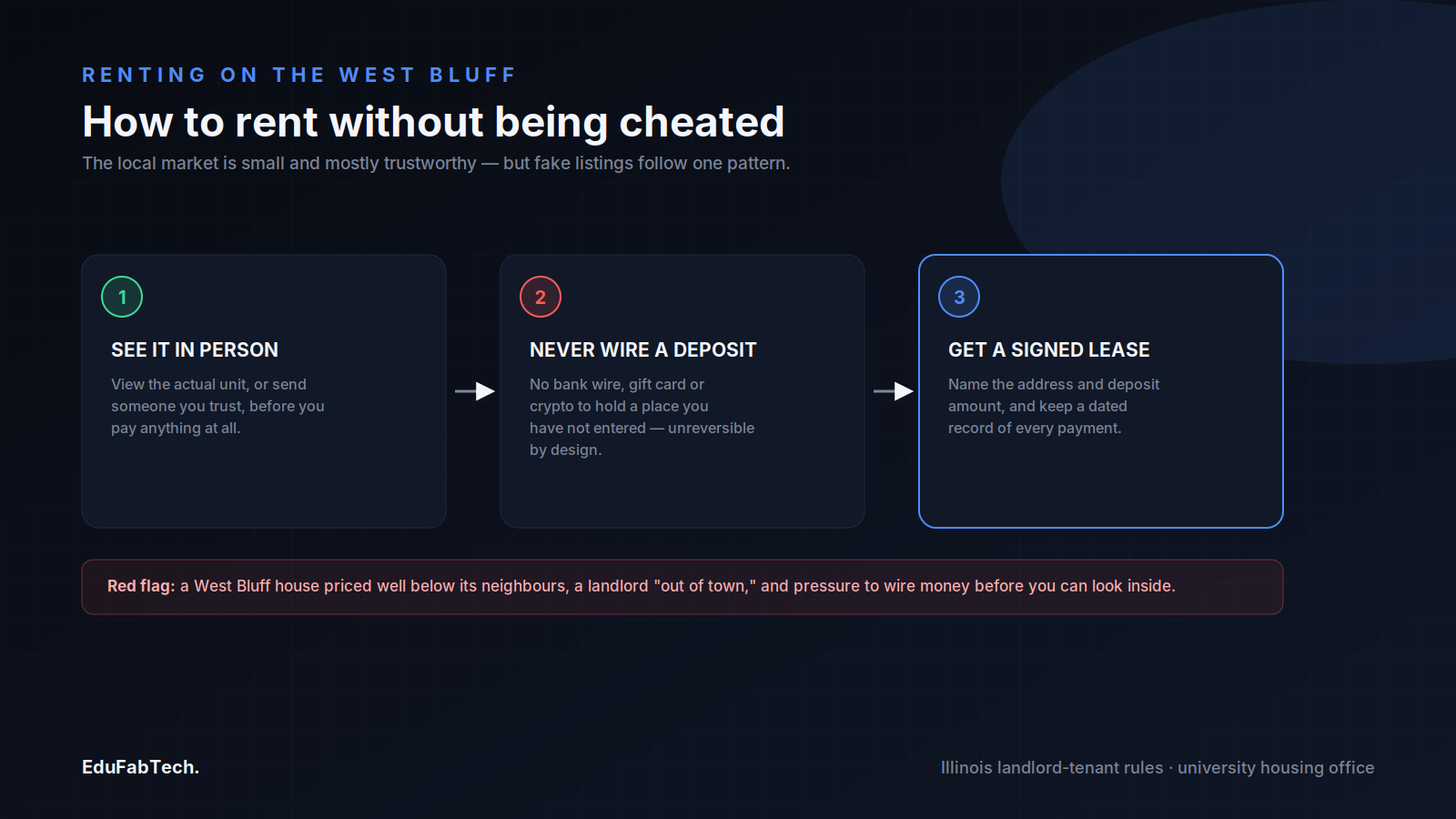
The protection is simple. See the actual unit in person, or send someone you trust, before any money changes hands; a genuine local landlord can let you into a West Bluff house on short notice. Never send a deposit or first month's rent by bank wire transfer, gift card or cryptocurrency to secure a place you have not entered — those are the methods used precisely because they cannot be reversed. Get a signed lease that names the address and the deposit amount, and keep a dated record of anything you pay. Illinois has specific rules on how security deposits must be handled and returned, and your university's housing or international-student office can point you to them; that is also the right place to ask before you commit to anything off campus.
Furnishing a room cheaply
A room on the West Bluff is often rented unfurnished or half-furnished, and the cheapest way to fill it is second-hand. Peoria has a long-running Giant Flea Market held at Exposition Gardens (1601 W. Northmoor Road), where second-hand household goods and furniture change hands on scheduled dates; admission is $1.50 for adults, with children 12 and under free, per Explore Peoria — worth timing a visit to when you are setting up a room. For food and local produce rather than furniture, the Peoria RiverFront Market runs every Saturday morning from 8 a.m. to noon on the 200 block of Water Street, across from the Peoria Riverfront Museum, from 23 May to 26 September 2026, selling produce, bread, eggs, meat and cheese alongside crafts, per Explore Peoria.
Beyond markets, the usual student economy applies: end-of-term move-outs around the West Bluff leave serviceable furniture on the kerb and in cheap sales, and charity and resale shops around the city carry kitchenware and bedding. EduFabTech collects local second-hand things and furniture for the city, which saves trawling several sites. When you buy second-hand, favour things you can inspect and carry yourself; a mattress or sofa you cannot examine in person is the one category worth being fussy about.
Working while you study
If you are an international student on an F-1 visa, the rule that governs your term-time work is set by U.S. federal immigration policy, not the university or the employer. The Department of Homeland Security's Study in the States guidance states plainly that if you take on-campus employment, you "may not work more than 20 hours per week when school is in session," as published at studyinthestates.dhs.gov. On-campus jobs — in dining, the library, departments and so on — are the most accessible kind because they generally do not require separate work authorisation, while off-campus work and practical training have their own conditions and approvals. This is a summary, not legal advice: confirm your own situation with your Designated School Official in the university's international-student office before you accept any job, and treat their word and the official DHS page as authoritative over anything you read second-hand. Local part-time openings are listed at /in/united-states/peoria/jobs.
Libraries and study space on and off campus
Bradley's main academic library is the Cullom-Davis Library on the West Bluff campus, which keeps long evening hours during term; current hours are posted on its LibCal hours page, which is the thing to check before a late study session since hours change around breaks and exam weeks.
Off campus, the Peoria Public Library is a genuinely useful free resource open to anyone, not just its members, for study space and wi-fi. Its downtown Main Library is at 107 N.E. Monroe, and the system runs five locations in all — Main, plus the North, Lincoln, Lakeview and McClure branches — with the current addresses and opening hours listed at peoriapubliclibrary.org. For Methodist College students on the north side, the North Branch on Grand Parkway is far closer than the Bradley campus. More desks and study spaces around the city are indexed at /in/united-states/peoria/study-spaces.
Getting around on CityLink
Public transport in Peoria is run by the Greater Peoria Mass Transit District, which operates fixed bus routes under the CityLink name, radiating from the downtown Transit Center at 407 SW Adams Street. The fares are modest and students get a real discount: CityLink's fares page lists a single cash ride at $1.00, a reduced student fare of $0.50 per ride with a valid school or college ID, a Day Pass at $3.00 and a 30-Day Pass at $40.00, per ridecitylink.org. Two practical warnings from the same page: drivers are not equipped to give change, so carry exact fare, and transfers are no longer issued, so you pay for each boarding unless you hold a pass.
Be honest with yourself about the bus, though. Peoria is a spread-out, car-oriented city, and while the West Bluff and downtown are walkable and bus-served, the service is not frequent enough to make a carless life effortless if you live further out or work odd hours. Many students who stay beyond first year end up with a car or a bike for exactly that reason.
What it costs
The clearest dated figures come from Bradley's own costs page. For the 2026–2027 academic year, Bradley lists tuition at $43,718, university fees at $1,010, and room and board at $14,330 for a standard double, broken down as $8,190 for the room and $6,140 for board; a single room raises the room-and-board total to $17,278, according to bradley.edu/admissions/tuition. Those are private-university sticker figures before any scholarship or aid, and they describe on-campus living specifically.
For a sense of the wider rental market off campus, the U.S. Census Bureau's QuickFacts for Peoria city put the median gross rent at $1,005 a month over 2020–2024, against a median household income of $59,410 over the same period, as reported on the Bureau's QuickFacts page. A median rent is not a student rent — a room in a shared West Bluff house typically costs less than a whole unit — but it anchors expectations: Peoria is inexpensive by U.S. urban standards, and housing is the reason most students choose it over pricier college towns.
The honest ledger
What is good about Peoria as a student city: it is affordable, the West Bluff puts cheap housing within walking distance of Bradley, there is a real downtown and riverfront rather than just a campus strip, and a city this size has a working library system, markets and a bus network you can actually use. The scale is forgiving — you can find a quiet place to live and still reach things.
What is hard: it is a car-oriented, spread-out city, so without a car the geography can feel limiting once you leave the bluff. The older West Bluff housing stock is uneven, and condition varies sharply from one house to the next. Winters in central Illinois are cold, grey and long, and the student scene is more dispersed than in a dense college town, so the social life takes more initiative to build. And the headline tuition at a private university like Bradley is high before aid, which makes the financial-aid conversation central rather than optional.
A checklist for the first weeks
- Sort housing on the university's timeline, not the calendar's — West Bluff places go in spring for autumn, so start early and never pay to "hold" a room you have not seen.
- Carry a school or college ID for the $0.50 CityLink student fare, and buy a 30-Day Pass if you will ride regularly, since drivers do not make change (ridecitylink.org).
- International students: confirm your work limits with your Designated School Official before taking any job, against the official DHS guidance (studyinthestates.dhs.gov).
- Get a Peoria Public Library card for free study space and wi-fi beyond campus (peoriapubliclibrary.org).
- Furnish from the flea market and move-out season rather than buying new, and inspect anything you cannot easily return; browse local second-hand listings first.
- Check the Cullom-Davis Library's current hours before relying on a late-night session, especially around breaks (bradley.libcal.com/hours).
A quick question for readers
Do you work part-time while you study?
Many students work to pay the bills. See how common it is — and how many hours people really do.
Pick an answer, create a free account in a minute, and your vote counts. Already a member? Sign in
Comments 0
CommentNo comments yet. Members start the conversation.
Source: Bradley University
Sources (5)
- Bradley University. Tuition & Fees. Bradley University, 2026. bradley.edu ↗ · checked 19 Oct 2026
- Greater Peoria Mass Transit District. Fares & Ticket Prices. CityLink, 2026. ridecitylink.org ↗ · checked 19 Oct 2026
- U.S. Department of Homeland Security. Working in the United States. Study in the States, 2026. studyinthestates.dhs.gov ↗ · checked 19 Oct 2026
- U.S. Census Bureau. QuickFacts: Peoria city, Illinois. U.S. Census Bureau, 2024. census.gov ↗ · checked 19 Oct 2026
- Ronald Reagan Presidential Library. Remarks at Eureka College in Eureka, Illinois. National Archives, 1984. reaganlibrary.gov ↗ · checked 19 Oct 2026