Studying in Philadelphia: universities, housing and student life
A practical, honest guide to the city's universities, neighbourhoods, housing, markets, work rules, study spaces, transit and costs — for students local and from abroad.
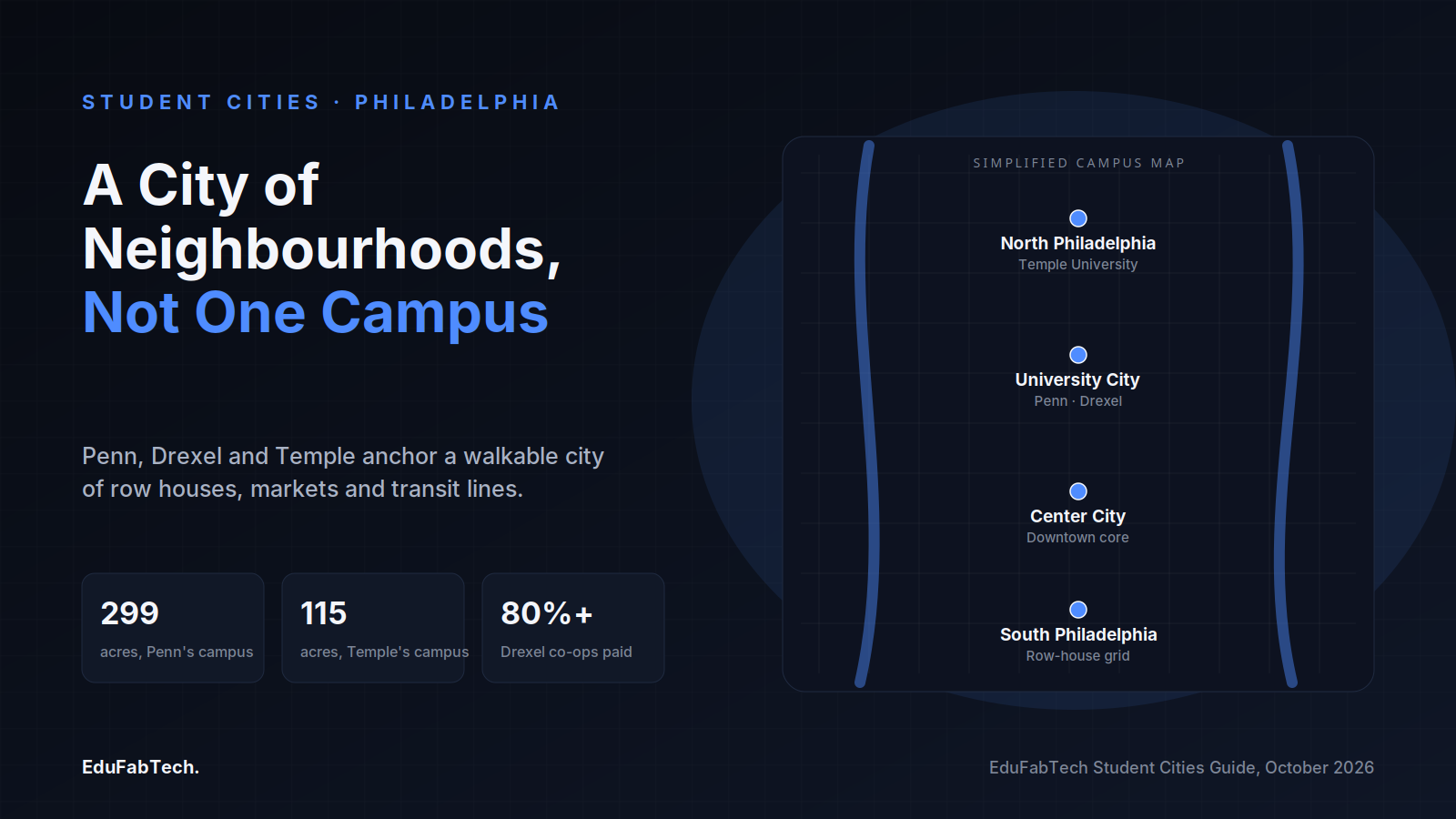
Philadelphia sits on a flat neck of land between two rivers — the Schuylkill to the west, the Delaware to the east — with a street grid that William Penn's surveyors laid out in the 1680s and the city never really abandoned. The result is one of the most walkable large cities in the United States: numbered streets running one way, tree-named streets crossing them, and whole districts of brick row houses two and three storeys high. For a student this matters more than it sounds. Rooms are smaller and cheaper than in a tower block, you will almost certainly live in a converted house rather than a purpose-built hall, and most of your life happens at street level.
It is also a genuine student city rather than a city with a university bolted on. Two large campuses dominate: the University of Pennsylvania and Drexel University share the West Philadelphia district now branded University City, just across the Schuylkill from the downtown core that Philadelphians call Center City. North of downtown, Temple University fills a large chunk of North Philadelphia. Ringing the city to the west and north-west is the commuter-rail corridor known as the Main Line, home to a cluster of smaller, older colleges.
Philadelphia rewards students who treat it as a collection of neighbourhoods. It is cheaper than New York or Boston, the transit network reaches far, and the food is extraordinary for the money. It is also a city with real poverty, uneven streets, hot humid summers and, in places, a genuine shortage of decent cheap housing. This guide tries to be straight about both halves.
The universities, and what studying here is like
The University of Pennsylvania is an Ivy League research university on a 299-acre campus in University City, which it moved to from Center City in the 1870s. Its graduate business school, The Wharton School, is a separate school within Penn and one of the oldest collegiate business schools in the world; undergraduates and MBAs both study there. Penn's campus is dense and green, built around the Perelman Quadrangle, and it bleeds directly into Drexel's.
Drexel University, a few blocks north, is best known for cooperative education. Under the Drexel Co-op model, running since 1919, most students alternate six months of classes with six-month paid work placements; Drexel reports that more than 80 percent of co-op positions are paid. If you want a degree welded to work experience, this is the city's clearest example.
Temple University is a large public research university whose main campus occupies about 115 acres in North Philadelphia, roughly 1.5 miles north of Center City. It is a very different experience from Penn — bigger, less selective, more commuter-heavy, deeply woven into its surrounding neighbourhood. Temple also runs the Boyer College of Music and Dance, its performing-arts school, on the same campus.
Out on the Main Line and in the nearer suburbs sit several smaller institutions worth knowing even if you do not attend them, because their libraries and events draw in the wider student world. Villanova University, in Radnor Township, is an Augustinian Catholic university founded in 1842 and the oldest Catholic university in Pennsylvania. Bryn Mawr College and Haverford College — both in the leafy Bryn Mawr area — form a bi-college partnership and, with Swarthmore and Penn, part of a long-standing consortium with shared Quaker roots that lets students cross-register. Saint Joseph's University, a Jesuit institution on City Avenue, absorbed the former University of the Sciences in Philadelphia in 2022, giving it a University City health-sciences campus. Thomas Jefferson University runs health-sciences programmes in Center City and design, architecture and fashion programmes at its East Falls campus — the latter was Philadelphia University until the two institutions combined under the Jefferson name in 2017.
Other universities in and around Philadelphia
- Rowan University — a public university in Glassboro, New Jersey, about 20 miles south-east, with health and engineering strengths.
- Arcadia University (Glenside/Wyncote area) — a private university known for study-abroad programmes.
- Eastern University (St Davids, in Radnor Township) — a small Christian liberal-arts university.
- Holy Family University — a Catholic university in Far Northeast Philadelphia.
- Neumann University — a Franciscan university in Aston, in the Delaware County suburbs.
- Cairn University — a Bible-based Christian university in Langhorne, in Bucks County to the north-east.
- Delaware County Community College (Broomall and other campuses) — a two-year public college and a common, affordable starting point.
- Salus University, the optometry and health-sciences school in Elkins Park, merged into Drexel University; final approval came in 2025, and its Elkins Park site is now a Drexel campus.
- UMDNJ – School of Osteopathic Medicine in Stratford, New Jersey became part of Rowan University in 2013 and is today the Rowan-Virtua School of Osteopathic Medicine.
- The University of the Arts, long a fixture on the Avenue of the Arts, closed abruptly in June 2024 after losing its accreditation; do not expect to enrol there.
- Spring Garden College, once the oldest private technical school in the country, closed in 1992; you will meet the name only in archives.
- American University for Humanities (associated with a Claymont, Delaware address) and The Sphere College Project (Phoenixville) appear in regional records but have little visible campus presence for a prospective student; verify directly before committing anything.
Beyond these, the Woman's Medical College of Pennsylvania — the first medical school for women in the world — lives on inside Drexel University's College of Medicine, which absorbed its successor institutions by 2002. Public two-year options such as the Community College of Philadelphia and Peirce College serve large numbers of city students, and Penn State Abington and Rutgers University–Camden extend the regional map further.
Where students actually live
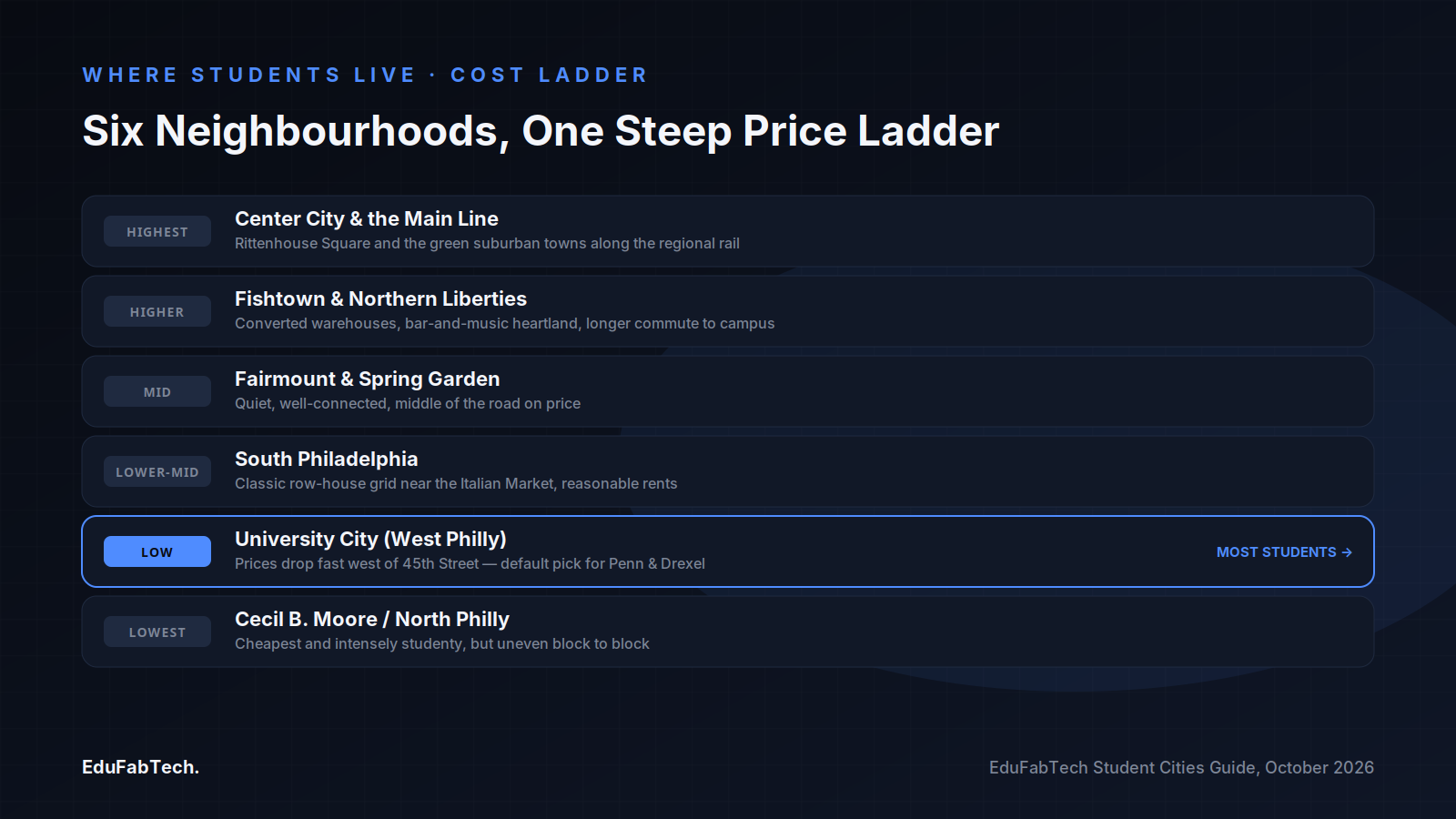
University City (West Philadelphia). The obvious choice for Penn, Drexel and the Saint Joseph's health campus. Expect Victorian twins and row houses carved into shared flats, a constant churn of students, and prices that drop quickly as you move west past 45th Street. Powelton Village and Mantua, just north, are cheaper and popular with Drexel students; both have blocks in transition, so walk them at night before signing.
Cecil B. Moore and lower North Philadelphia. The streets immediately around Temple. Cheap, convenient, intensely studenty, and uneven block to block — some stretches are well-kept student housing, others are rough. Temple's own security presence is heavy here; most students rent within a few blocks of campus and use the shuttle after dark.
Center City. Downtown, between the rivers. More expensive, but you are walking distance from Jefferson's Center City campus and a short ride from everywhere. Rittenhouse Square is the premium pocket; the blocks around Washington Square and Chinatown are slightly gentler on the budget. Good for students who want city life over a campus bubble.
Fishtown and Northern Liberties. North-east of Center City along the Delaware, these former working-class districts are now the city's bar-and-music heartland. Converted warehouses and new-build flats, a younger crowd, and a longer commute to most campuses — fine if you value nightlife and the Market-Frankford Line reaches you.
South Philadelphia. South of South Street: the row-house grid at its most classic, the Italian Market, cheese-steak rivalries and the stadiums. Rents are reasonable and the community feel is strong. Transit to University City means a bus or a change, so weigh the commute.
Fairmount and Spring Garden. North of Center City near the art museum and the main library. Quieter, residential, well-connected, middle of the road on price — popular with graduate students who want calm without leaving the core.
The Main Line and near suburbs. Bryn Mawr, Haverford, Villanova, Radnor, Wyncote and Elkins Park. Students at those colleges mostly live on or near campus in genuinely green, quiet and relatively expensive towns strung along the regional rail line into the city.
Finding a room without getting burned
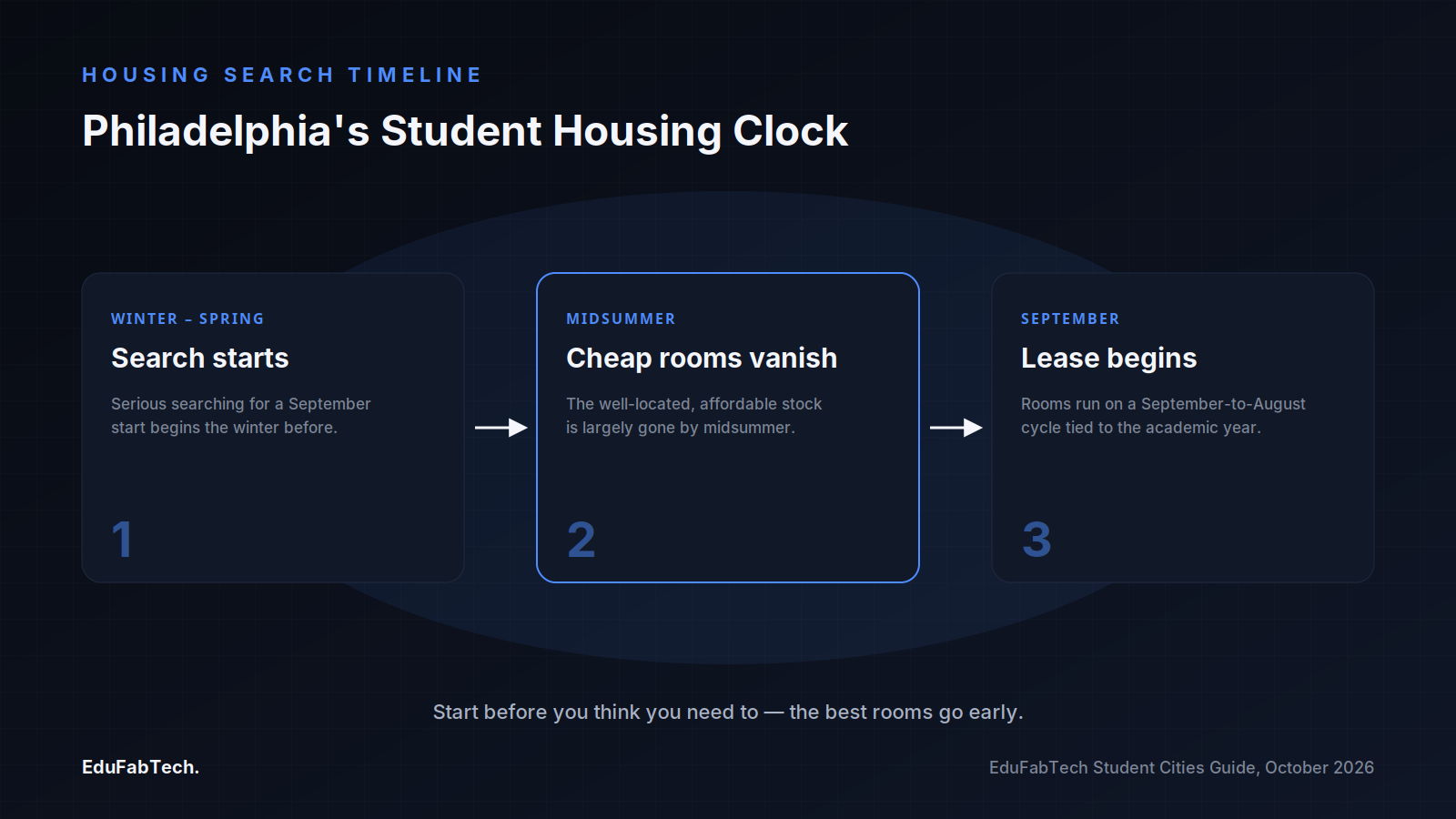
Most undergraduates start in university housing and move into the private market in their second year. The private stock is overwhelmingly rooms in shared row houses, let by the room or by the whole house, often on a September-to-August cycle tied to the academic year. Because of that cycle, the best rooms go early: serious searching for a September start begins in the preceding winter and spring, and by midsummer the cheap, well-located stock is largely gone. Start before you think you need to.
Before you pay anything, see the actual room — in person if you can, or on a live video walk-through if you are still abroad, where the person shows you the street, the room, the kitchen and the bathroom in one continuous call. Ask for the written lease and read it: who pays for heating, water, electricity and internet; how the deposit is held and returned; whether it is a joint lease where you are liable for flatmates' unpaid rent; and when it ends. Check water pressure, heating (Philadelphia winters are real), damp in basements, and whether windows lock. If a landlord or roommate cannot show you the room or produce a lease, walk away.
On scams: never send money to "hold" a room you have not seen, and never pay a deposit by bank transfer, wire, gift card or cryptocurrency. A legitimate landlord does not need payment in untraceable forms before you have seen the place and signed a lease. The classic fraud copies a real listing's photos, offers a suspiciously cheap room, invents a reason the owner is out of town, and pressures you to wire a deposit immediately. See it live, pay by a traceable method, and keep every message. EduFabTech's Philadelphia rooms listings are a starting point, not a substitute for seeing the place.
Furnishing a room cheaply
Philadelphia is a good city to furnish a room for very little, partly because so many leases turn over on the same late-summer week and the pavements fill with usable furniture. The city is also defined by its markets. Reading Terminal Market, open since 1893 under the old Reading Railroad train shed in Center City, is the obvious food market — a cavernous hall packed with produce, Pennsylvania Dutch stalls and cheap lunches. In South Philadelphia, the 9th Street Italian Market, whose shops date from the first decade of the 20th century, is often described as one of the oldest open-air markets of its kind in the country and the place for cheap vegetables, cheese and kitchen basics.
For furniture, bedding and kitchenware, the city's thrift stores, church rummage sales and weekend flea markets are where students actually kit out a room. The large non-profit charity shops across the city and suburbs carry desks, lamps and crockery for a fraction of new prices, and seasonal flea markets appear across Center City and the neighbourhoods. Around move-out week in late August, "stooping" — taking furniture left on the pavement — is a local institution. On EduFabTech you can also browse second-hand things in the city before you buy anything new.
Part-time work and money
Rules for working depend heavily on your status. Domestic students can work freely, subject to their own time and energy. International students on an F-1 visa face specific limits: according to the national immigration authority, F-1 students "may not work off-campus during the first academic year, but may accept on-campus employment subject to certain conditions and restrictions." Later, off-campus work tied to your field — Curricular Practical Training and Optional Practical Training — generally requires authorisation and must be arranged through your university's designated school official. This is not legal advice: confirm your own case with your university's international office and the national immigration authority's official pages before you take any job, and never work in a way that breaches your visa.
Co-op cities reward work-integrated study. Drexel's model, described above, is the most structured route into paid placements; many Penn, Temple and Jefferson students instead take term-time campus jobs in libraries, labs and dining halls. EduFabTech's Philadelphia jobs listings collect part-time and casual work around the city.
On costs, verifiable figures are thinner than the internet suggests, so treat round numbers with suspicion. One solid anchor: the U.S. Census Bureau's QuickFacts put the median gross rent for Philadelphia at 1,323 US dollars a month over the 2019–2023 American Community Survey period — a whole-city figure that includes family apartments, so a room in a shared student house typically costs well below it. Philadelphia is markedly cheaper than New York or Boston for housing and food, which is much of its appeal; it is not cheap in absolute terms, and the gap between a University City room and a far-west or deep-South-Philadelphia one is large.
Libraries, study spaces and getting around
Every university has its own libraries, and students at the consortium colleges can use one another's. Beyond campus, the Parkway Central Library of the Free Library of Philadelphia, on Vine Street near the art museum, is the flagship public library, with study rooms and long weekday hours; the Free Library runs more than 50 neighbourhood branches, so there is usually one near where you live. Reading Terminal Market and the city's many cafés double as informal study spots, and EduFabTech lists bookable study spaces and desks across the city.
Getting around is the job of SEPTA, the regional transit authority, whose subways, trolleys, buses and regional-rail lines cover the city and suburbs. The Market-Frankford ("El") and Broad Street lines are the two subways; trolleys serve West Philadelphia; regional rail ties the Main Line colleges to Center City. Some universities fund free transit for their students: Bryn Mawr College, for example, participates in the SEPTA Key Advantage UPass programme, which it describes as a free pass giving eligible full-time students unlimited rides (to a monthly cap) across SEPTA modes during the academic year. Whether you get such a pass depends entirely on your university, so check with yours; otherwise you pay per ride or load a pass onto a SEPTA Key card. Much of student Philadelphia is walkable or cyclable, which keeps transport costs down.
What's good, what's hard — and a first-weeks checklist
The good: Philadelphia is affordable by big-US-city standards, walkable, dense with universities, and unusually rich in food, music and history for the money. The neighbourhoods have real character, and the transit reaches the suburban colleges. The hard: summers are hot and humid and winters genuinely cold, with snow most years; some student-adjacent blocks, especially near Temple and in parts of West Philadelphia, are poor and uneven, so street sense matters; the late-summer lease cycle creates a crunch for good cheap rooms; and the city's poverty and patchy maintenance are visible, not hidden. Read these as trade-offs, not deal-breakers — most students settle in fast.
A short checklist for your first two weeks:
- Walk your own neighbourhood by day and after dark, and learn your two nearest transit lines.
- Get a SEPTA Key card, and confirm with your university whether you qualify for a subsidised or free pass.
- Register with your university's international office if relevant, and confirm your work options before taking any job.
- Sort a library card at the Free Library and find your nearest branch and a quiet study spot.
- Furnish from thrift shops, flea markets and move-out "stooping" before buying anything new.
- Stock up at Reading Terminal Market or the Italian Market, and find your local corner store.
- Save your lease, deposit receipt and landlord's contact details, and note your lease end date.
- Browse listings near campus — for example near the University of Pennsylvania or Temple University — to meet people early.
A quick question for readers
What is your biggest monthly expense as a student?
Knowing where the money really goes helps new students plan. Your answer helps someone budget.
Pick an answer, create a free account in a minute, and your vote counts. Already a member? Sign in
- U.S. Census Bureau. QuickFacts: Philadelphia city, Pennsylvania. U.S. Census Bureau, 2024. link
- Drexel University. Explore Cooperative Education. Drexel University, 2026. link
- U.S. Citizenship and Immigration Services. Students and Employment. U.S. Department of Homeland Security, 2026. link
- Bryn Mawr College. SEPTA Key Advantage UPass Program. Bryn Mawr College, 2026. link
- Reading Terminal Market. History. Reading Terminal Market, 2024. link
- Susan Snyder. University of the Arts in Philadelphia is closing June 7, president Kerry Walk says. The Philadelphia Inquirer, 2024. link