Studying in Phoenix: universities, housing and student life
A practical, sourced guide to studying in Phoenix, Arizona — the universities led by Arizona State, where students live along the Valley Metro light rail, what a room costs, where to furnish it cheaply, and how the desert heat shapes the year.
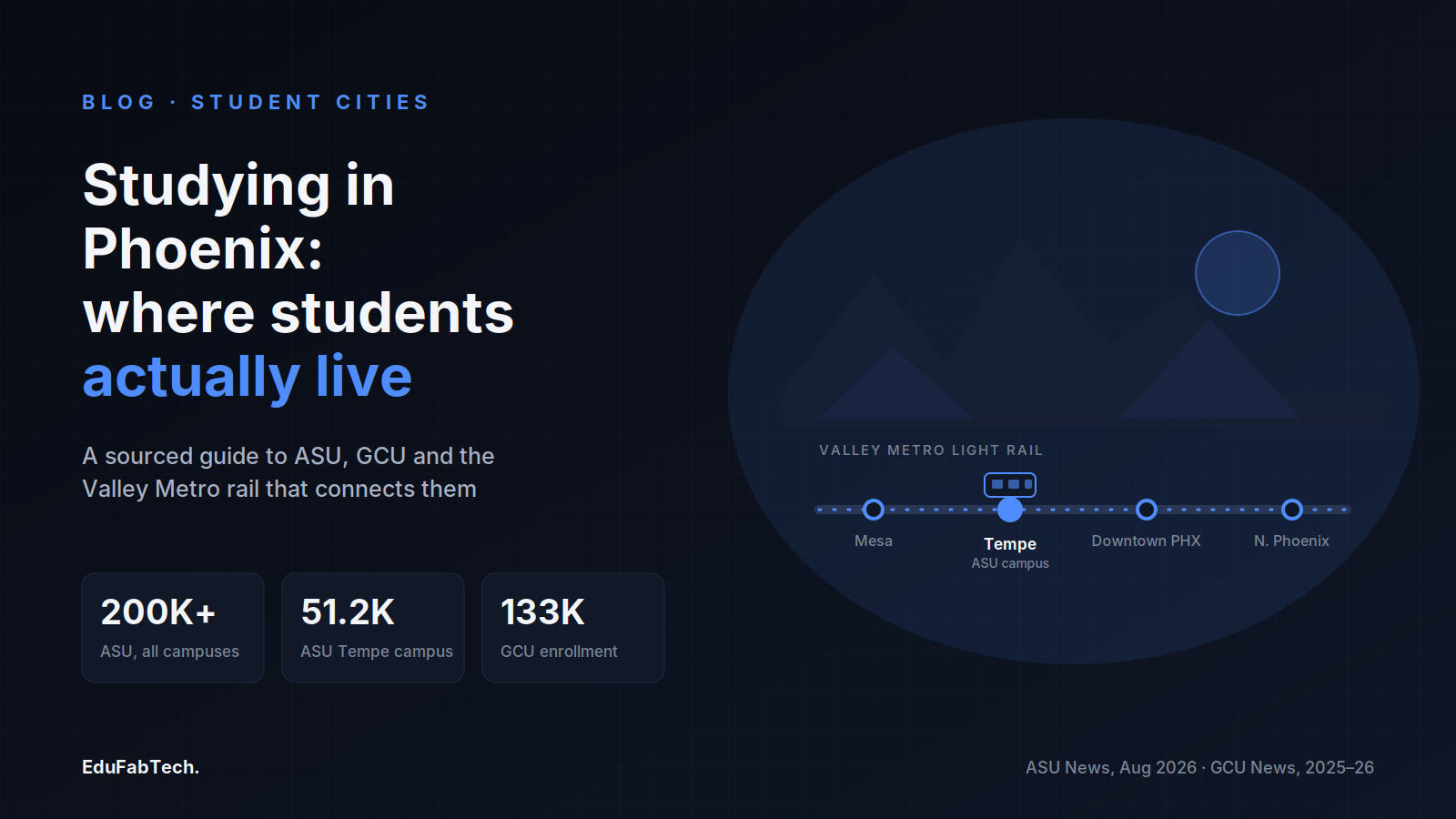
Phoenix is a low, wide city in the Sonoran Desert, laid out on a grid of long avenues under a mountain horizon — South Mountain, Camelback, the Papago buttes. It is the most populous city in Arizona and anchors a metro that runs continuously through Tempe, Mesa, Glendale, Chandler and Peoria, so a "Phoenix" student address is often in one of those adjoining cities rather than Phoenix proper. The practical spine of student life is the Valley Metro light rail, which threads Mesa, Tempe, downtown Phoenix and north-central Phoenix along one line; where you can reach it matters more than which municipality your lease names.
Student life here is dominated by one institution to a degree few cities match. Arizona State University reported that it enrolled more than 200,000 students across all campuses and online during the 2025–26 year, with roughly 51,200 of them based at the Tempe campus, according to ASU News (August 2026). That scale shapes rents, bus timetables and nightlife across the east Valley. But Phoenix also holds a cluster of smaller and very different colleges, and knowing which is which saves time.
The universities, and what studying here is like
Arizona State University is the giant. Its original and largest campus is in Tempe, immediately east of Phoenix, but ASU is really four metro campuses: the Tempe campus; the Downtown Phoenix campus; the West Valley campus in Glendale; and the Polytechnic campus in Mesa. The Downtown Phoenix campus houses the Walter Cronkite School of Journalism and Mass Communication, with its "teaching hospital" newsroom model, alongside nursing and public-service programmes. At Tempe you will find the ASU School of Sustainability — part of ASU's College of Global Futures and among the first degree programmes of its kind in the United States — and Barrett, The Honors College, whose students take an honours track toward an ordinary ASU degree. The West Valley campus is home to the New College of Interdisciplinary Arts and Sciences, and ASU's older public-affairs unit, once the ASU College of Public Programs, now operates as the Watts College of Public Service and Community Solutions. Degrees across all of these are conferred by ASU, not by the individual schools.
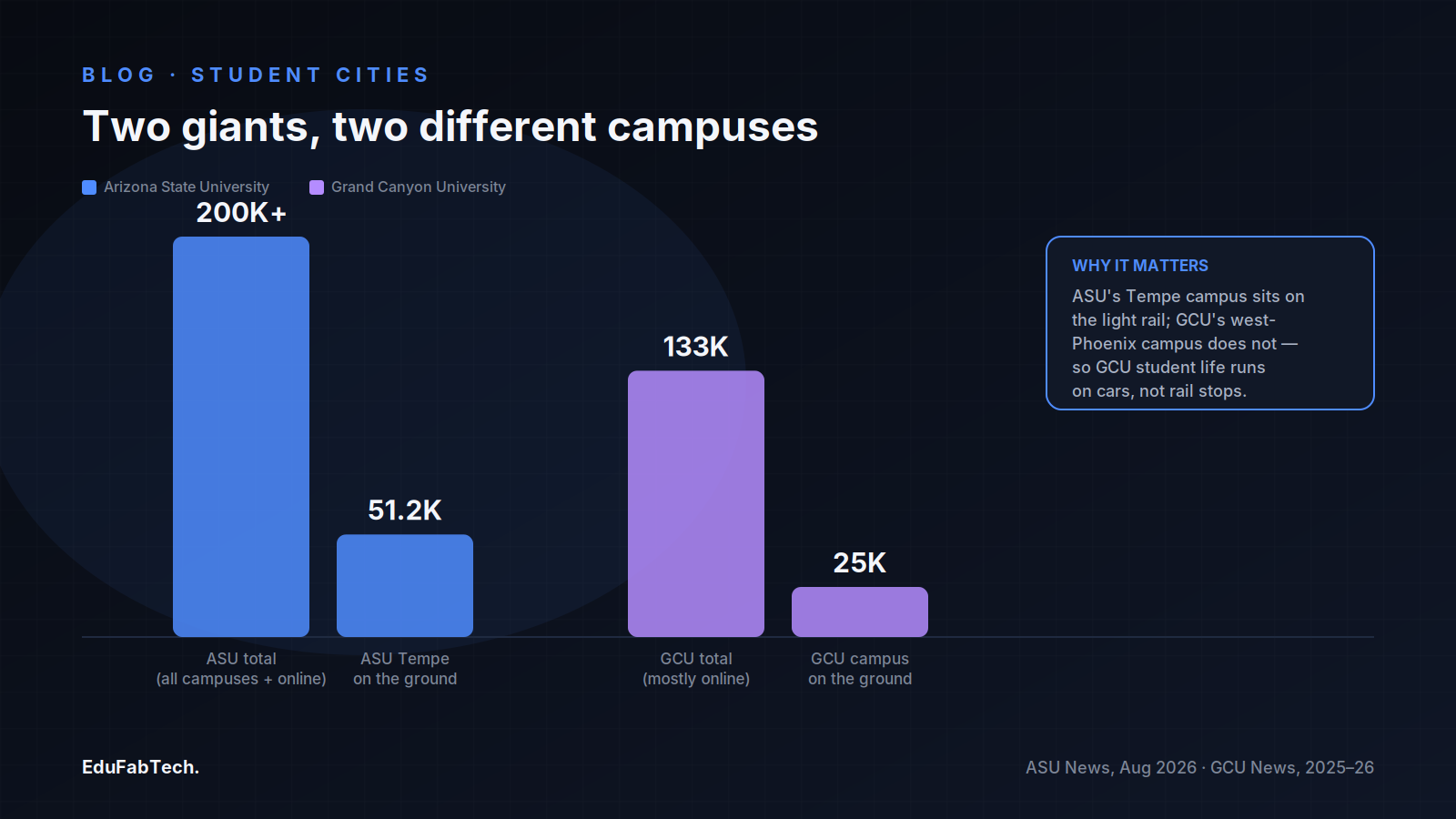
Grand Canyon University is the other large campus player, a private Christian university on a 300-acre site in west Phoenix along Camelback Road; GCU News reported a projected record enrolment of about 133,000 students for 2025–26, the large majority of them online, with roughly 25,000 on the ground campus. It is not on the light rail, so GCU life is more car- and campus-centred than ASU's.
The University of Phoenix, the for-profit institution whose name tends to confuse newcomers, is headquartered in Phoenix and teaches predominantly online rather than through a traditional residential campus. Several smaller specialised schools round out the city: the University of Advancing Technology in Tempe, a STEM-only school built around cybersecurity, game development and computing; Sonoran University of Health Sciences in Tempe (formerly Southwest College of Naturopathic Medicine), which runs an accredited naturopathic-medicine doctorate; Arizona Christian University, a liberal-arts Christian university that moved in 2019 to the former Thunderbird campus in Glendale; and two accredited distance institutions based in the metro, Harrison Middleton University in Tempe, a "Great Books" graduate school, and National Paralegal College in Phoenix, which grants online legal-studies degrees. You can see the full set of local listings and housing on EduFabTech's Phoenix page.
Neighbourhoods along the light-rail spine
Because the metro is so spread out, students cluster where they can walk to campus or catch the train. A short tour of where they actually settle:
Downtown Tempe and the Mill Avenue District is the heart of ASU's Tempe campus — a dense strip of apartments, cafés and bars running down to Tempe Town Lake, walkable to lectures and served by light rail at Veterans Way/College Avenue. It is the most convenient address and the priciest. Maple–Ash and University Heights, the older bungalow blocks just west and south of campus, offer house shares and smaller older rentals within a walk or a bike ride, with a quieter residential feel.
Move east along the train and rents fall. The Apache Boulevard corridor, running toward McClintock and Dorsey in east Tempe, is lined with mid-rise apartments a few light-rail stops from campus — a common choice for students trading a short ride for lower rent. Downtown Phoenix and Roosevelt Row suit students at the Downtown Phoenix campus (Cronkite, nursing, public service); it is the Valley's arts district, with high-rise flats, galleries and First Friday crowds, well connected by rail but still pockmarked by surface parking and gaps between blocks.
West Phoenix around Camelback Road, near Grand Canyon University, is more suburban and car-dependent, with cheaper rents but no rail link. Out east, Downtown Mesa and the area toward the Polytechnic campus benefit from the light-rail extension that now reaches Mesa; rents are generally lower than in Tempe, which appeals to engineering and aviation students at Poly and to anyone willing to commute inbound. Browse rooms by area on the Phoenix rooms listings, and ASU-specific options near Arizona State University.
Finding a room without losing a deposit
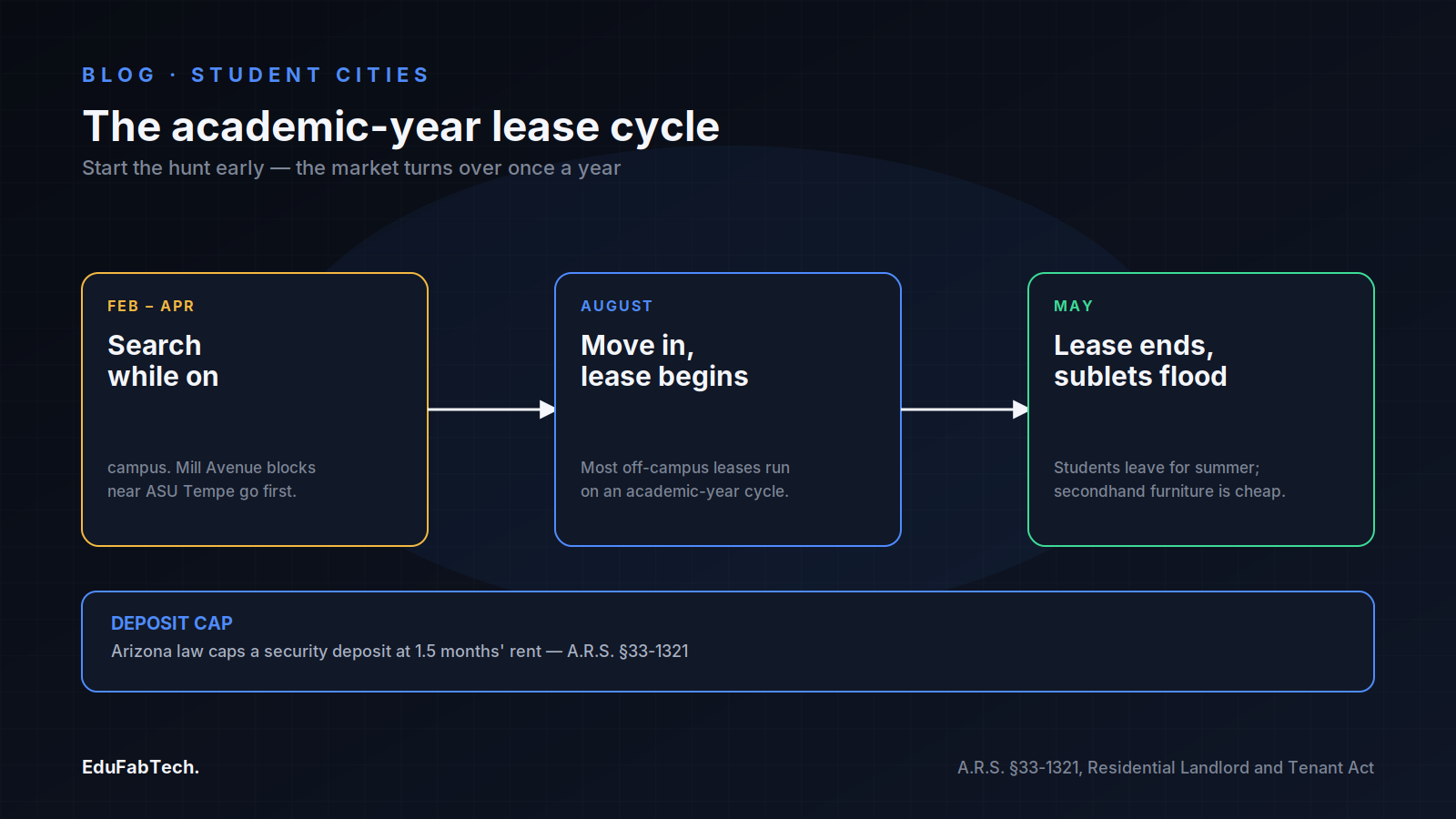
Most off-campus student housing near Tempe runs on an academic-year cycle: leases typically start in August and end in May, which floods the market with sublets each May as students leave for the summer. Start looking in late winter — roughly February to April — for an August move-in, and expect the walkable Mill Avenue blocks to go first. First-year undergraduates at ASU generally live in residence halls on campus, which bundle a required meal plan into the cost; after that, almost everyone moves to private flats and house shares.
Before you pay anything, know the local rules. Under Arizona's Residential Landlord and Tenant Act, a landlord may not demand a security deposit worth more than one and one-half months' rent, and any deposit not labelled non-refundable in writing is refundable — set out in A.R.S. §33-1321. If someone asks for far more than that to "hold" a place, treat it as a warning sign. Rental scams in Phoenix show up most on free classifieds and in the Facebook and group-chat housing boards aimed at ASU and GCU students — usually a room priced suspiciously below the Mill Avenue norm, with a "landlord" who is conveniently out of state. See the unit in person, or on a live video walk-through if you are applying from abroad, before you commit, and never send a deposit or first month by bank wire, gift card or cryptocurrency to reserve a room you have not seen; legitimate landlords and management offices in the Valley do not ask for those. A signed lease and a walk-in office you can visit are worth more than any emailed promise.
Furnishing a room second-hand
A room over the summer sublet season turns over fast, so used furniture is plentiful and cheap. Goodwill of Central and Northern Arizona runs dozens of thrift stores across the metro and funds free job-training programmes from the sales; its outlets are the default first stop for a desk, a chair or kitchenware. The Society of St. Vincent de Paul operates several Phoenix thrift stores, including its Last Chance outlet, and offers free furniture pickup across greater Phoenix — useful when you are moving a sofa without a car. For the larger weekend hunt, the Mesa Market Place Swap Meet on East Baseline Road packs hundreds of vendors under cover (handy given the heat), and the Phoenix Park 'n Swap on East Washington Street runs several days a week near the light rail. For fresh food and a Saturday-morning outing, the Downtown Phoenix Farmers Market sets up downtown. EduFabTech also lists local second-hand furniture as students move out.
Part-time work and what the rules allow
If you are an international student on an F-1 visa, the headline rule is strict and worth getting right: U.S. Citizenship and Immigration Services states that F-1 students with approval from their Designated School Official may work on campus for up to 20 hours per week while school is in session, and full-time during official breaks. On-campus jobs — libraries, dining, labs, administrative offices — are the straightforward option; off-campus work generally needs separate authorisation and cannot be assumed. This is a summary, not legal advice: check with your university's international student office and the USCIS page itself before taking any job, because a misstep can affect your immigration status. Domestic students face no such cap, and the ASU and GCU campuses are themselves large employers. Current openings students post and look for are on the EduFabTech Phoenix jobs board.
Libraries and places to study
On the Tempe campus, Hayden Library is the largest, reopened in 2020 after a roughly US$90 million renovation that nearly doubled student space and added reading rooms and reservable study rooms; it keeps long hours during term (ASU Library). Off campus, the Phoenix Public Library's flagship Burton Barr Central Library on North Central Avenue — a landmark of desert-modern architecture — offers free Wi-Fi, a large reading room and small study rooms you can reserve for free with a library card. The branch libraries and the Tempe Public Library add neighbourhood options closer to where students live. When term-time crowds fill every desk, EduFabTech's study-spaces listings point to quieter alternatives.
Getting around
Phoenix is built for cars, but students have a real alternative in Valley Metro, which runs the light rail and the bus network. The rail line links Mesa through Tempe (past the ASU campus) into downtown and north-central Phoenix; a Tempe Streetcar loop adds coverage around Mill Avenue, free at launch but charging a US$1 fare since August 2025. Standard Valley Metro fares are US$2 for a single local ride and US$4 for an all-day pass, paid with the reloadable Copper Card or the Valley Metro app (Valley Metro). The reduced fare of US$1 per ride is limited to youth aged 6–18, seniors, Medicare cardholders and riders with disabilities — university students do not automatically qualify, per Valley Metro's reduced-fare program. ASU students instead buy the subsidised U-Pass: ASU prices it at US$150 for the academic year (August to mid-May) for unlimited rides on Valley Metro light rail and local, express and RAPID buses — a steep discount on the full value. If you can live along the rail, you can plausibly study in Phoenix without a car; off the line, in west Phoenix or the outer suburbs, a car becomes hard to avoid, and cycling is pleasant for much of the year but brutal at the height of summer.
Costs, climate and the honest trade-offs
Housing is the main expense and the main reason to plan early. The U.S. Census Bureau's QuickFacts put the median gross rent in the city of Phoenix at US$1,582 a month for the 2020–2024 period (Census QuickFacts); shared student flats near Tempe cost less per person, but the convenient, walkable blocks sit at the top of the range. Against that, Arizona has no city-wide student housing shortage of the kind seen in some coastal metros, and the summer sublet churn gives latecomers a second chance each May.
The hardest fact of living here is the heat. The National Weather Service recorded that Phoenix reached 100°F (38°C) or hotter on 143 days in 2024, and 110°F (43°C) or hotter on 70 of them, in what it logged as the region's hottest summer on record (NWS Phoenix, 2024 year in review). That reshapes the academic year: autumn and winter are superb — mild, dry, perfect for studying outdoors — while from late May into September daily life retreats indoors, utility bills climb with air-conditioning, and walking or cycling in the afternoon becomes genuinely dangerous. Set against the climate are real advantages: a very large and varied university system, comparatively affordable rent for a big Sun Belt city, a growing downtown arts scene, and a transit line that makes a car optional for those who live near it. The honest summary is a trade: space, sun and value in exchange for a punishing summer and a sprawl that rewards living on the rail.
A checklist for your first weeks
- Confirm which campus and city you are actually studying in — Tempe, downtown Phoenix, Glendale or Mesa — and search for housing around that point, not around "Phoenix" in general.
- If you are an international student, visit your university's international student office in the first week and confirm the on-campus work rules on the USCIS page before taking any job.
- View any room in person or by live video before paying; never wire a deposit or pay by gift card or crypto to hold a place, and check the deposit is within the Arizona limit of one and a half months' rent.
- If you live near the rail, buy an ASU U-Pass or set up a Valley Metro Copper Card early; if you do not, budget for a car.
- Get a Phoenix Public Library card for free study rooms at Burton Barr, and furnish the room from Goodwill, St. Vincent de Paul or a weekend swap meet rather than new.
- Plan around the calendar: do your outdoor errands and apartment-hunting in the cooler months, and set up reliable air-conditioning before the first 100°F days arrive.
A quick question for readers
Do you work part-time while you study?
Many students work to pay the bills. See how common it is — and how many hours people really do.
Pick an answer, create a free account in a minute, and your vote counts. Already a member? Sign in
Source: Arizona State University
Sources (5)
- Arizona State University. ASU reaches milestone enrollment. ASU News, 2026. news.asu.edu ↗ · checked 3 Oct 2026
- Arizona State University. Transit passes. ASU Financial Services (CFO), 2026. cfo.asu.edu ↗ · checked 3 Oct 2026
- U.S. Citizenship and Immigration Services. Policy Manual, Volume 2, Part F, Chapter 6: Employment. USCIS, 2026. uscis.gov ↗ · checked 3 Oct 2026
- National Weather Service. 2024 Climate Year in Review for Phoenix, Yuma, and El Centro. NOAA / NWS Phoenix, 2025. weather.gov ↗ · checked 3 Oct 2026
- Arizona State Legislature. A.R.S. §33-1321: Security deposits. Arizona Revised Statutes, 2026. azleg.gov ↗ · checked 3 Oct 2026