Studying in Pittsburgh: universities, housing and student life
A practical, honest guide to living and studying in Pittsburgh — its universities, neighbourhoods, housing, costs, work rules, markets and transport — for students arriving locally or from abroad.
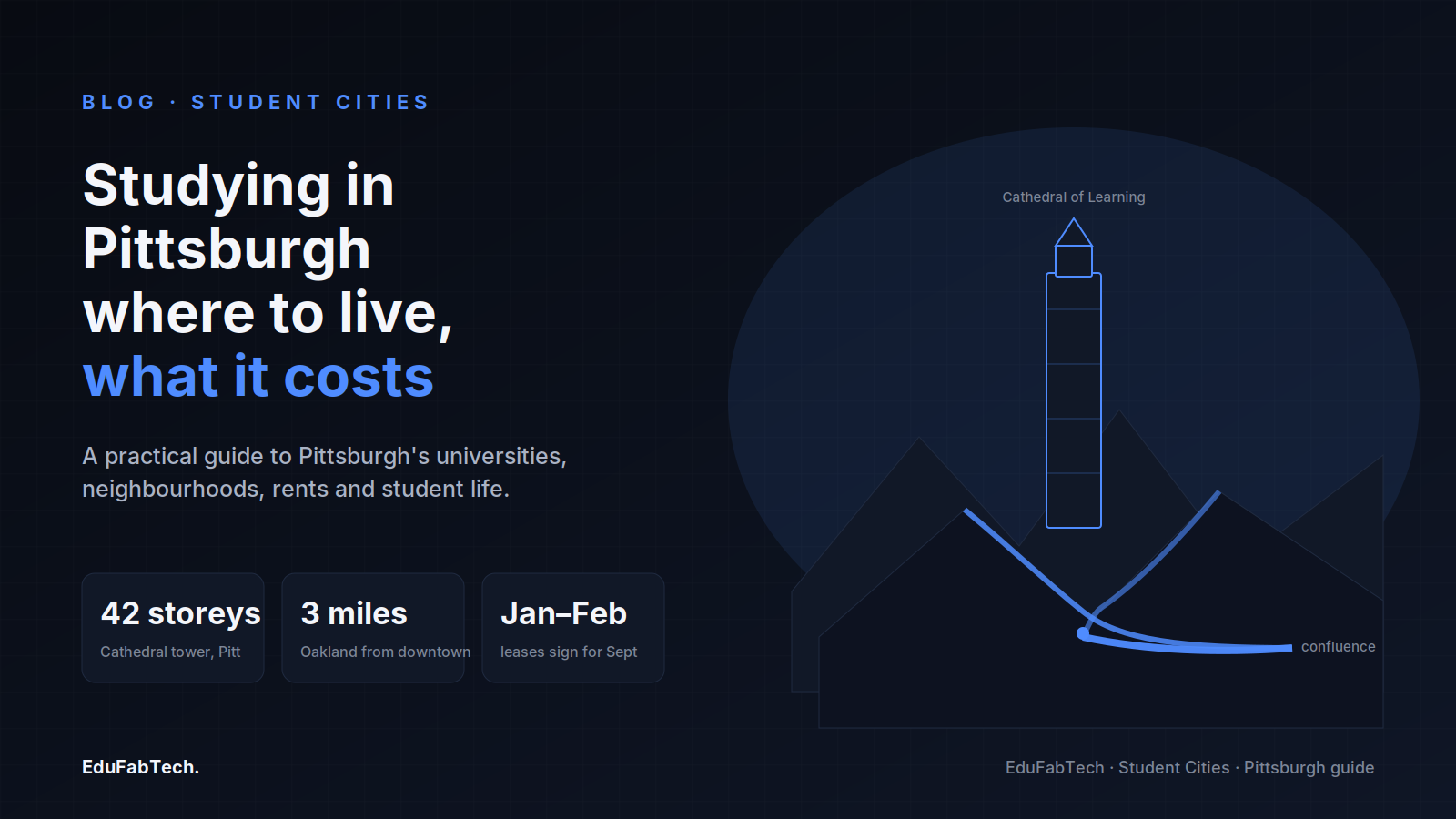
Pittsburgh sits where the Allegheny and Monongahela rivers meet to form the Ohio, and the city has grown up and down the steep hills around that confluence. This matters more to a student than it sounds. A room that looks a ten-minute walk from campus on a map may sit at the top of a long flight of public stairs, and the bus you take home climbs grades that would defeat a bicycle. The former steel town has become, over a generation, a city of universities, hospitals and software companies — but its geography has not flattened, and learning to read the hills is part of settling in.
Most of student Pittsburgh is concentrated in one neighbourhood: Oakland, about three miles east of downtown, which functions as the city's academic and medical core. Two major research universities, several smaller colleges, the central public library and a cluster of hospitals all sit within walking distance of one another there. If you study in Pittsburgh, you will spend a great deal of time in Oakland regardless of where you sleep.
The student culture that results is less about a single campus and more about a shared district. People from very different institutions ride the same buses, queue at the same lunch counters on Forbes and Fifth Avenues, and study in the same library reading rooms. It is an unpretentious, work-oriented city, cold and grey for a good part of the academic year, with a strong research pull and rents that are still lower than on the coasts.
The universities, and what studying there is like
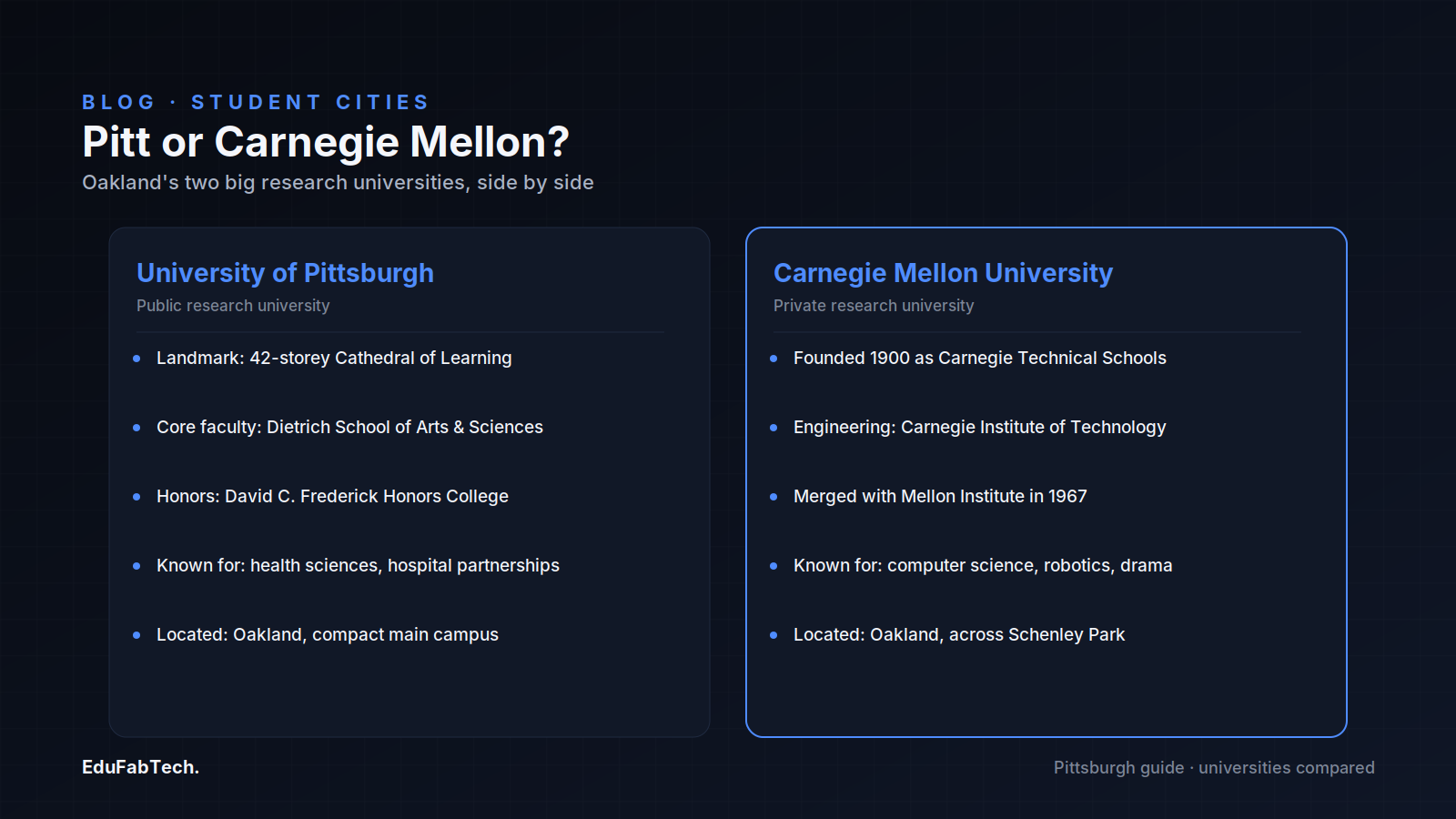
The University of Pittsburgh is the larger of the two big institutions, a public research university whose main campus occupies a compact site in Oakland dominated by the Cathedral of Learning, a 42-storey Gothic tower used for teaching. Its strengths are broad, with particular depth in the health sciences through its partnership with the surrounding hospital system. Most undergraduates begin in the Dietrich School of Arts and Sciences, the university's core faculty for the humanities, natural sciences and social sciences; high-attaining students can also affiliate with the University of Pittsburgh Honors College (now named the David C. Frederick Honors College), which adds research funding, seminars and advising rather than a separate degree.
Carnegie Mellon University is Pittsburgh's private research university, also in Oakland, a short walk from Pitt across Schenley Park. It grew from the Carnegie Technical Schools that Andrew Carnegie founded in 1900 and is known internationally for computer science, robotics, engineering, drama and fine art. Its engineering faculty still carries its historic name, the Carnegie Institute of Technology, which became a degree-granting institute in 1912 and merged with the Mellon Institute in 1967 to create the modern university. Studying at either place means being close to a lot of active research — and, in practice, a lot of competition for the quiet desks during exam season.
Three smaller universities round out the Oakland and downtown core. Carlow University is a small Catholic university in Oakland with a long tradition in nursing and the health professions; Chatham University, in nearby Shadyside, traces its roots to a women's college chartered in 1869 as the Pennsylvania Female College and now runs well-regarded sustainability and health programmes; and Point Park University sits right in Downtown, strong in the performing arts, cinema and journalism, with a campus woven into city-centre streets rather than a green quad.
Other universities and colleges in Pittsburgh
Beyond the headline names, a student will meet several more institutions, some of them schools within the larger universities and a few further out of town:
- Duquesne University College of Osteopathic Medicine — the medical school of Duquesne University, in the Uptown/Bluff area near Downtown, which welcomed its first class in 2024 and has since been renamed the Nasuti College of Osteopathic Medicine.
- University of Pittsburgh School of Dental Medicine — Pitt's dental school in Oakland, which also runs public clinics where patients are treated at reduced cost.
- University of Pittsburgh School of Social Work — one of Pitt's professional schools, in Oakland, offering social-work degrees up to doctoral level.
- Center for Latin American Studies – University of Pittsburgh — a long-standing area-studies centre within Pitt that coordinates teaching, language study and research on the region rather than admitting its own undergraduates.
- UPMC Shadyside School of Nursing — a hospital-based nursing school in Shadyside that prepares registered nurses through a diploma programme tied to the surrounding hospital system.
- Robert Morris University — a private university on a green campus in Moon Township, in the Carnot-Moon area northwest of the city toward the airport, with a business-school heritage and a downtown satellite.
- Pittsburgh Institute of Aeronautics — a specialist aviation-maintenance school based at the Allegheny County Airport, in the West Mifflin and Pleasant Hills area south of the city, training aircraft and avionics technicians.
- Pittsburgh Technical College — a career-focused college in Oakdale, west of the city, which closed in August 2024 after a long enrolment decline; prospective students should treat it as no longer operating.
- Penn State Beaver — a regional campus in Monaca, in Beaver County roughly 45 minutes northwest, offering the first two years of many degrees close to home.
One historical footnote: the Western Female Collegiate Institute was a nineteenth-century women's school in the Pittsburgh region and does not survive as a separate institution today. It is worth knowing the name only because older city histories still mention it.
Where students actually live
Pittsburgh's student neighbourhoods are clustered to the east of Oakland, each with its own character and price level.
Oakland itself is the obvious first home: undergraduate-heavy, loud, and walkable to both big campuses, with everything from purpose-built student blocks to subdivided old houses. North Oakland is generally quieter and pricier, South Oakland (around the Boulevard of the Allies) cheaper and more worn, and Central Oakland the most studenty. It is the most convenient place to live and the least peaceful.
Shadyside, just northeast, is leafier and more polished, built around the shops and cafés of Walnut Street. It draws graduate students and young professionals who want a short bus ride to campus and a quieter street, and rents reflect that. Chatham University sits on its edge.
Squirrel Hill, east of the universities, is a large, settled residential neighbourhood with two walkable business streets (Forbes and Murray), grocers, a public library branch and a strong community feel. Many graduate students, especially at Carnegie Mellon, consider it the best balance of space, safety and price, at the cost of a slightly longer commute.
Bloomfield, between Oakland and the East End, is Pittsburgh's traditionally Italian neighbourhood and now a mixed, lively district of restaurants and flats. It is popular with students who want a neighbourhood rather than a campus and can be a little cheaper than Shadyside.
Lawrenceville, along the Allegheny, has shifted from working-class rowhouses to one of the city's trendiest strips; it is further from campus and increasingly expensive, but well-liked by older students who commute by bus. Greenfield and the South Side are two more options — Greenfield a quiet, affordable residential pocket near Squirrel Hill, the South Side a flatter, nightlife-heavy grid across the Monongahela that suits those who want cheaper rooms and do not mind weekend noise.
You can browse rooms, sublets and shared flats across all of these on EduFabTech's Pittsburgh rooms listings, and filter by proximity on the pages for listings near the University of Pittsburgh and near Carnegie Mellon University.
Finding a room without getting caught out
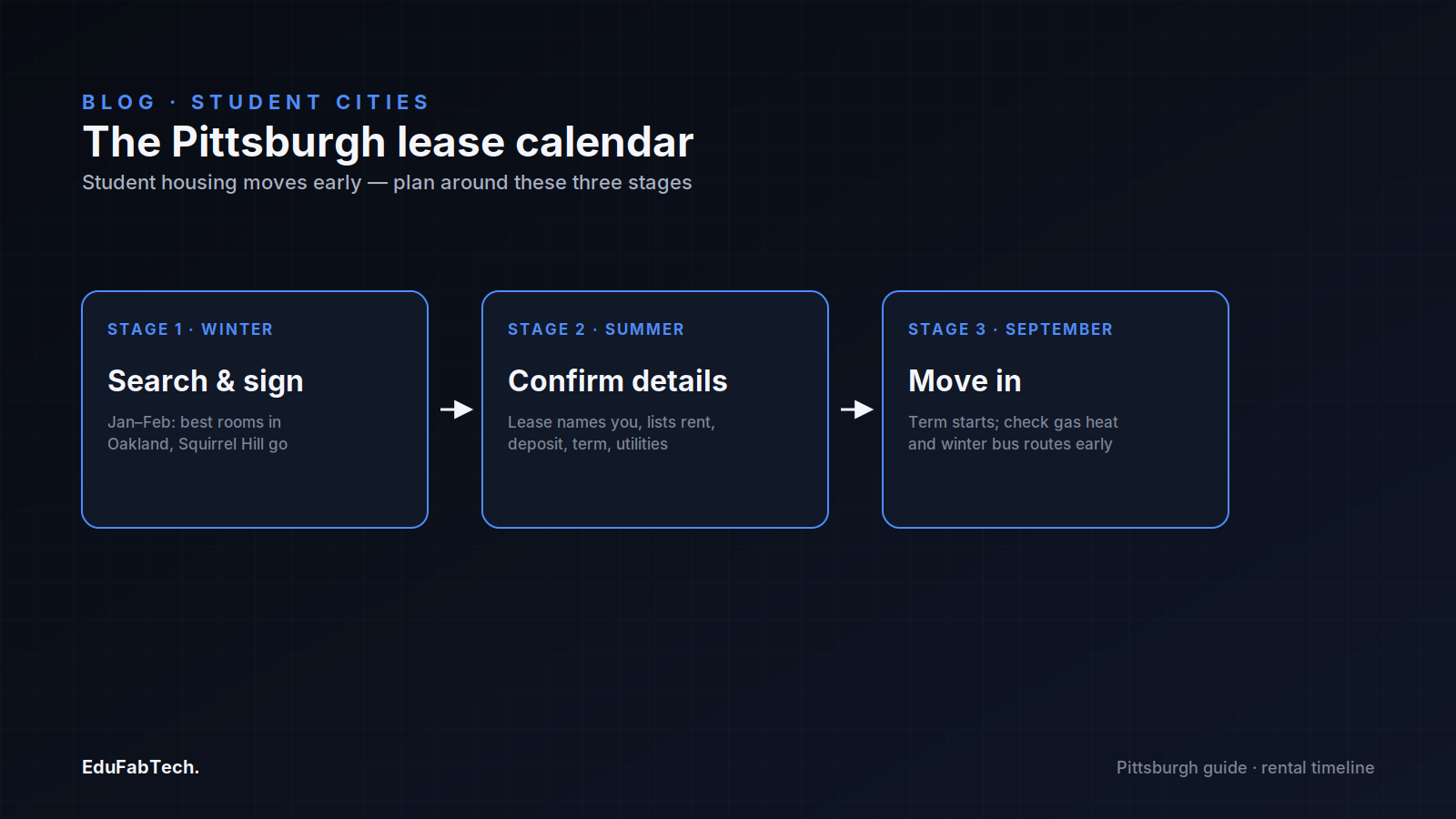
The rental calendar in the student neighbourhoods runs early. Leases for the following academic year are often signed in the winter and early spring — by January or February for a September move — so the best-value rooms in Oakland and Squirrel Hill go months before the summer. If you are arriving from abroad and cannot view in person, it is reasonable to take a short-term room or university housing first and search properly once you are on the ground.
Before you pay anything, check a few concrete things: that the person showing the room actually controls it; that the lease names you and lists the rent, the deposit, the term and who pays which utilities; whether heating in an old Pittsburgh house is gas and how the winter bills run; and what the walk or bus ride to campus is really like in snow. Ask whether the deposit is held properly and what the move-out conditions are. A genuine landlord expects these questions.
On scams, be firm. See the place in person, or at the very least on a live video call where the person walks through the actual room on request, before you send money. Never pay a deposit or "holding fee" by bank wire transfer, gift card or cryptocurrency to secure a room you have not seen — these payments cannot be reversed, and a listing that is cheaper than everything around it, with a landlord who is conveniently abroad and in a hurry, is the classic pattern. No legitimate landlord needs crypto to hold a room.
Furnishing a room cheaply
Pittsburgh is a good city for second-hand furnishing, partly because so many students cycle through it every year and leave usable things behind each May. The standout is Construction Junction in Point Breeze North, a reuse nonprofit operating since 1999 that sells salvaged furniture, lighting, doors, lumber and fittings from a large warehouse — ideal if you are setting up a flat on a budget and do not mind collecting things yourself.
For food, produce and the general pleasure of a market morning, the Strip District — a half-mile of Penn Avenue northeast of Downtown — is the city's signature. On a Saturday the pavements fill with vendors selling produce, spices, coffee and sports merchandise, alongside long-established Italian, Polish and Asian grocers and fishmongers. It is cheapest and liveliest early in the day; go late and you fight the crowds. Neighbourhood grocers along Murray Avenue in Squirrel Hill and Penn Avenue in Bloomfield cover day-to-day shopping. For the end-of-semester furniture hunt, watch the student blocks in Oakland and South Oakland in late spring, and check EduFabTech's page for second-hand things.
Work, money and what it costs
Costs in Pittsburgh are moderate by large-US-city standards but no longer cheap. The clearest figure to anchor on comes from the universities themselves: the University of Pittsburgh estimates on-campus housing at USD 10,374 and food at USD 6,118 — about USD 16,492 together — for the 2026–2027 academic year (University of Pittsburgh, 2026). Off-campus rents vary sharply by neighbourhood: a room in South Oakland or Greenfield is markedly cheaper than a flat in North Oakland or Shadyside, and sharing is how most students bring the monthly cost down. Rather than trust a single market average, compare several current listings for the specific neighbourhood you want.
On paid work, the rules depend on your immigration status and are set nationally, not by the city or university, so treat the official source as authoritative. According to the official federal guidance for international students, those on an F-1 study visa may generally work on campus but not more than 20 hours per week while classes are in session, with more hours allowed during official breaks; off-campus work has its own, narrower authorisations. This is a summary, not legal advice — confirm your own situation with your institution's international-student advisers before you accept any job, and browse current openings on EduFabTech's Pittsburgh jobs page.
Libraries, study spaces and getting around
For study space, Oakland is unusually well supplied. Pitt's Hillman Library stays open late into the night during term and around the clock in finals weeks; CMU's libraries serve its own students similarly. Open to everyone, the grand Main branch of the Carnegie Library of Pittsburgh sits on Forbes Avenue beside the museums, with quiet rooms and public desks, and neighbourhood branches in Squirrel Hill, Shadyside and the South Side give you alternatives closer to home.
Getting around is mostly by bus, with two light-rail lines and the historic inclines up Mount Washington. The operator, Pittsburgh Regional Transit, charges a standard single fare of USD 2.75, valid for three hours of transfers when paid with stored value (Pittsburgh Regional Transit, 2026). The important detail for students: the University of Pittsburgh confirms that eligible students, faculty and staff ride buses, light rail and the inclines within the county at no cost using their university ID or the transit app (University of Pittsburgh, 2026), and several other local institutions run their own free or discounted schemes — check what your own university offers before you pay a fare. Owning a car is possible but parking in Oakland is scarce and expensive; most students do without.
The good and the hard, honestly
What is good about Pittsburgh for a student is real. It is a serious research city with an outsized concentration of universities and hospitals, so opportunities to work on interesting problems are close at hand. It is compact and green, with large parks (Schenley and Frick) within reach of campus, and it remains more affordable than Boston, New York or the Bay Area. The student districts are genuinely walkable, and free or cheap transit removes a cost that bites hard elsewhere.
What is hard is also real. The winters are long, grey and snowy, and the hills that make the city beautiful make icy commutes genuinely awkward; good boots are not optional. Oakland can feel overcrowded and worn in term time, and the best-value rooms disappear early, so a late search leaves you with the leftovers. The bus network is good along the main east-end corridors but thin crosstown and in the evenings, which quietly shapes where it is practical to live. And like much of the country, rents have risen faster than many students expected. None of this is a reason to stay away — but arrive with warm clothes, a realistic budget and an early housing plan.
A short checklist for the first weeks
- Sort a bed for the first month before you fix a year-long lease — a short-term room buys you time to view places in person.
- Register with your institution's international-student or new-student office early; they handle status, work advice and orientation.
- Set up your university ID and transit access, and learn the two or three bus routes between your room and campus, including the evening schedule.
- Open the practical accounts you need and keep copies of your lease, immigration documents and deposit receipts.
- Do one Strip District run and one Construction Junction trip to furnish and stock the room cheaply.
- Walk your commute once in daylight and note where the public stairs and steep blocks are before the first snow.
- Browse what is already listed for the city — rooms, work and more — on EduFabTech's Pittsburgh page to settle in faster.
A quick question for readers
Do you work part-time while you study?
Many students work to pay the bills. See how common it is — and how many hours people really do.
Pick an answer, create a free account in a minute, and your vote counts. Already a member? Sign in
- University of Pittsburgh. Undergraduate Cost of Attendance — Pittsburgh Campus. University of Pittsburgh, 2026. link
- Pittsburgh Regional Transit. Fare Information. Pittsburgh Regional Transit, 2026. link
- University of Pittsburgh. Public Transit — Parking, Transportation and Services. University of Pittsburgh, 2026. link
- U.S. Department of Homeland Security. Working in the United States. Study in the States, 2025. link
- Chatham University. History. Chatham University, 2024. link
- Josh Moody. What Drove Pittsburgh Technical College to Close?. Inside Higher Ed, 2024. link
- Construction Junction. History of Construction Junction. Construction Junction, 2024. link