Studying in Plymouth, United Kingdom: universities, housing and student life
A practical, sourced guide to Plymouth's three universities, where students live, part-time work, study spaces, markets, getting around and what it costs.
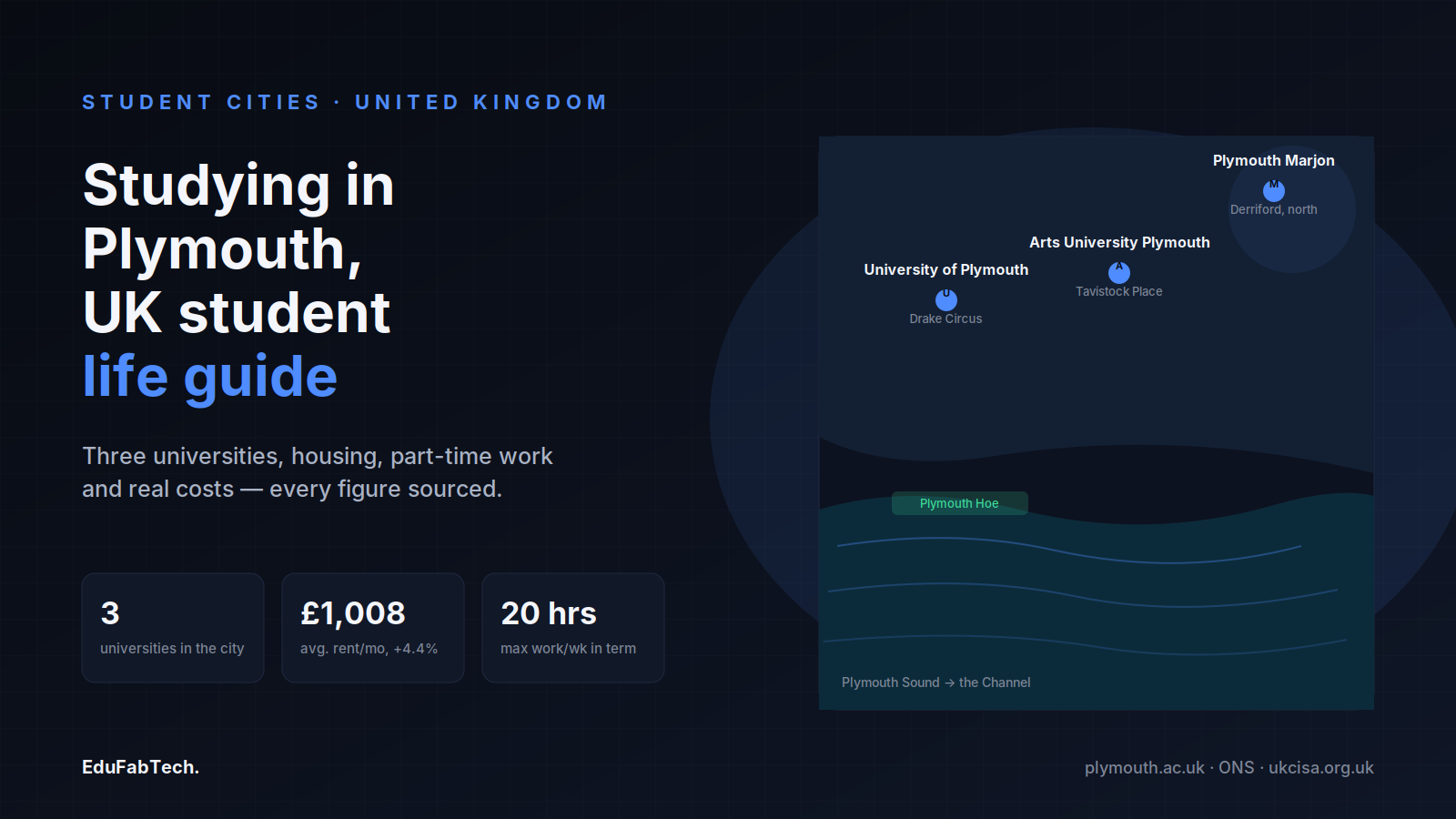
Plymouth sits at the far south-western edge of England, where the River Tamar meets the sea and the city looks out over Plymouth Sound towards the open Channel. It is a working port — the Royal Navy's Devonport base is still here — wrapped around a waterfront of granite quays, a lido, and the broad green of Plymouth Hoe. Behind the city the land rises quickly into Dartmoor. For a student, that geography shapes daily life: the sea is rarely more than a walk away, the moor is a bus ride out, and the three universities are packed into a compact centre that was rebuilt after wartime bombing on a wide, gridded plan.
That compactness is the first thing to understand. Plymouth is not a sprawling commuter metropolis; its centre, its main campus, its market and its railway station are close enough to cross on foot. It is also a long way from anywhere else — the city is at the end of the main line, several hours from London and a fair distance even from Bristol or Exeter — so students here tend to build a life inside the city rather than treat it as a dormitory for somewhere larger.
This guide covers the universities, where students live, how rooms are rented safely, furnishing a place cheaply, part-time work, study spaces, transport and the real costs — with every figure tied to the page it comes from. You can also browse current student listings across Plymouth on EduFabTech as you read.
Three universities, three different cities
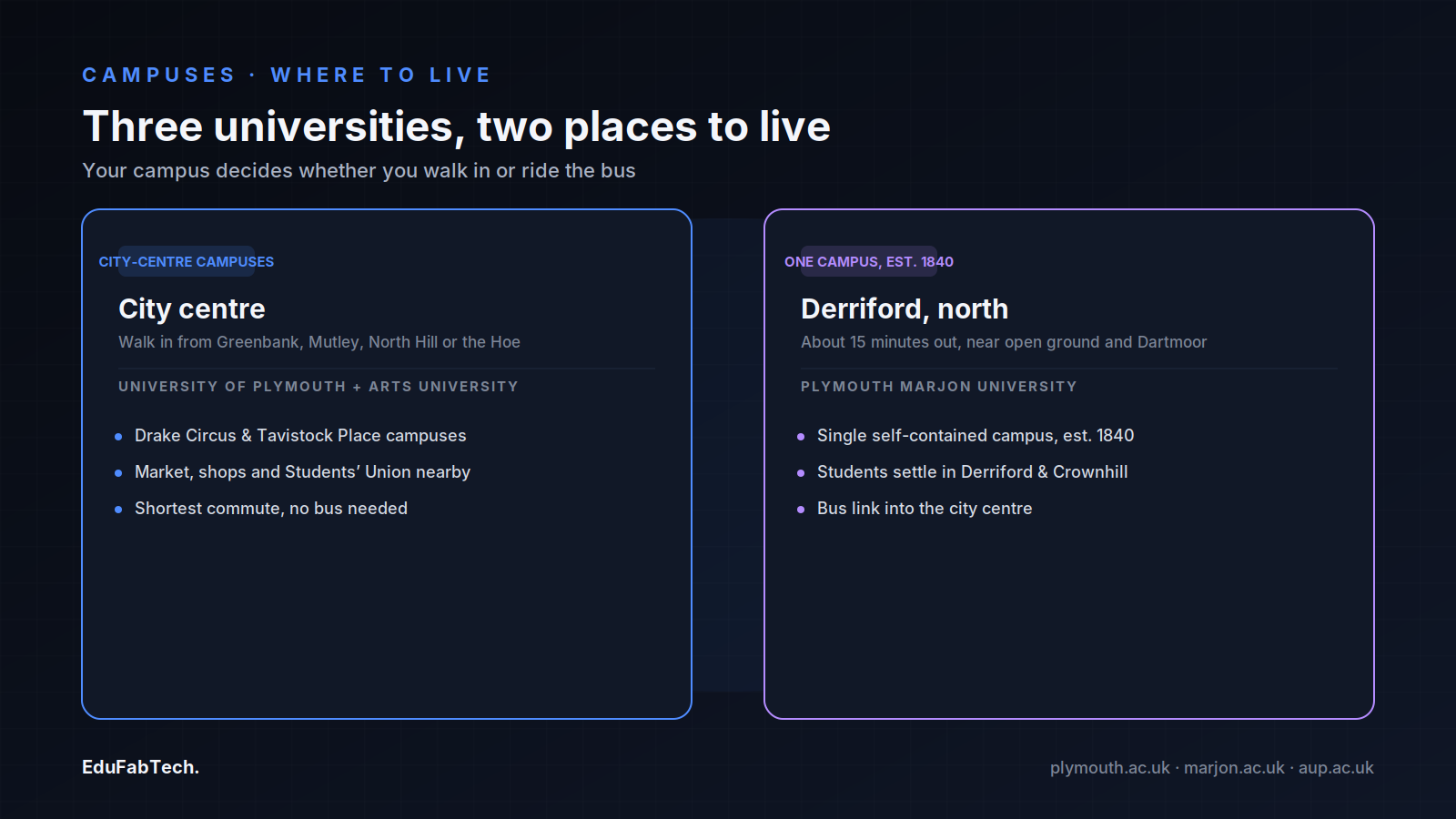
Plymouth has three degree-awarding universities, and they sit in genuinely different parts of town. The largest is the University of Plymouth, whose main campus is in the city centre at Drake Circus (PL4 8AA). The university describes the campus as the focal point of student life and notes it is compact and easy to navigate, with the Roland Levinsky Building, a library, a sports centre and the Students' Union clustered together, while specialist teaching spaces and facilities such as InterCity Place, the Centre for Eyecare Excellence and the Marine Station sit within walking distance (plymouth.ac.uk). Its waterfront Marine Station reflects a long-standing strength in marine and maritime science — fitting for a university in a port city.
Plymouth Marjon University has a quite different feel. Its single campus is in Derriford, on the northern edge of the city about 15 minutes from the centre, in green and open surroundings near Dartmoor; the institution dates its origins to 1840 (marjon.ac.uk). Everything is on one site — teaching, sports and health facilities, library and halls — which gives Marjon a close-knit, self-contained campus character that the city-centre institutions cannot match.
Arts University Plymouth is the specialist of the three. It occupies a city-centre campus on Tavistock Place, in what the city calls its Cultural Quarter, and was founded in 1856 as the Plymouth Drawing School before gaining university status in May 2022. Spread across more than 13,000 square metres of studios and workshops, it houses Fab Lab South West, the public gallery MIRROR and the Plymouth Arts Cinema (aup.ac.uk). It is a small, practice-based art-and-design institution, and its campus feeds directly into the galleries and venues around The Box next door.
Which university you attend affects where it makes sense to live. A University of Plymouth or Arts University student can live centrally and walk in; a Marjon student is drawn north towards Derriford, or relies on buses from the centre.
Where students live around the city
Most first-year students start in university or private halls and then move into shared houses for later years. The neighbourhoods that absorb students are fairly distinct. Just east and north of the centre, Greenbank and Mutley — strung along the shops and takeaways of Mutley Plain — are the traditional student quarters, within walking distance of the University of Plymouth. Nearby North Hill and the streets around Freedom Fields put you close to campus. Towards the water, Stonehouse and the Barbican and Hoe areas are more mixed but popular for their waterfront. For Marjon students, the northern suburbs around Derriford and Crownhill are the practical choice, closer to campus and the hospital.
University-managed halls are the simplest starting point. For 2026-27 the University of Plymouth lists its own halls from £141 a week for a shared-facilities room in Gilwell Hall (and £141–£188 in Robbins Hall) up to £209.50 for en-suite rooms in Francis Drake Hall and £209.50–£233 in Mary Newman Hall, with bills, Wi-Fi and contents insurance included in every price (plymouth.ac.uk/services/accommodation/halls). Marjon and Arts University Plymouth also offer their own accommodation on or near their campuses; check each university's accommodation pages for current rooms and prices.
For the wider private market, the Office for National Statistics put the average monthly private rent in Plymouth at £1,008 in September 2026, up 4.4% from £966 in September 2025 (ONS). That figure covers all homes, not student rooms, but it is a useful gauge of the direction of travel. You can compare live options on EduFabTech's Plymouth rooms page and listings near the University of Plymouth.
Renting a room without losing a deposit
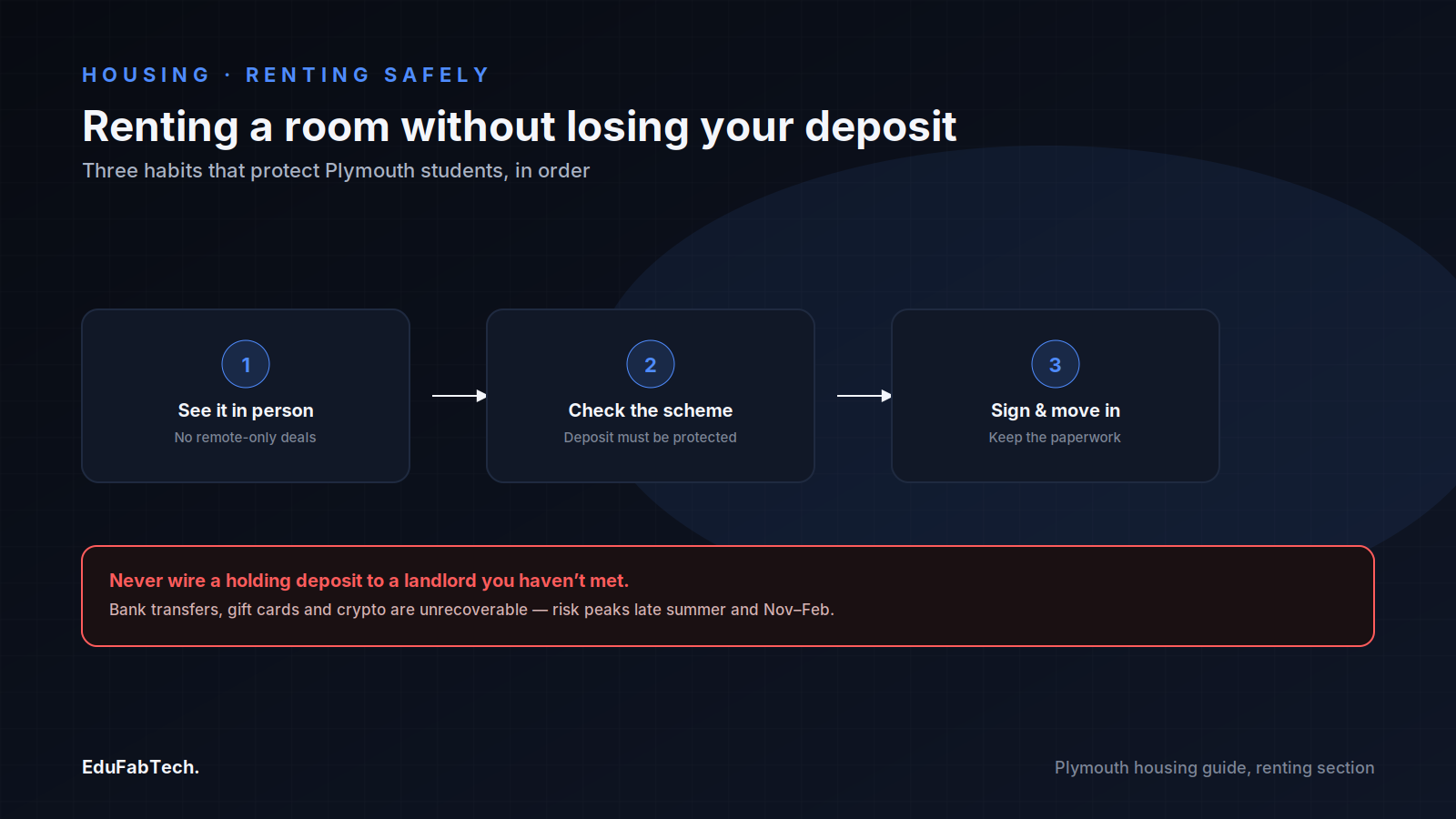
The practical risk in Plymouth is the same as in any university city, and it bites hardest at two moments: the late-summer scramble before term, and the November-to-February rush when second-years lock in a house for the following year. That pressure is exactly when fake-listing scams appear — a too-cheap room in Mutley or on the Hoe, a landlord who is conveniently "away", and a request to transfer a holding deposit before you have seen anything.
A few habits protect you. See the actual room in person before you pay a penny — Plymouth is small enough that an in-person viewing is realistic, and anyone refusing one is a warning sign. Never send money by bank transfer, gift card or cryptocurrency to "hold" a room; those payments are effectively unrecoverable, and no legitimate Plymouth landlord needs them. Understand the normal structure: a tenancy deposit (commonly around five weeks' rent) must by law be protected in a government-approved deposit scheme, and you should be told which one. If you are an incoming student who cannot travel to view, lean on your university's accommodation service rather than paying a stranger remotely.
Furnishing a room cheaply: the Market and the charity run
Plymouth's rebuilt centre is unusually good for second-hand basics because so much is within a few hundred metres. The anchor is Plymouth Market on Cornwall Street (PL1 1PS), a large covered market in the West End. Its official opening hours are 08:00–17:00 Monday to Saturday, closing earlier at 16:30 on Wednesdays, closed Sundays and on Bank Holiday Mondays (plymouthmarket.co.uk). Under one roof you will find fresh food, household goods, fabric and haberdashery, and a changing roster of independent traders — useful for kitchen kit and the small things a new room needs.
Around the market, the West End and Mutley Plain carry a dense run of charity shops, which in a city this size turn over crockery, lamps, desks and bikes quickly. For larger items — a desk, a mattress topper, a drying rack — the second-hand route is both cheaper and faster than ordering new to a shared house. EduFabTech keeps a local page for second-hand things in Plymouth, where students pass on desks, lamps and other furniture they no longer need at the end of each year.
Working part-time while you study
Plymouth's hospitality, retail and events scene — the Barbican's bars, the market, the city-centre shops, the student union venues — provides the usual pool of part-time jobs. If you are an international student, how much you may work is a condition of your immigration permission, not a matter of local practice, so check the rules before you take anything on.
The UK Council for International Student Affairs (UKCISA) summarises the standard position: a Student visa typically allows up to 20 hours a week in term time if you are studying a qualification at degree level or above, and up to 10 hours a week if you are studying below degree level, with full-time work permitted outside term time, including in vacations (ukcisa.org.uk). Your own conditions are printed on your visa or eVisa, and the official rules are set out on the UK government's Student visa guidance at gov.uk. This is general information, not legal advice: confirm your specific conditions with your university's international student advisers before starting a job. Current local openings are listed on EduFabTech's Plymouth jobs page.
Libraries and places to study
The main academic study space is the University of Plymouth's Charles Seale-Hayne Library. Most of it keeps extended term-time hours, but the key point for anyone who works late is the Level 0 Learning Space, which the library says is open 24/7 all year to anyone with a University card, with PCs, study desks and plenty of power points (plymouth.libguides.com). Marjon's campus library and Arts University Plymouth's studios and workshops serve their own students, so your first stop depends on where you are enrolled.
Beyond the campuses, the city centre gives students neutral ground to work in: the cafés around the Barbican and Royal William Yard, and the public cultural buildings of the centre, are common spots for reading and group work when a change of scene helps. EduFabTech also maintains a Plymouth study-spaces page for desks and quiet rooms shared locally.
Getting around: buses, ferries and feet
Plymouth is walkable at its core — for many University of Plymouth and Arts University students, the commute is a ten-minute stroll. Beyond that, two main bus operators cover the city: Plymouth Citybus and Stagecoach, each with its own tickets and student passes, as the University of Plymouth Students' Union sets out in its local travel guidance, which also notes that some medical, dentistry and health students get bus access with their University Card (upsu.com). For a Marjon student commuting from the centre out to Derriford, a termly or weekly bus pass is usually the sensible buy; compare both operators' student fares directly on their websites, since prices change each year.
The water is part of the transport network too. The Students' Union lists three ferries — Mount Batten to the Barbican, the Cremyll crossing from Stonehouse to Mount Edgcumbe, and the Torpoint Ferry across the Tamar to Cornwall, which it notes is free of charge to foot passengers — along with three park-and-ride sites on the city's edge (upsu.com). Plymouth's mainline railway station, a short walk from the city-centre campus, links the city along the Great Western main line towards Exeter, Bristol and London, and west into Cornwall.
What is good, and what is hard
The good is real. Plymouth is a coastal city where students can swim, sail or walk on the Hoe between lectures, with Dartmoor National Park on the doorstep for anyone who wants hills and dark skies. It is compact, so the daily geography is simple, and — on the ONS figure above — its average private rents remain lower in absolute terms than those in many larger English university cities, which stretches a student budget further.
The hard parts are worth naming honestly. Plymouth is remote: the long rail journeys mean trips home or to other cities are a real commitment, and some students feel the distance in term. The weather is Atlantic — wet and windy stretches are common on an exposed south-west coast. And like every UK student city, Plymouth has felt a housing squeeze, with rents rising year on year (ONS recorded a 4.4% increase to September 2026) and the sharpest competition for rooms concentrated in a few late-summer and mid-winter weeks. None of this is a reason to stay away; it is a reason to plan the housing hunt early and budget for the trip home.
A checklist for your first weeks
- Register and get your University card. It is your library pass, including 24/7 access to the Seale-Hayne Library's Level 0 space, and often your route to student bus deals.
- Sort transport. Decide whether you will mostly walk, and if not, compare Plymouth Citybus and Stagecoach student passes before buying — the right one depends on whether you commute to Derriford.
- Furnish from second-hand. Start at Plymouth Market and the West End and Mutley Plain charity shops before buying anything new.
- If you are an international student, check your work conditions on your visa and against the UKCISA and gov.uk guidance before taking a job.
- Never pay to "hold" a room by bank transfer, gift card or crypto, and see any place in person first — Plymouth is small enough to make that easy.
- Explore the waterfront early. The Hoe, the Barbican and Royal William Yard are what make living here distinctive; they are also where you will meet people outside your course.
A quick question for readers
Do you work part-time while you study?
Many students work to pay the bills. See how common it is — and how many hours people really do.
Pick an answer, create a free account in a minute, and your vote counts. Already a member? Sign in
Comments 3
Comment-
The number that jumps out is the Level 0 Learning Space being open 24/7 all year to anyone with a University card. That's a cheap, durable p…
-
The line that needs a citation and doesn't get one is "its average private rents remain lower in absolute terms than those in many larger En…
-
The number I'd want a first-year to actually sit with is the halls range: £141 a week for shared facilities up to £209.50-£233 for en-suite,…
Join free to read the full comments and reply Comments are between members; an account takes a minute.
Source: Office for National Statistics
Sources (5)
- University of Plymouth. Halls of residence 2026-27. University of Plymouth, 2026. plymouth.ac.uk ↗ · checked 9 Nov 2026
- Office for National Statistics. Private rent and house prices, Plymouth (E06000026). ONS, 2026. ons.gov.uk ↗ · checked 9 Nov 2026
- UKCISA. Working as an international student. UK Council for International Student Affairs, 2026. ukcisa.org.uk ↗ · checked 9 Nov 2026
- Arts University Plymouth. About us. Arts University Plymouth, 2026. aup.ac.uk ↗ · checked 9 Nov 2026
- University of Plymouth. Study Areas, Library and IT Self Help. University of Plymouth, 2026. plymouth.libguides.com ↗ · checked 9 Nov 2026