Studying in Portland, United States: universities, housing and student life
A sourced, practical guide to Portland, Oregon for students — its universities across the metro, where people live, finding a room safely, markets, work rules, transit fares and what a room actually costs.
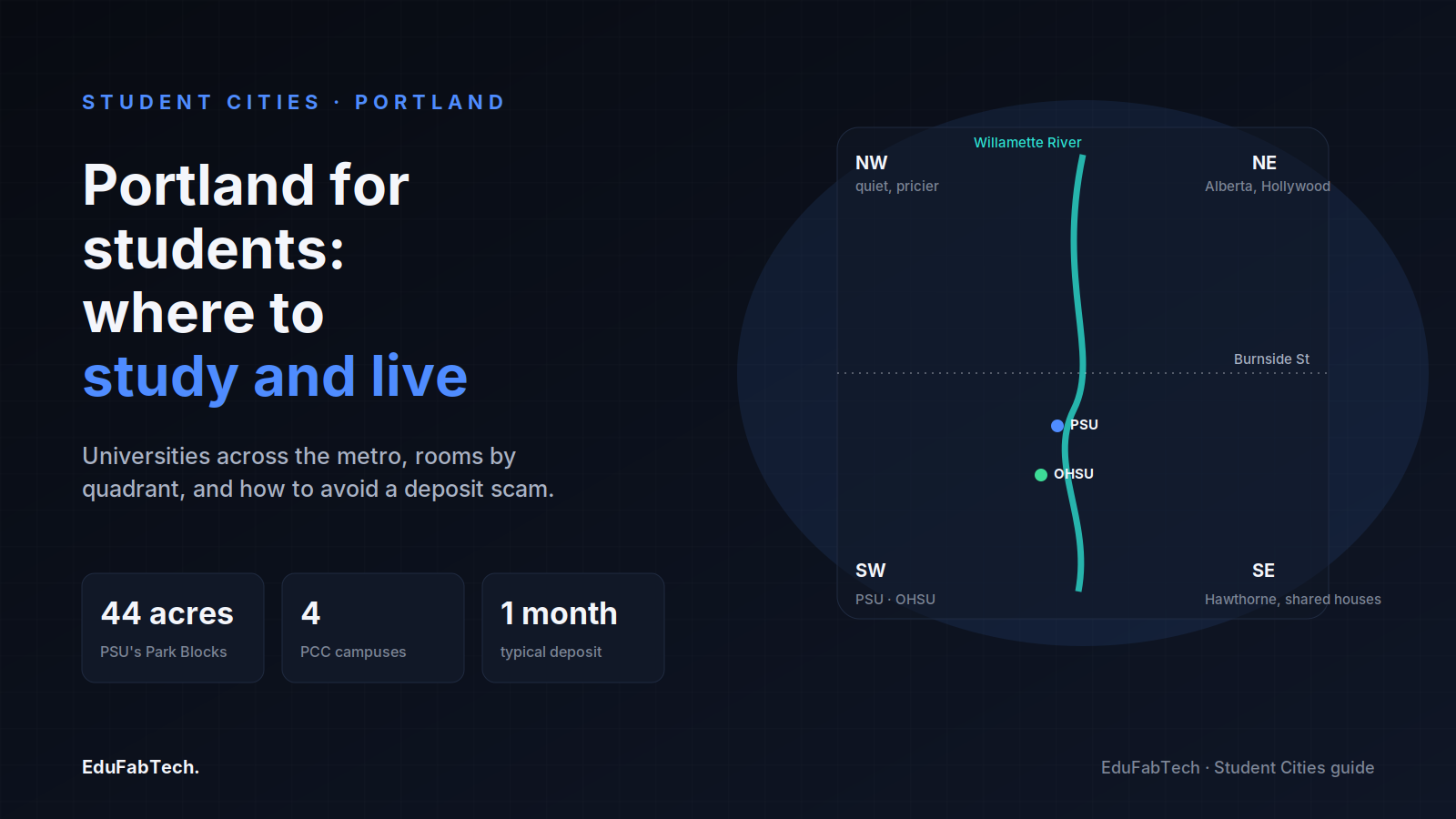
Portland sits where the Willamette River runs north through the city toward its meeting with the Columbia, and most of what shapes student life here follows from that. The river splits the city into east and west; Burnside Street splits it north from south. Out of those two lines come the addresses Portlanders live by — Northwest, Northeast, Southwest, Southeast, and the separate sliver called North Portland — and a set of bridges that quietly decide how long your commute really is. Downtown, the state's largest university and the wooded west hills are all packed into a few square miles on the west bank; most of the cheaper rooms lie across the water to the east.
Two research institutions anchor the city. Portland State University spreads through the downtown core, and Oregon Health and Science University climbs the forested rise just south of it that locals call Pill Hill. Around them, a scatter of smaller universities and community-college campuses reaches out across the metro — west to Hillsboro and Beaverton, south to Milwaukie and Oak Grove, and north across the Columbia into Washington State. Where you study shapes where you can afford to live, so it is worth knowing them before you sign anything. A running list of student rooms, jobs and second-hand things across the city is kept on EduFabTech's Portland page.
From the Park Blocks to Pill Hill: the universities
Portland State University is the public university downtown, built into a 44-acre campus along the tree-lined South Park Blocks, and it has been part of the city centre since the 1950s, according to the university's own account of its campus. There is no sealed quad: lecture halls sit beside coffee shops, light rail runs through the middle of it, and PSU says students can ride the city streetcar for free. It is the most common starting point for both local and international students, with a broad spread of undergraduate and graduate programmes in business, engineering, the sciences, education and the arts.
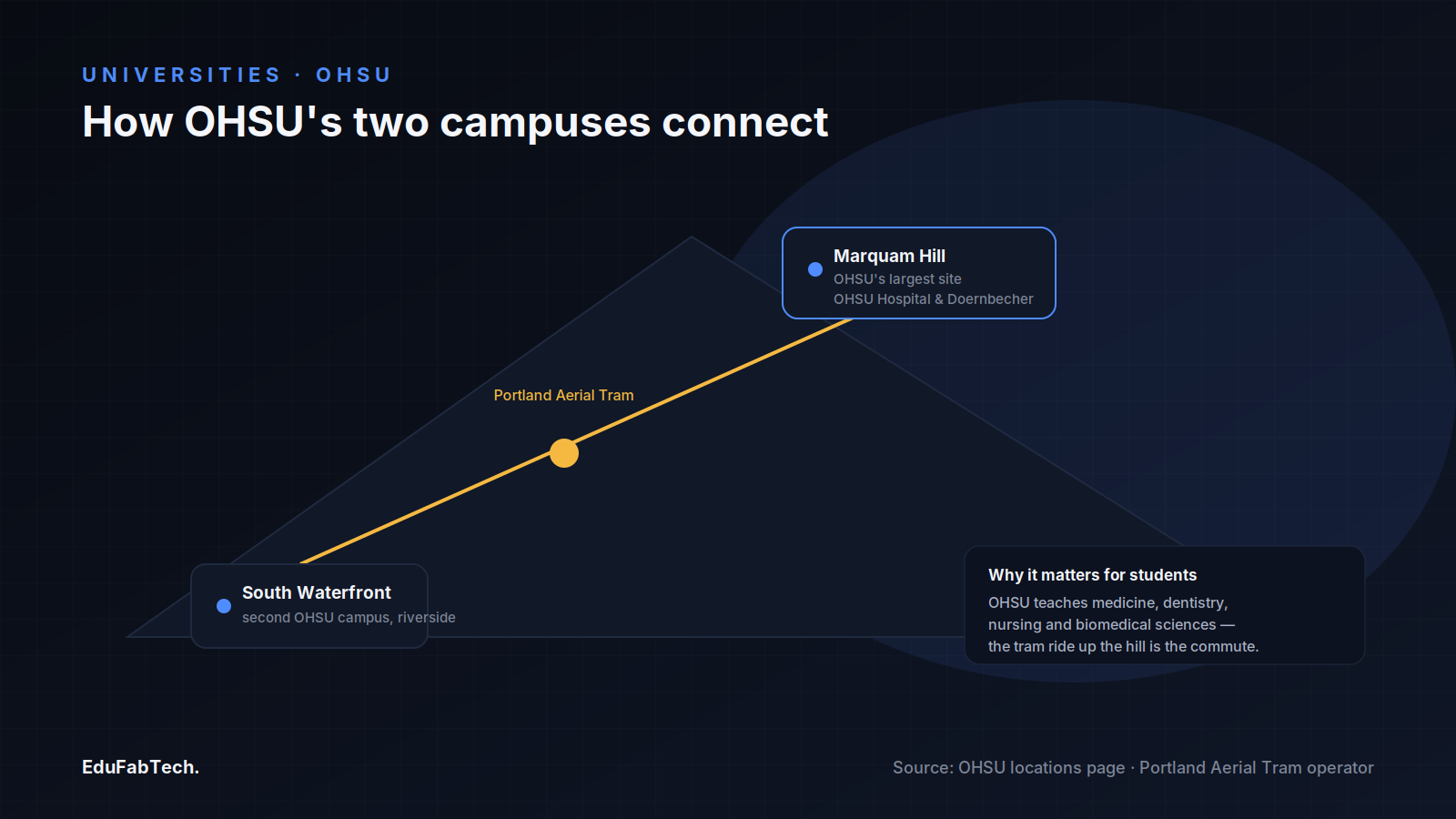
Oregon Health and Science University is a different kind of place: a health-sciences university and hospital system whose main campus sits on Marquam Hill, immediately south of downtown, with a second campus on the South Waterfront below. OHSU's locations page describes Marquam Hill as its largest site, home to OHSU Hospital and Doernbecher Children's Hospital. The two campuses are joined by the Portland Aerial Tram, which the tram's operator says connects the South Waterfront and Marquam Hill — a short cable-car ride that doubles as the daily commute up the hill. OHSU teaches medicine, dentistry, nursing and the biomedical sciences, so it draws graduate and professional students rather than first-years.
The rest of the metro's universities are smaller and more specialised. George Fox University is a private Christian university in Newberg, in the Willamette Valley southwest of the city, with teaching sites in Portland as well. Warner Pacific University occupies a hillside campus on the south side of Mount Tabor in Southeast Portland. University of Western States, in Northeast Portland, is one of the older chiropractic and integrated health-sciences schools in the country. American College of Healthcare Sciences, near the South Waterfront, teaches holistic and integrative health, largely online. Pacific University Health Professions Campus puts the university's health programmes in downtown Hillsboro, beside the light rail. And Oregon Institute of Technology, Wilsonville — Oregon Tech's metro campus, roughly 18 miles south of downtown in the "Silicon Forest" — concentrates on engineering, health and applied technology.
Two more institutions matter for everyday life. Lewis & Clark College is a private liberal-arts college on wooded Palatine Hill in the far southwest, beside Tryon Creek, with separate law and graduate-education schools. Washington State University Vancouver sits across the Columbia in Washington State, a short drive north. And for many people the cheapest route into a degree is Portland Community College, whose campuses ring the city — Cascade in North Portland, Rock Creek out toward Bethany, Southeast near Happy Valley, and Sylvania in the Metzger area to the southwest — feeding transfers into PSU and the state universities.
Where students settle, read by quadrant
Because the city is read by quadrant, students tend to describe where they live by compass point first and neighbourhood second. The choice is almost always a trade between walking to campus and affording the room, and the river is the usual dividing line: the west side is closer to PSU and OHSU and costs more; the east side is where the shared houses are.
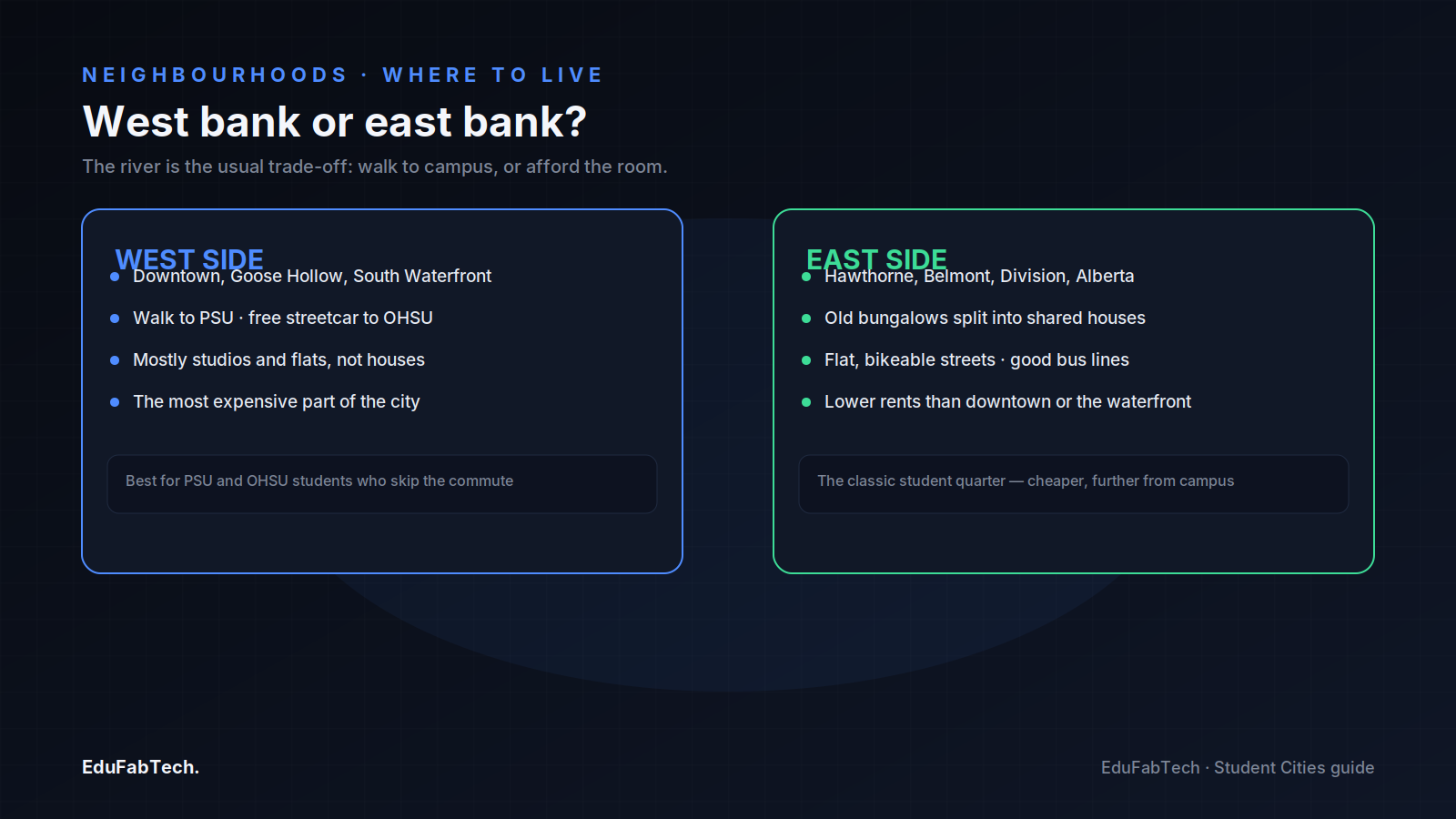
Downtown and Goose Hollow (Southwest). The blocks around the Park Blocks and up toward Goose Hollow put you within walking distance of PSU and on the free streetcar, which suits students who do not want to commute. It is the densest and most expensive part of the city, almost entirely flats and studios rather than houses, and the streets can feel hard-edged at night.
South Waterfront and South Portland. The newer glass towers along the river below Marquam Hill are the natural base for OHSU students, since the aerial tram and the streetcar both stop here. Rooms are modern and priced to match; listings near the hospital are gathered on EduFabTech's OHSU page.
Southeast — Hawthorne, Belmont, Division. This is the classic east-side student quarter: old timber bungalows split into shared houses, long commercial streets of cafés and bookshops, and flat, bikeable ground. Rents are lower than downtown, the bus and bike routes into the city are good, and the character is unmistakably Portland.
Northeast — Hollywood and Alberta. Leafy residential streets stretch northeast toward University of Western States, with the Hollywood MAX station on the light-rail line and streets quiet enough for people who want a neighbourhood rather than a nightlife. Prices sit between the cheaper far-east and the pricier centre.
North Portland — Overlook, Kenton, St. Johns. North of the river's bend, around PCC's Cascade campus and out to St. Johns with its own bridge, rooms are among the more affordable in the city. The MAX Yellow Line runs up Interstate Avenue through Overlook and Kenton, while St. Johns itself relies on the bus; the trade either way is distance and a longer ride downtown.
The westside suburbs — Beaverton, Hillsboro, Wilsonville. Out past the west hills, near PCC Rock Creek, the Pacific University Health Professions Campus and Oregon Institute of Technology, Wilsonville, the metro turns suburban: lower per-room costs, the MAX Blue Line into town, and a car that is useful rather than optional.
Finding a room without losing a deposit
Most student rooms here are in shared east-side houses or in the apartment blocks near PSU, and demand peaks in late summer, in the weeks before fall term, so start looking in July and August if you can. In Oregon a landlord commonly asks for the first month's rent plus a security deposit, often around one month, before you move in — a normal, documented payment made once you have seen the place and signed a lease. What is not normal is being asked to send money to "hold" a room you have not seen. The scams that circulate in Portland tend to be too-good downtown or South Waterfront listings, often lifted from real adverts, where the supposed owner is "out of state" and wants a wire transfer, gift cards or cryptocurrency before any viewing. Treat any of those three payment methods as a stop sign: see the room in person, or on a live video call that shows the actual unit and the view from its windows, and pay only after a signed lease with a named party and a local address. EduFabTech's Portland rooms list and its listings near Portland State University are starting points, not a substitute for seeing the place.
Furnishing a room: markets, thrift and the kerb
If you are in a PSU residence hall the basics come with it — the university says each room includes a bed, desk, desk chair and dresser — so most furnishing effort goes into a private flat. One thing to know first: the famous Portland Saturday Market, in Old Town by the waterfront, is a handmade arts-and-crafts and food market founded in 1974, not a place for cheap used furniture, so do not head there for a desk. For second-hand goods, Portland's thrift shops, estate and garage sales — common on weekends across Southeast and Northeast — and the city's well-known habit of leaving usable furniture on the kerb with a "free" sign are the real sources. EduFabTech keeps separate Portland lists for second-hand things, second-hand furniture and things given away free. For food, the Portland Farmers Market at Portland State University runs every Saturday year-round in the South Park Blocks on campus, roughly 8:30 am to 2 pm in summer and 9 am to 2 pm in winter, which makes it an easy weekly stop between classes.
What a room actually costs
The clearest dated figures come from the universities themselves. Portland State University's published 2025–26 housing rates are charged per term — the academic year runs three terms — and include all utilities, that is electricity, water, gas and wireless internet, according to PSU University Housing. A sample:
| Residence hall (room type) | Per term, 2025–26 |
|---|---|
| Ondine — studio suite, double | $2,210 |
| Broadway — studio, double | $2,800 |
| Montgomery — sleeper single | $2,375–$2,485 |
| Blumel — one-bedroom, single | $5,270 |
Because those are per-term figures covering about three months, a shared double works out well below a solo flat downtown. Reliable, current market-rent figures for the city that name an institution and year are harder to pin to a single page, so rather than quote a number I cannot source cleanly, treat the dormitory rates above as the firm anchor and the east-side shared house as the usual way students get below them.
Part-time work, and the rules for international students
This is guidance on where to read the official rules, not legal advice. For students on an F-1 visa, the U.S. Department of Homeland Security's Study in the States site states that you "may not work more than 20 hours per week when school is in session," and that on-campus work must be arranged through your Designated School Official, or DSO, as set out on its working in the United States page. The same source explains that off-campus employment generally requires that you have completed at least one full academic year and can show qualifying economic hardship, and that practical training is authorised through your school and, where needed, a Form I-765 filed with USCIS. Your university's international-student office is the place to confirm any of this before you take a job; local part-time openings students post are collected on EduFabTech's Portland jobs page.
Libraries and places to study
On campus, PSU's Branford Price Millar Library on SW Park Avenue is the main study building — several floors split between silent study and group work, with laptops, chargers and other kit to borrow at the desk, and longer hours around midterms and finals. Off campus, the public option is strong: the Multnomah County Library's Central Library downtown, at 801 SW 10th Avenue, offers free wifi, public computers and bookable rooms, and its posted hours run from the late morning into the evening on weekdays, according to the library's own page. Both are open to anyone, which helps if you are new and have not yet sorted a routine; students also swap quieter desks and cafés on EduFabTech's study-spaces list.
Getting around: Hop, MAX, the streetcar and the tram
The regional transit operator is TriMet, running buses, the MAX light rail and the WES commuter line; its farecard is the Hop Fastpass. According to TriMet's fare page (2026), the Adult fare is $2.80 for 2½ hours and $5.60 for a day, and once you reach $100 of fares in a calendar month on a Hop card you ride free for the rest of the month. The reduced Honored Citizen and Youth fares are $1.40 for 2½ hours with a $28 monthly cap — but note what that list does not contain: there is no general university-student discount. Youth fares cover ages 7–17 and high-school or GED students only, so most college students pay the adult fare unless they qualify for Honored Citizen on income grounds. Within downtown the Portland Streetcar is the easy local link, and PSU says its students ride it free; the MAX lines reach the airport, Hillsboro and Gresham; and BIKETOWN bikes and the city's flat west-side-to-east-side bridges make cycling genuinely practical. For OHSU, the aerial tram up Marquam Hill is the point.
What is good, and what is hard
The good is real. Portland is compact, flat on the east side and seriously bikeable; nature is close, from Forest Park to the Gorge; the food, coffee and weekend markets are a large part of why people stay; transit is dense by American standards; and the free downtown streetcar plus the monthly fare cap keep getting-around costs low. The hard is also real. Winters are long, grey and wet — rain from roughly October into May tests newcomers more than any single storm would. Rooms near the two main campuses are expensive, and the suburban campuses almost assume a car. The bridges mean an east-side bargain can carry a real commute. Downtown has visible homelessness and can feel bleak after dark. And the absence of a student transit fare is a genuine, if modest, running cost.
A checklist for your first weeks
- Fix your quadrant first: decide whether walking to campus or a cheaper east-side room matters more, then search within one or two neighbourhoods rather than the whole metro.
- See any room in person or on a live video call before paying; never send a deposit by wire, gift card or cryptocurrency to hold a place.
- Get a Hop Fastpass and let the monthly cap work for you; check whether your campus offers a subsidised pass through its transport office.
- If you are an international student, meet your DSO in week one and read the DHS rules before accepting any work.
- Register for a free Multnomah County Library card for study space, wifi and computers off campus.
- Plan for the rain — waterproofs and lights for the bike do more for daily life here than almost anything else — and use the PSU Saturday farmers market and the city's thrift and kerbside finds to furnish a room cheaply.
A quick question for readers
Do you work part-time while you study?
Many students work to pay the bills. See how common it is — and how many hours people really do.
Pick an answer, create a free account in a minute, and your vote counts. Already a member? Sign in
Source: Portland State University
Sources (5)
- Portland State University. 2025–2026 Rates & Payment (University Housing). Portland State University, 2026. pdx.edu ↗ · checked 4 Oct 2026
- TriMet. Fares. TriMet, 2026. trimet.org ↗ · checked 4 Oct 2026
- U.S. Department of Homeland Security. Working in the United States (Students). Study in the States, 2026. studyinthestates.dhs.gov ↗ · checked 4 Oct 2026
- Portland Farmers Market. PSU Farmers Market. Portland Farmers Market, 2026. portlandfarmersmarket.org ↗ · checked 4 Oct 2026
- Multnomah County Library. Central Library — hours and location. Multnomah County Library, 2026. multcolib.org ↗ · checked 4 Oct 2026