Studying in Providence: universities, housing and student life
A practical, sourced guide to the universities in and around Providence, where students live, what it costs, and the honest trade-offs of studying in Rhode Island's capital.
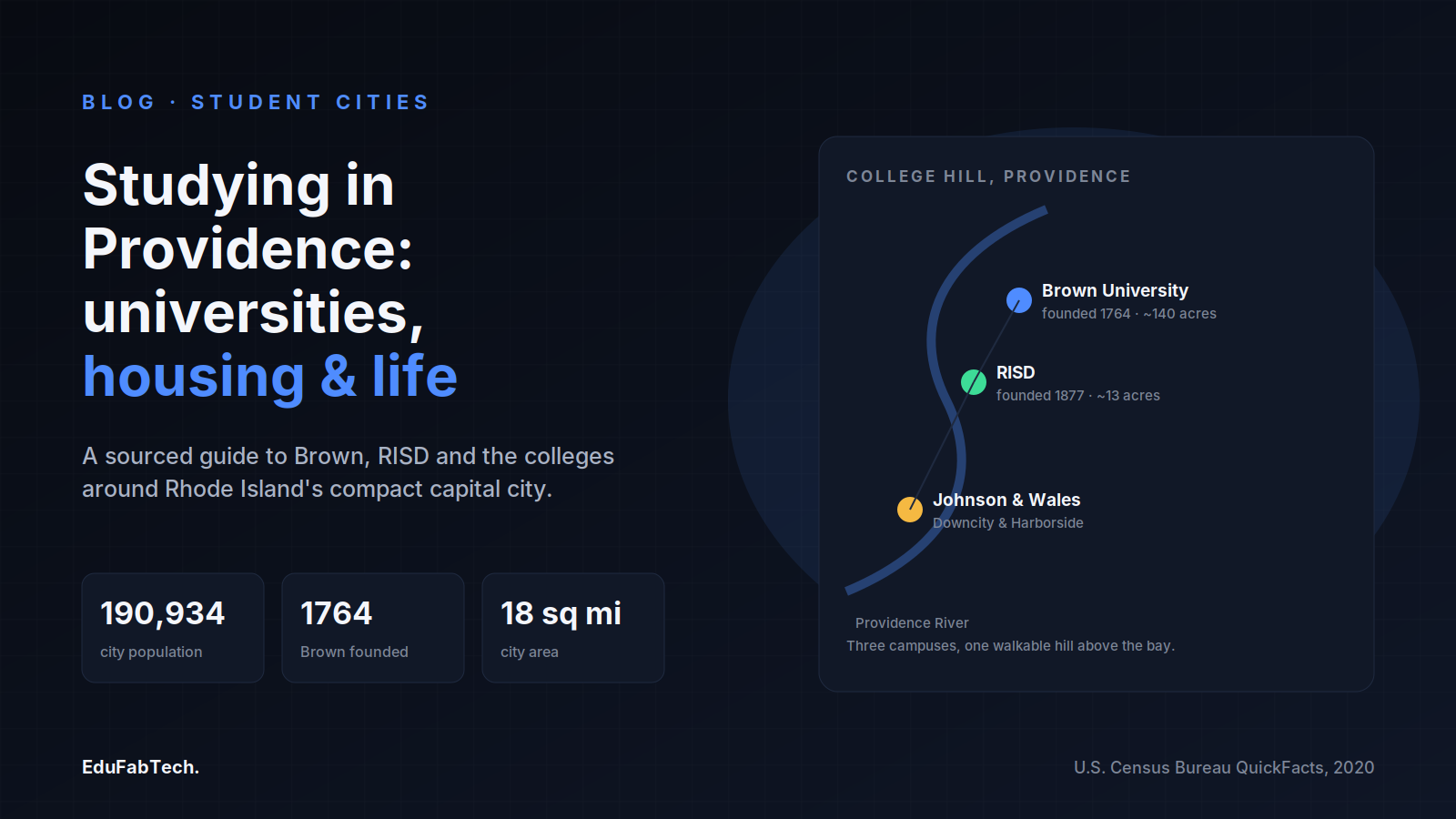
Providence is small, old and unusually dense with students. The U.S. Census Bureau's QuickFacts recorded a city population of 190,934 at the 2020 Census, spread across roughly eighteen square miles at the head of Narragansett Bay. Into that compact footprint are packed an Ivy League research university, one of the world's best-known art and design schools, a culinary and hospitality university, and — within a short bus or train ride — several more colleges across the Rhode Island and Massachusetts state line. For a city you can cross on foot in an afternoon, the concentration of lecture halls, studios and libraries is remarkable.
That scale shapes everything about student life here. Rents are lower than in nearby Boston but have climbed; neighbourhoods change character within a few blocks; the hills are real and the winters are long. This guide walks through the universities, the districts students actually live in, how to find a room without being cheated, what things cost where a figure can be sourced, and the honest pros and cons of the place.
A note on geography that newcomers find confusing: several institutions carry a nearby town's name or sit just outside the city line, while others that sound suburban are in fact inside Providence. The sections below say where each campus really is, verified against each university's own pages.
The universities on and around College Hill
Brown University is the anchor. Founded in 1764, it is one of the oldest universities in the United States and sits on the East Side of Providence in the College Hill neighbourhood, its brick quadrangles and greens spread across roughly 140 acres above the Providence River. Brown is known for its "open curriculum," which lets undergraduates design much of their own course of study, and for research strength across the sciences, humanities and medicine. Two units named separately on many lists are part of the same institution on the same hill: the Brown University Graduate School coordinates its master's and doctoral programmes, while the Brown University School of Public Health, founded as an independent school in 2013, occupies a building on South Main Street a short walk downhill from the central campus.
Sharing the top of College Hill — the two campuses interleave so closely that visitors rarely notice the boundary — is the Rhode Island School of Design, or RISD. Founded in 1877, it is an art and design college on a dense urban campus of about thirteen acres that tumbles down the hill toward the river, mixing nineteenth-century mill-style buildings with modern studios. RISD runs a well-regarded museum open to the public and cross-registration with Brown, so a student can study at one and take courses at the other.
Down in the centre of the city, Johnson & Wales University, Providence occupies several blocks of Downcity plus a second, quieter Harborside campus overlooking the bay. Founded in 1914, it is best known for culinary arts, hospitality, business and health, built around hands-on, career-focused teaching; it has consolidated in recent years to two residential campuses, Providence and Charlotte. For a student, the practical point is that three very different institutions — a research university, an art school and a career-focused university — all sit within walking distance of one another and of downtown.
Campuses across the city and nearby towns
Several campuses that recruit Providence students, or that the city claims as its own, sit outside the central College Hill cluster — some still inside the city, some in surrounding towns close enough to matter but far enough to change your commute. Providence College, despite its name, is in the city's Elmhurst neighbourhood (not the separate town of North Providence); it is a Catholic university run by the Dominican order, with a campus of about 105 acres and roughly 5,000 students. Rhode Island College, the state's oldest public higher-education institution (founded 1854), sits a little to the west in the Mount Pleasant section of Providence on a 180-acre campus and serves a large, substantially commuter student body.
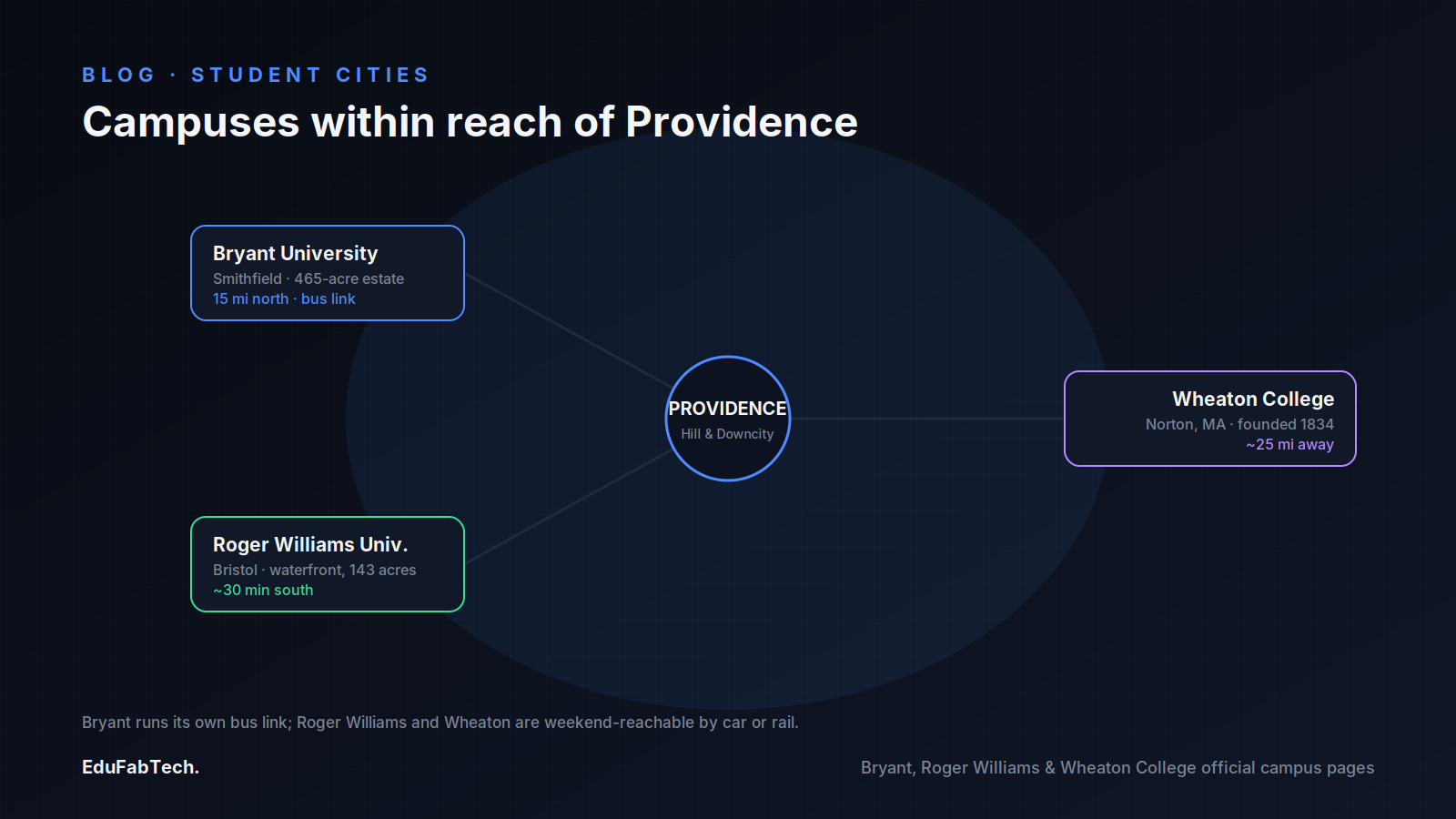
Further out, Bryant University is in Smithfield, about fifteen miles north of the city on a 465-acre former estate, strong in business and health sciences; it runs a bus link to Providence. Roger Williams University is on the water in Bristol, roughly half an hour south, a waterfront campus of about 143 acres known for architecture, marine science, law and historic preservation. Across the state line in Norton, Massachusetts — about 25 miles away — is Wheaton College, a liberal arts college founded in 1834 with around 1,750 students. These are realistic options for someone who wants a greener campus but still wants to reach Providence on weekends.
Other institutions on the record
A few names that circulate on local lists deserve a true line each. The Bradford Durfee College of Technology in Fall River, Massachusetts, no longer exists as such: it merged in 1960 with the New Bedford Institute of Technology into what eventually became today's University of Massachusetts Dartmouth, so a student cannot enrol in it today. Saint Paul School in Cranston is a Pre-K–8 Catholic elementary school, not a college — worth noting only so you are not misled by the name. And just over the Massachusetts line, Dean College in Franklin is a small private college with a strong performing-arts tradition, reachable from Providence by regional rail. If you are weighing a campus, always confirm programmes and location on the institution's own site rather than on aggregator pages.
Where students actually live
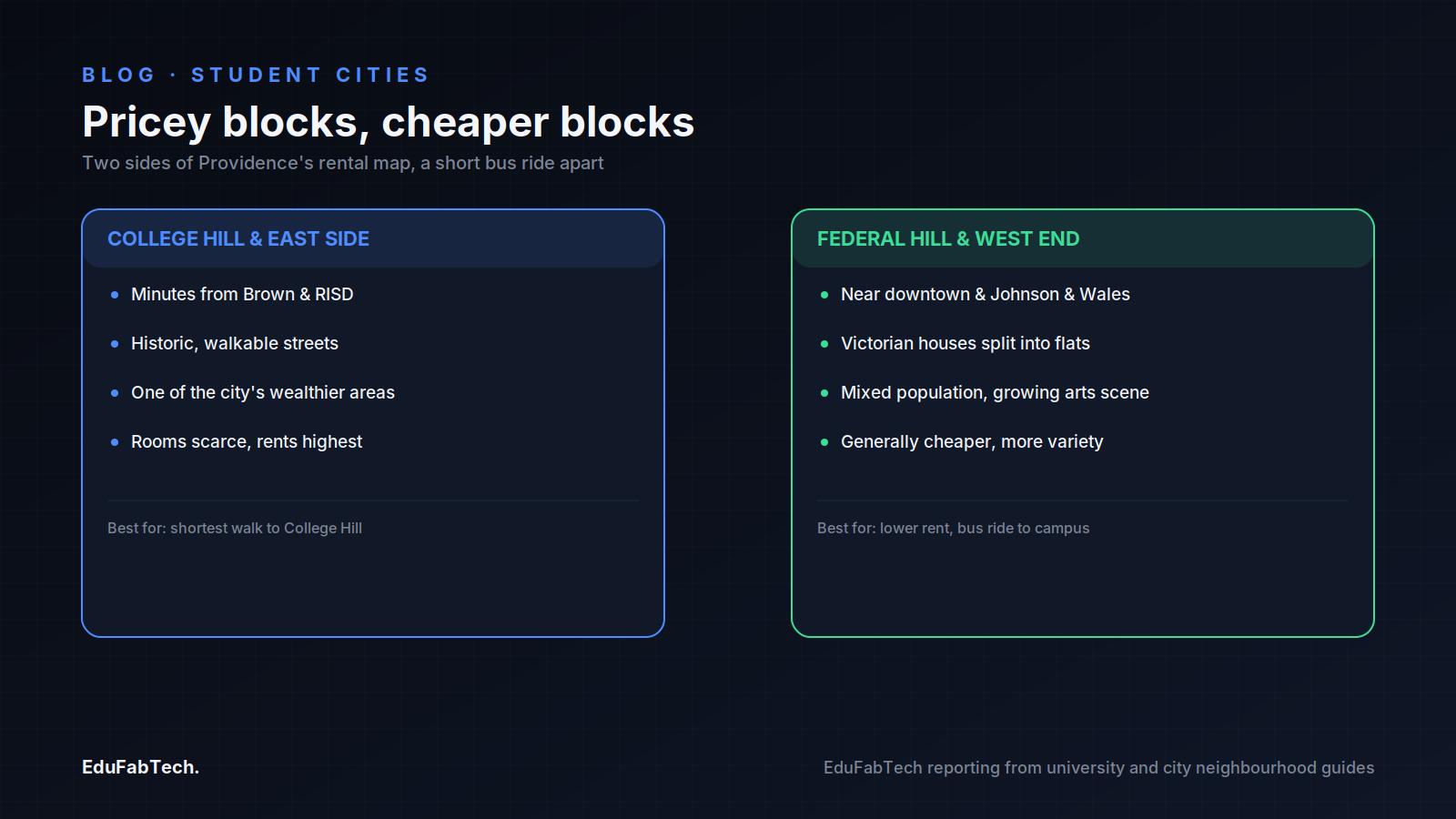
College Hill and Fox Point form the obvious centre of gravity for Brown and RISD students. College Hill is historic, walkable and one of the city's wealthier districts, which keeps rents high and rooms scarce; Fox Point, just downhill toward the river and the bay, has a Portuguese-American heritage, a mix of students and long-time residents, and slightly more variety in price. Both put you minutes from the two campuses on foot.
The East Side and Wayland Square extend north and east from College Hill — leafy, quieter, family-oriented streets around Hope Street and Blackstone Boulevard. It is pleasant and safe-feeling but among the pricier parts of the city, and better suited to graduate students or those sharing a house than to anyone on the tightest budget.
Federal Hill and the West End sit on the other side of downtown. Federal Hill is the city's famous Italian-American dining district, lively and central; the adjoining West End and Armory District are more mixed and generally cheaper, with big Victorian houses carved into flats, a diverse population and a growing arts scene. Both are a reasonable bus ride or bike from Downcity and Johnson & Wales.
Elmhurst, Smith Hill and Mount Pleasant are the natural catchment for Providence College and Rhode Island College. Elmhurst is residential and close to Providence College; Smith Hill, between the campus and the State House, is more working-class and central; Mount Pleasant surrounds Rhode Island College with modest single- and multi-family homes. Rents here tend to be lower than on the East Side, with the trade-off of a longer trip to the Brown/RISD side of the city.
Wherever you look, start early. The academic-year leases in the student districts turn over fast, and the best-value rooms near College Hill are often spoken for months ahead. You can browse what is currently available across the city on EduFabTech's Providence rooms listings, or narrow the search to rooms near Brown University.
Finding a room without being scammed
The housing stock here is mostly old wooden "triple-deckers" — three-storey houses split into flats — so condition varies enormously from one address to the next. Before you commit, see the actual room (in person, or on a live video call if you are still abroad), ask what heating costs over a Rhode Island winter, check for damp and working smoke detectors, read the full lease, and find out who is responsible for snow clearing. Get every promise in writing.
On scams, be blunt with yourself. Never send money to "hold" a room you have not seen, and never pay a deposit or first month by bank wire, gift card or cryptocurrency — those payments are effectively impossible to recover, and that is exactly why fraudsters demand them. A listing priced well below everything comparable, a "landlord" who is conveniently overseas and cannot show you in, and pressure to pay immediately are the classic warning signs. A genuine landlord or university-affiliated housing office will let you view the place and sign a proper lease before any money changes hands. If something feels rushed, walk away.
Furnishing a room cheaply, and the city's markets
Providence is a good city for second-hand furnishing, partly because thousands of students move out every spring and leave usable things behind. The Providence Flea is the best-known vintage-and-maker market, running outdoors along the downtown riverfront on summer Sundays and moving indoors to the Farm Fresh Rhode Island market hall in the colder months — good for housewares, furniture and the small things that make a rented room liveable. For food and fresh produce, the Hope Street Farmers Market in Lippitt Memorial Park on the East Side is the largest in the state, running Saturday mornings in the warmer half of the year, with a Thursday counterpart at Armory Park. For everyday second-hand goods, the city has the usual spread of charity and thrift shops. EduFabTech also lists local second-hand things and items people are giving away free in Providence — the free pile peaks around move-out in May and move-in in late August.
Working, money and getting around
International students should understand the rules before taking any job, and should treat the official guidance — not advice from friends — as the authority. For students in F-1 status, the United States federal immigration authorities state that on-campus work is capped at 20 hours per week while school is in session, with full-time work permitted during official breaks; off-campus work generally requires specific authorisation such as curricular or optional practical training. Read the official overview of students and employment and always confirm your own situation with your university's international-student office. Nothing here is legal advice. When you are ready to look, local openings are collected on EduFabTech's Providence jobs page.
Getting around is where Providence rewards students. The Rhode Island Public Transit Authority runs the bus network, and several universities participate in its U-Pass programme: students at Brown, Providence College and Rhode Island College, among others, can ride the buses across the state for free by showing their university ID. That turns the whole small state into commuting distance. Within College Hill and downtown, most students simply walk or cycle; the hill is steep, so a bike with low gears earns its keep. Intercity trains from the downtown station reach Boston and beyond for weekend trips.
On costs, use sourced figures and treat the rest as relative. The U.S. Census Bureau's QuickFacts give a median gross rent of US$1,408 for Providence across 2020–2024 — a citywide median for all housing, so a shared student room can be well below it and a one-bedroom near College Hill well above. Expect the East Side and College Hill to sit at the top of the range, and Smith Hill, the West End and Mount Pleasant toward the more affordable end.
Libraries and places to study
Study space is one of Providence's quiet strengths. Brown's main humanities and social-sciences library, the John D. Rockefeller Jr. Library — universally called "the Rock" — anchors the campus alongside the John Hay Library for special collections and the sciences library; access to these is generally limited to current Brown and RISD ID holders, and RISD students study in its own Fleet Library. For everyone else, the Providence Public Library downtown on Empire Street is a genuinely public, historic building with reading rooms, study desks and events, open to all. Add in café study culture across Federal Hill, Fox Point and the West End, and you are rarely far from somewhere to work. EduFabTech also lists bookable desks and study spaces around the city.
The honest trade-offs
What is good about Providence for students is real: it is compact and walkable, academically dense far beyond its size, cheaper than Boston or New York, strong on food and the arts, and — thanks to the U-Pass — cheap to get around. The city has a creative, slightly offbeat character that suits art and design students especially well.
What is hard is equally real. Housing is older stock in variable condition, and good rooms near the campuses are tight and go early. The winters are long and grey: the NOAA State Climate Summary (2022) notes that Rhode Island's statewide average precipitation is about 46 inches a year with substantial winter snow, and that temperatures have risen almost 4°F since the start of the twentieth century — warmer summers, but still a real New England winter to budget clothing and heating for. The hills make cycling a workout, bus frequency outside peak routes can be thin, and the gap between the wealthy East Side and poorer districts is visible street to street. None of this is a reason to stay away; it is a reason to choose your neighbourhood deliberately and start your housing search early.
A checklist for the first weeks
- Confirm your room by viewing it in person or on live video, sign a written lease, and never wire a deposit or pay by gift card or crypto to hold an unseen room.
- Get your university ID and, if your institution participates, activate your U-Pass so bus travel is free from day one.
- If you are an international student, meet your international-student office early and read the official employment guidance before accepting any work.
- Furnish from the free and second-hand listings and the Providence Flea rather than buying new.
- Find your study base — the Rock or your campus library if you have access, the Providence Public Library if not — in week one.
- Walk your neighbourhood and the route to campus before term starts so the hills and bus stops hold no surprises.
A quick question for readers
What is your biggest monthly expense as a student?
Knowing where the money really goes helps new students plan. Your answer helps someone budget.
Pick an answer, create a free account in a minute, and your vote counts. Already a member? Sign in
- U.S. Census Bureau. QuickFacts: Providence city, Rhode Island. U.S. Census Bureau, 2024. link
- Kunkel, K. E. et al.. Rhode Island State Climate Summary 2022. NOAA National Centers for Environmental Information / NCICS, 2022. link
- U.S. Immigration and Customs Enforcement. Student and Exchange Visitor Program: Employment. U.S. Department of Homeland Security, 2024. link
- U.S. Citizenship and Immigration Services. Students and Employment. U.S. Department of Homeland Security, 2024. link
- Rhode Island Public Transit Authority. Students (U-Pass). RIPTA, 2026. link