Studying in Provo: universities, housing and student life
A practical, honest guide to studying in Provo, Utah — its universities, the BYU housing contract that shapes where single students live, part-time work, study spaces, transport and what things cost.
A valley town hemmed in by a lake and a mountain wall
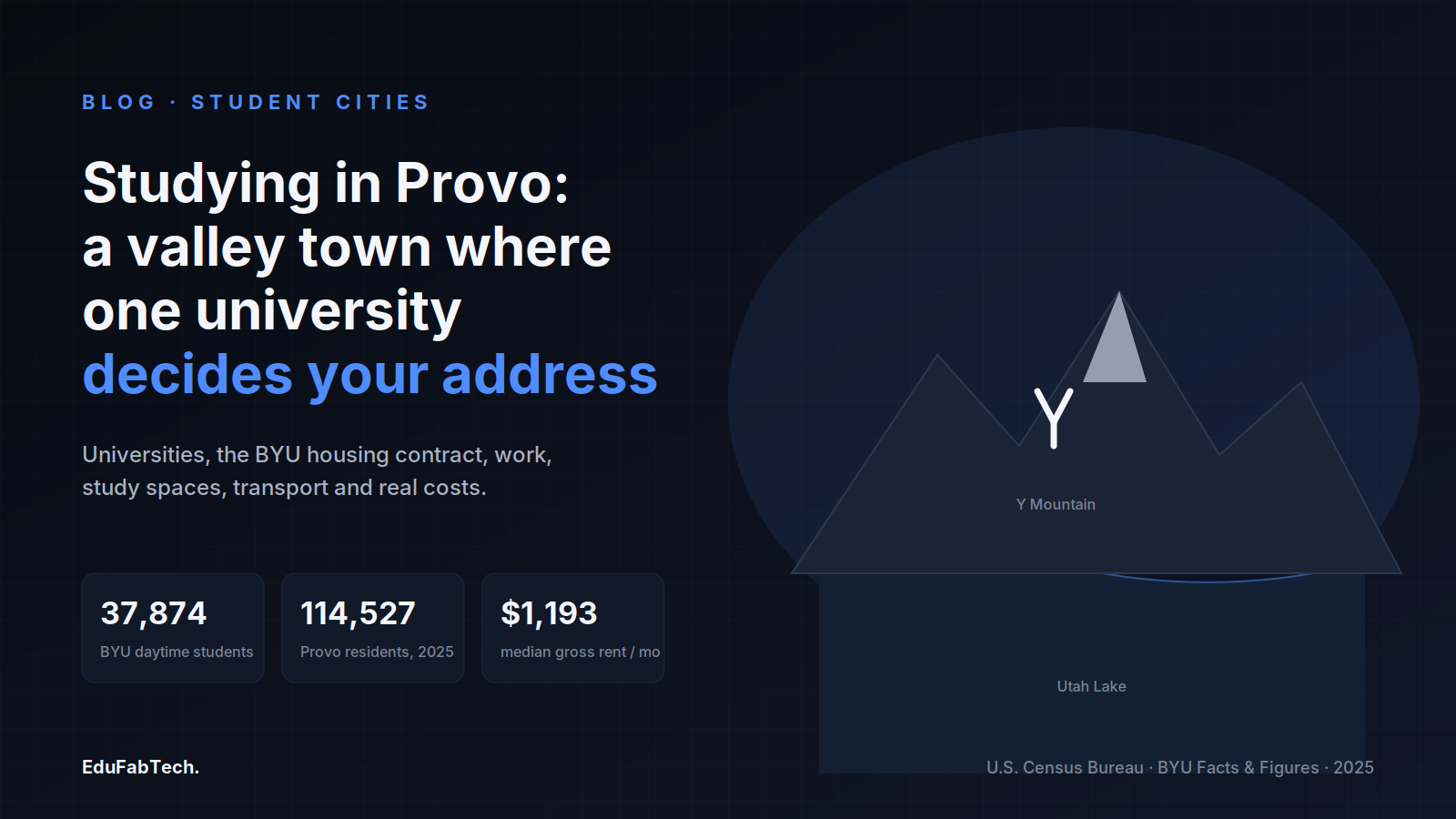
Provo lies in a narrow strip of Utah County, pinned between the shallow, windy expanse of Utah Lake to the west and the near-vertical face of the Wasatch Range to the east. The city's grid is numbered outward from the old centre, so an address like "900 East 700 North" is also a set of directions, and the whitewashed "Y" on the flank of Y Mountain is visible from most of town. According to U.S. Census Bureau QuickFacts, Provo had an estimated 114,527 residents as of 1 July 2025 (census.gov/quickfacts), which makes it mid-sized on paper but unusually young in practice, because a single institution dominates it.
That institution is Brigham Young University, owned by The Church of Jesus Christ of Latter-day Saints, and its culture sets the tone of the city: alcohol is scarce, most businesses close on Sundays, and a large share of students are returned missionaries in their twenties who are married or marrying. Downtown, along Center Street and University Avenue, sits a small restored core of brick storefronts, a performing-arts centre and the county courthouse; east and north of it the blocks fill with low apartment buildings packed with students. Provo also sits at the southern end of Utah's "Silicon Slopes" technology corridor and was one of the first U.S. cities wired for Google Fiber, so a startup-and-software undercurrent runs beneath the campus town.
For a student, the thing to understand first is that where you can live, and for how long on what terms, is partly decided by the university rather than the open market. The rest of this guide works outward from that fact — the campuses, the housing system, furnishing a room, working, studying, getting around, and the honest balance of what is good and what is hard. You can browse local listings on EduFabTech's Provo city page as you read.
The campuses: Brigham Young University and its neighbours
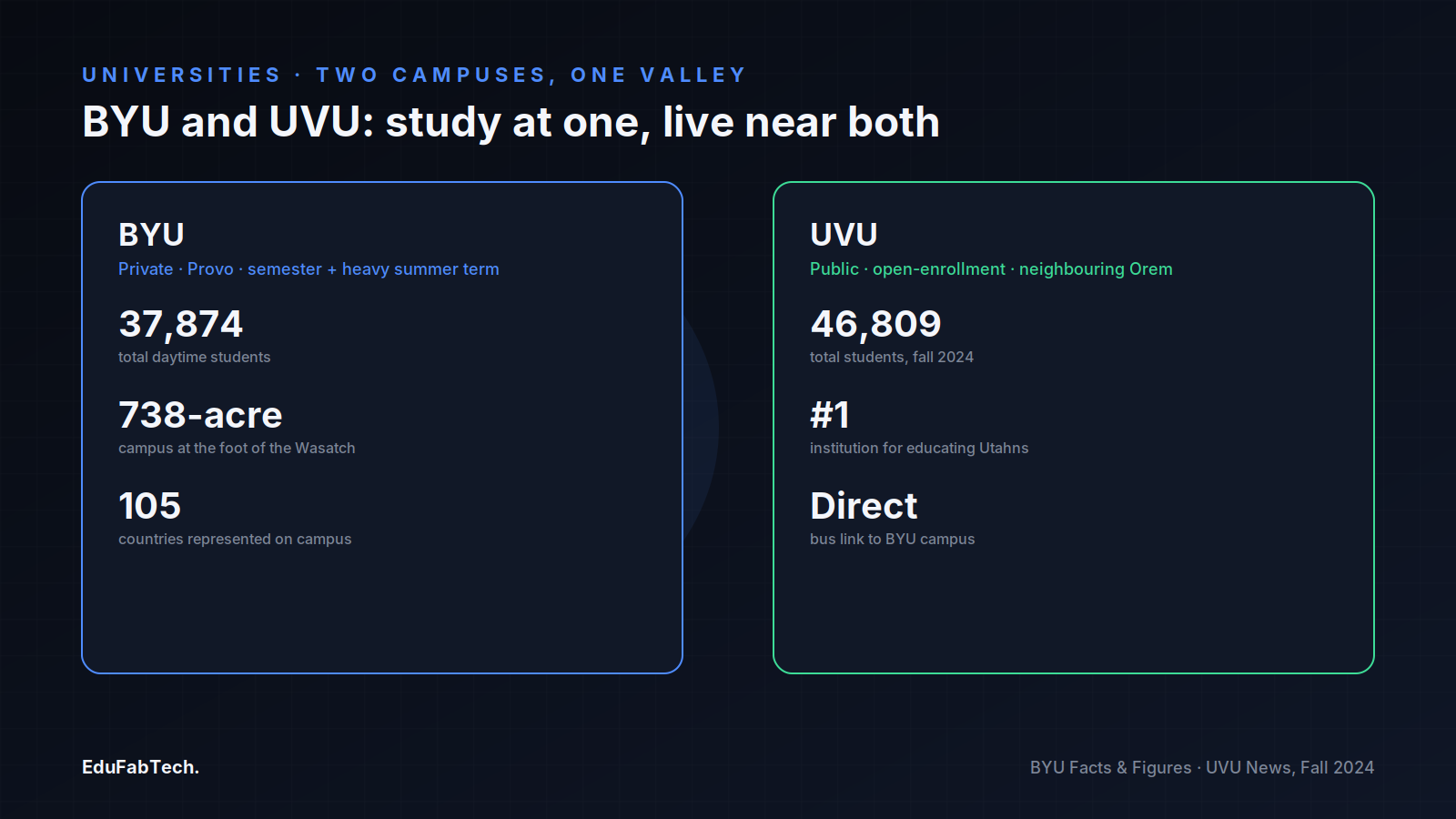
Brigham Young University's own facts page lists 37,874 total daytime students on a 738-acre campus at the foot of the Wasatch, with students from 105 countries and every U.S. state (byu.edu/facts-figures). It is primarily an undergraduate university, strong in business, engineering, law and the humanities, and it runs on a semester calendar with a heavy summer "Spring/Summer" term that empties and refills much of the student housing stock. Within BYU's Marriott School of Business, the BYU School of Accountancy grants undergraduate and graduate accounting degrees, including the Master of Accountancy, and is one of the programmes the university is best known for.
Provo also hosts two specialised health-science institutions. Rocky Mountain University of Health Professions is a graduate-level healthcare university headquartered in Provo that grants doctoral and master's degrees in fields such as physical therapy, occupational therapy, speech-language pathology and nursing (rm.edu/about). Noorda College of Osteopathic Medicine, on a campus in south Provo between the lake and the mountains, was established in 2019 according to the American Association of Colleges of Osteopathic Medicine and grants the Doctor of Osteopathic Medicine (DO) degree (aacom.org); it enrolled its first class in 2021. Both are small and graduate-focused, so their students fold into the city's rental market rather than into undergraduate dorms.
The campus most students will encounter next is in the neighbouring city of Orem. Utah Valley University is a large open-enrolment public university; it reported a record 46,809 total students in fall 2024, which it said made it the institution educating the most Utahns (uvu.edu news). Many people in the valley study at one institution and work, worship or shop near the other, and the two campuses are directly linked by bus, so it is worth knowing both even if you are enrolled at only one.
Studying here, especially at BYU, comes with an Honor Code that governs dress, conduct and housing, and most students sign an ecclesiastical endorsement. That shapes daily life well beyond the classroom, which is why housing in Provo is not quite like housing in any secular college town.
Housing: the contract that decides where single students live
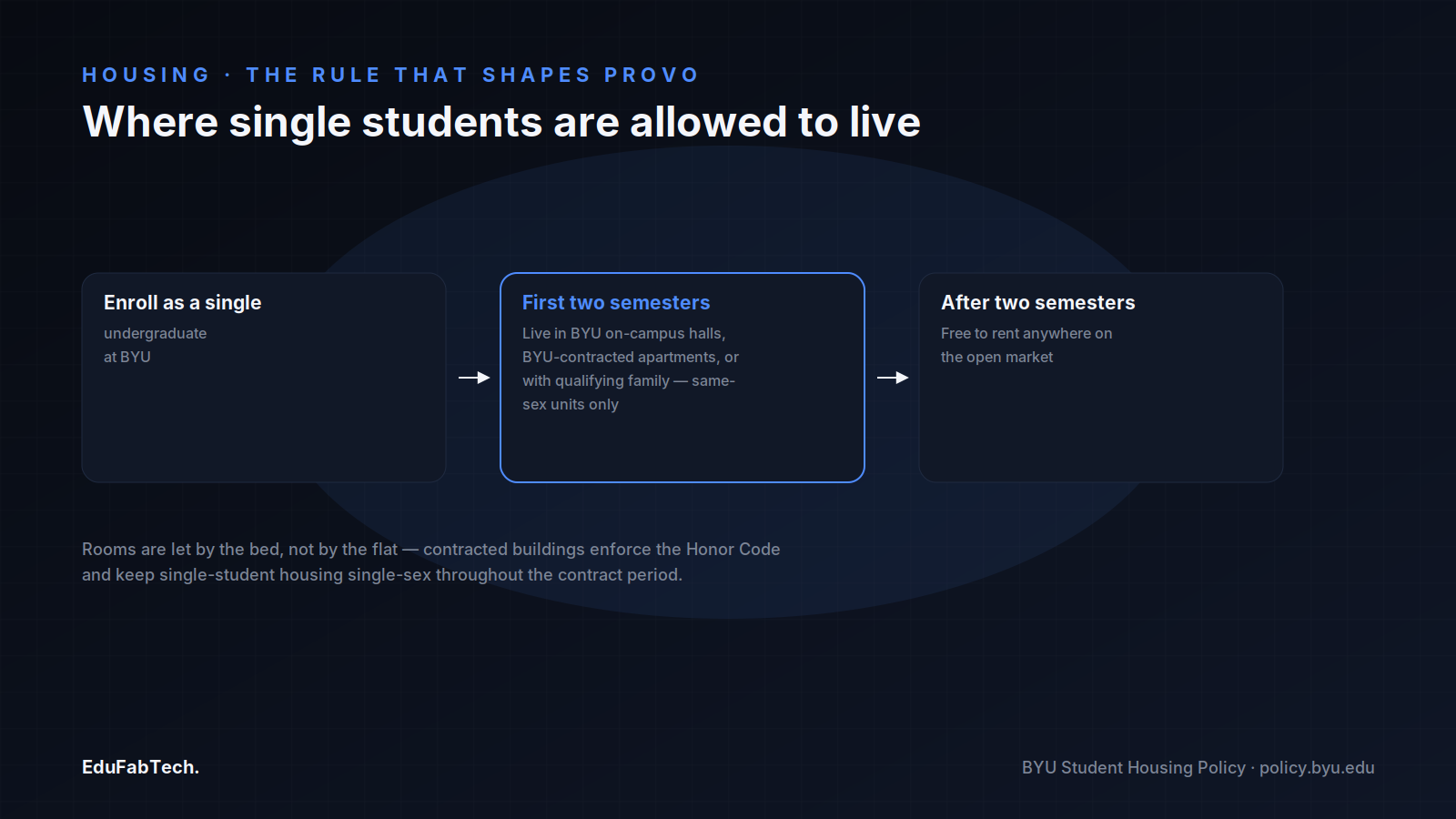
BYU's Student Housing Policy states that "for their first two semesters as a BYU student, all single undergraduate students must live (1) in BYU on-campus housing, (2) in BYU off-campus contracted housing, or (3) with qualifying family members," and that single students not living with family "are required to live in dwelling units only with persons who are the same sex as the student" (policy.byu.edu). In practice this means new single undergraduates choose between the on-campus halls — Helaman Halls and Heritage Halls, plus Wyview Park and other complexes listed on BYU's housing site — and a set of privately owned but BYU-contracted apartment buildings that agree to keep buildings single-sex and enforce the Honor Code. After those first two semesters you may rent anywhere.
Geographically, most single-student housing clusters in the Joaquin neighbourhood immediately north and west of campus, a dense grid of apartment blocks within walking distance of the quad; married and graduate students spread into quieter parts of north and south Provo and across into Orem. Rooms are usually let by the bed — you contract for a spot in a shared room, not a whole flat — and because of the heavy summer term, contracts are often sold and sublet between terms. Start looking early: for fall, serious searching in spring is normal, and the best-located contracted spots go first.
Scams in Provo tend to exploit exactly this contract-and-sublet system. The common traps are fake listings for "BYU-contracted" apartments that are not actually on the university's contracted list, and summer-sublet offers that demand money before you have seen anything. Before you pay, confirm a complex's contracted status through BYU's off-campus housing office, see the unit in person or on a live video walk-through, and read the actual contract. A deposit plus a month's rent is normal locally; never send a deposit by bank wire, gift card or cryptocurrency to "hold" a room or a contract — legitimate Provo landlords and contracted complexes do not ask for that. EduFabTech's Provo rooms page is a starting point, not a substitute for seeing a place.
For a dated market figure, the U.S. Census Bureau's 2020–2024 American Community Survey estimates put Provo's median gross rent at $1,193 a month (census.gov/quickfacts). A shared bed in student housing generally costs less than that per person because the rent is split across a room; whole-apartment rents for families or groups run well above it. BYU publishes current dormitory rates on its housing site, so check those directly rather than relying on a figure you read second-hand.
Furnishing a room without overspending
Because beds turn over every term, Provo has a lively second-hand economy. The LDS Church runs Deseret Industries thrift stores in the valley, which are among the largest sources of cheap furniture, kitchenware and clothing, and the end of each semester floods local giveaway channels with desks, mattresses and microwaves as students clear out. For produce and local makers, the Provo Farmers Market runs on Saturday mornings from June through October at Pioneer Park, 500 West Center Street, and is free to wander. Plan your furnishing around move-out weekends in April and August, when supply is highest and prices lowest. EduFabTech keeps Provo pages for second-hand things and used furniture, and it is often cheaper to collect a desk someone is leaving behind than to buy one.
Working while you study
For international students, work is tightly regulated and the rules are federal, not local. The U.S. Department of Homeland Security's Study in the States guidance states that an F-1 student "may not work more than 20 hours per week when school is in session" in on-campus employment (studyinthestates.dhs.gov). Off-campus work, and training options such as Curricular Practical Training and Optional Practical Training, carry their own conditions and authorisations; this is not legal advice, and you should confirm your own situation with your institution's international student office and the official DHS pages before accepting any job. Domestic students face no such cap, and the campuses, the technology firms along the corridor and downtown service jobs are the usual sources. EduFabTech lists local openings on its Provo jobs page.
Where to study: the Lee Library and Academy Square
BYU's Harold B. Lee Library is the main study building on campus and keeps long hours — Monday to Friday 7:00 a.m. to 11:45 p.m. and Saturday 8:00 a.m. to 11:45 p.m., closed Sunday, per the library's hours page (byu.libcal.com/hours). It holds reservable group and single-user study rooms alongside large open reading floors. Off campus, the Provo City Library at Academy Square, 550 N. University Avenue, is open to anyone, Monday to Friday 9:00 a.m. to 9:00 p.m. and Saturday 9:00 a.m. to 6:00 p.m. (provolibrary.gov), with free study rooms and public computers in a restored historic academy building — a useful alternative on Sundays and for students not enrolled at BYU. More desks and quiet spaces are collected on EduFabTech's Provo study-spaces page.
Getting around: UVX, FrontRunner and a walkable grid
Public transport in the valley is run by the Utah Transit Authority. Its flagship line for students is the Utah Valley Express (UVX), a bus-rapid-transit route that connects BYU, downtown Provo, Utah Valley University in Orem and the FrontRunner commuter-rail station with frequent dedicated-lane service. UTA began charging a regular fare of $2.50 on UVX from 18 August 2024, but notes that "the majority of riders are BYU and UVU students, staff, and employees, who will still be able to ride at no cost with their student or staff ID" (rideuta.com). FrontRunner links Provo northward through the valley toward Salt Lake City for day trips and the airport corridor. Within Provo itself the flat, numbered grid around campus is genuinely walkable and bikeable, which is why many single students manage without a car.
Costs, and what is genuinely hard
The good side of Provo is real: housing is comparatively cheap for the United States, with a Census-estimated median gross rent of $1,193 a month (2020–2024, census.gov/quickfacts); the UVX makes a car optional for campus life; the setting against the Wasatch is spectacular, with canyon trails and skiing within a short drive; and the student second-hand economy keeps setup costs low. The U.S. Census Bureau also estimated Provo's 2020–2024 median household income at $64,171, a reminder that this is not a high-wage city, which keeps some prices modest but also caps part-time pay.
The hard parts are equally real. The housing contract system, single-sex buildings and Honor Code mean your choices are narrower than in a secular college town, which newcomers — especially international and non-LDS students — should weigh honestly before committing. Sunday closures and limited nightlife suit some students and frustrate others. The valley's air can stagnate in winter "inversions" that trap pollution against the mountains, and summers are hot and dry. And the per-bed contract market, with its summer churn, is where most rental trouble starts, so the caution above is worth repeating.
A checklist for the first weeks
- If you are a single BYU undergraduate, confirm whether a prospective apartment is actually BYU-contracted via the university's off-campus housing office before signing (policy.byu.edu).
- See any room in person or by live video before paying; expect a deposit plus first month, and never wire money or pay by gift card or crypto to "hold" a place.
- Load your UVX/UTA pass onto your student or staff ID so you ride free (rideuta.com).
- If you are on an F-1 visa, check on-campus work limits and any training authorisation with your international office and DHS before taking a job (studyinthestates.dhs.gov).
- Furnish from Deseret Industries, the Saturday Provo Farmers Market and end-of-term giveaways rather than buying new — see EduFabTech's second-hand and furniture pages.
- Scout study spots early: the Harold B. Lee Library on campus (byu.libcal.com/hours) and the Provo City Library for Sundays and non-BYU students.
A quick question for readers
Do you work part-time while you study?
Many students work to pay the bills. See how common it is — and how many hours people really do.
Pick an answer, create a free account in a minute, and your vote counts. Already a member? Sign in
Source: Brigham Young University
Sources (5)
- Brigham Young University. Facts & Figures. Brigham Young University, 2026. byu.edu ↗ · checked 5 Oct 2026
- Utah Transit Authority. Utah Valley Express (UVX). Utah Transit Authority, 2024. rideuta.com ↗ · checked 5 Oct 2026
- U.S. Department of Homeland Security. Working in the United States — F-1 students. Study in the States (DHS), 2024. studyinthestates.dhs.gov ↗ · checked 5 Oct 2026
- U.S. Census Bureau. QuickFacts: Provo city, Utah. U.S. Census Bureau, 2025. census.gov ↗ · checked 5 Oct 2026
- Brigham Young University. Student Housing Policy. Brigham Young University, 2026. policy.byu.edu ↗ · checked 5 Oct 2026