Studying in Pullman: Washington State University, housing and student life
A practical, honest guide to studying in Pullman, Washington — its universities, where students live, what a room costs in 2026-27, work rules, libraries and getting around the Palouse.
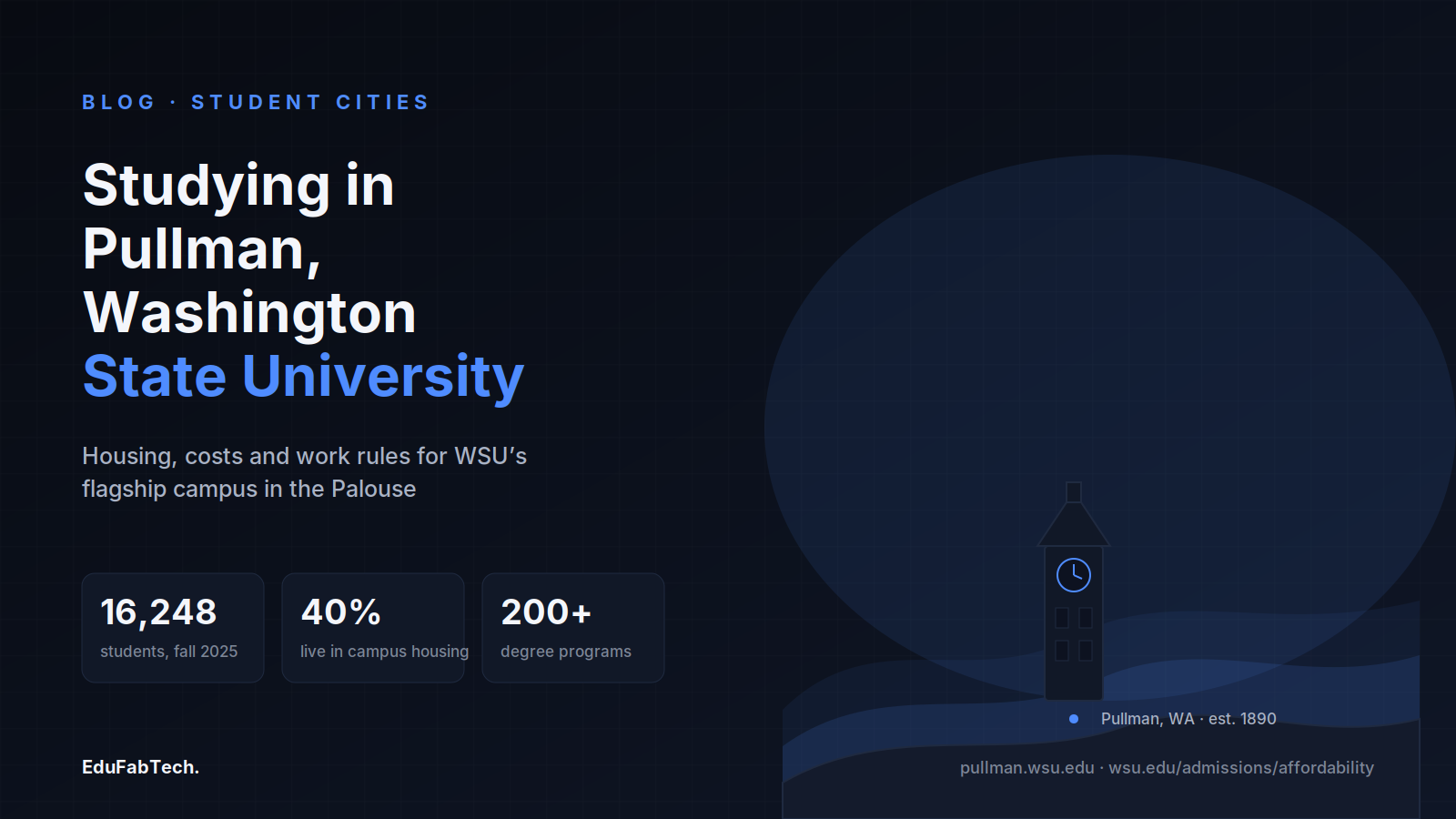
Pullman is a town shaped almost entirely by one institution. It sits in the Palouse, the rolling wheat-and-lentil country of southeastern Washington, close to the Idaho state line and a short drive from Moscow, Idaho. For most people who arrive here, the reason is Washington State University, whose Pullman campus is described by the university as its oldest and largest, home to 16,248 students as of fall 2025, on a classic college-town setting with more than 200 undergraduate, graduate and professional degree programs (pullman.wsu.edu).
That ratio of students to town is the single fact that explains everyday life here. Classrooms, housing, buses, cafés and the rhythm of the year all move with the academic calendar. This guide covers the universities, where students actually find rooms, how to avoid losing a deposit, furnishing a room cheaply, work rules, libraries and transport, what it costs in 2026-27, and the genuine upsides and drawbacks of studying in a remote town built around a campus.
Pullman is not a city with a student quarter tucked inside it; it is closer to the reverse. WSU rises on the hills above the small downtown, and when the semester ends the population drops noticeably. If you want anonymity in a big metropolis, this is not that. If you want a walkable campus where you will keep running into the same people, it is.
The universities, and what studying here is like
Washington State University was founded in 1890 and runs a six-campus system in which Pullman is the flagship residential campus (wsu.edu/about). The teams are the Cougars, and game weekends reorganise the whole town. As Washington's land-grant university, some of its strongest programs are in agriculture, veterinary medicine and the sciences, alongside a broad spread of liberal arts, business and engineering.
Two WSU units are worth naming for students who come specifically for them. The Washington State University College of Veterinary Medicine, based in Pullman, grants the Doctor of Veterinary Medicine (DVM) and runs a Veterinary Teaching Hospital it describes as the leading veterinary referral centre in Washington and the Pacific Northwest, along with a diagnostic laboratory (vetmed.wsu.edu). The Washington State University College of Agricultural, Human, and Natural Resource Sciences (CAHNRS) leads the university's land-grant teaching, research and extension mission and, by its own count, offers 22 majors and 19 minors (cahnrs.wsu.edu). High-achieving undergraduates across any major can also apply to the Washington State University Honors College in Pullman.
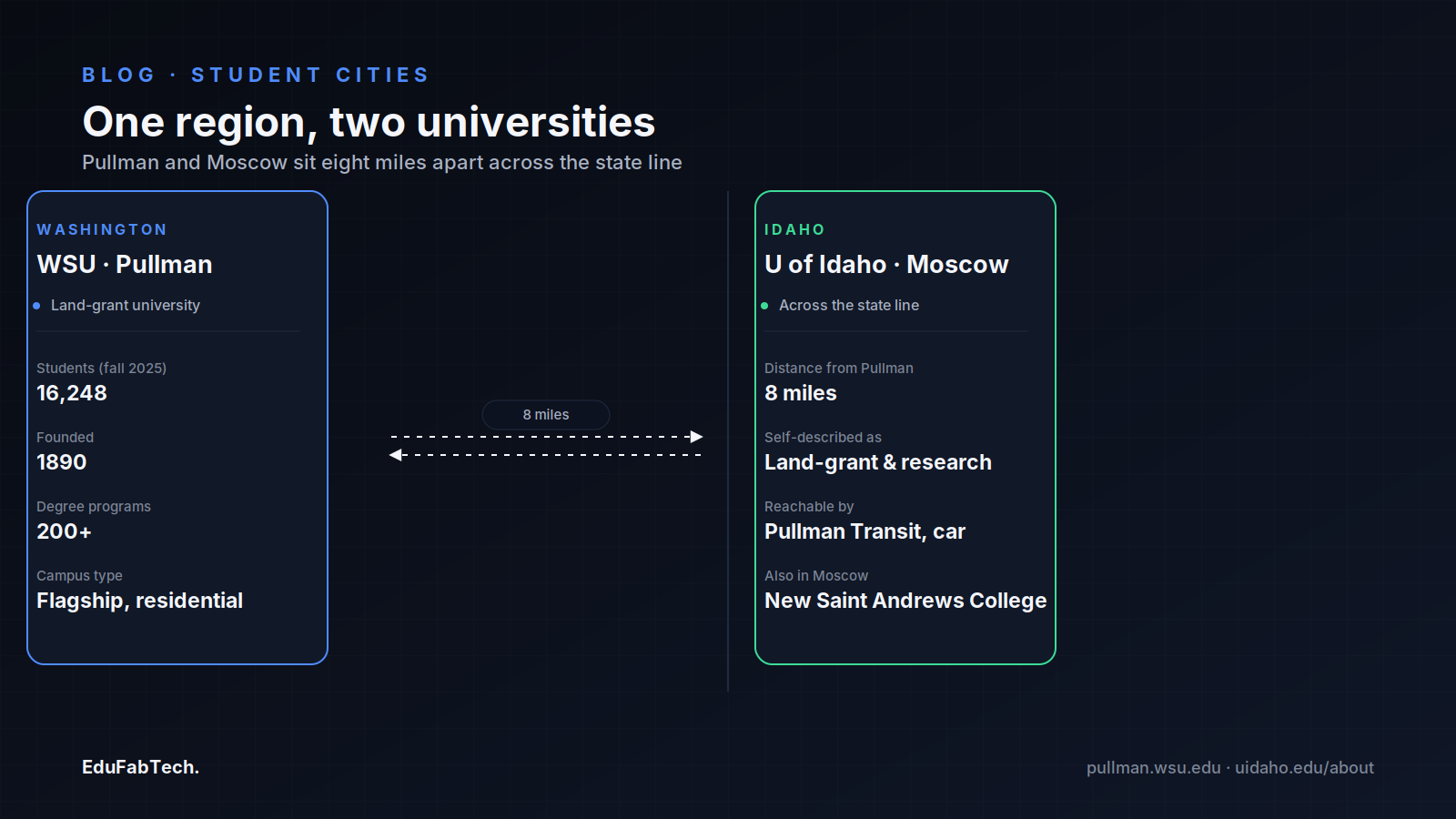
Eight miles east, across the state line in Moscow, Idaho, is the University of Idaho, which calls itself Idaho's land-grant university and research university (uidaho.edu/about). The two campuses make the Pullman–Moscow area a genuine two-university region, and students routinely cross between them for friends, events and work. Moscow also hosts the small New Saint Andrews College, a classical Christian liberal-arts college in its downtown. You can browse local listings near the Pullman campus on EduFabTech at /near/washington-state-university.
Where students live, and how the housing year works
WSU Pullman is its own largest provider of housing, and the university says about 40 percent of undergraduate students live in residence halls or university-owned apartments (pullman.wsu.edu/about). First-year undergraduates are the core of hall life; the halls sit on and just below campus, within walking distance of class. If you are arriving from abroad or from out of state and want the simplest, safest first year, a residence-hall contract removes most of the risk, because you are dealing directly with the university rather than an unknown landlord.
Off campus, the two neighbourhoods students know best are College Hill, immediately next to campus and dense with older houses split into rooms, and the flatter streets toward Military Hill and the apartment complexes along the Moscow–Pullman corridor. Leases in a college town run on the academic clock: much of the good off-campus stock for the following August is spoken for by the previous winter and spring, so the realistic time to start looking is several months ahead, not weeks. Browse what is currently listed in the city on EduFabTech at /in/united-states/pullman/rooms.
Renting off campus without losing a deposit
The scam pattern to watch for in Pullman is the one aimed at people who cannot visit first: an attractive College Hill room or corridor apartment is advertised at a suspiciously low rent, the "owner" says they are out of town, and you are asked to send money to hold it before you have seen inside. Do not. See the actual unit in person, or have someone you trust see it for you, before any money changes hands, and confirm the person collecting rent is the real landlord or management for that address. Expect a normal lease and a deposit that is roughly a month's rent, paid by a traceable method with a signed receipt — never by bank wire, gift card or cryptocurrency to "reserve" a place, because those payments cannot be recovered. International students who arrive in August with no local history are the most exposed, which is exactly why a first-year hall contract, or lining up a viewing before you fly, is worth the trouble.
Furnishing a room: Goodwill, thrift and the Wednesday market
Because the student population turns over every year, Pullman generates a steady flow of second-hand furniture and household goods, most of it cheapest at the end of spring when leases end. Goodwill Industries of the Inland Northwest runs a store on South Grand Avenue in Pullman and a separate donation drop-off nearby (discovergoodwill.org). For produce and local goods, the Pullman Farmers Market sets up on Wednesday afternoons at the Brelsford WSU Visitor Center during the warmer months, as listed by WSU (events.wsu.edu). For the rest — desks, bikes, mini-fridges, or things neighbours are giving away as they move out — EduFabTech keeps local listings at /in/united-states/pullman/second-hand.
Working while you study
WSU is the largest employer in Pullman, with about 5,000 faculty, staff and graduate assistants (pullman.wsu.edu/about/jobs), which means on-campus jobs — dining, the library system, labs, residence life — are the practical first place to look for part-time work. International students should know the rules before starting: U.S. Study in the States guidance for F-1 students states that a student in on-campus employment "may not work more than 20 hours per week when school is in session," and that the first step is to talk to your designated school official, the DSO (studyinthestates.dhs.gov). That is the authority to rely on, and your DSO at WSU's International Programs office is the person who confirms what you are allowed to do; this guide is not legal advice. Current local openings are collected at /in/united-states/pullman/jobs.
Libraries and places to study
The core study buildings are WSU's Holland and Terrell Libraries, the linked pair at the centre of campus; their opening hours change by term, so check the library's own hours page for current times before planning a late night. The Compton Union Building (the CUB) is the other main indoor spot, with lounges and group-study space that fill up on weekday afternoons. Off campus, Neill Public Library at 210 N Grand Avenue is open to the public; the City of Pullman lists its hours as Monday 10 a.m.–4 p.m., Tuesday to Friday 10 a.m.–7 p.m., and Saturday 10 a.m.–2 p.m., closed Sunday (pullman-wa.gov). More desks and quiet rooms are listed at /in/united-states/pullman/study-spaces.
Getting around
Pullman Transit is the city bus service. The City of Pullman states that WSU students, staff and faculty ride by presenting a valid WSU identification when boarding, that youth aged 18 and under ride free under a fare-free policy that began in October 2022, and that the standard adult cash fare is otherwise US$1.00 (pullman-wa.gov). For a student with a WSU card, that means the daily bus is covered by the ID rather than a per-trip cash fare. The routes are built around campus and the main apartment corridors, so a car is a convenience here rather than a necessity for day-to-day student life. The Pullman–Moscow Regional Airport sits between the two towns for longer trips, and the eight-mile link to Moscow is the other everyday journey most students make.
What it costs
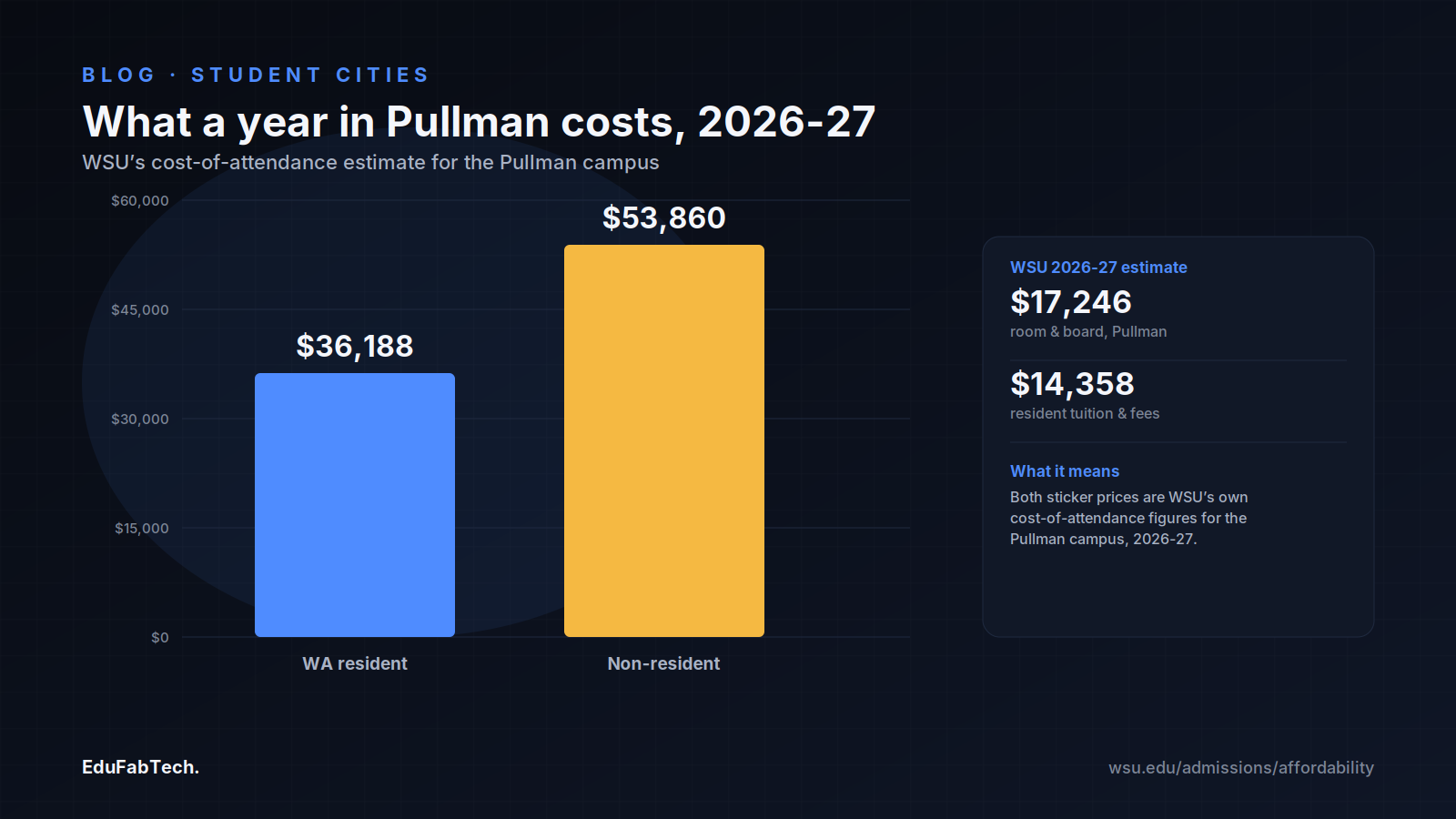
The most reliable dated housing figure comes from WSU itself: for 2026-27 the university's cost-of-attendance estimate puts room and board at Pullman at US$17,246 and tuition and fees for a Washington resident at US$14,358, for a resident "sticker price" of US$36,188 and a non-resident estimate of US$53,860 (wsu.edu/admissions/affordability). Those rates rose for 2026-27: The Daily Evergreen reported in August 2026 that the Board of Regents, meeting in November 2025, approved increases including about 4.50 percent for older residence halls and 3.29 percent for single-student apartments, alongside a 3.3 percent tuition rise (dailyevergreen.com). Renting privately can be cheaper than a hall contract if you split a house, though prices on College Hill track demand tightly. For context on the town, Census Reporter's American Community Survey 2024 five-year profile gives Pullman a population of 32,229 and a median household income of US$46,812 — a figure held down by the large share of residents who are students rather than full-time earners (censusreporter.org).
The honest trade-offs
What is good: the campus is compact and walkable, the city bus is covered by your WSU card, second-hand goods are plentiful and cheap, and the two-university Palouse gives a surprisingly full social and cultural life for a town this size. The land-grant programs, veterinary medicine and the sciences, are genuine draws. What is hard: Pullman is remote, and the nearest large airport (Spokane) is a long drive, so getting home for breaks takes planning. Winters on the Palouse are long and snowy. Housing near campus is competitive and dated, and the best off-campus rooms go early. And because the town empties with the calendar, quiet summers and holiday weeks can feel isolating if you are far from home. None of this is hidden, and knowing it before you arrive is the point.
Your first weeks: a short checklist
- If it is your first year, confirm your residence-hall contract through WSU Housing rather than chasing a private room sight unseen.
- Get your WSU ID card early — it is what lets you ride Pullman Transit by showing it rather than paying a cash fare.
- International students: meet your DSO at WSU International Programs before taking any job, and confirm the 20-hour on-campus limit applies to you.
- If you are renting off campus, view the actual unit before paying, verify the landlord, and never wire, gift-card or crypto a deposit to hold a place.
- Furnish from Goodwill on South Grand Avenue and from end-of-lease giveaways before buying new.
- Learn your bus route to campus and the apartment corridors, and note Neill Public Library and the CUB as back-up study spots when Holland and Terrell are full.
- Browse upcoming local events at /in/united-states/pullman/events to meet people in your first fortnight.
A quick question for readers
Do you work part-time while you study?
Many students work to pay the bills. See how common it is — and how many hours people really do.
Pick an answer, create a free account in a minute, and your vote counts. Already a member? Sign in
Comments 2
Comment-
Sticker price is doing a lot of heavy lifting in the cost section here. $36,188 for residents and $53,860 for non-residents are WSU's own pu…
-
The median household income of $46,812 next to the $17,246 room-and-board figure is a strange pairing to even include, and the piece itself…
Join free to read the full comments and reply Comments are between members; an account takes a minute.
Source: Washington State University
Sources (5)
- Washington State University. Affordability: Cost of Attendance 2026–27. Washington State University, 2026. wsu.edu ↗ · checked 4 Nov 2026
- Christopher Henderson. Tuition rates soar — among other fees. The Daily Evergreen, 2026. dailyevergreen.com ↗ · checked 4 Nov 2026
- City of Pullman. Pullman Transit. City of Pullman, 2026. pullman-wa.gov ↗ · checked 4 Nov 2026
- Census Reporter. Pullman, WA — American Community Survey 2024 5-year profile. U.S. Census Bureau / Census Reporter, 2024. censusreporter.org ↗ · checked 4 Nov 2026
- University of Idaho. About the University of Idaho. University of Idaho, 2026. uidaho.edu ↗ · checked 4 Nov 2026