Studying in Raleigh: universities, housing and student life
A practical, honest guide to studying and living in Raleigh and the wider Research Triangle — the universities, the neighbourhoods students choose, how to find a room safely, work, transport and real costs.
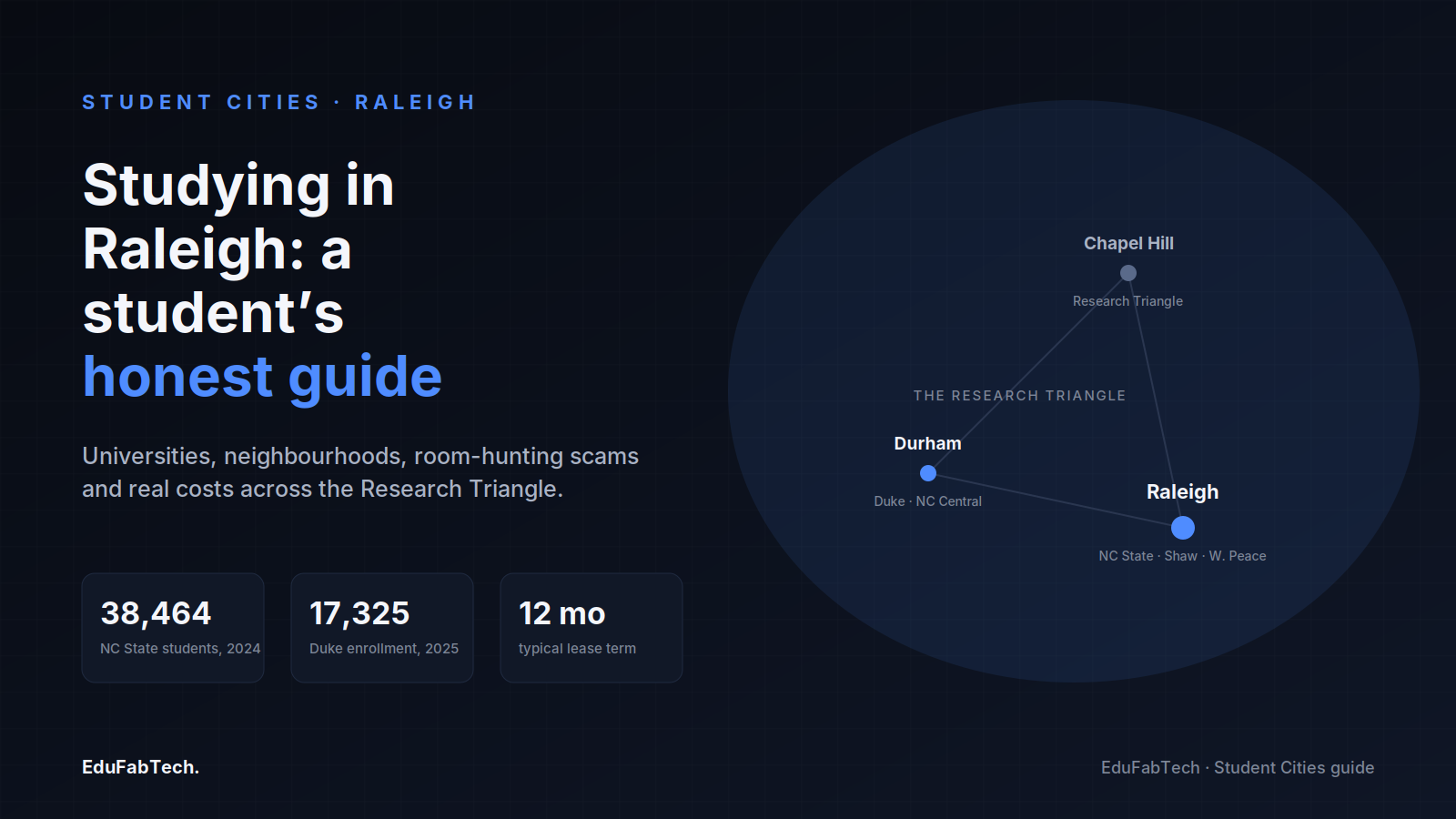
Raleigh is the capital of North Carolina and one corner of the Research Triangle, the cluster it forms with nearby Durham and Chapel Hill around the research-and-technology district between them. For a student that geography matters more than any city limit: the universities you might attend are spread across several towns, the jobs are in biotech and software labs that sit between them, and "living in Raleigh" often means living in Wake County or across the line in Durham and commuting. Treat the whole Triangle as your map and the place makes much more sense.
The city itself is green, low-rise and spread out — nicknamed the City of Oaks for a reason — with a compact downtown, a tech-heavy economy and a car-shaped layout that newcomers from denser cities find surprising. The climate is humid subtropical: long hot, sticky summers, a short mild winter that occasionally delivers an ice storm that shuts everything down for a day. It is a comfortable, fast-growing place to be a student, but it rewards planning, especially around housing and transport.
This guide is written for students heading to any of the universities in and around Raleigh, whether you grew up an hour away or are arriving from another country. It covers the institutions, the neighbourhoods people actually live in, how to find a room without being cheated, part-time work, study spaces, getting around, and what things honestly cost. Where a number appears, the source and year are named in the sentence so you can check it.
The universities, and what studying here is like
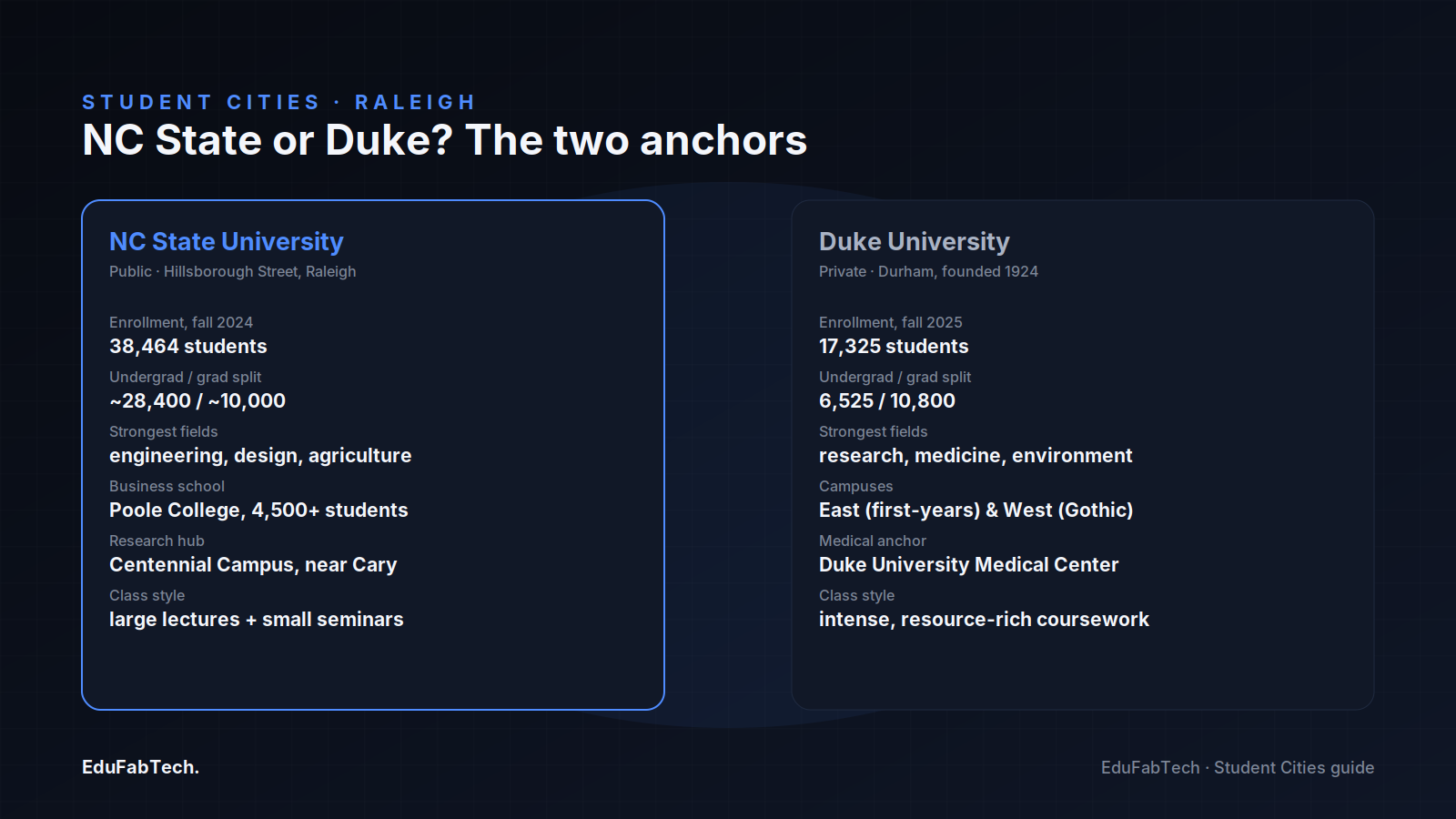
The region's largest institution is North Carolina State University, a public land-grant university with its main campus along Hillsborough Street in western Raleigh. The United States' federal education-statistics service recorded 38,464 students at North Carolina State University for fall 2024 (about 28,400 undergraduates and 10,000 graduate students), which makes it the dominant student presence in the city. It is strongest in engineering, design, agriculture and the sciences, and its business school, the Poole College of Management, enrols more than 4,500 students according to the college. NC State's research hub, Centennial Campus, sits in southwest Raleigh near the Cary line; NC State University's partnerships and facilities reach outward toward neighbouring Cary, where many graduates end up working.
A short drive west, in Durham, is Duke University, a private research university that dates its creation as Duke to 1924 and reports a total enrolment of 17,325 students in fall 2025 — 6,525 undergraduates and 10,800 graduate and professional students. Duke's undergraduate life centres on two linked campuses: Duke University East Campus, where most first-years live, and the Gothic Duke University West Campus with its landmark chapel; the sprawling Duke University Medical Center anchors one of the country's large academic health systems. Graduate study runs through the Graduate School of Duke University, and environmental programmes through the well-regarded Nicholas School of the Environment, headquartered on Duke's Durham campus. Duke is not in Raleigh proper, but its students are part of the same regional housing and transport picture.
Also in Durham is North Carolina Central University, a public historically Black university founded in 1910, known for law, business and the sciences; its campus sits in the south of the city. Back in Raleigh, two smaller institutions shape the city's character. Shaw University, founded in Raleigh in 1865, is widely described as the first historically Black university in the South and still occupies a downtown campus. William Peace University, a small liberal-arts university just north of downtown in Wake County, builds its programmes around internships in the surrounding capital — a useful model if you want work experience woven into your degree.
Studying here, whatever the institution, tends to share a rhythm: large public lectures and small seminars at NC State; intense, resource-rich coursework at Duke; close, community-sized classes at William Peace, North Carolina Central and Shaw. The real advantage is the density of research employers within a half-hour drive, which makes internships and part-time lab or campus work genuinely available rather than theoretical.
Other universities and colleges around Raleigh
- Centennial Campus of North Carolina State University (Wake County) — NC State's research-and-industry campus in southwest Raleigh, home to the Hunt Library and many company partners.
- Duke University West Campus and East Campus (Durham) — Duke's two core undergraduate campuses, linked by a free bus.
- Duke University Medical Center (Durham) — the teaching hospital and health-sciences campus.
- Southeastern Free Will Baptist College (Wendell) — a small Bible college in Wendell, east of Raleigh.
Where students actually live
Because the region is polycentric, your neighbourhood should follow your campus. A few areas do most of the student housing:
Hillsborough Street and West Raleigh. The spine of NC State. Cafés, cheap eats, student bars and older apartment blocks line the street, and you can often walk or take a short bus to class. It is lively, convenient and, by Raleigh standards, mid-priced — the obvious first choice for undergraduates who want to skip a car.
The Village District (formerly Cameron Village). Just southeast of NC State and adjacent to it, this is an older planned district of shops and apartments popular with students and young professionals. It is walkable and central; rents sit a little below the downtown core but above the farther-out suburbs.
Southwest Raleigh and around Centennial Campus. Avent Ferry Road and the streets near Centennial Campus hold a lot of purpose-built and shared student housing. It is handy for engineering and design students based at Centennial, though you will likely rely on the Wolfline bus or a bike.
Downtown and Glenwood South. Newer flats, nightlife and the William Peace and Shaw campuses. It is the most urban feeling part of the city and the most expensive to rent in — better suited to graduate students, or undergraduates splitting a flat several ways.
North Hills (Midtown). A mixed district of newer apartment communities a few kilometres north of downtown. It is car-dependent and priced for professionals, but shared units can work for graduate students who want quieter, newer buildings.
Across the line in Durham. If you are at Duke or North Carolina Central, look at Durham itself — the Ninth Street and Trinity Park area near Duke's East Campus, or the neighbourhoods south toward North Carolina Central. Living near your own campus in Durham almost always beats commuting from Raleigh. Some NC State families also look at Cary, a large, quieter town between Raleigh and the Triangle's research district.
Finding a room — and the scams to dodge
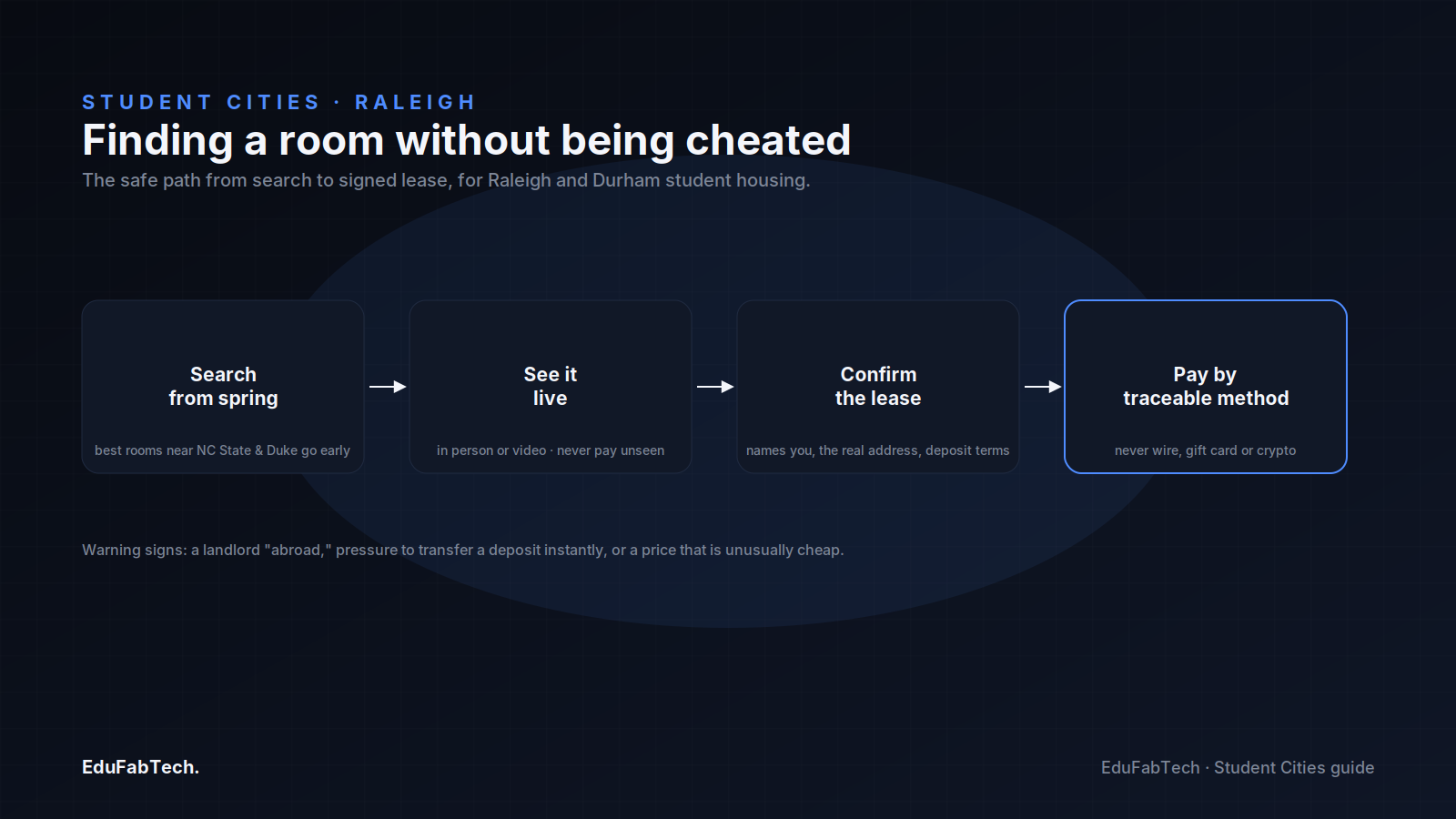
For a September start, serious searching from late spring is normal; the best-located, best-priced rooms near NC State and Duke go early. Most students either take a room in a university residence for the first year, then move into a shared off-campus flat, or go straight into a house-share. Lease terms in the United States are typically a fixed twelve months, often with a security deposit of around one month's rent and a request for proof of income or a guarantor — something international students should sort out in advance. You can browse local rooms, sublets and shares, including listings near North Carolina State University and the city-wide rooms and places to stay on EduFabTech.
Before you pay anything, check the basics: that the person showing the room controls it, that the lease names you and the real address, that you understand what the deposit covers and how it is returned, and whether utilities and internet are included. Ask about the bus routes and the actual walk to campus at night, not just the map distance.
On scams: never send money to hold a room you have not seen. See the place in person, or on a live video call where the person walks through the actual rooms on request, before you pay a cent. A listing that is unusually cheap, a "landlord" who is conveniently abroad, or pressure to transfer a deposit by bank wire, gift card or cryptocurrency to "secure" it are the classic signs of a rental scam — walk away. Pay deposits only through a traceable method once you have a signed lease and have confirmed the person's right to rent the property.
Furnishing a room cheaply: markets, flea markets and thrift
Furnishing a student room in Raleigh does not have to be expensive. The Raleigh Market, a large flea market held on Saturdays and Sundays at the state fairgrounds on Trinity Road, brings together hundreds of indoor and outdoor vendors selling second-hand furniture, kitchenware, bikes and household odds and ends. For food, plants and household basics, the State Farmers Market on Agriculture Street runs year-round, Monday to Saturday from early morning and on Sundays, and is free to enter. Charity thrift shops across the city are the other reliable source for desks, chairs and crockery at a fraction of new prices.
Students also pass furniture along directly, especially at the end of each semester when people move out and give things away. On EduFabTech you can look through second-hand things other students are selling or giving away in the city. A mattress and a desk are worth buying new or barely used for hygiene and posture; almost everything else can be found second-hand if you start a few weeks before you need it.
Working while you study
Many students take part-time work to cover living costs, and campus jobs — libraries, dining, labs, student services — are the most common entry point. If you are an international student, the rules are strict and worth reading from the primary source rather than from hearsay. In general, students on the most common study visa may not work off campus during their first academic year but may accept on-campus employment on a limited, part-time basis, subject to conditions; later, off-campus work tied to your programme (such as practical training) must be authorised in advance through your university's designated school official and, where required, the national immigration authority. The official guidance on students and employment sets out the categories, and your campus international-student office is the place to confirm what applies to you before you accept any job. This is not legal advice — treat the official page and your adviser as the authorities. You can also scan local jobs and part-time work listed on EduFabTech.
Libraries and places to study
NC State's standout study space is the James B. Hunt Jr. Library on Centennial Campus, opened in 2013 and designed with dozens of reservable rooms, media and visualisation labs, and an automated book-retrieval system that frees up floor space for seats. On the main campus, the D. H. Hill Jr. Library is the older, larger humanities-and-sciences workhorse. Duke and North Carolina Central run their own extensive university libraries for their students.
Beyond the campuses, the county public library system operates more than twenty branches across Wake County, free to join for residents, with quiet desks, computers and meeting rooms — useful if you live off-campus or want a change of scene. Downtown cafés and the study lounges in the Hunt and Hill libraries fill up around exams, so learn the quieter branches and off-peak hours early. EduFabTech also lists bookable study spaces and desks around the city.
Getting around
Raleigh is built for cars, but students can get by without one if they live near a campus or a good bus line. NC State runs its own free campus shuttle network, the Wolfline, linking its campuses, park-and-ride lots and nearby housing. For city and regional travel, NC State's GoPass lets students "ride GoRaleigh and GoTriangle buses at no cost" using an active university email to request the pass — a genuinely useful perk that removes most of the case for a car if your life stays within the bus network. GoRaleigh is the city bus operator; GoTriangle connects Raleigh, Durham, Cary and the research district between them, and Duke runs its own free buses between its campuses.
The honest caveat: outside the campus corridors, buses are infrequent and journeys are slow, so many students eventually get a bike or a car. The city's growing greenway network makes cycling pleasant for shorter trips. If you do bring a car, factor in parking permits, which are limited and priced on every campus.
What it costs, and the honest trade-offs
Rents in Raleigh are below those of the big coastal cities but have risen sharply with the region's growth. As a neutral benchmark, the United States' federal housing agency's fiscal-year 2025 Fair Market Rents for the Raleigh metro area give a sense of market level:
| Unit | Fair Market Rent (FY2025, Raleigh metro) |
|---|---|
| Studio / efficiency | US$1,533 / month |
| One-bedroom | US$1,592 / month |
| Two-bedroom | US$1,763 / month |
| Three-bedroom | US$2,192 / month |
These figures, published for fiscal year 2025, are standard benchmarks rather than quotes for any particular flat, and a room in a shared house splits the cost several ways. The practical lesson is that sharing a two- or three-bedroom unit is far cheaper per person than renting alone, which is why most students do it.
What is good about Raleigh for students is real: a strong job market in tech and biotech, comparatively affordable living for a fast-growing region, green space, a mild winter and several serious universities within a short radius. What is hard is also real: the city is spread out and car-centric, so without a campus-adjacent room you will spend time on slow buses or buying a car; rents are climbing as newcomers arrive; summers are hot and humid; and the very things that make the Triangle attractive — jobs and growth — are tightening the rental market each year. Go in expecting to plan your location around transport, and the trade-offs are manageable.
Your first two weeks: a checklist
- Confirm your room in writing, with a signed lease that names you and the real address, before you arrive if you can.
- Request your university email, student ID and — at NC State — your GoPass for free city and regional buses.
- Learn the bus routes and the realistic night-time walk between your room and campus.
- Join the county public library and locate the quiet study branches near you.
- Furnish from the Raleigh Market, thrift shops and end-of-semester giveaways rather than buying everything new.
- If you plan to work, visit your international-student office and read the official employment guidance before accepting a job.
- Set up a local bank account and a traceable way to pay rent — never a wire or gift card to "hold" a room.
- Browse the city-wide Raleigh student listings to find your feet in the first month.
A quick question for readers
Do you work part-time while you study?
Many students work to pay the bills. See how common it is — and how many hours people really do.
Pick an answer, create a free account in a minute, and your vote counts. Already a member? Sign in
- Duke University. Duke University Facts. Duke University, 2025. link
- NC State University Libraries. James B. Hunt Jr. Library. North Carolina State University, 2026. link
- NC State Transportation. Local/Regional Transit (GoPass). North Carolina State University, 2025. link
- Poole College of Management. About Poole College of Management. North Carolina State University, 2026. link
- U.S. Citizenship and Immigration Services. Students and Employment. U.S. Department of Homeland Security, 2025. link
- National Center for Education Statistics. College Navigator: North Carolina State University at Raleigh (Fall 2024). U.S. Department of Education, 2024. link
- North Carolina Department of Agriculture & Consumer Services. State Farmers Market — Raleigh. NCDA&CS Marketing Division, 2026. link
- RentData.org. Raleigh, NC MSA Fair Market Rents, Fiscal Year 2025 (reproducing U.S. Dept. of Housing and Urban Development data). RentData.org, 2025. link