Studying in Reading, United Kingdom: universities, housing and student life
A practical, sourced guide to the University of Reading and nearby campuses, where students live, what rooms cost, and how to work, study and get around a Thames Valley town.
A university built around a parkland campus
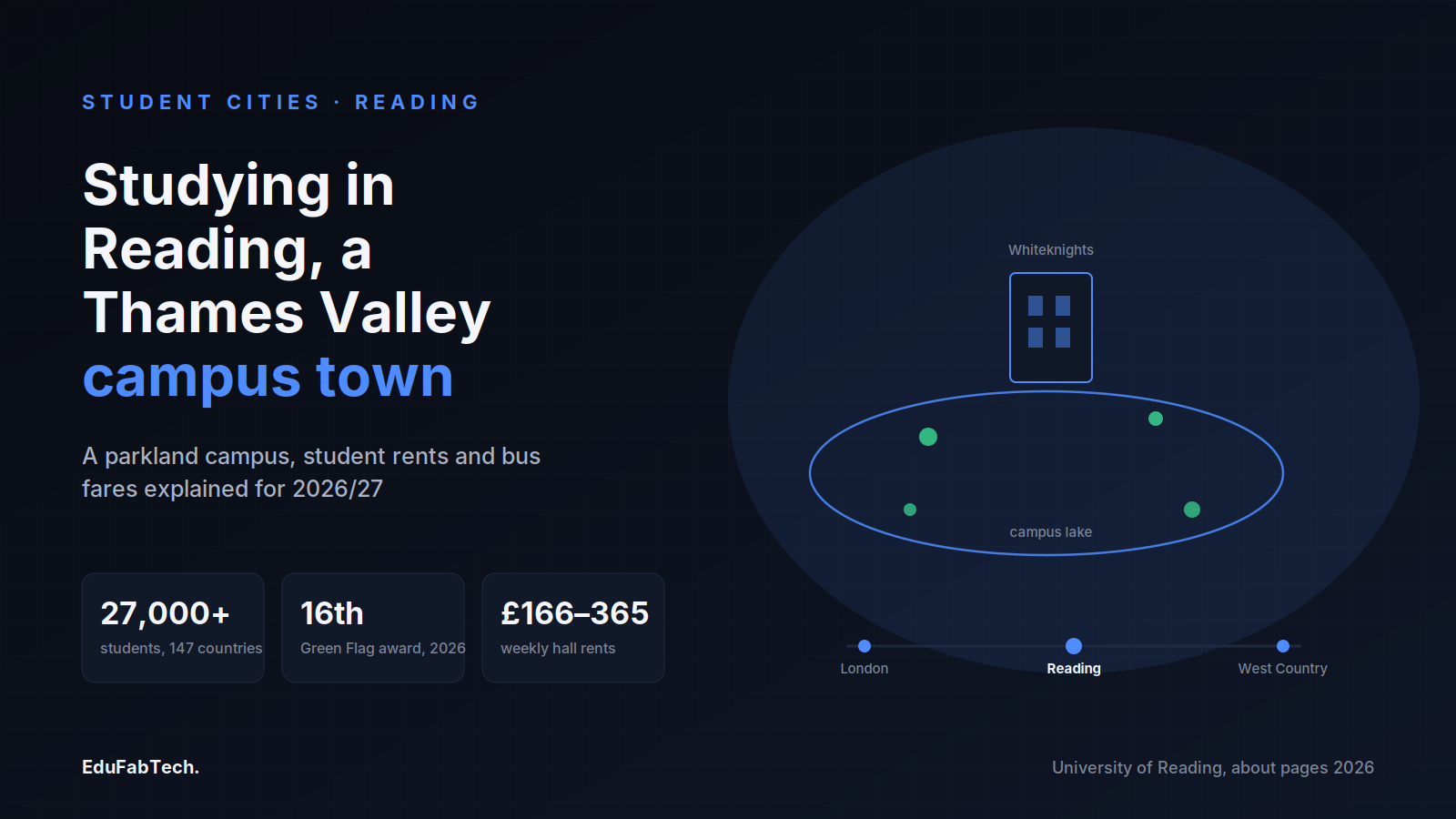
Reading sits where the River Kennet meets the Thames, roughly midway between London and the west of England, at the centre of the business corridor often called the Thames Valley. For students that location shapes almost everything: fast trains in both directions, a town centre that is busier with commuters and office workers than most university towns its size, and rents pulled upward by proximity to the capital. The academic anchor is the University of Reading, whose main site, Whiteknights, is a landscaped park on the south-eastern edge of town rather than a scatter of buildings in the centre.
The University of Reading says on its about pages that more than 27,000 students from 147 countries study there, with campuses in Reading and Henley-on-Thames, as well as sites in Johannesburg and Iskandar. The same pages note that the Whiteknights campus received its 16th consecutive Green Flag Award in 2026 — a recognition for the grounds themselves, which run to lakes, woodland and open lawns that double as the campus's social space in warmer months.
Teaching is spread over more than one site. Whiteknights holds most schools, the main library and the students' union. The nearby London Road campus, the university's original home closer to the centre, houses the Institute of Education. Business and finance students may spend time at Henley Business School, which includes the ICMA Centre, a Reading-based centre focused on capital markets and financial training. Henley's Greenlands campus, used mainly for executive and postgraduate business programmes, is further out along the Thames near Henley-on-Thames.
Other campuses within a train ride
Reading is not isolated, and several other universities are close enough to consider if a course or a room there suits you better. The University of Surrey is in Guildford, to the south, and is known for engineering, sciences and its sandwich-year placements. Royal Holloway, University of London is in Egham, Surrey, recognisable from its Victorian Founder's Building and strong in the arts, sciences and social sciences. Buckinghamshire New University is in High Wycombe, Buckinghamshire, with a vocational and healthcare focus. The University for the Creative Arts runs an art-and-design campus in Farnham, Surrey. All are separate towns rather than parts of Reading, so treat them as regional alternatives reached by train or bus, not as local options you can walk to. EduFabTech keeps listings near some of them, including University of Surrey and Royal Holloway.
Which parts of Reading students settle in
Most undergraduates spend first year in halls and then move into shared houses, and in Reading those houses cluster in a fairly predictable arc east and south-east of the centre, close to Whiteknights.
Redlands and Erleigh Road make up the traditional student quarter: terraced houses within walking distance of Whiteknights, the Royal Berkshire Hospital and the East Reading shops around Cemetery Junction. It is the most "studenty" area, which cuts both ways — convenient and sociable, but noisier and well-known to landlords who price accordingly. Newtown and Cemetery Junction, just east of the centre between the Kennet and the London Road, are a little cheaper and put you closer to town while still within reach of campus by bus or bike.
Earley and Lower Earley, immediately beyond Whiteknights, are quieter and more suburban, with supermarkets and family housing; rooms can be good value but the atmosphere is residential rather than lively. Caversham, across the Thames to the north, is pleasant and a short bus ride from the centre, popular with postgraduates and those who want a calmer base near the river. Tilehurst, to the west and uphill, is further out and cheaper again, but the commute to Whiteknights is longer. The town centre itself has a growing stock of purpose-built student blocks, convenient for the station and nightlife but usually the priciest option per week. EduFabTech's rooms in Reading listings cover these areas.
Renting a room without losing a deposit
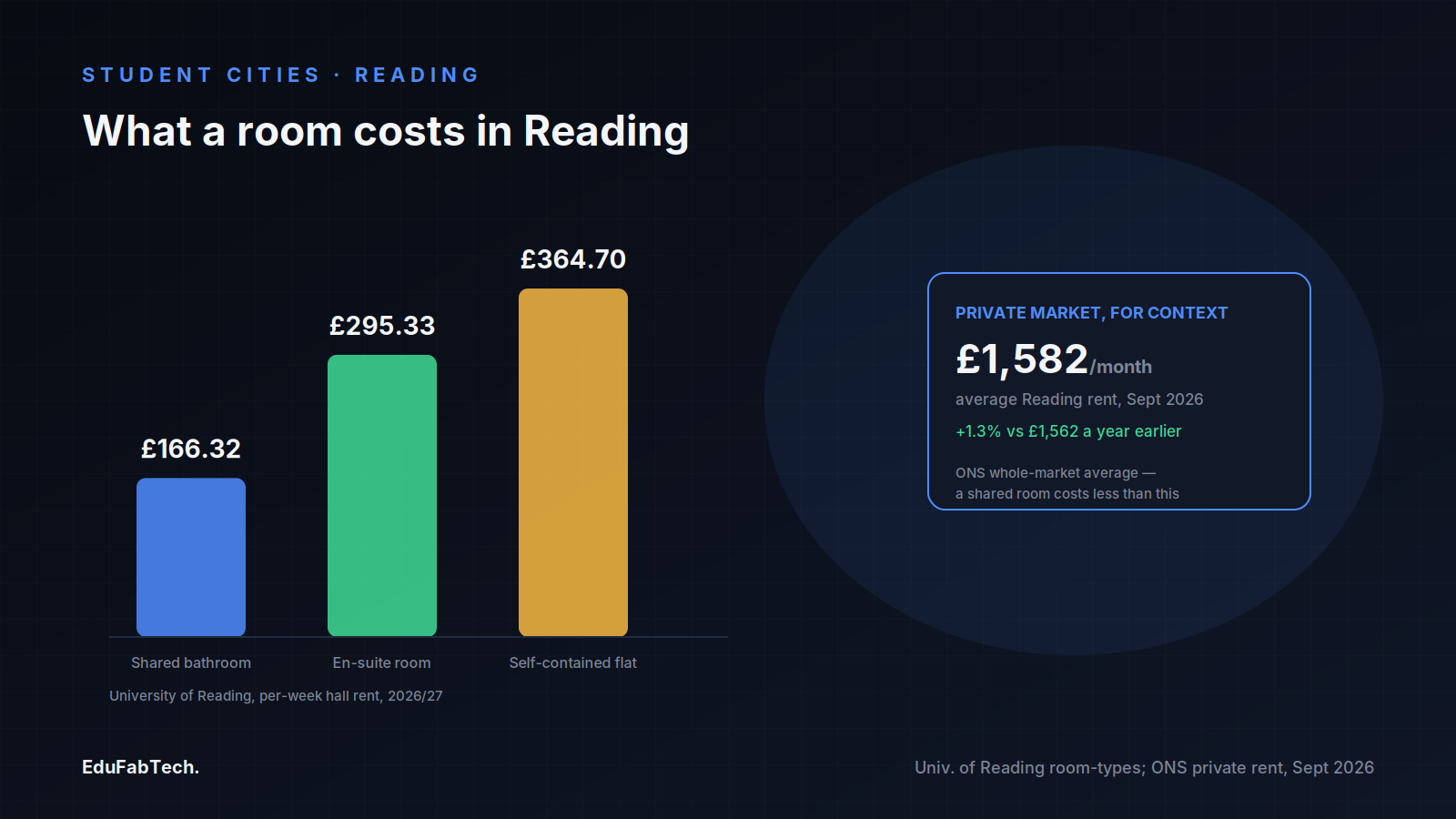
For halls, the University of Reading's room-types pages list 2026/27 weekly rents from £166.32 for a standard room with a shared bathroom up to £295.33 for the dearest en-suite and £364.70 for a self-contained flat. For the private market, the Office for National Statistics put the average monthly private rent in Reading at £1,582 in September 2026, a 1.3% rise from £1,562 a year earlier, in its private rent figures — that is a whole-market average across all property sizes, so a room in a shared house costs less, but it signals a tight and fairly expensive market.
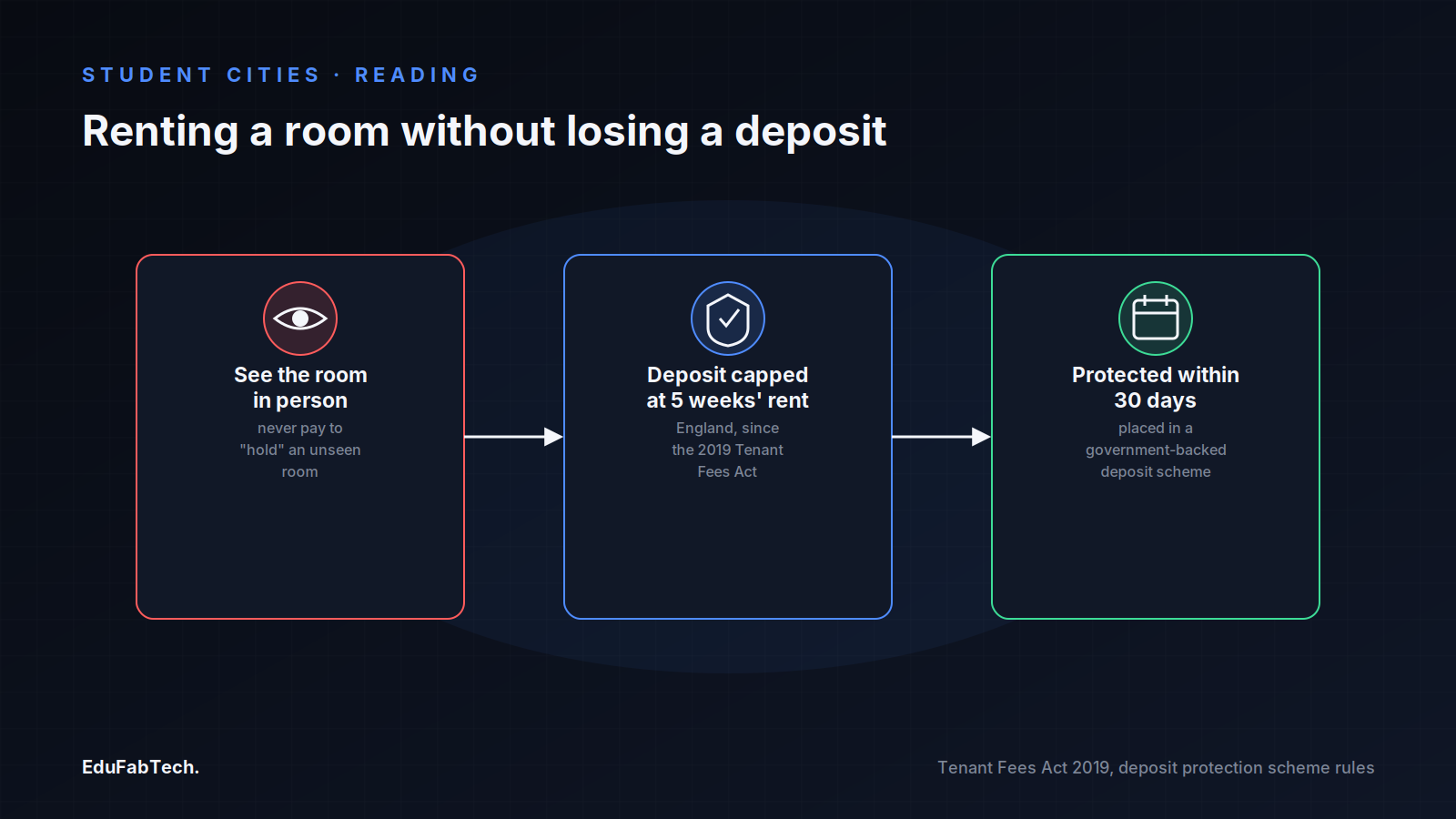
House-hunting for shared homes in the Redlands and Erleigh Road streets tends to start early, often in the winter and spring before the September it is for, so viewings happen while the current tenants are still living there. That timing is where Reading's rental scams appear: listings for the exact streets students want, at rents a little below the going rate, from someone who says they cannot show you round because they are away and asks for a deposit or a month's rent up front to "hold" the room. Do not pay anything to reserve a place you have not seen. See the actual room in person (or send someone you trust), and be wary of any ad that only exists on a social-media group. A genuine deposit in England is protected: since 2019 it is capped at five weeks' rent for most tenancies, and it must be placed in a government-backed deposit protection scheme within 30 days — ask which scheme before you sign. Never send money by bank transfer, gift card or cryptocurrency to a landlord you have not met to secure a room.
Furnishing a room, markets and second-hand Reading
A shared house in Reading is often let part-furnished, so new arrivals usually need to fill gaps — a desk lamp, kitchen bits, a chair — rather than furnish from scratch. The cheapest routes are second-hand. Charity shops are plentiful along Friar Street and Broad Street in the centre, and students passing through the city in June and September leave a good deal of usable furniture behind. EduFabTech runs a local page for exactly this: second-hand things in Reading, from furniture to items given away free.
For food and the general rhythm of the centre, Blue Collar is the name to know. Reading Borough Council, confirming Blue Collar as the operator of the Hosier Street market, notes that the firm already runs Wednesday and Friday markets in Market Place; Visit Reading lists those Market Place street-food sessions as running roughly 11:30am to 2:30pm, with a separate permanent site, Blue Collar Corner, on Hosier Street. It is a street-food market rather than a produce or flea market, but it is where the town gathers at lunchtime.
Working while you study
If you are an international student, how much you can work is set by your visa, not your university, and the rules are national rather than local. UKCISA, the UK Council for International Student Affairs, states that a Student visa holder studying a full-time course at degree level or above may work up to 20 hours a week in term time, and full time outside term time, including vacations. UKCISA also warns that your university may set its own, lower limits, so check those too. The official overview of what you can and cannot do on a Student visa — including the jobs that are not allowed, such as being self-employed or working as a professional sportsperson — is on GOV.UK. This is general information, not legal advice; confirm your own conditions against the sticker or digital status attached to your visa. Reading's office economy means term-time jobs in retail, hospitality and campus roles are realistic; EduFabTech lists part-time work in Reading.
Where to read and revise
The University of Reading Library, on the Whiteknights campus, is the main study hub, and its opening-hours page shows it running 24 hours Monday to Friday during semester, closing only from 21:00 on Saturday until 08:30 on Sunday; between midnight and the early morning you scan in with your Campus Card. Alongside it, the URS Building offers a large block of extra study spaces and computers, with Café Libro inside. London Road campus has its own quieter study areas. Off campus, the town's public Central Library and the many café-study spots around the centre fill in the gaps, especially for students living in Caversham or the town centre who want somewhere to work without the trek to Whiteknights. EduFabTech also collects desks and bookable rooms on its study spaces page.
Getting around Reading and beyond
Local buses are run by Reading Buses, and for students the relevant product is the Boost fare. The University of Reading's sustainable travel pages set out Boost prices within the simplyReading zone: £2.40 for a single trip, £4.30 for unlimited all-day travel, and a boostsaver10 bundle of ten tickets for £19.00, which works out at £1.90 a journey. Boost fares are bought through the Reading Buses app (where you verify your student eligibility) or as a smartcard, and frequent services such as the Claret and the Whiteknights link connect the campus with Lower Earley and the town centre.
For travel beyond Reading, the railway station is a major interchange. Visit Reading describes the town as the western terminus of the Elizabeth line, with direct trains from central London stations including Paddington, Bond Street, Tottenham Court Road, Farringdon and Liverpool Street in under an hour, while Great Western Railway trains reach Reading from Paddington in as little as 23 minutes. That makes day trips to London, Oxford or the west straightforward — and is part of why Reading's rents behave like a London satellite rather than a provincial town.
What Reading does well, and what is harder
The strengths are real. A genuine parkland campus close to a working city centre; one of the best rail positions of any UK student town; a lively, compact centre with the Oracle shopping quarter, riverside walks and an established street-food scene. The difficulties are mostly about money and competition for homes. Reading's rents sit well above the national average because of its Thames Valley economy and London commuters, the private rental market is tight, and the best shared houses near Whiteknights go early, which pushes students into decisions — and sometimes deposits — before they have properly seen a place. The centre can feel more corporate than collegiate, and if you live out in Tilehurst or across the river in Caversham, the daily commute to campus is a real factor. None of this is a reason to avoid Reading; it is a reason to plan the housing early and budget honestly.
A checklist for your first weeks
- Get your Campus Card and set up library and building access — you will need it for 24-hour study space.
- Download the Reading Buses app, verify your student status and decide whether Boost singles or the ten-ticket bundle fits your commute.
- If you are on a Student visa, read your own work conditions on GOV.UK and check any limit your department sets before taking a job.
- If you are flat-hunting for next year, view in person, confirm the deposit is in a protection scheme, and never transfer money to hold an unseen room.
- Walk Redlands, Erleigh Road, Newtown and Earley to see which fits before committing to a house-share area.
- Furnish from charity shops and second-hand pages rather than buying new at full price.
A quick question for readers
Do you work part-time while you study?
Many students work to pay the bills. See how common it is — and how many hours people really do.
Pick an answer, create a free account in a minute, and your vote counts. Already a member? Sign in
Comments 3
Comment-
The 20-hour-a-week cap for Student visa holders reads like the number that matters, but it's almost a red herring — the piece immediately ad…
-
The "16th consecutive Green Flag Award" line is doing more work than it's earned. It's lifted straight from the university's own about page,…
-
The deposit protection point is the one worth flagging twice: capped at five weeks' rent and it has to go into a government-backed scheme wi…
Join free to read the full comments and reply Comments are between members; an account takes a minute.
Source: University of Reading
Sources (5)
- University of Reading. Room types — accommodation charges 2026/27. University of Reading, 2026. reading.ac.uk ↗ · checked 7 Nov 2026
- Office for National Statistics. Private rent and house prices: Reading. Office for National Statistics, 2026. ons.gov.uk ↗ · checked 7 Nov 2026
- UKCISA. Working as an international student. UK Council for International Student Affairs, 2026. ukcisa.org.uk ↗ · checked 7 Nov 2026
- University of Reading. Sustainable travel: bus. University of Reading, 2026. sites.reading.ac.uk ↗ · checked 7 Nov 2026
- Visit Reading. Elizabeth line to Reading. Visit Reading, 2026. visit-reading.com ↗ · checked 7 Nov 2026