Studying in Richmond, Virginia: universities, housing and student life
A practical guide to VCU, the University of Richmond and Virginia Union — where students live along the James River, what rooms cost, and how to get around a city where the buses are free.
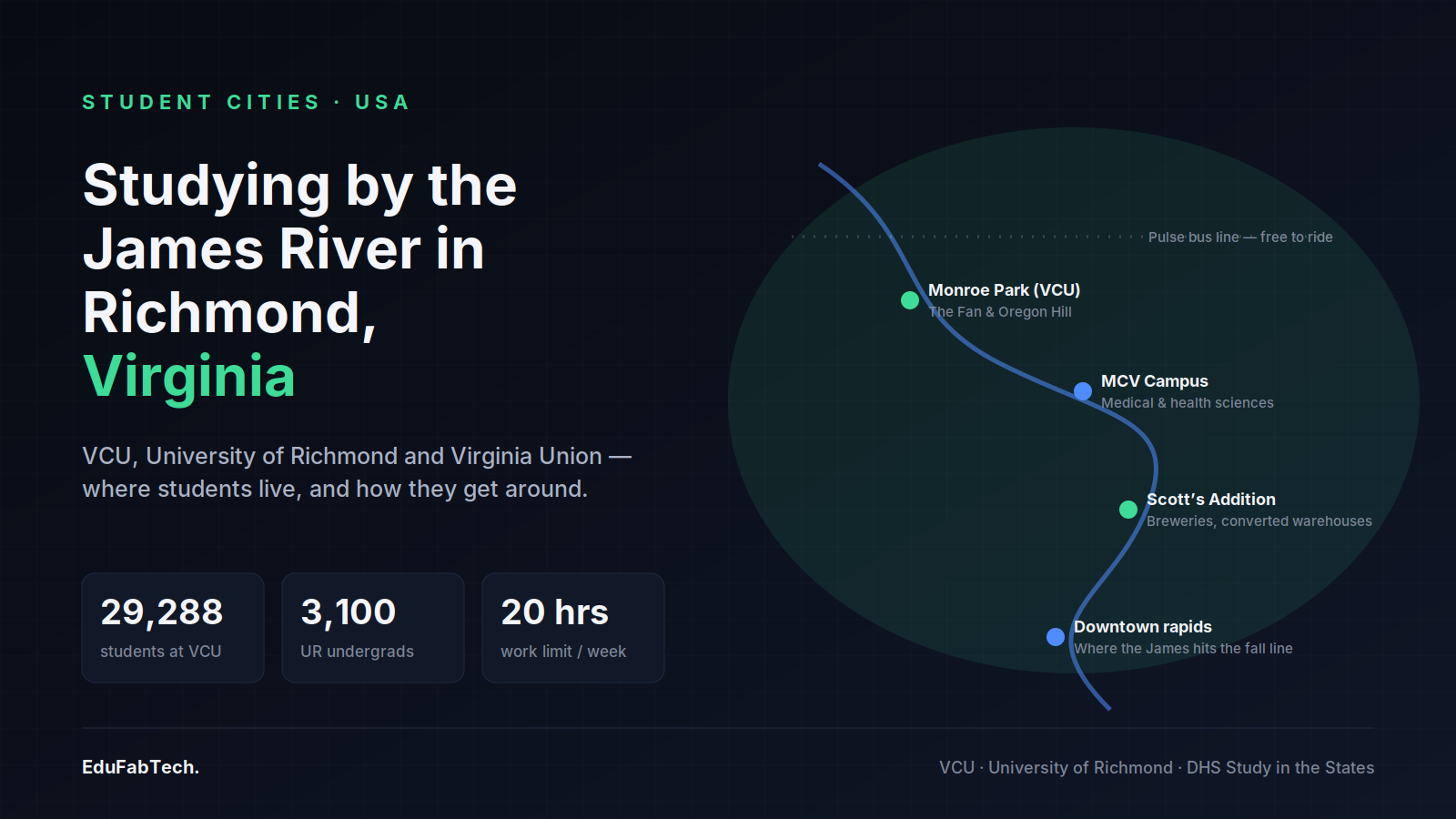
Richmond sits on the fall line of the James River, the point where the Piedmont drops to the coastal plain and the river breaks into rapids that run straight through the middle of the city. It is Virginia's capital, and its student population is concentrated in a compact downtown rather than spread across a commuter sprawl. The University of Richmond calls the surrounding metro area home to more than a million people, which gives a sense of the scale: a mid-sized American city, walkable at its core, with a river you can actually swim in on a hot afternoon.
Two very different kinds of student experience coexist here. One is urban and public, built around a large research university whose buildings are woven into the downtown street grid. The other is residential and private, on a wooded campus with a lake a few miles out of the centre. A third, older tradition — a historically Black university on the north side — rounds out the picture. The result is that "studying in Richmond" can mean almost opposite things depending on which gate you walk through.
What ties them together is the city itself: a layered, sometimes uncomfortable history (Richmond was the capital of the Confederacy, and that past is argued over in its museums and former monument avenues), a strong arts and music scene, one of the densest clusters of craft breweries in the country, and a cost of living that is still, for now, below the big coastal cities students might otherwise choose.
Two universities, one small capital
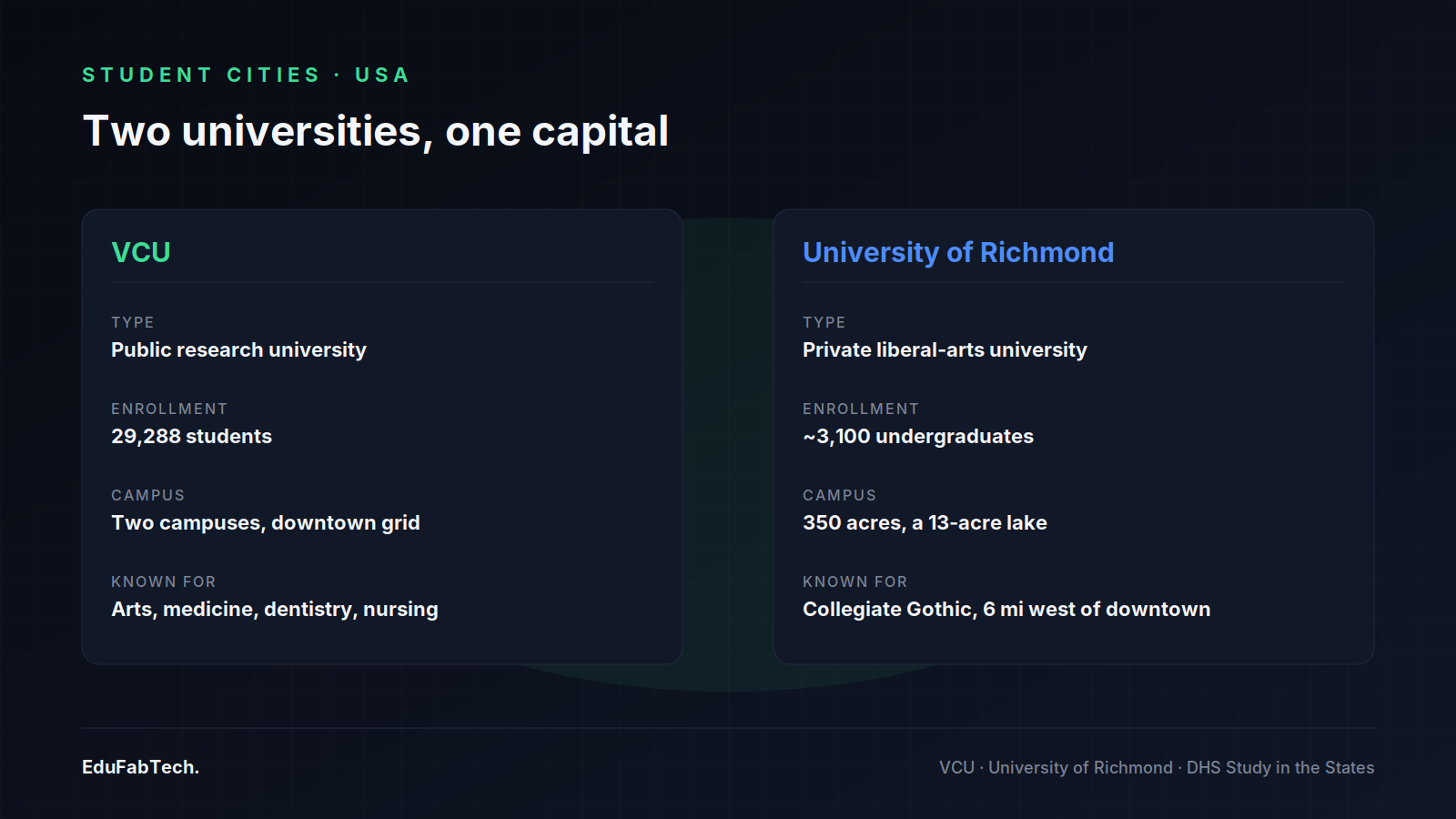
Virginia Commonwealth University is the dominant presence. VCU says it enrols 29,288 students and traces its roots to 1838, and it spreads across two campuses about a mile apart in downtown Richmond. The Monroe Park Campus holds most undergraduate life, built around the historic Monroe Park and the surrounding Fan District; the MCV Campus to the east is the health-sciences side, anchored by VCU Medical Center, which VCU describes as the state's top hospital and where its clinical students train. VCU is unusual in its range: it says it is the only Virginia school to offer degrees in dentistry, health professions, medicine, nursing, pharmacy and public health, and the School of the Arts gives it a national profile in studio art and design.
Several of VCU's schools are landmarks in their own right. The VCU School of the Arts (known on campus as VCUarts) is the reason many students come to Richmond at all, and it sits on the Monroe Park Campus among the galleries and studios of the Broad Street arts district. The VCU School of Business and the VCU School of Engineering occupy modern downtown buildings near the city's financial core, and the VCU School of Allied Health Professions is based on the MCV Campus alongside the medical and nursing schools. If you are weighing a health-sciences programme, note that your daily life will revolve around the MCV side downtown, not the Fan.
The University of Richmond is the counterpoint. It describes a 350-acre campus about six miles west of downtown, with roughly 3,100 undergraduates and a 13-acre lake, its Collegiate Gothic buildings closer in feel to a small liberal-arts college than to a city university. Its University of Richmond School of Professional & Continuing Studies offers part-time and evening degrees and certificates aimed at working adults, which is worth knowing if you are studying while employed. Across town on the north side, Virginia Union University is one of Richmond's historically Black universities, with a compact residential campus off Lombardy Street.
Which Richmond neighbourhoods students choose
The Fan. The signature VCU neighbourhood, named for the way its streets splay outward west of Monroe Park. It holds one of the longest intact stretches of Victorian rowhouses in the country, carved into student flats. You can walk or bike to class in minutes, which is its whole appeal; rents are higher than the city average precisely because of that walkability, and parking is a daily battle.
Oregon Hill. A small, tightly packed neighbourhood just south of the Fan, wedged between campus and the river. Historically working-class and now heavily student, it is among the closest places to the Monroe Park Campus you can live without being in a dorm, and it backs onto Hollywood Cemetery and the James River Park trails.
Carytown and the Museum District. West of the Fan along Cary Street, Carytown is Richmond's independent-shopping strip, anchored by the restored Byrd Theatre. The adjoining Museum District, around the Virginia Museum of Fine Arts, is quieter and leafier. Both draw graduate students and anyone who wants Fan character with a little more space; expect a longer walk or a short bus ride to campus.
Scott's Addition. A former warehouse district north of the Fan, now dense with breweries, distilleries and tasting rooms set among converted industrial buildings. Most residents rent in new-build or converted-warehouse apartments. It is lively and central but increasingly expensive, and the housing stock skews toward purpose-built complexes rather than cheap rooms.
Jackson Ward. Immediately north-east of VCU, a historically Black neighbourhood once called the "Harlem of the South," now a mix of renovated historic homes and newer flats. It puts you close to both the Monroe Park and MCV campuses and to the Pulse line along Broad Street.
Church Hill. East of downtown on one of the city's seven hills, around the 18th-century St. John's Church. It is residential and relatively calm, with cobblestone blocks and river views; good for MCV-campus students and anyone wanting distance from the undergraduate crush, at the cost of a longer commute to the Fan.
The West End. The suburban area around the University of Richmond, including Westhampton and the stretch toward the river. Quieter, greener and generally pricier, with more houses than flats — most relevant if your campus is UR rather than VCU.
Signing a lease without losing a deposit
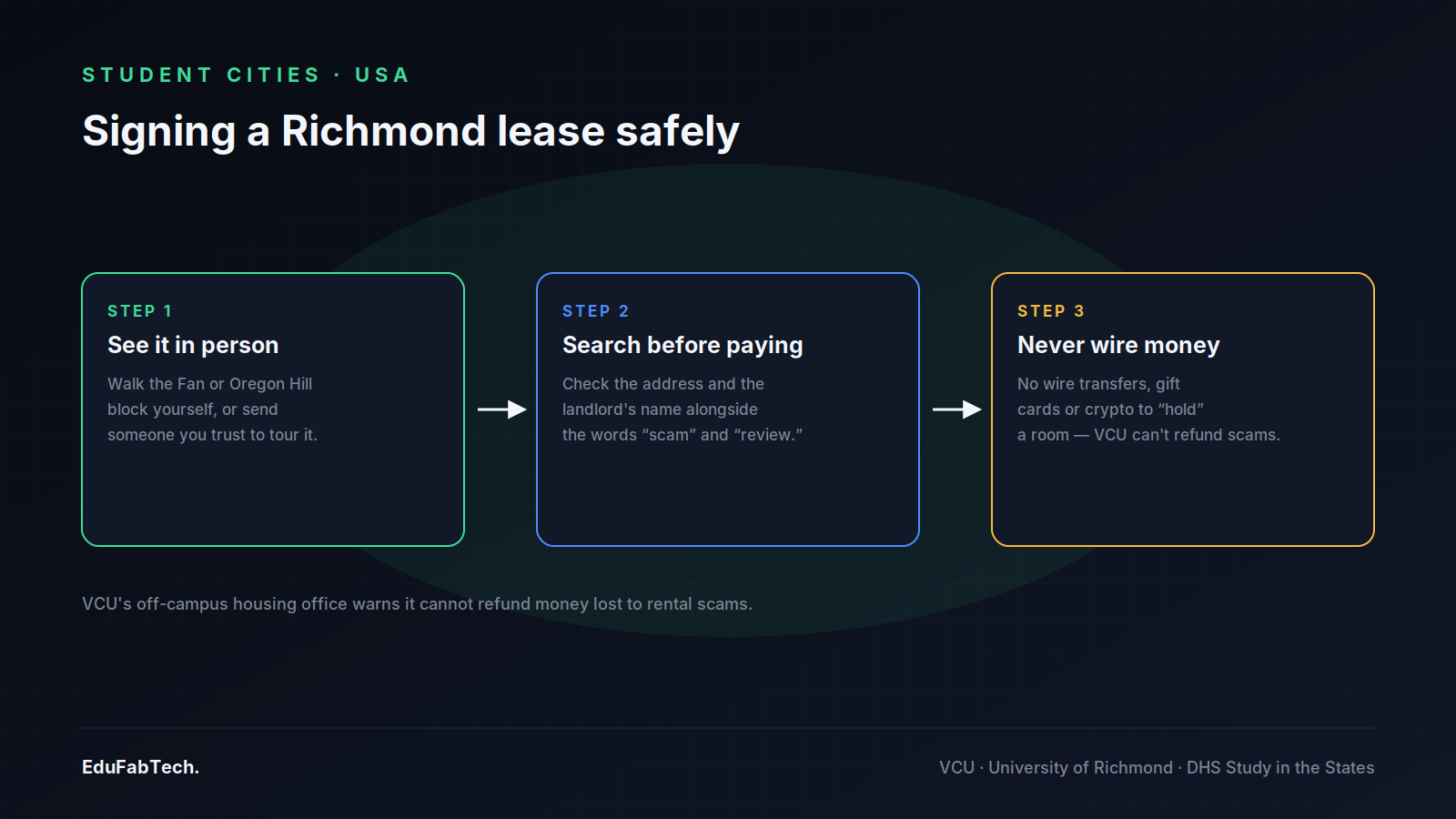
VCU's own off-campus service is blunt about the risks, and its advice is the right default for the whole city. VCU and its listings partner state plainly that they do not take part in rental transactions and cannot refund your money if you are scammed. The red flags they describe are the ones that actually show up in Richmond: a Fan or Oregon Hill rowhouse listed far below the going rate, pressure to pay fast, and excuses for why you cannot tour the place. Scams cluster where demand is highest and turnover is fast — the blocks nearest the Monroe Park Campus — and they target international and first-year students arriving sight-unseen.
The protective steps are specific, not generic. See the actual room before you pay anything: walk the Fan or Oregon Hill block in person, or send someone you trust to do it, and search the address and the name you are given alongside words like "scam" and "review." Never wire a deposit, buy gift cards, or send cryptocurrency to "hold" a room for you — a genuine Richmond landlord will not ask for that, and no legitimate holding deposit is paid that way. Because judging a neighbourhood and a roommate online is so hard, VCU recommends not committing to a lease before you arrive in the city if you can possibly avoid it. For first-year students, a university dorm removes most of this risk for the first year while you learn the map.
Furnishing a room: markets and second-hand
Richmond rewards patience when you are kitting out a room. The city runs a cluster of open-air markets listed by its own economic-development office: the 17th Street Farmers' Market in Shockoe Bottom — a public gathering place since 1737 and one of America's oldest public markets — plus the producer-only South of the James Market in Forest Hill Park, the Sunday Carytown Farmers Market, and the smaller BirdHouse Market. These are strongest for food and local makers rather than furniture, but they are where you meet the people who know where the cheap sofas go.
For second-hand furnishing itself, Carytown and the Fan are full of vintage and resale shops, and the start and end of each semester flood the Fan and Oregon Hill with discarded furniture as students move. On EduFabTech you can browse second-hand things in Richmond, used furniture and even items given away free — the last of these peaks in May and August when leases turn over. Buy the bulky things locally rather than carrying them; a mattress and a desk are not worth shipping.
Part-time work and what a student visa allows
If you are an international student on an F-1 visa, the headline rule is set by the U.S. Department of Homeland Security, not by any employer: its Study in the States guidance says that "if you participate in on-campus employment, you may not work more than 20 hours per week when school is in session," and that you can apply for on-campus work up to 30 days before classes begin. Off-campus work, and training schemes such as CPT and OPT, carry separate conditions and authorisations. This is a summary, not legal advice: confirm your own situation with your Designated School Official before you accept any job. Campus roles — library desks, dining halls, research assistantships — are the simplest path, and both VCU and UR post them internally. Local openings also appear on EduFabTech's Richmond jobs board.
Where to study: Cabell, the Main Library and beyond
VCU's James Branch Cabell Library on the Monroe Park Campus is the obvious hub — VCU Libraries calls it the busiest academic library in Virginia — and it is organised by noise level: open collaborative floors lower down, whisper-only quiet study on the third floor, silent study on the fourth, with group rooms throughout. Off campus, the Richmond Public Library's Main Library at 101 East Franklin Street offers public study rooms you can book ahead (the library asks for at least two weeks' notice) plus open seating, useful for students who are not at VCU or who want a neutral space downtown. Beyond the libraries, the coffee shops of Carytown and the breweries of Scott's Addition double as informal study spots; EduFabTech also lists bookable study spaces and desks around the city.
Getting around: GRTC and a fare-free experiment
Richmond's buses are run by the Greater Richmond Transit Company (GRTC), and the single most student-relevant fact is that they are currently free. GRTC's flagship line, the Pulse bus rapid transit route, runs between Willow Lawn and Rockett's Landing every 10 minutes at weekday peaks, and like all GRTC buses requires no fare to ride. That "Zero Fare" policy began in 2020 as a pandemic measure and has been renewed year to year; GRTC's board approved a fiscal-2027 budget in May 2026 that keeps the system fare-free for another year, with longer-term funding still being worked out. Because it is free, there is no student discount card to worry about — you simply board. The Pulse connects the VCU campuses, downtown and the western neighbourhoods directly; for the University of Richmond out in the West End, the campus is served by a GRTC route but a bike or a car is more common there.
What a year actually costs
The most reliable housing figures come from the universities themselves. For the 2026-27 year, VCU's cost page lists on-campus room at $9,259 and dining at $6,630, with tuition and fees of $17,963 for Virginia residents and $41,127 for non-residents — the in-state/out-of-state gap is large and worth planning around if you are coming from abroad or out of state. For off-campus renting, the U.S. Census Bureau's QuickFacts put the median gross rent in Richmond city at $1,314 a month over 2019-2023 across all housing, not just student rooms; a shared Fan rowhouse per person typically runs below that, while a new Scott's Addition flat runs above it. Treat these as anchors, not quotes — the single figure you can rely on is the dated one with a source attached.
| Item | Figure (source, year) |
|---|---|
| VCU on-campus room | $9,259 / year (VCU, 2026-27) |
| VCU on-campus dining | $6,630 / year (VCU, 2026-27) |
| VCU tuition & fees, in-state | $17,963 / year (VCU, 2026-27) |
| VCU tuition & fees, out-of-state | $41,127 / year (VCU, 2026-27) |
| Median gross rent, all housing | $1,314 / month (U.S. Census Bureau, 2019-2023) |
| GRTC bus fare | $0 (GRTC Zero Fare, FY2027) |
The honest trade-offs
The good: Richmond is genuinely affordable for an East Coast city, the compact Fan makes a car optional for VCU students, the free buses remove a recurring cost most student cities impose, and the arts, food and river culture give the place a strong identity. The hard parts are real too. Richmond's summers are hot and humid, and the city floods pockets of the Fan and Shockoe Bottom in heavy rain. Housing nearest VCU is competitive and the best rooms go early, which is exactly where scams concentrate. The two VCU campuses sit inside a working downtown, so students should take the usual city precautions after dark. And Richmond's layered history — Confederate capital, a city shaped by slavery and segregation — is present in a way that can be jarring; engaging with it honestly is part of studying here.
Start your search early rather than late, see any room before you pay, and lean on university housing for a first year while you learn which neighbourhood actually suits you. To go deeper, browse all student listings in Richmond, rooms and places to stay, or listings near Virginia Commonwealth University and near the University of Richmond.
Your first two weeks in Richmond
- Confirm your campus — Monroe Park, MCV or the West End — because it decides which neighbourhood makes sense.
- If you are a first-year, take a dorm for year one; use that year to scout the Fan, Oregon Hill and Jackson Ward in person.
- Never send a deposit by wire, gift card or crypto; tour the room yourself or send someone you trust, and search the address for complaints.
- Download GRTC route maps and ride the Pulse end to end once — it is free and it teaches you the city's spine along Broad Street.
- Get your VCU or UR ID early; it is what you need for campus jobs and full library access.
- International students: meet your Designated School Official before accepting any work, and keep to the 20-hour on-campus limit while classes are in session.
- Furnish from local markets and second-hand listings, and wait for the May and August move-out gluts for free furniture.
- Walk down to the James River Park trails once in your first fortnight — it is the thing most students say they wish they had found sooner.
A quick question for readers
Do you work part-time while you study?
Many students work to pay the bills. See how common it is — and how many hours people really do.
Pick an answer, create a free account in a minute, and your vote counts. Already a member? Sign in
Source: Virginia Commonwealth University
Sources (5)
- Virginia Commonwealth University. Tuition & fees (2026-27 estimated cost of attendance). VCU Office of Admissions, 2026. admissions.vcu.edu ↗ · checked 7 Oct 2026
- U.S. Census Bureau. QuickFacts: Richmond city, Virginia (median gross rent, 2019-2023). U.S. Census Bureau, 2024. census.gov ↗ · checked 7 Oct 2026
- U.S. Department of Homeland Security. Working in the United States (F-1 on-campus employment). Study in the States, DHS, 2025. studyinthestates.dhs.gov ↗ · checked 7 Oct 2026
- City of Richmond. Outdoor Markets. Richmond Department of Economic Development, 2026. rva.gov ↗ · checked 7 Oct 2026
- Greater Richmond Transit Company. Pulse (BRT). GRTC, 2026. ridegrtc.com ↗ · checked 7 Oct 2026