Studying in Riverside: universities, housing and student life
A practical guide to studying in Riverside, California — its universities, the neighbourhoods students rent in, what a room costs, how to get around without a car, and where the city makes life hard.
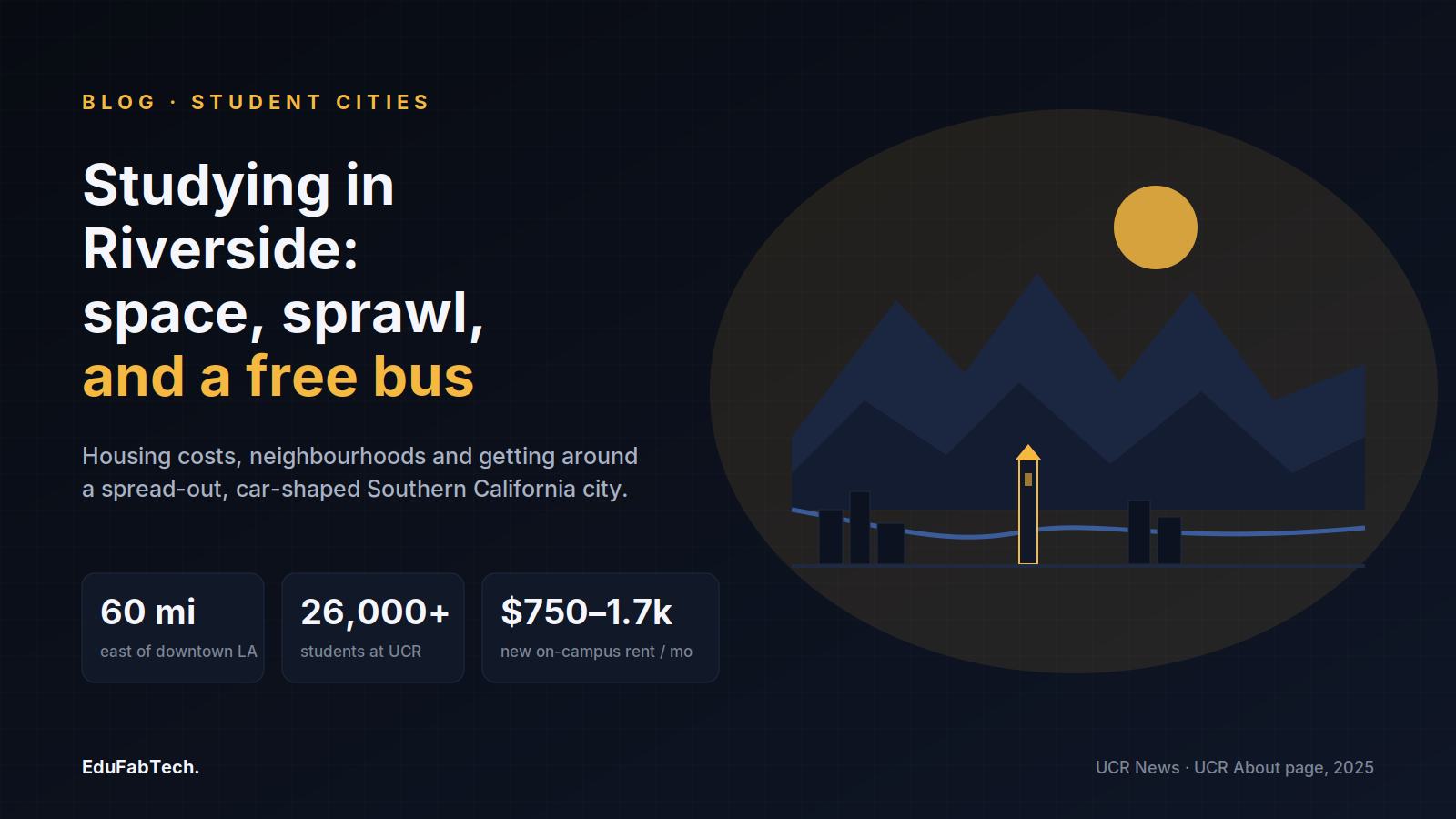
Riverside sits about 60 miles east of downtown Los Angeles, in the broad, dry basin that Californians call the Inland Empire. The city of roughly a third of a million people is wedged between the Box Springs Mountains and the Santa Ana River, with the snow-topped San Bernardino and San Jacinto ranges filling the horizon on clear winter mornings. By its own account, the University of California, Riverside describes the setting as Inland Southern California, with diverse geography running "from the desert to the coast." For a student, the practical translation is this: you are not in a dense coastal college town but in a spread-out, car-shaped Southern California city where summers are long and hot and the ocean is an hour or two of traffic away.
That geography shapes everything about studying here. Riverside is not one campus and one neighbourhood; it is a scattering of universities across a region, linked by freeways, a local bus network and a commuter rail line. Some students live within walking distance of lectures. Many more drive, and a growing number ride a free bus pass they may not know they already own. The upside is space and comparatively lower rents than the coast; the downside is sprawl, heat, and the quiet assumption that you have a car.
The student body is unusually diverse, both ethnically and economically. UCR is frequently cited for social mobility, and the campus and its neighbours serve a large share of first-generation and local students alongside those arriving from across the world. That mix sets the tone: Riverside is a working, commuter-heavy student city rather than a postcard one.
The universities, named
University of California, Riverside is the anchor. Its main campus spreads across nearly 1,200 acres on the city's east side, below the Box Springs Mountains, and it enrols more than 26,000 students, according to the university's own About page. UCR runs on the quarter system, grants degrees across the sciences, humanities, business and engineering, and houses the UCR School of Medicine, the Bourns College of Engineering and well-regarded programmes in entomology, plant sciences and creative writing. The students are the Highlanders; the campus bell tower and the botanic gardens on the hillside are the landmarks you will hear about first.
California Baptist University is the city's other large institution, a private Baptist university on Magnolia Avenue in the Magnolia Center district, a few miles south-west of downtown. Its students are the Lancers, and the campus has grown quickly over the past two decades into one of the larger Christian universities in the state. La Sierra University, a private Seventh-day Adventist institution founded in 1922 and independent since 1990, sits further west in the La Sierra neighbourhood, near the Metrolink station of the same name. Together these three put tens of thousands of degree-seeking students inside the city limits.
Around Riverside, within a short drive across the Inland Empire, are several more. Loma Linda University, in nearby Loma Linda, is a Seventh-day Adventist health-sciences university founded in 1905, built around medicine, dentistry, nursing, pharmacy, public health and allied health, with its medical centre attached. California University of Science and Medicine in Colton is a young medical school, founded in 2015, granting the Doctor of Medicine degree. California State University, San Bernardino lies to the north in San Bernardino, a large public comprehensive university and designated Hispanic-Serving Institution. University of Redlands, in Redlands to the east, is a private liberal-arts university founded in 1907 on a residential campus near its own downtown.
Further west, in Claremont at the Los Angeles County line about half an hour away, is the cluster of the Claremont Colleges. Claremont Graduate University, graduate-only since 1925, grants master's and doctoral degrees and shares a consortium library with its neighbours Pomona College and Claremont McKenna College. Claremont Lincoln University, also in Claremont, is a non-profit, fully online university accredited by the WASC Senior College and University Commission. Closer to home, Moreno Valley College, part of the Riverside Community College District, offers associate degrees and career certificates with a strong health-education focus and feeds transfer students into the four-year campuses.
Neighbourhoods students settle into
Where you live depends almost entirely on which campus you attend, because Riverside is too spread out to treat as a single housing market. A short list of the areas students actually choose:
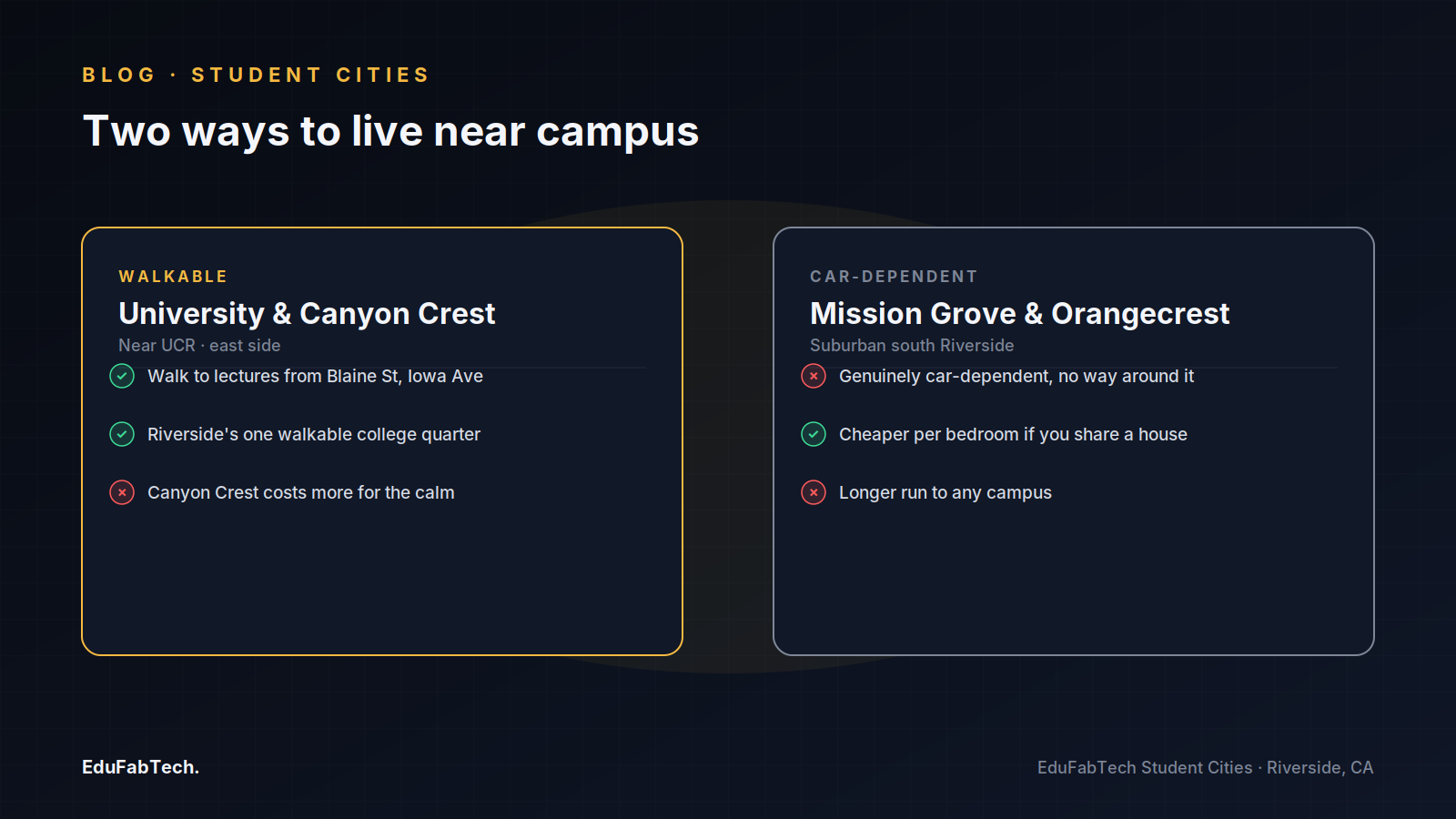
- University and Canyon Crest (near UCR). The streets east of campus — around Blaine Street, Iowa Avenue and Linden Street — are dense with student apartments and the closest thing Riverside has to a walkable college quarter. Canyon Crest, just south, is quieter and greener, a mix of condos, apartments and family homes with its own small shopping centre; rents run a little higher for the calm.
- Downtown Riverside. The historic core around the Mission Inn, the museums and the pedestrianised Main Street is the most urban, walkable part of the city, with cafés, a farmers' market and the Riverside–Downtown Metrolink station. It appeals to students who want street life and don't mind older buildings; it is a bus ride, not a walk, from UCR.
- Eastside. Wedged between downtown and UCR, this older, historically diverse neighbourhood tends to be more affordable and is well placed for anyone splitting time between campus and the city centre.
- Magnolia Center and Arlington (near CBU). The corridor along Magnolia Avenue around California Baptist is where many of that university's students look first — ordinary Southern California apartment blocks and houses, close to shops and the bus.
- La Sierra (near La Sierra University). West Riverside around the university and its Metrolink station is lower-key and residential, handy if you study there or commute west toward Corona and Orange County.
- Mission Grove and Orangecrest. Suburban south Riverside: newer, calmer, cheaper per bedroom if you share a house, but genuinely car-dependent and a longer run to any campus.
You can browse what is currently available across these areas on EduFabTech's rooms page, and filter for places near UC Riverside if your campus is fixed.
Renting around Riverside's campuses
On-campus housing is the simplest first year, and UCR has just added a lot of it. The university's new North District complex opened for move-in in late August and September 2025 with 1,568 beds in 429 fully furnished one- to four-bedroom apartments, UCR News reported; the university set rents on 916 of the beds at roughly $1,300 to $1,700 a month depending on room size and type, with a further 652 below-market beds at $750 to $850 split between lower-income UCR and Riverside Community College District students sharing the building. Those are concrete, current numbers to measure any off-campus offer against.
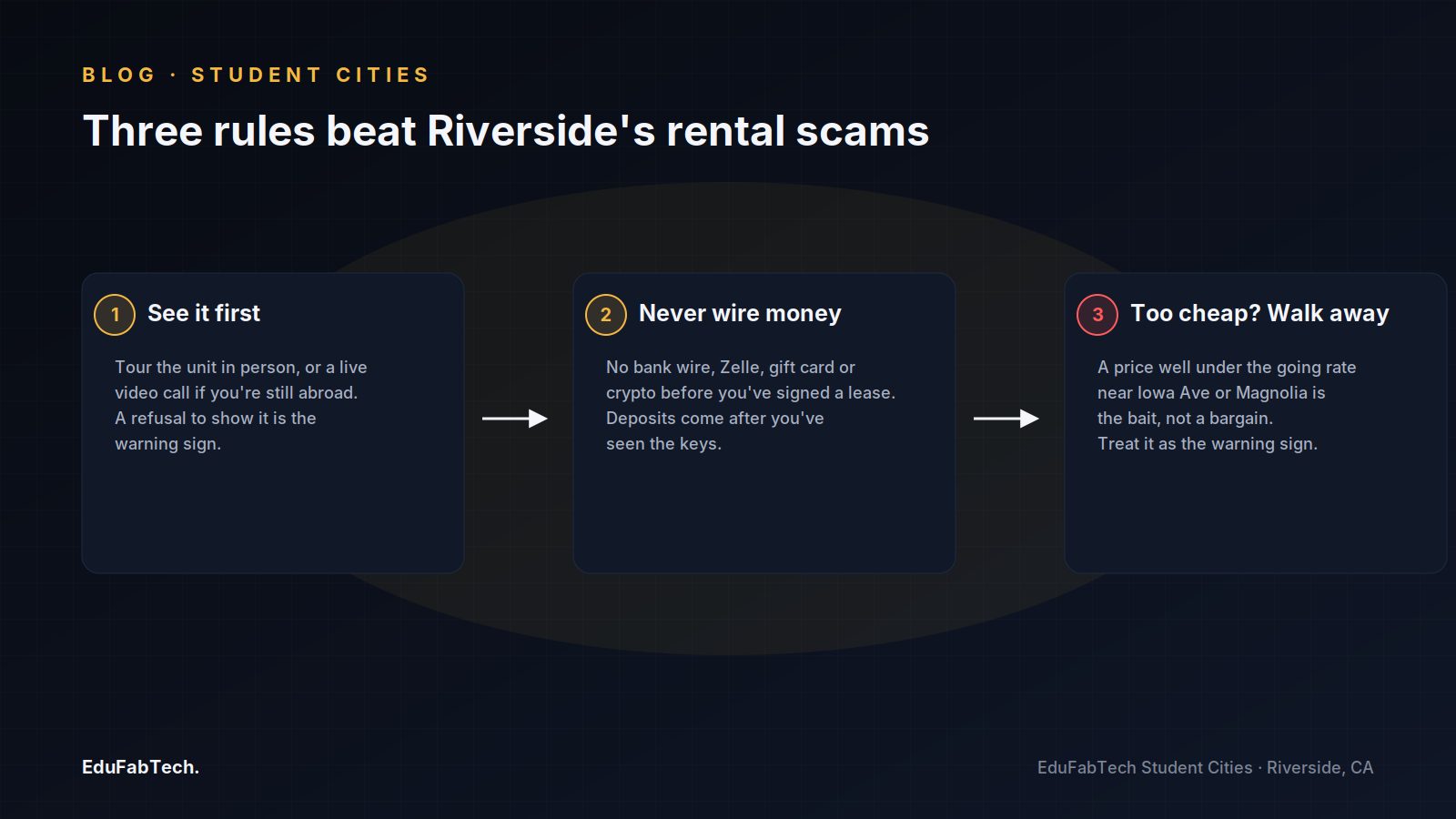
Off campus, start early. UCR's quarter calendar means the crush hits in late summer before the September move-in, so begin looking in June or July for autumn. Both UCR and California Baptist run official off-campus housing portals through their student services; use them as your baseline, because listings there are at least tied to the university. The honest risk in Riverside is the same one that turns up in every fast-moving rental market: a listing for a tidy apartment near UCR on Iowa Avenue or Canyon Crest, or near CBU off Magnolia, priced slightly below everything around it, from a "landlord" who is travelling and wants a deposit to "hold" the unit before you can see it.
Three rules defeat almost all of it. See the actual unit in person, or have someone you trust see it, before any money changes hands — a video call walking the rooms is a reasonable substitute if you are still abroad, but a refusal to show the place at all is the warning sign. Never send money by bank wire, Zelle, gift card or cryptocurrency to reserve a room; legitimate Riverside landlords and leasing offices take a deposit after you have signed a lease, not before you have seen the keys. And treat a price well under the local run of rents as the bait it usually is. A normal move-in here means a signed lease, a security deposit and usually the first month up front, paid to a named person or office you have met. If you are furnishing from scratch, EduFabTech's second-hand listings are a safer place to spend than a stranger's "holding fee".
Furnishing cheaply, and where Riverside buys second-hand
Riverside is good terrain for furnishing a room without buying new. The city's signature market is the antique and collectibles trade along the Main Street pedestrian mall downtown, and the much larger weekend swap meets at the Van Buren Drive-In on Van Buren Boulevard, where sellers spread out household goods, furniture and bicycles. Thrift chains — Goodwill, Savers and the Salvation Army — have several branches across the city, and the turnover of students every quarter means usable desks, chairs and mini-fridges circulate constantly, especially at term's end.
For furniture specifically, it is worth watching EduFabTech's second-hand furniture listings around the June and September move-out dates, when departing students shed everything they cannot fit in a car. Buy local and collect in person: a desk is rarely worth paying to ship, and a cash handover at a real address is also a quiet way to confirm the person is who they say they are.
Working while you study
Rules on part-time work depend heavily on your status, and this is one area where it pays to read the official source rather than a forum. International students on an F-1 visa are generally limited to on-campus work and must obtain specific authorisation for most off-campus employment; the U.S. Department of Homeland Security explains the categories — on-campus work, Curricular Practical Training and Optional Practical Training — on its Study in the States site, which is the authority to trust over any second-hand summary. This is not legal advice, and the details change; confirm your own case with the international-student office at your university — UCR's International Students and Scholars office, or California Baptist's International Center — before you take any job.
For students who can work, a university city of this size has the usual on-campus roles — libraries, dining, labs, administrative and research assistantships — plus the retail and hospitality jobs that come with a large commuter population. Current local openings are gathered on EduFabTech's Riverside jobs page.
Libraries and places to think
UCR's Orbach Science Library and Rivera Library are the main study buildings on campus, extending their hours during finals week each quarter; between them they cover the sciences and the humanities and provide the group rooms and quiet floors most students end up living in before exams. Off campus, the Riverside Public Library, with its main branch downtown and neighbourhood branches around the city, gives you a free, quiet alternative that does not require a student ID, along with the Riverside County Library system. California Baptist, La Sierra and the other campuses each run their own libraries for their students. When those are full in exam season — and they do fill — EduFabTech's study-spaces listings can point you to desks and quiet rooms elsewhere in the city.
Buses, trains and the car question
The single most useful thing an incoming student can know about getting around Riverside is that the local bus may already be free to them. The Riverside Transit Agency runs the city's buses, and its Go-Pass and U-Pass programmes let enrolled students at participating institutions ride the RTA network at no extra fare. California Baptist spells it out on its own transportation page: currently enrolled CBU students get free access to the RTA bus system through the RTA GoMobile app, with the pass requested per semester for registered students. The same type of programme covers students at other participating campuses, including UC Riverside and the Riverside Community College District colleges. You download the GoMobile app, register with your university email, and show the on-screen pass to the farebox reader.
For longer trips, Metrolink — the regional commuter rail run by the Southern California Regional Rail Authority — connects Riverside to Los Angeles, Orange County and San Bernardino from three city stations: Riverside–Downtown, Riverside–Hunter Park/UCR and Riverside–La Sierra. RTA buses link those stations to the campuses. None of this fully removes the car, though. Riverside was built for driving, many of the apartment areas and the suburban neighbourhoods are poorly served in the evenings, and a car remains the normal way most students reach a supermarket, a weekend job or the coast. Budget honestly for whether you will need one.
What it costs, and the honest trade-offs
Housing is the figure that matters most, and UCR publishes a usable one. For a California resident living in university housing in 2025–2026, the university's Cost of Attendance lists housing and food together at $20,425 for the year, within a total estimated cost of $44,839 including tuition and fees of $14,934. Non-resident and international students carry the same housing-and-food figure but add $37,602 in non-resident supplemental tuition, for a published total of $82,441. These are the university's own planning estimates for the academic year, not a quote for a specific room, but they frame the scale: housing and food alone are the price of a small car every year.
Off-campus rents in Riverside are generally lower than on the Los Angeles or Orange County coast, which is the city's main financial advantage for students — more space and a lower monthly rent than you would pay 60 miles west. Set against that are the real costs of sprawl: the car or the long bus ride, the petrol, and summers hot enough that air conditioning is not optional, which pushes up the electricity bill from roughly June to September. The city sits in a basin that traps smog blowing in from the coast, and its summer air quality is often poor — worth knowing about if you have asthma. And while Riverside is cheaper than the coast, it is not cheap in absolute terms by the standards of much of the United States or the world.
What is genuinely good here: a large, diverse and welcoming student population; a strong anchor university expanding its housing rather than letting it stagnate; a free transit pass that quietly solves a real expense; nearby mountains, desert and beaches within a day trip; and a pace and cost that, for all the grumbling about sprawl, are easier than California's famous coastal cities. What is hard: the commuting culture, the summer heat and air, the thin evening transit, and the quiet default that you will drive. Go in expecting a working commuter city and Riverside rewards you; expect a compact walkable campus town and it will not.
A checklist for your first weeks
- Confirm your housing in writing and keep the signed lease; if you took a university room, note your move-in date against UCR's quarter calendar.
- Download the RTA GoMobile app and activate your free Go-Pass or U-Pass with your university email before classes start.
- Get your student ID and library access set up; locate Orbach and Rivera libraries, or your own campus library, and the nearest Riverside Public Library branch.
- If you are an international student, visit your campus international office and read the official Study in the States work guidance before accepting any job.
- Furnish from local second-hand sources rather than buying new, and watch the June and September move-out weeks for what departing students give away.
- Decide the car question early, and if you are going without one, test your real bus or Metrolink commute before you commit to a lease far from campus.
A quick question for readers
Do you work part-time while you study?
Many students work to pay the bills. See how common it is — and how many hours people really do.
Pick an answer, create a free account in a minute, and your vote counts. Already a member? Sign in
Source: University of California, Riverside
Sources (5)
- University of California, Riverside. Cost of Attendance 2025-2026. University of California, Riverside, 2025. financialaid.ucr.edu ↗ · checked 4 Oct 2026
- UCR News. New UCR student housing complex to open. University of California, Riverside, 2025. news.ucr.edu ↗ · checked 4 Oct 2026
- University of California, Riverside. About UCR. University of California, Riverside, 2026. ucr.edu ↗ · checked 4 Oct 2026
- California Baptist University. Transportation Programs (RTA Go-Pass). California Baptist University, 2026. calbaptist.edu ↗ · checked 4 Oct 2026
- Riverside Transit Agency. Go-Pass / U-Pass. Riverside Transit Agency, 2026. riversidetransit.com ↗ · checked 4 Oct 2026