Studying in Rochester, United States: universities, housing and student life
A practical, sourced guide to Rochester's universities, where students live, what a room costs, how to get around in a snowbelt city, and the honest trade-offs.
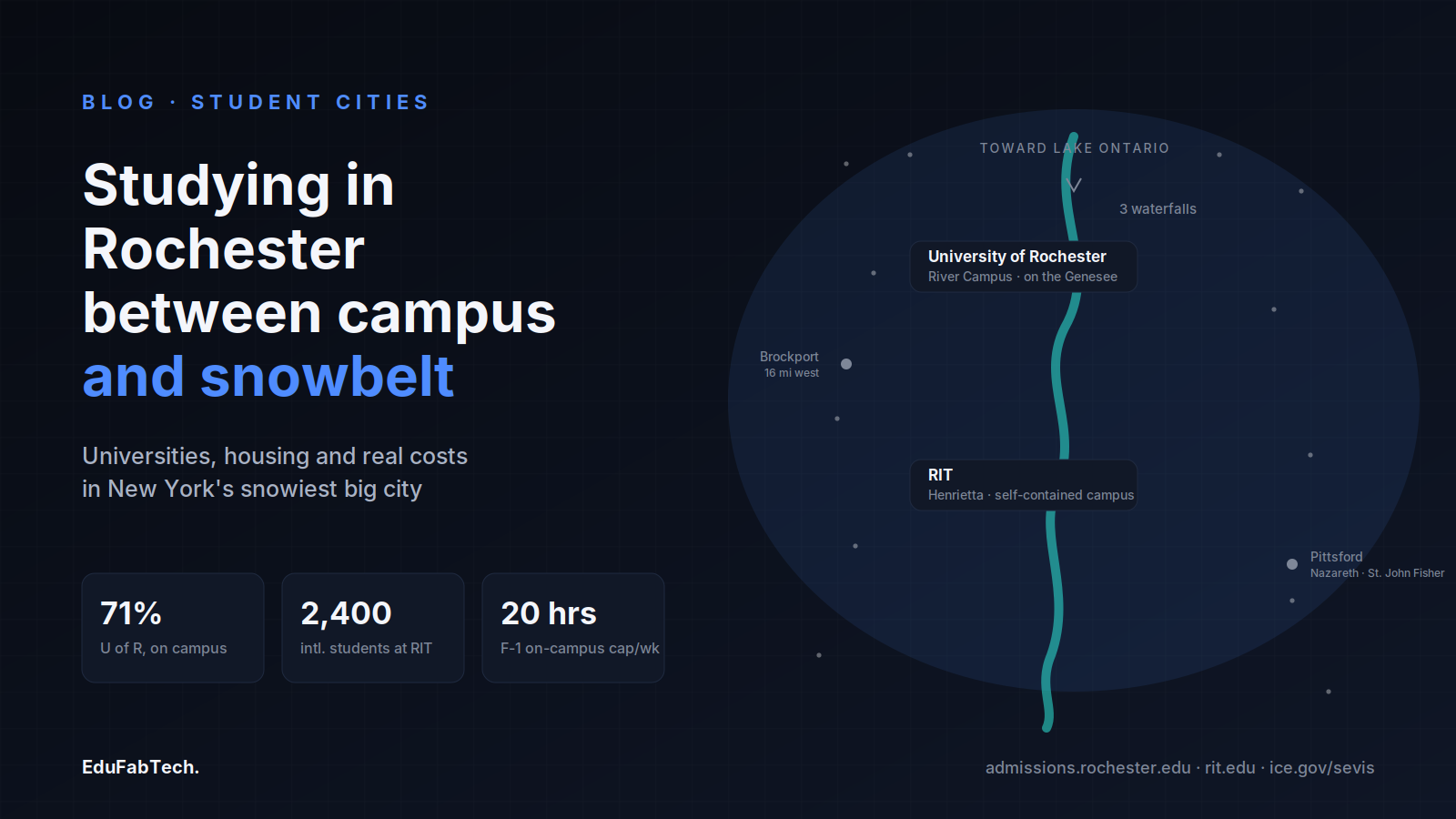
Rochester sits in western New York where the Genesee River cuts north through the middle of the city and drops over three waterfalls on its way to Lake Ontario, a few miles past downtown. It is the third-largest city in the state, after New York City and Buffalo, and it carries two industrial names at once: the Flower City, from the nurseries that once ringed it, and the company town that grew up around Eastman Kodak, Xerox and Bausch & Lomb. That optics-and-imaging heritage still shapes what the universities here are strongest at, and it shapes the kind of student who comes.
Students are not concentrated in one quarter the way they are in a classic college town. The University of Rochester sits on a bend of the Genesee just south of downtown; Rochester Institute of Technology is a self-contained campus in the suburb of Henrietta, several miles further south; and a ring of smaller institutions sits in the villages around the edge — Brockport to the west, Pittsford to the south-east. Where you live, how you commute and what you pay depend heavily on which of these you attend.
The other fact that governs student life here is the weather. Rochester is one of the snowiest big cities in the United States, and planning a room, a commute and a winter wardrobe around that is not optional. The rest of this guide is specific to the city: its campuses, its neighbourhoods, its market, its buses and its costs. You can browse current student listings for the city on EduFabTech's Rochester page alongside what follows.
The campuses, from the Genesee to Henrietta
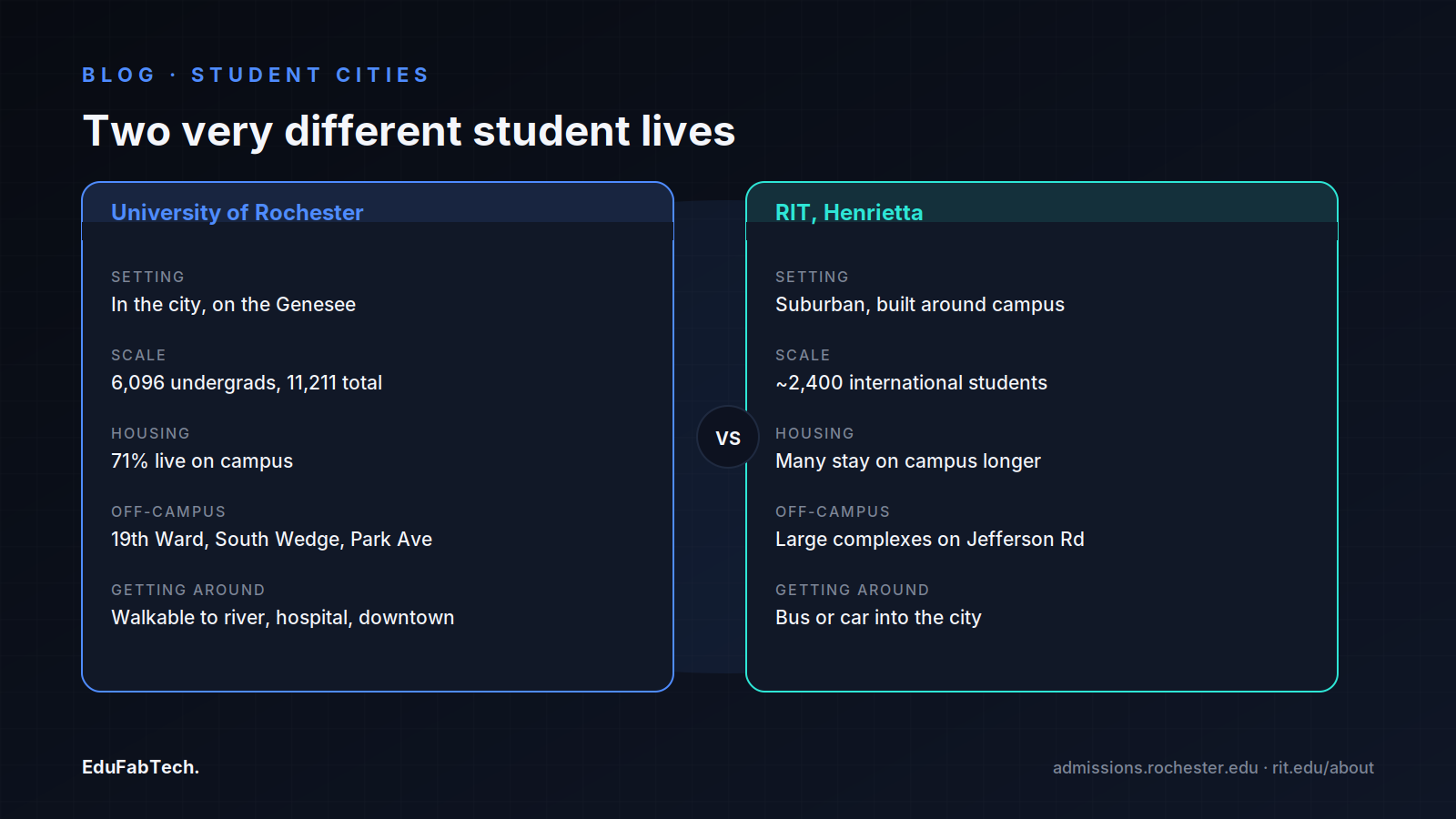
The University of Rochester is the private research university most people mean when they say "U of R." Its main River Campus sits at 300 Wilson Boulevard on the west bank of the Genesee. According to the university's own facts page, it enrolled 6,096 undergraduates and 11,211 students university-wide in 2025–26, and 71% of students live on campus (admissions.rochester.edu). It is known for federally funded research across science, engineering, medicine and the humanities, and it includes the Eastman School of Music, which occupies its own building downtown, and a large academic medical centre immediately south of the River Campus.
Rochester Institute of Technology is a different kind of place — a sprawling brick campus at 1 Lomb Memorial Drive in Henrietta, built after RIT left downtown in the late 1960s. RIT's strengths sit in computing, imaging science, engineering, photography and film, art and design, and its co-op programme, under which students alternate semesters of paid work with study. RIT states on its own site that it enrols about 2,400 international students (rit.edu/about). Two parts of RIT are worth naming on their own. The National Technical Institute for the Deaf, one of RIT's colleges, describes itself as "the first and largest technological college in the world for deaf and hard-of-hearing students," with more than 1,100 deaf and hard-of-hearing students studying alongside hearing peers (rit.edu/ntid). RIT's engineering programmes sit within the Kate Gleason College of Engineering, named after a Rochester engineer and industrialist.
Three more degree-granting institutions sit in the villages around the city, and students at them still live and shop in greater Rochester. The State University of New York at Brockport is a public campus on the Erie Canal about 16 miles west of the city (suny.edu), the most affordable of the local options because SUNY tuition is set by the state system. Nazareth University is a private university on a 150-acre campus on East Avenue in Pittsford, south-east of downtown (naz.edu). St. John Fisher University, also in the Pittsford area and a short drive from downtown, is a private university known for its nursing and health-sciences programmes (sjf.edu).
Practically, this means the "studying in Rochester" experience splits in two. At U of R you are in the city, within walking distance of the river, the hospital and neighbourhoods full of off-campus houses. At RIT you are in a suburb organised around the campus itself, where most daily life happens on university land and a car or a bus route into the city is how you reach everything else. Decide which of those two lives you want before you choose where to rent.
Neighbourhoods students actually settle in
Around the University of Rochester, students cluster in a handful of nearby neighbourhoods. The 19th Ward, directly across the Genesee from the River Campus, is a grid of early-20th-century houses, many split into rented flats. Mount Hope and the South Wedge, between the campus and downtown, put you within walking or short-bus distance of the hospital and the river trail. Further out, Park Avenue and the Monroe Avenue corridor are the dense, walkable, café-and-bar districts that older undergraduates and graduate students favour. The university also runs College Town, a mixed-use development of flats and shops next to the medical centre, if you want to stay close to campus without a traditional dorm.
Around RIT the pattern is suburban. Henrietta is built along commercial roads such as Jefferson Road and West Henrietta Road, and off-campus student housing is mostly in large apartment complexes within a bus ride or short drive of campus rather than in a walkable neighbourhood. Many RIT undergraduates stay in university housing longer than they might in the city precisely because the surrounding area is spread out. SUNY Brockport students mostly live in the compact village around the campus and the canal, which keeps a car optional there in a way it rarely is elsewhere in Henrietta. You can compare rooms across these areas on EduFabTech's Rochester rooms listings and filter by what is near the University of Rochester or RIT.
Signing a lease without losing your deposit
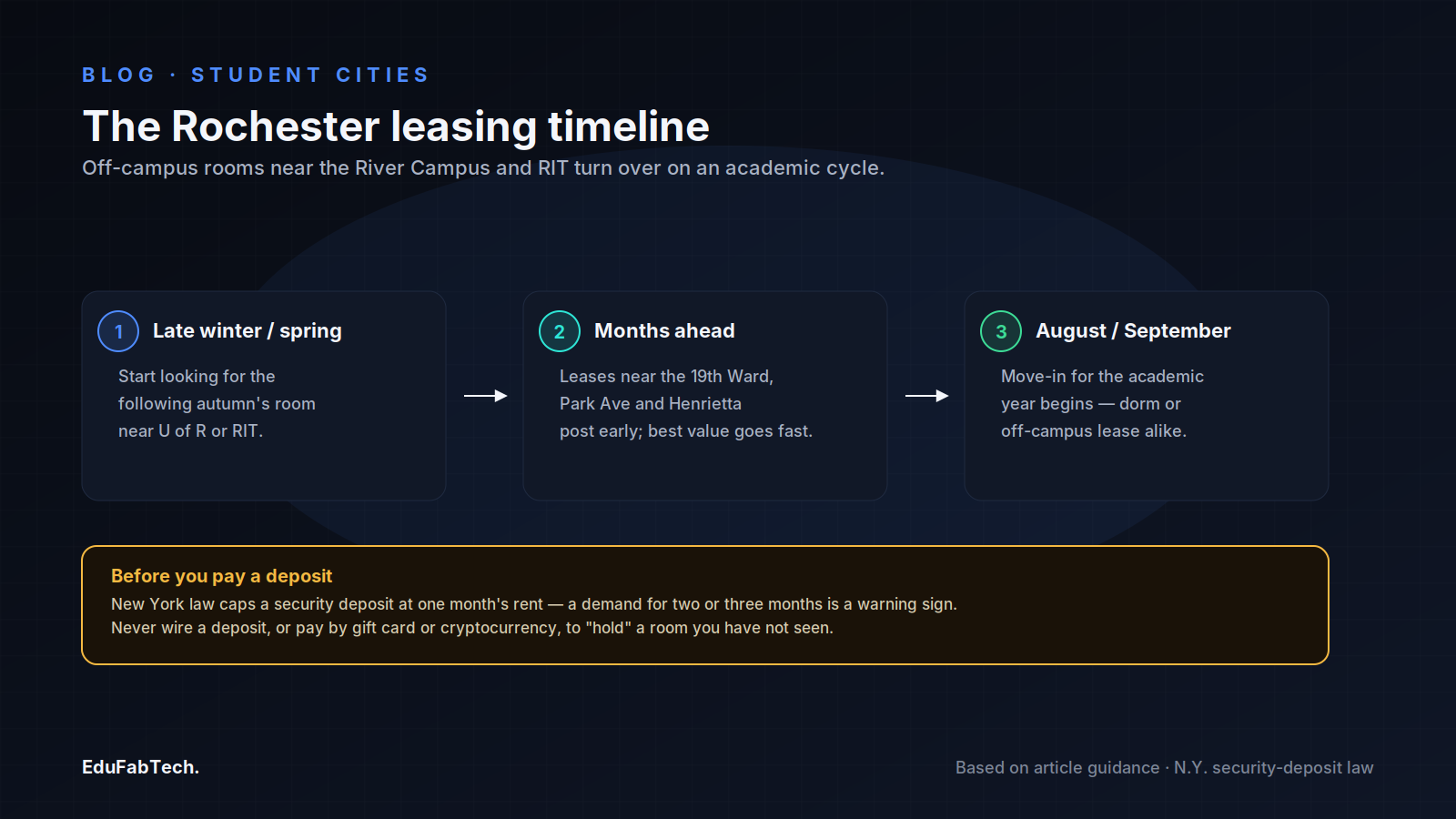
If you will live in a dormitory, the timeline is set by the university housing office and your contract is with the institution — straightforward, if not cheap. The off-campus market is where care is needed. Rochester's student rentals turn over on an academic cycle: leases for houses in the 19th Ward, the South Wedge and Park Avenue, and for the Henrietta complexes near RIT, are typically advertised months ahead for an August or September start, and the best-value places go early. Starting to look in late winter or early spring for the following autumn is normal.
The scams that appear in Rochester are the ordinary ones that follow any student market: listings for houses near the River Campus or RIT at prices that look too good, posted by someone who says they are "out of town" and wants a deposit to "hold" the room before you can see it. Treat that as the warning sign it is. See the actual unit in person, or send someone you trust, before you pay anything; meet the person who manages the building; and confirm the address is a real rentable unit and not a photo lifted from elsewhere. Never send a deposit or first month's rent by bank wire transfer, gift card or cryptocurrency to secure a place — no legitimate landlord in Rochester needs to be paid that way, and those payments cannot be recovered. In New York, a security deposit on most residential leases is limited by state law to one month's rent, so a demand for two or three months up front should make you pause and check. Get the lease and any promises in writing before money changes hands.
Furnishing a room, and the Public Market
Rochester's landmark for cheap, practical shopping is the Rochester Public Market at 280 North Union Street, which the City of Rochester says has operated since 1905 and now opens Tuesday and Thursday from 6 a.m. to 1 p.m. and Saturday from 6 a.m. to 3 p.m. (cityofrochester.gov). Beyond produce, meat and dairy, its stalls carry what the city describes as "general merchandise," and the market is the cheapest way in town to fill a fridge and a kitchen cupboard at once. For furniture and the things a dorm room needs, the end-of-year move-out period in May and the start of term both flood the second-hand market, and buying used is far cheaper than furnishing from new. EduFabTech keeps running local listings for second-hand goods and used furniture in the city, which is worth watching around those dates.
Working while you study
If you are an international student on an F-1 visa, the rules on working are federal, not local, and they are strict. U.S. Immigration and Customs Enforcement, through the Student and Exchange Visitor Program, states that F-1 students may work on campus up to 20 hours per week while school is in session, and full-time during periods when school is not in session (ice.gov/sevis). Off-campus work, and the training programmes known as Curricular Practical Training (CPT) and Optional Practical Training (OPT), carry their own conditions and approvals. This is not legal advice: the authoritative source is ICE/SEVP and your university's international student office, which is the designated office that authorises any work and should be your first stop before you accept a job. Domestic students face no such cap, and on-campus jobs — in libraries, dining halls, labs and the medical centre — are the usual starting point. Current local openings are collected on EduFabTech's Rochester jobs page.
Libraries and places to study
Each campus has its own anchor. At the University of Rochester, Rush Rhees Library on the River Campus is the main humanities and social-sciences library; its iZone collaboration space keeps long evening hours during term and the Gleason Library within the same building stays open around the clock (library.rochester.edu). At RIT, the Wallace Library in the Wallace Center has reservable study rooms and after-hours study space, with its coffee shop, Java Wally's, attached (rit.edu/library). Off campus, the Central Library of Rochester and Monroe County at 115 South Avenue downtown is free to use, open to the public, and part of the county-wide library system with branches across the city (roccitylibrary.org). It is a genuine alternative if you want a quiet desk away from campus, and a lifeline over breaks when campus buildings scale back.
Getting around a city built for cars and snow
Public transport in Rochester is run by the Regional Transit Service (RTS), whose buses converge on the RTS Transit Center downtown. On RTS's Monroe County fare schedule, effective 1 September 2025, a single ride on its fixed-route RTS Connect buses is $1.00, the reduced fare for seniors, riders with disabilities and children aged 6–11 is $0.50, an all-day pass is $3.00, and a monthly pass is $56 (myrts.com). RTS lists no separate student fare on that schedule, so check with your university about any pass arrangement before assuming one exists. Beyond the fares, two things define moving around here. First, this is a car-oriented metro: the bus network is usable, especially along the main corridors and between the campuses and downtown, but service thins in the suburbs and in the evenings. Second, the winter is the real planner. The National Weather Service office in Buffalo puts Rochester's typical seasonal snowfall at about 90 inches, rising to more than 120 inches along the Lake Ontario shore east of the city, with roughly half of it from lake-effect snow (weather.gov/buf). A room you can reach without a long outdoor walk, and boots you can trust, matter more here than in most American cities.
What it costs, and what is hard
The clearest housing figures are the universities' own. The University of Rochester's 2025–26 cost of attendance lists on-campus housing at $12,328 and food at $8,138 for the year, on top of tuition of $69,030 (rochester.edu/financial-aid). RIT's housing office lists 2026–27 residence-hall rates from $5,045 per semester for a multiple-occupancy room up to $6,430 for a single with a bathroom (rit.edu/housing/rates). Those are private-university dormitory prices; off-campus rents, and SUNY Brockport's public costs, run lower, and sharing a house in the 19th Ward or South Wedge is how most undergraduates bring the number down.
What is good about Rochester as a student city: it is cheaper than the big coastal metros; the Public Market, the river gorge and the Lake Ontario shore are real amenities; and the concentration of optics, imaging and medical research gives technical students an unusually strong local job and co-op market. What is hard: the winter is long, grey and snowy, and it tests anyone who has not lived with it; the metro is spread out and genuinely car-oriented, so a campus-adjacent room or a reliable bus route matters; and some neighbourhoods near the River Campus shade quickly from student streets into areas where you will want to know the block before you sign. None of that is unusual for a northern American city, but it is worth knowing before you arrive in August and discover it in January.
A checklist for your first two weeks
- Confirm your housing contract or lease in writing, and never send a deposit by wire, gift card or crypto to hold a room you have not seen.
- International students: visit your university's international student office before taking any job, and read the ICE/SEVP employment rules first.
- Get an RTS fare sorted and learn the route between your room, your campus and the downtown transit centre.
- Register for a free Monroe County library card for study space and borrowing off campus.
- Do one big second-hand run — the Public Market plus local used-furniture listings — before term fully starts.
- Buy real winter boots and a warm coat early; by December the snow is not a surprise anyone can afford.
- Walk your neighbourhood in daylight and after dark in your first week so you know it before you need to.
A quick question for readers
Do you work part-time while you study?
Many students work to pay the bills. See how common it is — and how many hours people really do.
Pick an answer, create a free account in a minute, and your vote counts. Already a member? Sign in
Source: University of Rochester
Sources (5)
- University of Rochester. University Facts; Undergraduate Tuition & Expenses 2025–2026. University of Rochester, 2025. admissions.rochester.edu ↗ · checked 4 Oct 2026
- Rochester Institute of Technology. Housing Rates 2026–2027; About RIT; NTID. Rochester Institute of Technology, 2026. rit.edu ↗ · checked 4 Oct 2026
- City of Rochester. Public Market. City of Rochester, NY, 2026. cityofrochester.gov ↗ · checked 4 Oct 2026
- Regional Transit Service. Fares and Passes (effective 9/1/25). RTS Monroe, 2025. myrts.com ↗ · checked 4 Oct 2026
- U.S. Immigration and Customs Enforcement. SEVP: Employment. ICE / SEVIS, 2026. ice.gov ↗ · checked 4 Oct 2026