Studying in Salt Lake City: universities, housing and student life
A practical, sourced guide to studying in Salt Lake City — its universities and colleges, the neighbourhoods students rent in, the free UCard transit, what a room costs, and the honest trade-offs of the Wasatch valley.
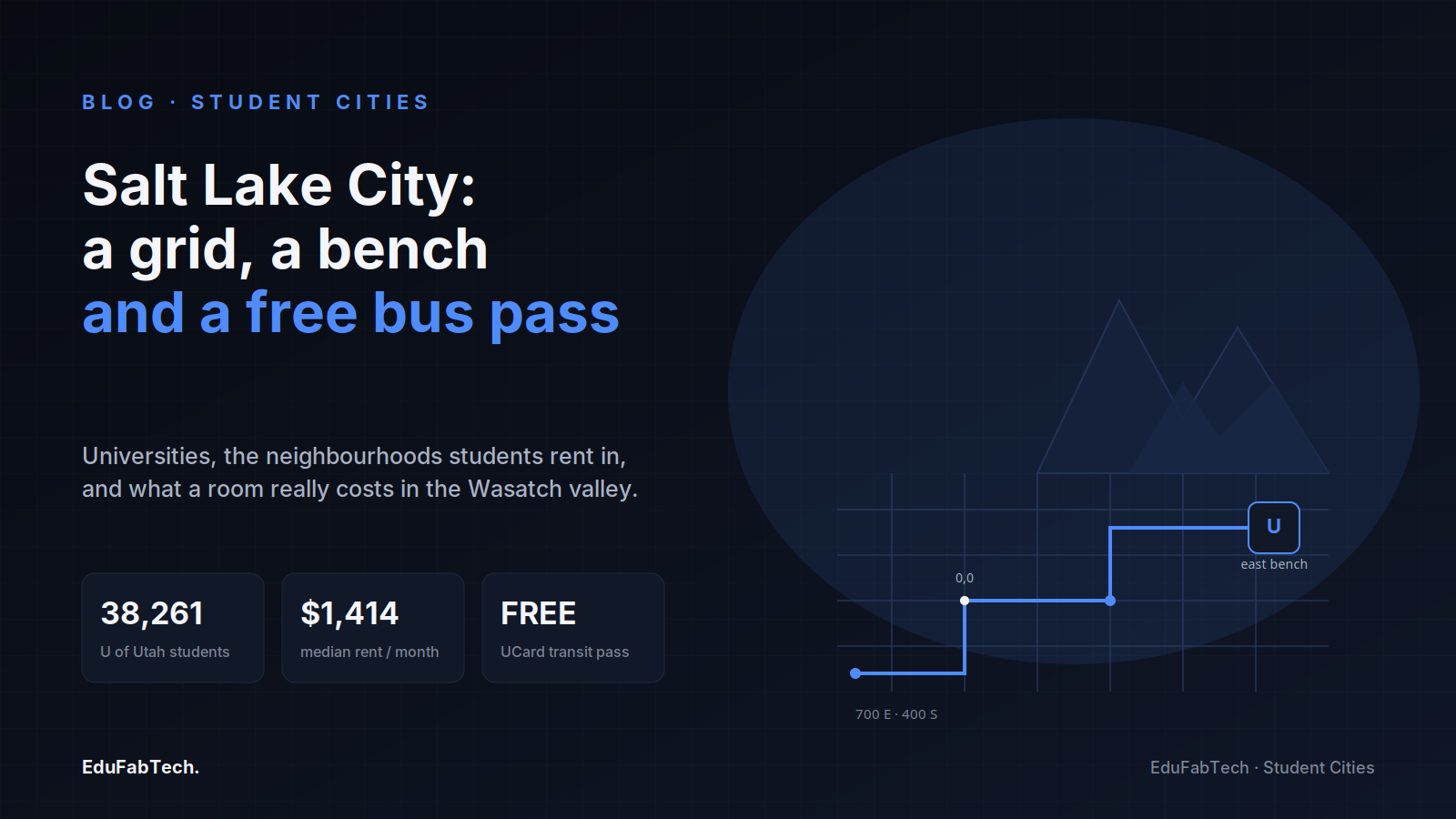
A grid city wedged against the Wasatch
Salt Lake City is laid out as a giant numbered grid, and once you understand it the whole city becomes legible. Addresses count outward from a single origin near Temple Square downtown, so a room advertised at "700 East, 400 South" is seven blocks east and four blocks south of that point. For a student hunting flats, that grid is a gift: you can read an address and know roughly how far it is from your campus before you have seen a map.
The valley floor tilts west from the Wasatch Mountains, which rise steeply along the eastern edge of town. The University of Utah sits on that eastern bench, above and to the east of downtown, with the mountains directly behind it. Rents and prestige generally climb with the land toward the east; the flatter, more affordable west side runs out toward the airport and the interstate. A light-rail and commuter-rail network ties the two together, which matters more here than in most cities this size because campuses are scattered across several suburbs.
The student population is correspondingly spread out. The University of Utah reports a Fall 2025 enrolment of 38,261 students and describes itself as a member of the Association of American Universities, on a campus of 1,534 acres, founded in 1850, according to its own Facts and Figures page. Add Salt Lake Community College's many campuses and a nursing university in the southern suburbs, and "studying in Salt Lake City" can mean anywhere from a bench above the city to a strip-mall campus twenty kilometres south.
The universities and colleges
The University of Utah is the anchor. Its main campus is on the east bench in Salt Lake City, and it is a public research university with a large academic medical centre attached — University of Utah Hospital, the Huntsman Cancer Institute and the Huntsman Mental Health Institute all sit on or beside campus, so health sciences, engineering and the sciences loom large in student life here. Within it, the University of Utah College of Science groups the university's science departments — among them biological sciences, chemistry, mathematics, physics and astronomy, and the geosciences — and runs undergraduate and graduate degrees on the same Salt Lake City campus, as its college site describes.
Joyce University of Nursing & Health Sciences is a separate, private institution in Draper, at the far south end of the valley. It is focused on nursing and allied health, offering pathways from associate through master's level in nursing and related fields, per its own site. It is a long way from the University of Utah, and students there live a suburban, car-oriented life rather than a bench-and-TRAX one.
Most students who are not at the University of Utah are at Salt Lake Community College, which spreads across the valley. Its Salt Lake Community College–South City Campus is in Salt Lake City itself, on State Street, and is the most transit-friendly; the large Salt Lake Community College–Taylorsville Redwood Campus in Taylorsville is the main hub. There are three more suburban sites — the Salt Lake Community College–Jordan Campus in West Jordan, the Salt Lake Community College–Miller Campus in Sandy, and the Salt Lake Community College–Meadowbrook Campus in South Salt Lake. SLCC is a two-year college whose associate degrees are built to transfer into the state's four-year universities, so many locals spend two years at SLCC and finish at the University of Utah.
Neighbourhoods students actually live in
The Avenues is the historic grid that climbs the hill immediately north-east of downtown, toward the university. Its late-1800s and early-1900s houses are widely cut into flats, and it is the default for University of Utah students who want to walk, bike or take a short bus ride to class rather than commute. Demand is high and streets are tight, but nothing else is this close to campus while still feeling like a neighbourhood.
Federal Heights and the Foothill area sit right against campus on the bench. This is the quietest and generally the priciest option, popular with graduate students and anyone who wants to roll out of bed and be in a lab in ten minutes. It is leafy, residential and a little sleepy after dark.
Sugar House, roughly a couple of miles south of campus, is where students go for actual city life: cafés, restaurants, a cinema, independent shops, and the S-Line streetcar that links into the wider TRAX light-rail network. Apartments tend to be a touch roomier for the money than in the Avenues, in exchange for a longer trip to campus.
Downtown and Central City, around the numbered-street core, suit students at SLCC's South City Campus or anyone who wants to be on a TRAX line and near the main public library. It is a mix of older walk-ups and newer apartment blocks, walkable and flat.
The west-side neighbourhoods — Rose Park, Glendale and Poplar Grove, across the interstate — are generally the cheapest in the city proper and are served by bus and FrontRunner commuter rail. For SLCC students, the suburbs around the campuses themselves — Taylorsville, West Jordan, Sandy and South Salt Lake — are cheaper and more spread out, and the TRAX Blue Line runs south through the valley toward Sandy, which makes a car optional rather than essential.
Finding a room without losing a deposit
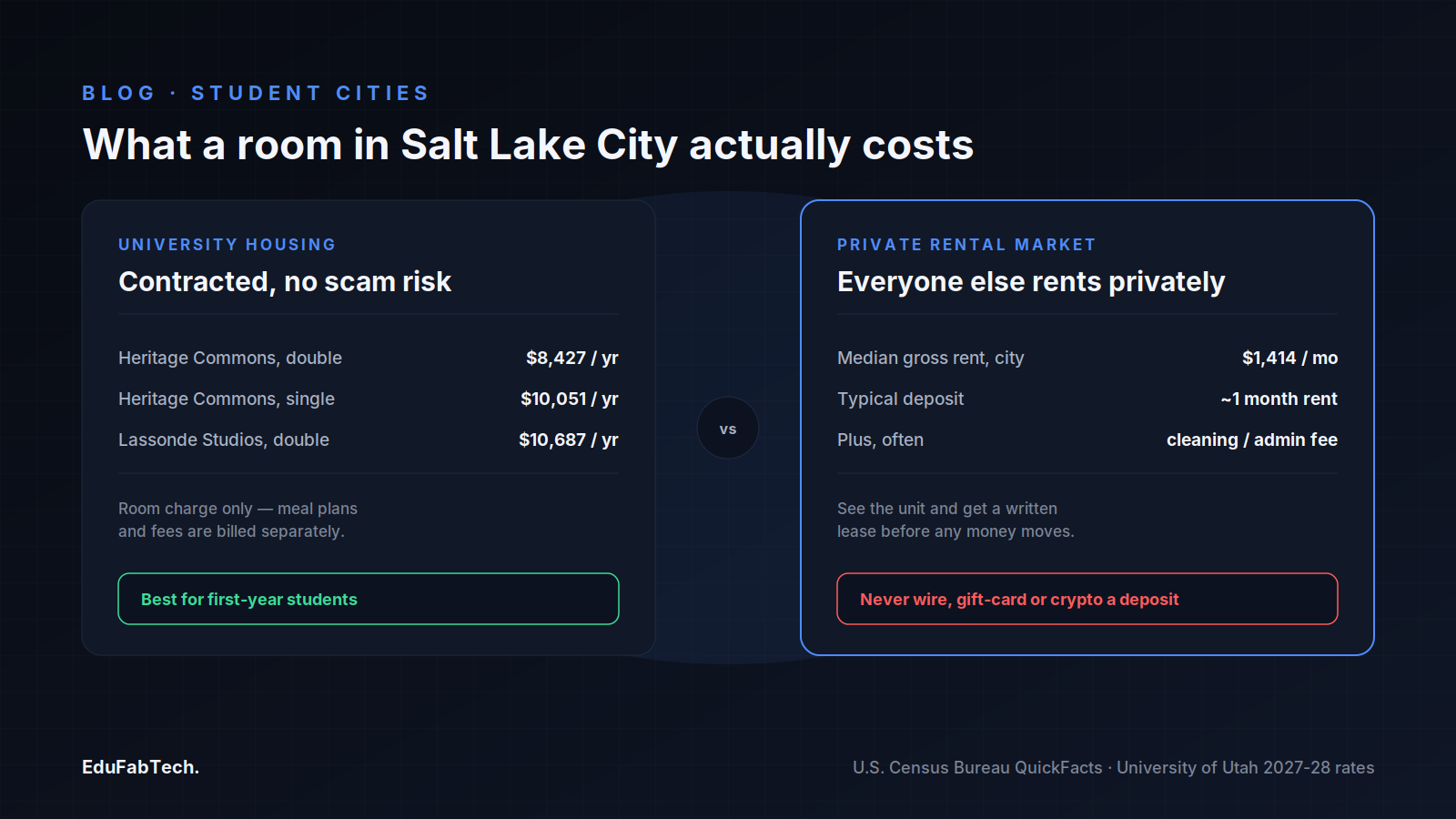
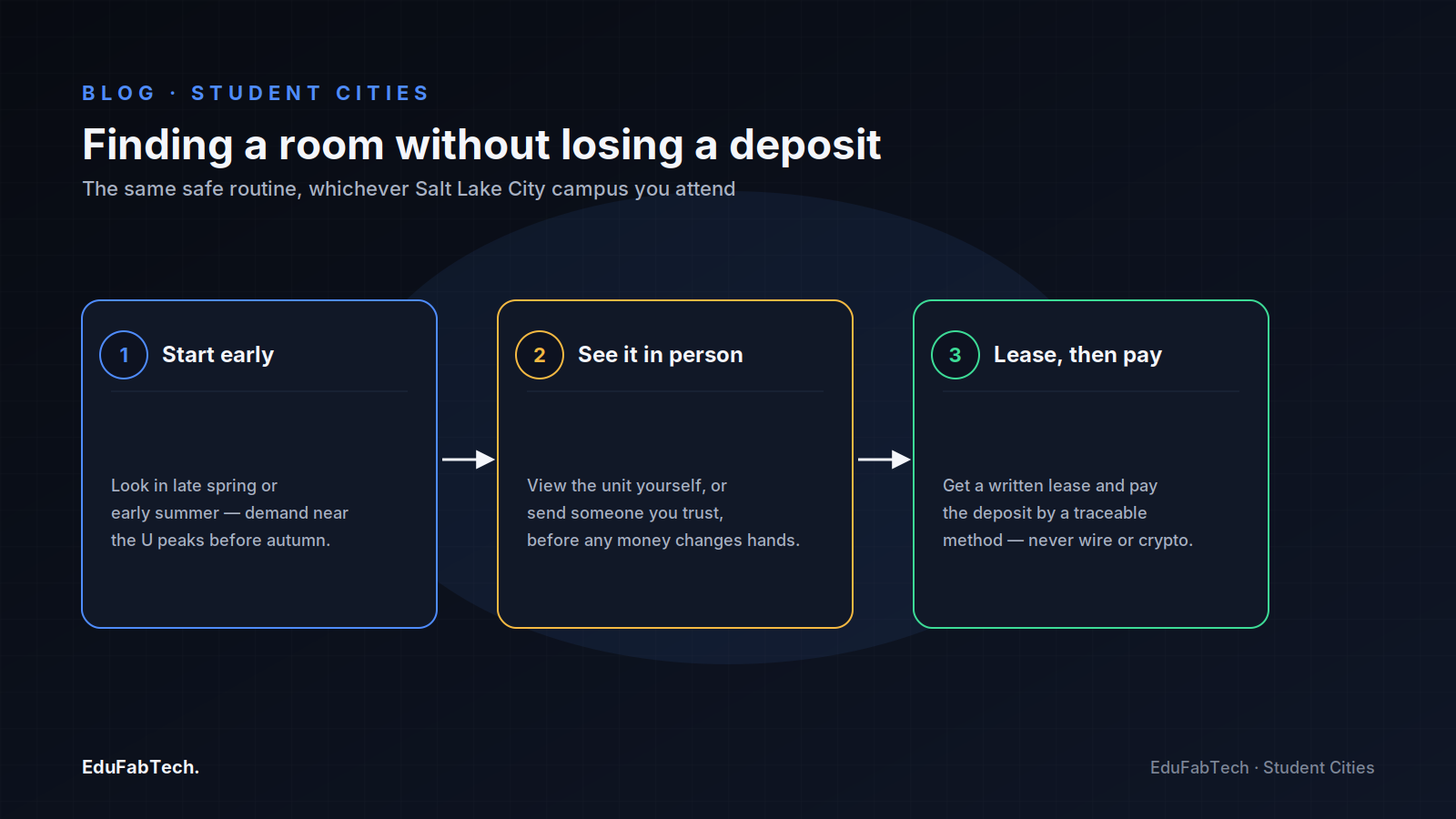
For first-year students at the University of Utah, the simplest safe option is university housing, which is contracted directly with the institution and removes the scam risk entirely. Everyone else rents privately, and the safe routine in Salt Lake City is the same whichever campus you attend. Start early — demand near the University of Utah peaks before the autumn semester, so looking in late spring and early summer gives you far more choice than arriving in August. Browse local listings, including the city-specific pages here on EduFabTech for rooms and the broader Salt Lake City listings, and use the grid address in each advert to check the real distance to your campus and the nearest TRAX or bus stop.
See the place, or have someone you trust see it, before any money changes hands. In Salt Lake City the fraud you are most likely to meet is the classic one: a room on the national rental sites, priced a little below the market, where the "owner" is conveniently out of state and asks you to wire a deposit to hold it. A genuine Salt Lake landlord expects to show you the unit, give you a written lease, and take a deposit by a traceable method. Never send money by bank wire, gift card or cryptocurrency to reserve a room you have not stood inside — those payments cannot be reversed, and no legitimate landlord here needs them. Expect to pay a deposit roughly in the range of one month's rent plus, often, a non-refundable cleaning or admin fee; ask which part is refundable and get it in writing before you sign.
As a sense of scale for the private market, the U.S. Census Bureau's QuickFacts put median gross rent in Salt Lake City city at $1,414 a month for the 2020–2024 period. For university housing, the University of Utah's 2027–2028 draft rates list a double room in the Heritage Commons first-year halls at $8,427 for the academic year and a single at $10,051, with newer buildings such as the Lassonde Studios higher again, a double there listed at $10,687 for the academic year. Those are room charges only; meal plans and fees are extra, and the university's rate estimator is the place to build a full figure.
Furnishing a room cheaply
Salt Lake City has an unusually strong second-hand economy, anchored by Deseret Industries, the thrift-store chain run by the Church of Jesus Christ of Latter-day Saints, with several large stores in and around the city selling donated furniture, kitchenware and clothing, as its own site describes. A single trip there can furnish most of a room. For food and the general feel of the city's markets, the Downtown Farmers Market at Pioneer Park (350 South 300 West) runs on Saturday mornings, roughly June to late October from 8am to 2pm, with a smaller indoor winter market on Saturdays from mid-November, according to the market's own listing; it is run as a program of the Downtown Alliance. When you move out, or move in, the EduFabTech pages for second-hand furniture and things given away free in the city are worth checking before you buy anything new.
Getting around on your UCard
Public transport is run by the Utah Transit Authority (UTA), whose network — buses, the TRAX light rail, the S-Line streetcar in Sugar House, and the FrontRunner commuter train up and down the Wasatch Front — covers the whole valley. The strongest student perk in the city is that the University of Utah's UCard doubles as a transit pass at no extra charge: UTA's school-pass page states the cost to students, faculty and staff is "NONE! It is FREE!" and that it is valid on bus, express bus, TRAX, FrontRunner, the S-Line and UTA On-Demand, excluding ski and paratransit service. Salt Lake Community College runs a comparable scheme: its OneCard page says SLCC "provides a transit pass to all active students, faculty and staff," good on UTA buses, TRAX, the S-Line and FrontRunner, though not express or ski buses, per the college's OneCard transit page. Between the free pass and the TRAX spine, many students here manage without a car — a real saving, given how spread out the valley is.
Libraries and places to study
On the University of Utah campus, the J. Willard Marriott Library is the main study building. Its spaces guide lists everything from silent floors and the George S. and Dolores Doré Eccles Grand Reading Room to the group-oriented Knowledge Commons and reservable study rooms, so you can match the room to the kind of work you are doing. Off campus, the City Library — the architecturally striking main branch of the Salt Lake City Public Library downtown — gives students who live away from campus a free, quiet place to work that is open to everyone, and the SLCC campuses each have their own libraries. For desk-sharing and other study spots around the city, the EduFabTech study-spaces listings are a useful supplement.
Working while you study
Students on an F-1 visa should treat work rules as a matter of their immigration status, not a casual decision, and confirm everything with their school's Designated School Official (DSO) in the Student and Exchange Visitor Program before taking any job. The headline rule, as stated by U.S. Immigration and Customs Enforcement's SEVP employment page, is that an F-1 student "may work up to 20 hours per week while school is in session" in on-campus employment, and full-time when school is not in session. Off-campus work is more restricted: U.S. Citizenship and Immigration Services' students-and-employment guidance states that F-1 students "may not work off-campus during the first academic year" and that later off-campus training — Curricular Practical Training and Optional Practical Training — must relate to the field of study and be authorised in advance. None of this is legal advice; your DSO and the official pages are the authority. For what is actually on offer locally, including on-campus roles, the EduFabTech jobs page is a starting point.
What is good, and what is hard
The good is genuine. A free transit pass on a real light-rail network, mountains and ski canyons within an hour of the lecture hall, a dry high-desert climate with a great deal of sun, and a compact, legible grid make Salt Lake City an easy place to live without a car and an unusually easy one to get outdoors from. The second-hand economy is strong, and the student rent is lower than in the big coastal cities.
The hard parts are real too. Housing demand near the University of Utah is tight and prices have been climbing, so the best rooms go early. The campuses are genuinely scattered — a student at a far SLCC campus or at Joyce University in Draper has a very different, more suburban experience than someone in the Avenues. Winters are cold and snowy, and the valley's geography traps cold, polluted air against the mountains during winter temperature inversions, which can make the air noticeably bad for days at a stretch. And Salt Lake City's culture is distinctive; it is more conservative and more shaped by the presence of the Church of Jesus Christ of Latter-day Saints than many newcomers expect, alongside a visible, growing secular and student scene.
A checklist for the first weeks
- Activate your UCard or SLCC OneCard and confirm it works as a UTA transit pass before you start paying fares.
- Learn the grid: practise reading a few addresses as directions from the downtown origin so you can judge distances instantly.
- If you rented privately, confirm in writing which part of your deposit is refundable and photograph the room's condition on day one.
- International students: meet your DSO early and get the on-campus employment and Social Security letters sorted before accepting any work.
- Find your default study spot — a Marriott Library floor or the downtown City Library — and your nearest TRAX or bus stop in the first week.
- Furnish from Deseret Industries and the city's second-hand and free-stuff listings before buying anything new.
- Plan for winter: warm layers, and a habit of checking air-quality alerts during inversion season.
A quick question for readers
Do you work part-time while you study?
Many students work to pay the bills. See how common it is — and how many hours people really do.
Pick an answer, create a free account in a minute, and your vote counts. Already a member? Sign in
Source: University of Utah
Sources (5)
- University of Utah. Facts and Figures. University of Utah, 2025. brand.utah.edu ↗ · checked 7 Oct 2026
- University of Utah Housing & Residential Education. Rates & Your Housing Account (2027–2028). University of Utah, 2027. housing.utah.edu ↗ · checked 7 Oct 2026
- Utah Transit Authority. University of Utah school pass program. Utah Transit Authority, 2026. rideuta.com ↗ · checked 7 Oct 2026
- U.S. Immigration and Customs Enforcement. Student and Exchange Visitor Program: Employment. U.S. Department of Homeland Security, 2026. ice.gov ↗ · checked 7 Oct 2026
- U.S. Census Bureau. QuickFacts: Salt Lake City city, Utah. U.S. Census Bureau, 2024. census.gov ↗ · checked 7 Oct 2026