Studying in San Antonio: universities, housing and student life
A practical, sourced guide to San Antonio's universities, where students live, what a room costs, part-time work rules, libraries, markets and getting around a wide, car-shaped city.
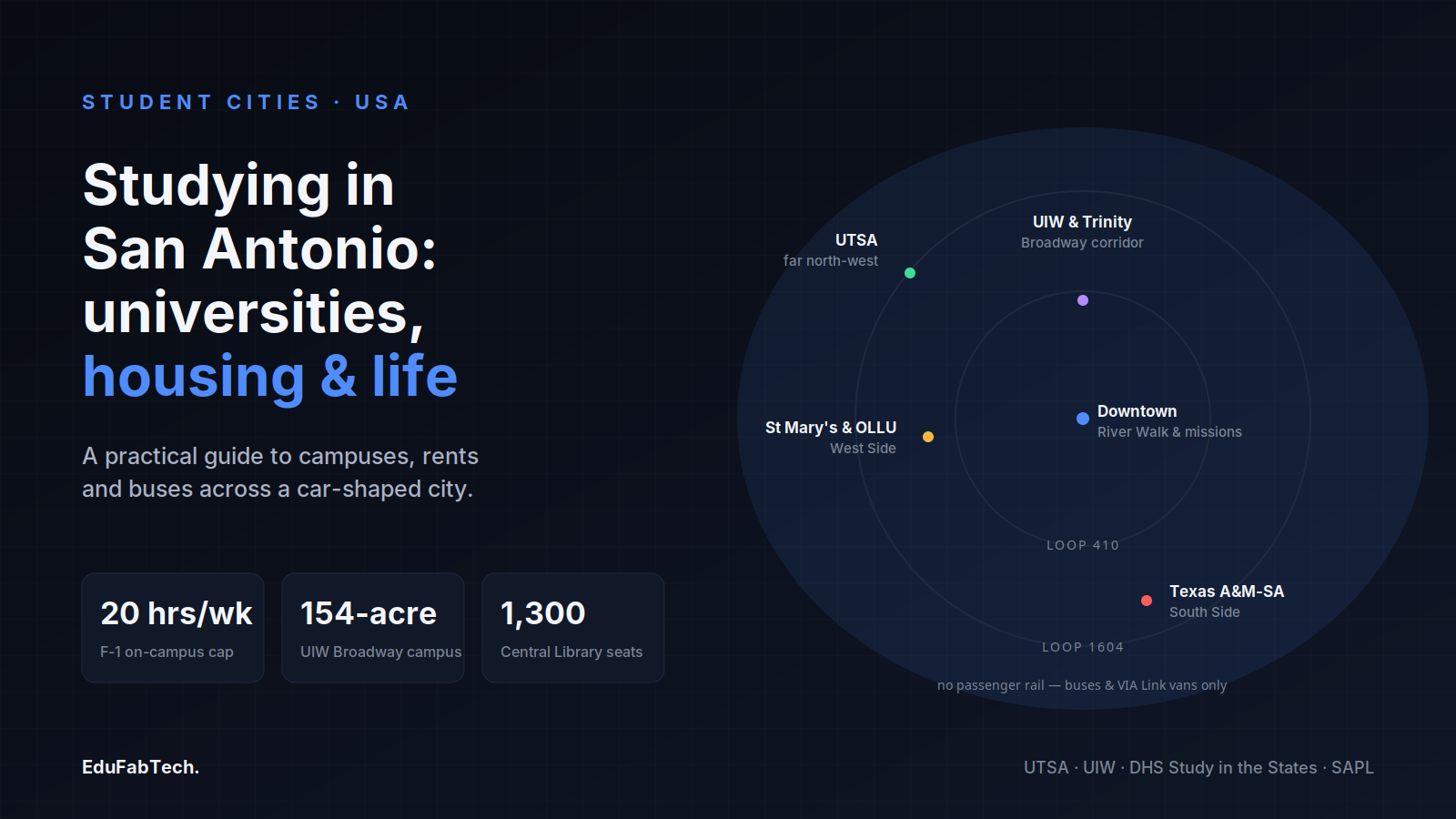
San Antonio spreads across South Texas in a way that shapes everything about student life here: a wide, low city of loop highways and old neighbourhoods, anchored by the River Walk and the eighteenth-century Spanish missions downtown, with universities scattered from the limestone hills of the far north-west to the flatlands of the South Side. There is no single student quarter. Where you study largely decides where you live, how far you travel and what you pay.
That dispersal is the first thing to grasp. A student at the main campus of the University of Texas at San Antonio lives a very different daily life from one near the Pearl and Brackenridge Park, or one commuting to the South Side. The city is built around Loop 410 and the outer Loop 1604, it has no passenger rail, and most routines assume a car. For students without one, the choice of neighbourhood and the bus map matter more than in a compact college town.
What follows is a grounded look at the universities, the housing market, the cost of a month, and the practical business of getting settled — with figures tied to the pages that publish them, so you can check them yourself before you commit money or a lease.
The universities, campus by campus
The University of Texas at San Antonio is the largest of the city's universities and the one most students mean when they say "UTSA". Its main campus sits in the far north-west off I-10 and Loop 1604, but the institution lists several locations in its general information — a Downtown Campus, the San Pedro I and II buildings used for data science and cybersecurity, a Southwest Campus and the Park West athletics complex — on the university's own catalog page. The health-sciences schools formerly run as the University of Texas Health Science Center at San Antonio — the Long School of Medicine, the School of Dentistry, the School of Nursing, the School of Health Professions, the Graduate School of Biomedical Sciences and the Kate Marmion School of Public Health — are now brought under UTSA and sit on the South Texas Medical Center campus, as its academics page sets out.
The private universities cluster closer to the centre. The University of the Incarnate Word occupies a 154-acre campus on Broadway near the urban core, founded by and still a sponsored ministry of the Sisters of Charity of the Incarnate Word; UIW describes itself as the largest Catholic university in Texas and a Hispanic-Serving Institution, and says international students make up 25% of enrolment from 67 countries on its about page. A short way north, Trinity University is a private residential university in the Monte Vista area, built around the liberal arts and sciences, as set out on its site. On the West Side, St. Mary's University calls itself the oldest Catholic university in Texas, a Marianist institution that has taught for more than 170 years and now enrols more than 3,000 students, according to its about page.
Three more degree-granting institutions round out the map. Texas A&M University–San Antonio, on the South Side, describes itself as the first upper-division institution of higher education founded in South San Antonio and now a comprehensive four-year university on its about page. Our Lady of the Lake University, also on the West Side, is a Catholic university founded in 1895 by the Congregation of Divine Providence, per its about page. And Hallmark University in Bexar County is a career-focused school offering associate, bachelor's and master's degrees in fields such as aeronautics, business, information technology and nursing, as its admissions page states. You can browse all San Antonio student listings on EduFabTech, or narrow to places near UTSA, near UIW or near Trinity.
Where students live, and how the city's shape sets the rent
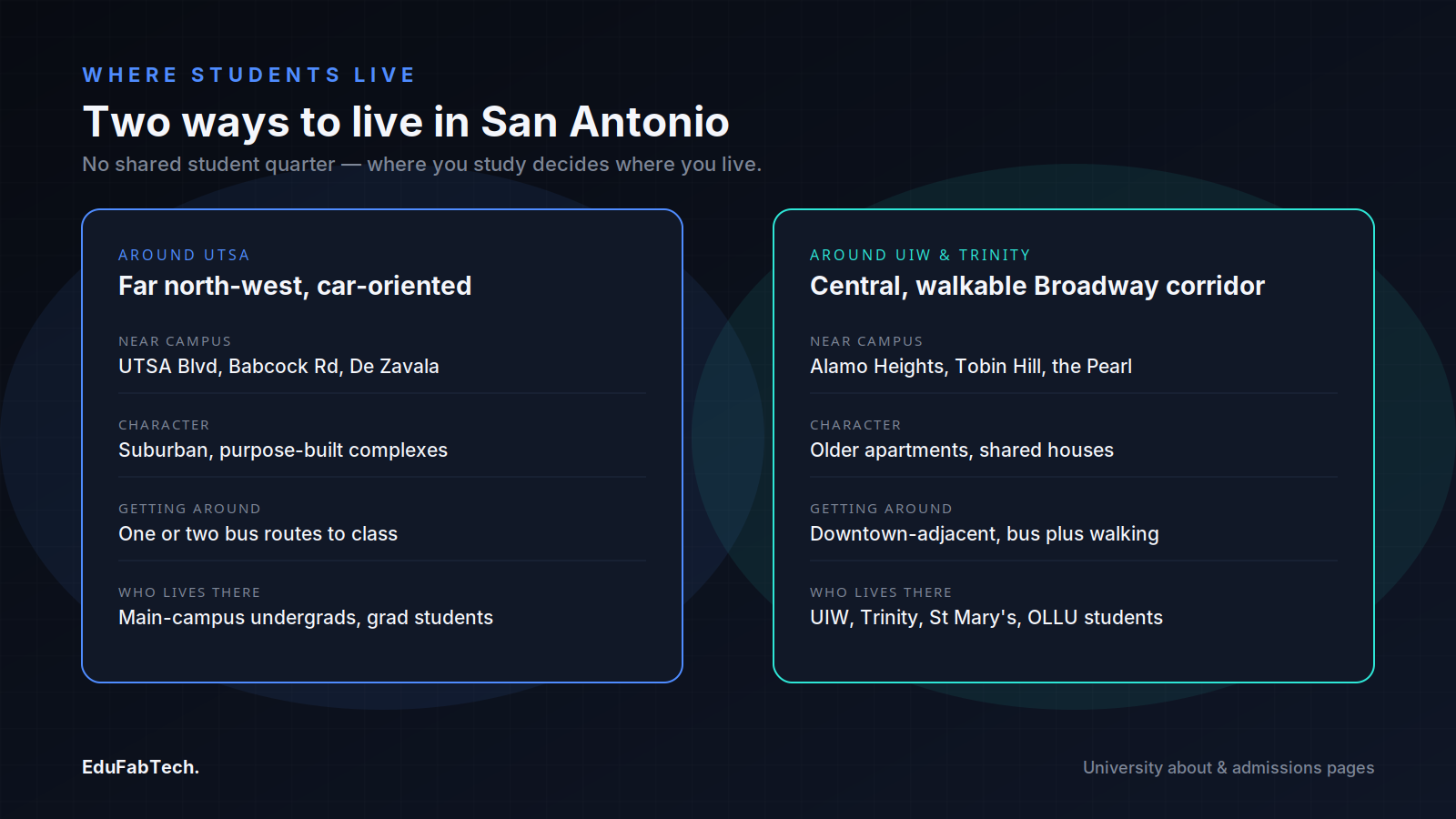
Because the campuses are far apart, there is no shared student district. Around UTSA's main campus, students fill the purpose-built complexes and older apartments along UTSA Boulevard, Babcock Road and De Zavala, and the nearby Medical Center area — car-oriented, suburban, and within one or two bus routes of class. UIW and Trinity students gravitate to the central neighbourhoods off Broadway: Alamo Heights and Olmos Park are the pricier end, while Tobin Hill, Mahncke Park and the blocks near the Pearl are walkable and in demand. St. Mary's and Our Lady of the Lake sit on the West Side, closer to downtown and generally cheaper, while Texas A&M–San Antonio draws a heavily commuting student body from across the South Side.
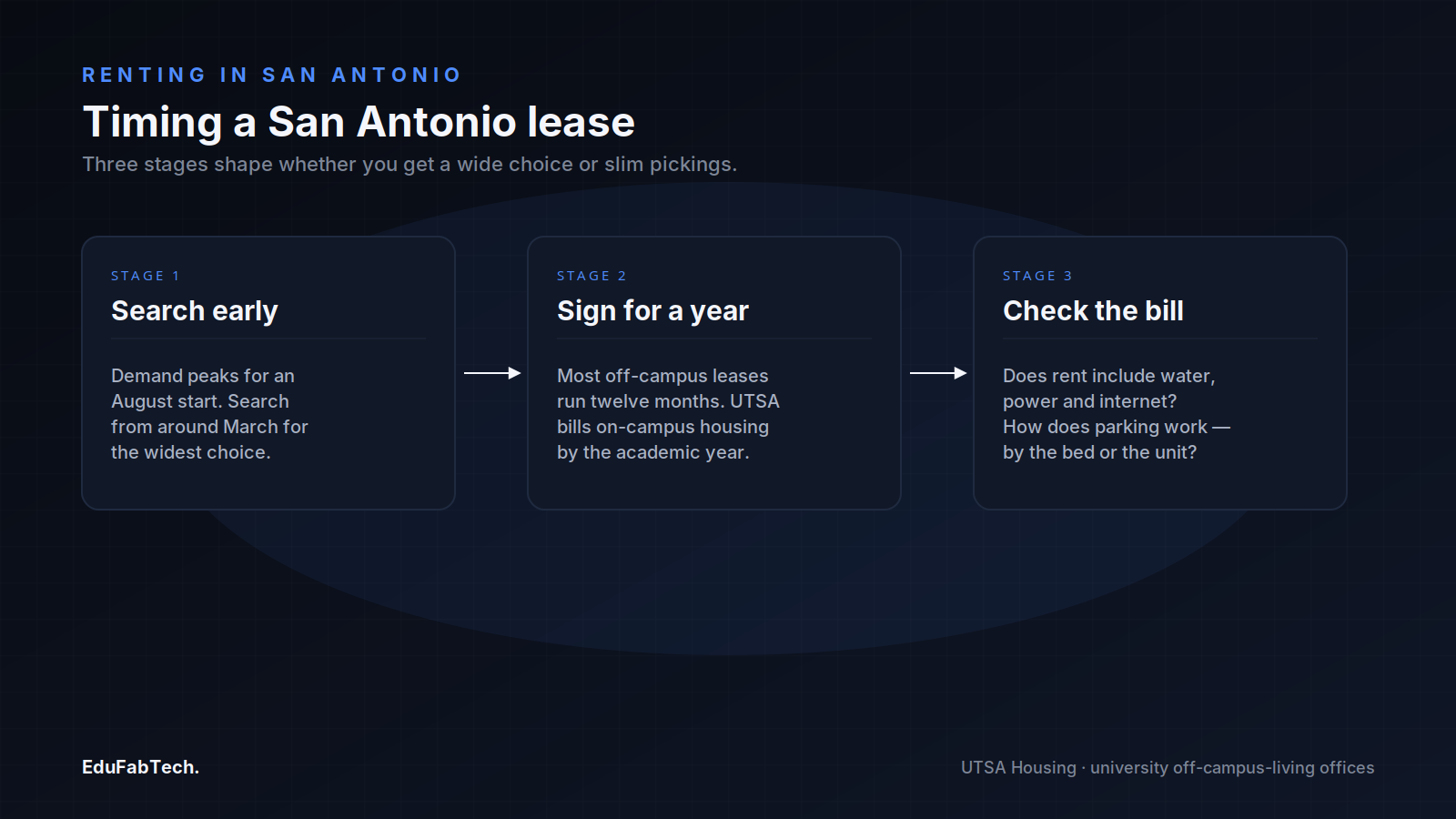
On-campus housing exists at the larger universities and is the simplest first-year option; UTSA, for instance, operates residence communities and apartment-style housing that it bills by the academic year. Off campus, most students sign a twelve-month lease on an apartment or a room in a shared unit, and demand peaks in late spring for an August start, so serious searching from around March gives the widest choice. Before paying anything, check the basics that trip people up here: whether rent includes water, electricity and internet (summer cooling bills in San Antonio are not small), how parking works, and whether the complex runs by the bed or by the unit.
Renting safely in San Antonio
Rental scams in San Antonio tend to surface where students search in a hurry: listings aimed at the UTSA-area complexes off De Zavala and Babcock, and "rooms" advertised cheaply near the central campuses just before term. The warning signs are the same ones that work anywhere, applied to this market — a price well below the going rate for the area, a "landlord" who is conveniently out of town, and pressure to reserve a place sight-unseen.
See the actual unit before you pay, in person or on a live video call where the person shows the specific apartment and keys, not a generic photo tour. A deposit of roughly one month's rent is normal locally; never send money by bank wire, gift card or cryptocurrency to "hold" a room, because those payments cannot be reversed and a genuine landlord or leasing office will not demand them. Get the lease in writing and keep a copy. Each university's housing or off-campus-living office can point you to vetted listings, and on EduFabTech you can look through rooms and places to stay in the city.
Furnishing a room: markets and second-hand
San Antonio is a good city for furnishing a room cheaply, and weekend markets are part of its culture. Traders Village, a large open-air weekend flea market on the South-West side off Loop 410, runs every weekend with more than 1,000 vendors — a place to find furniture, kitchen kit and bicycles. Bussey's Flea Market, on I-35 in Schertz to the north-east of the city, is another long-running weekend market with a similar range. Alongside these, the usual thrift and resale shops across town carry desks, chairs and small appliances for a fraction of new prices.
Timing helps as much as the venue: the end of each academic year, when leases turn over, is when the most furniture appears second-hand and free. On EduFabTech you can browse second-hand things and used furniture in San Antonio, and check what is being given away free before you buy anything.
Part-time work and the rules that apply
If you hold an F-1 student visa, the headline rule is strict: the U.S. Department of Homeland Security states on its Study in the States site that F-1 students may work on campus but not more than 20 hours per week while school is in session, and that you must talk to your designated school official (DSO) before applying for a job. On-campus roles — a library desk, a cafeteria, a lab — are the normal first option, and off-campus work generally needs separate authorisation. Treat your DSO as the authority on your own case rather than informal advice; this guide is not legal advice, and the official page is the source to follow. Domestic students face no such cap, and the universities, the Medical Center, the tourism economy downtown and the River Walk all hire students. EduFabTech lists part-time jobs in the city.
Libraries and places to study
Each university runs its own libraries, but the city library system is a genuine resource for students too. The San Antonio Public Library's Central Library — the striking red building at 600 Soledad Street downtown — is a six-storey, 240,000-square-foot building with seating for 1,300 and public computers and Wi-Fi, according to the library's page; its branches across the city offer quieter local alternatives. The Central Library's bookable study rooms, held at its Latino Collection and Resource Center on the first floor, are described on the library's study-rooms guide. For a change of scene near the central campuses, the cafés around the Pearl and Southtown are popular with students, and EduFabTech lists study spaces and desks around the city.
Getting around a car-shaped city
Public transport in San Antonio is run by VIA Metropolitan Transit — buses and the on-demand VIA Link vans; there is no train or metro. VIA's fare page lists a regular bus ride at $1.30 and a day pass at $2.75, with a 31-day pass at $38.00; qualifying students and seniors pay reduced fares of $0.65 a ride and $19.00 for a 31-day pass, as set out on the rates page (2026). Students enrolled at a local college, university or trade school who are 19 or older qualify for the reduced fare but must present either a VIA Reduced Fare ID or a current school ID when boarding, per VIA's reduced-fares page. Fares are paid with VIA's reloadable goCard smartcard, onto which you can load single rides or a 31-day or semester pass, as VIA's goCard page explains. Be realistic about the geography, though: from the UTSA main campus in the far north-west, a bus trip downtown is long, and for the immediate area a bicycle plus occasional rides often covers more of a student's week than the network alone.
Costs, and the honest trade-offs
For a dated, official housing figure, UTSA's 2026-2027 cost-of-attendance estimate is the clearest anchor. The university's One Stop office lists average housing for the fall and spring terms at $10,484 for a student living on campus, $8,110 living off campus, and $2,880 living at home with family, on its 2026-2027 cost-of-attendance page. The same page puts the full estimated cost of attendance for a full-time resident undergraduate at $31,840 living on campus and $30,946 living off campus for the year, including tuition and fees, meals, transport and personal expenses.
| UTSA 2026-27 average housing (fall + spring) | Amount |
|---|---|
| Living on campus | $10,484 |
| Living off campus | $8,110 |
| Living with family | $2,880 |
Those are averages, not quotes: an individual lease, a shared unit or a cheaper West Side neighbourhood can land well below the off-campus figure, while a studio of your own will run above it. The honest summary is that San Antonio is less expensive than the big coastal college cities, but it is not cheap, and the cost of a car — insurance, fuel, parking — is the hidden line that catches students who assumed they could live without one.
The good side of studying here is real: a large, friendly, strongly Hispanic-cultured city with cheap and excellent food, a walkable historic core, warm winters, and campuses that range from a big public research university to small residential colleges. The hard side is just as real. The sprawl and weak transit make a car close to a necessity for many; summers are long, hot and humid, and flash flooding is a genuine hazard in heavy rain; and because there is no student quarter, building a social life can take more deliberate effort than in a compact town. Weigh those honestly against the low rents and the climate before you decide which part of the city to live in.
A checklist for the first weeks
- Confirm your housing and read the lease before paying — know what utilities are included and never wire a deposit to hold a room you have not seen.
- International students: meet your DSO early and confirm in writing what work, if any, you are allowed before accepting a job.
- Get a VIA goCard if you will use the bus, and map your campus-to-home route before term starts.
- Furnish from weekend markets and end-of-lease giveaways rather than buying new; check second-hand listings first.
- Get a public-library card for the branch nearest you — it extends your study options beyond the campus library's hours.
- Plan for the climate: budget for summer cooling bills and know your neighbourhood's flood risk before the first heavy storm.
A quick question for readers
Do you work part-time while you study?
Many students work to pay the bills. See how common it is — and how many hours people really do.
Pick an answer, create a free account in a minute, and your vote counts. Already a member? Sign in
Source: University of Texas at San Antonio
Sources (5)
- UT San Antonio One Stop. 2026-2027 Cost of Attendance. University of Texas at San Antonio, 2026. onestop.utsa.edu ↗ · checked 8 Oct 2026
- VIA Metropolitan Transit. Fares and Passes. VIA Metropolitan Transit, 2026. viainfo.net ↗ · checked 8 Oct 2026
- U.S. Department of Homeland Security. Working in the United States (F-1 students). Study in the States, 2026. studyinthestates.dhs.gov ↗ · checked 8 Oct 2026
- San Antonio Public Library. Central Library. City of San Antonio, 2026. mysapl.org ↗ · checked 8 Oct 2026
- University of the Incarnate Word. About UIW. University of the Incarnate Word, 2026. uiw.edu ↗ · checked 8 Oct 2026