Studying in San Diego: universities, housing and student life
A practical, sourced guide to San Diego's universities, the neighbourhoods students live in, how to find a room without being scammed, work rules, study spaces, transport and the real costs.
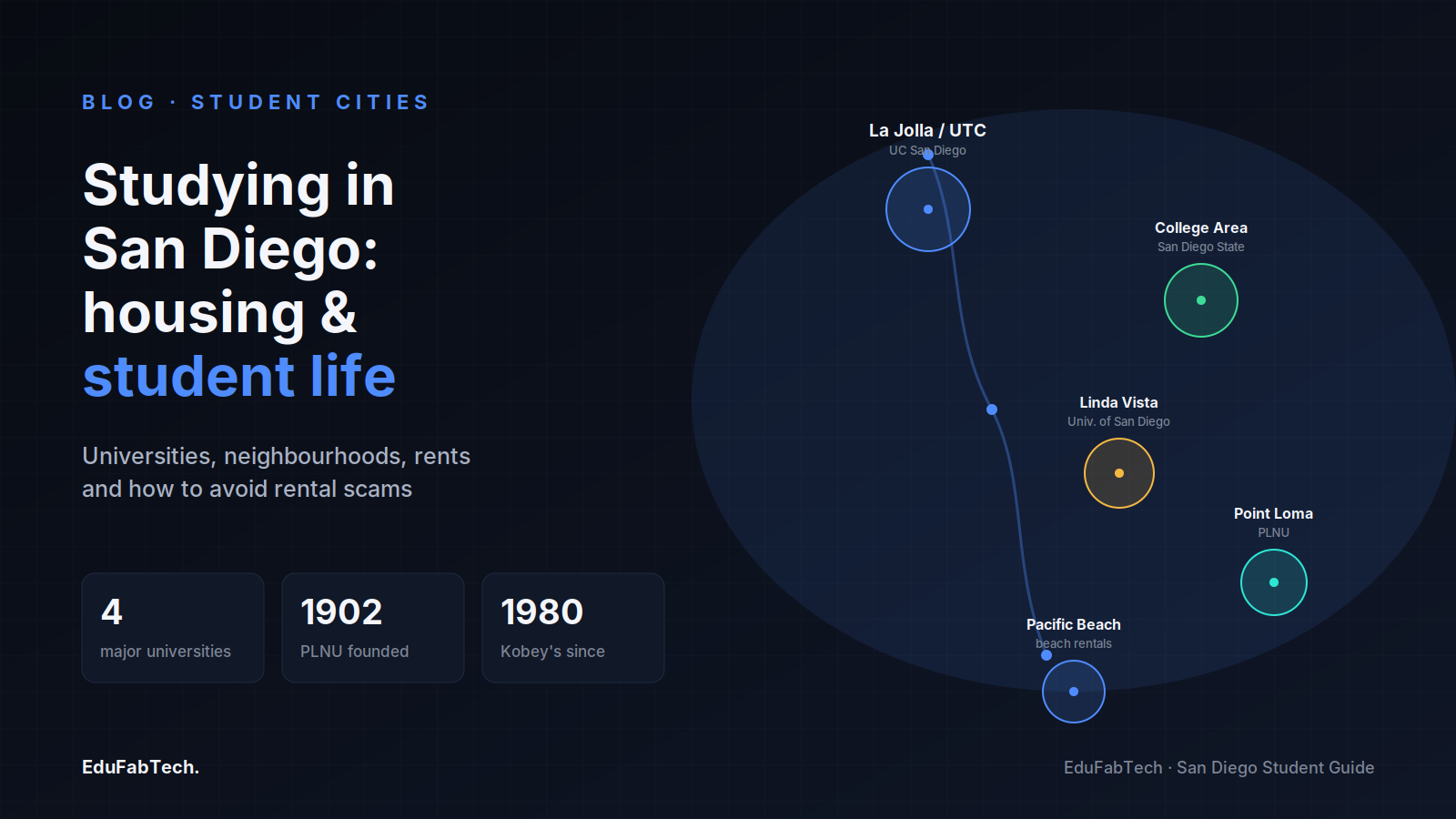
San Diego sits in the far south-western corner of the United States, pressed between the Pacific Ocean and the border with Mexico. It is a city of canyons, mesas and beaches rather than one dense core, which means that studying here is as much about which part of the county you land in as which university you attend. The weather is the first thing everyone mentions — the coast has a mild Mediterranean climate, with warm, dry summers and cool, wetter winters and very few extremes — and it is genuinely part of why people stay. The second thing is distance: campuses, cheap rooms and part-time jobs are often nowhere near each other, and the car-shaped geography shapes daily life.
This guide is for students coming to San Diego from elsewhere in the country or from abroad. It names the universities you will hear about, walks through where students actually live and how to rent without being cheated, and sets out costs only where a named institution has published a figure. Where a number cannot be sourced, it is described in relative terms instead. You can browse local student listings for the city on EduFabTech's San Diego pages as you read.
The universities, and what studying here is like
The largest name is University of California, San Diego, a public research university on a coastal mesa in the La Jolla district in the city's north-west. It is organised into undergraduate residential colleges and is strongest in the sciences, engineering, computing, oceanography and medicine; its setting beside the Pacific and next to a cluster of research institutes makes it feel like a self-contained town. Nearby in the same La Jolla research corridor is the Center for Academic Research and Training in Anthropogeny, a transdisciplinary centre based at University of California, San Diego that studies human origins and runs a graduate specialisation rather than admitting its own undergraduates.
San Diego State University is the city's big public campus for a broader range of subjects — business, education, the arts, engineering and the health professions — and sits in the College Area east of downtown, around the landmark Spanish-Revival Hepner Hall. It is the campus most woven into everyday neighbourhood life, with a dense ring of student housing around it. University of San Diego is a private Roman Catholic university on Alcalá Park, a hilltop campus above Mission Valley known for law, business, nursing and peace studies; its Spanish Renaissance architecture is hard to miss. On the oceanfront in Point Loma, Point Loma Nazarene University is a small Christian liberal-arts university founded in 1902, strong in the sciences, business and education and famous mainly for having one of the most dramatic cliff-top campuses anywhere.
Two institutions here are better known for graduate research than for undergraduate teaching. Scripps Research, also in La Jolla, is one of the largest independent biomedical research organisations in the country; its Skaggs Graduate School trains PhD students in chemistry and biology and does not run a conventional undergraduate programme. Alliant University — formally Alliant International University — has its San Diego campus in Scripps Ranch in the city's north-east and is built around professional psychology and related fields, with doctoral clinical programmes that draw students from across the region.
Other universities and colleges in San Diego
Several smaller or specialised institutions round out the picture, and a few on older lists have closed:
- California Miramar University is a small private university in San Diego that teaches business, information technology and criminal justice largely online and in hybrid form.
- John Paul the Great Catholic University is a small Catholic university focused on film, media, business and the creative arts; it moved to a permanent campus in Escondido, north of the city, in 2013.
- San Diego Continuing Education, the adult-education division of the San Diego Community College District, offers tuition-free courses — English language, high-school completion and short career certificates — across campuses including one in National City. It is a practical starting point for newcomers brushing up English or a trade.
- The Seminary of Mar Abba the Great is a small Chaldean Catholic seminary established in 2008 in the East County area near El Cajon, serving a specific religious community rather than the general student population.
- Coleman University, a long-running technology college, closed in August 2018 after losing a bid for accreditation; Fashion Careers College, a fashion-design school on Morena Boulevard, closed in 2013; and Kelsey-Jenney College, once San Diego's oldest business college, shut its doors around 2001–02 after going bankrupt. You may still see them in old directories, but none enrol students today.
Other career-focused colleges you may come across include San Diego Christian College in the East County hills, Platt College in Lemon Grove, California College San Diego, and the Pacific College of Oriental Medicine — useful to know if you are after a specific vocational programme rather than a traditional degree.
Where students actually live
Because the campuses are spread out, students cluster in a handful of distinct neighbourhoods, and the right one depends almost entirely on where you study.
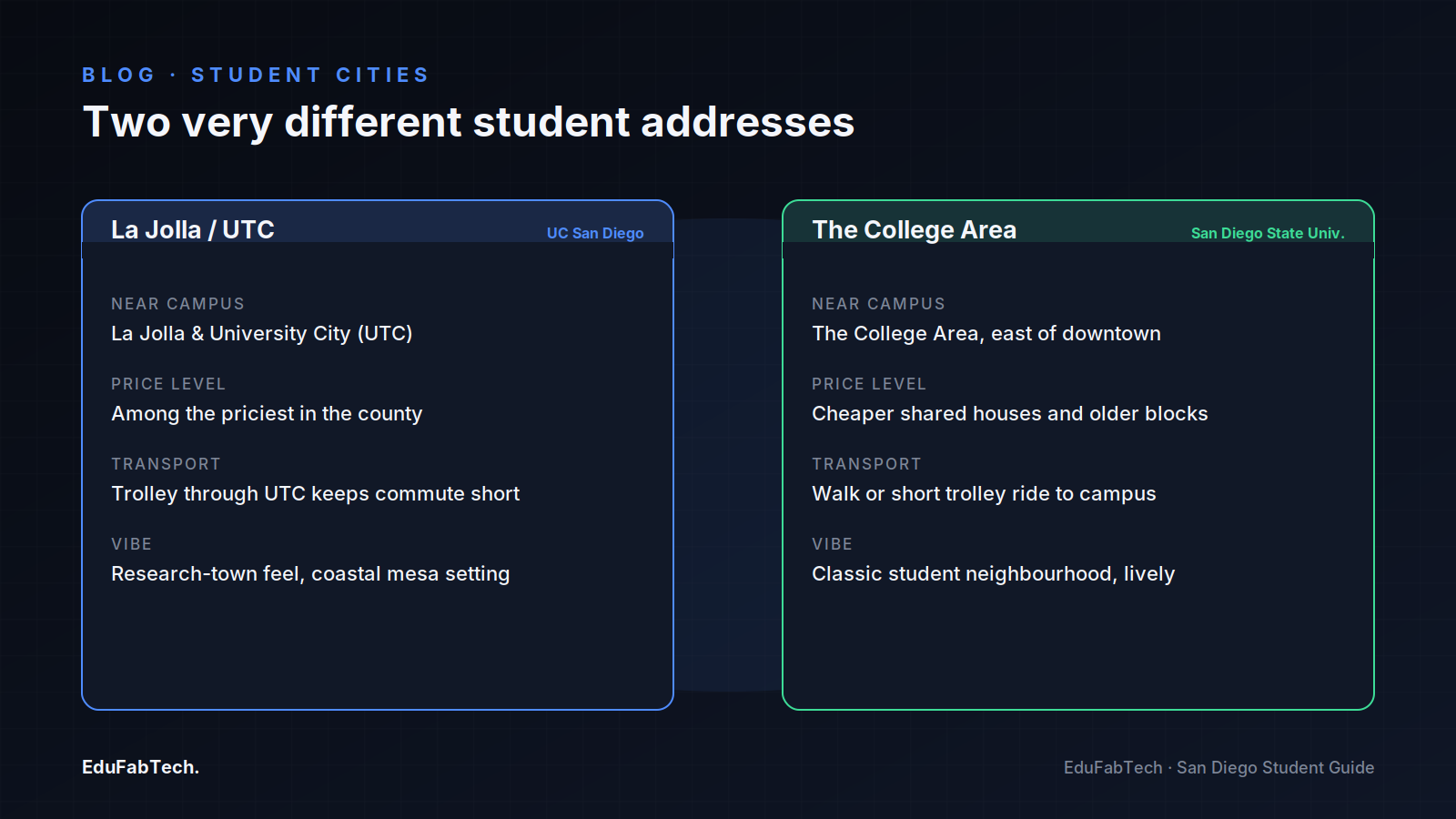
La Jolla and University City (UTC) are the orbit of University of California, San Diego and the La Jolla research institutes. La Jolla proper is beautiful and expensive; most students instead take rooms in University City and the UTC area just inland, which is denser, newer and better served by the trolley. It is among the pricier parts of the county, but it keeps the commute short.
The College Area, wrapped around San Diego State University, is the most classically student neighbourhood in the city: shared houses, older apartment blocks, cheap food and a short walk or trolley ride to campus. It is lively and sometimes noisy, which is the trade-off. Adjacent Del Cerro and the area toward La Mesa are quieter and a little cheaper, with an easy hop west on the Green Line trolley.
North Park and Normal Heights, between the two big campuses, are the hub of younger renters who want cafés, music and independent shops over a beach address. Rents are moderate by San Diego standards and both are well connected by bus. Pacific Beach ("PB") is the beach-town option — a magnet for students who prioritise the ocean and nightlife, with lots of shared rentals, though prices rise the closer you get to the sand and parking is a constant battle.
Linda Vista and Mission Valley are the practical middle ground near University of San Diego, with large apartment complexes, the trolley line through the valley and relatively central access to the rest of the city. Further out, communities such as Scripps Ranch (near Alliant University), Poway and the East County towns of El Cajon, Lemon Grove and La Mesa are cheaper again, at the cost of a longer commute that, without a car, leans heavily on buses.
Finding a room — and not getting scammed
Rooms in San Diego go quickly, especially in the weeks before the autumn term, so start looking early: a month or two ahead for a shared house, earlier still if you want a place within walking distance of a campus. Most students rent a room in a shared house or apartment rather than a whole flat. University housing offices keep off-campus listing boards, and student-to-student listings are often the safest route; you can also scan rooms and places to stay for the city on EduFabTech's San Diego rooms page, including listings near University of California, San Diego. Before you commit to anything, check the basics: who else lives there, what the total monthly cost includes (utilities, water, internet and parking are often extra), the length of the lease, and how the deposit is handled and returned.
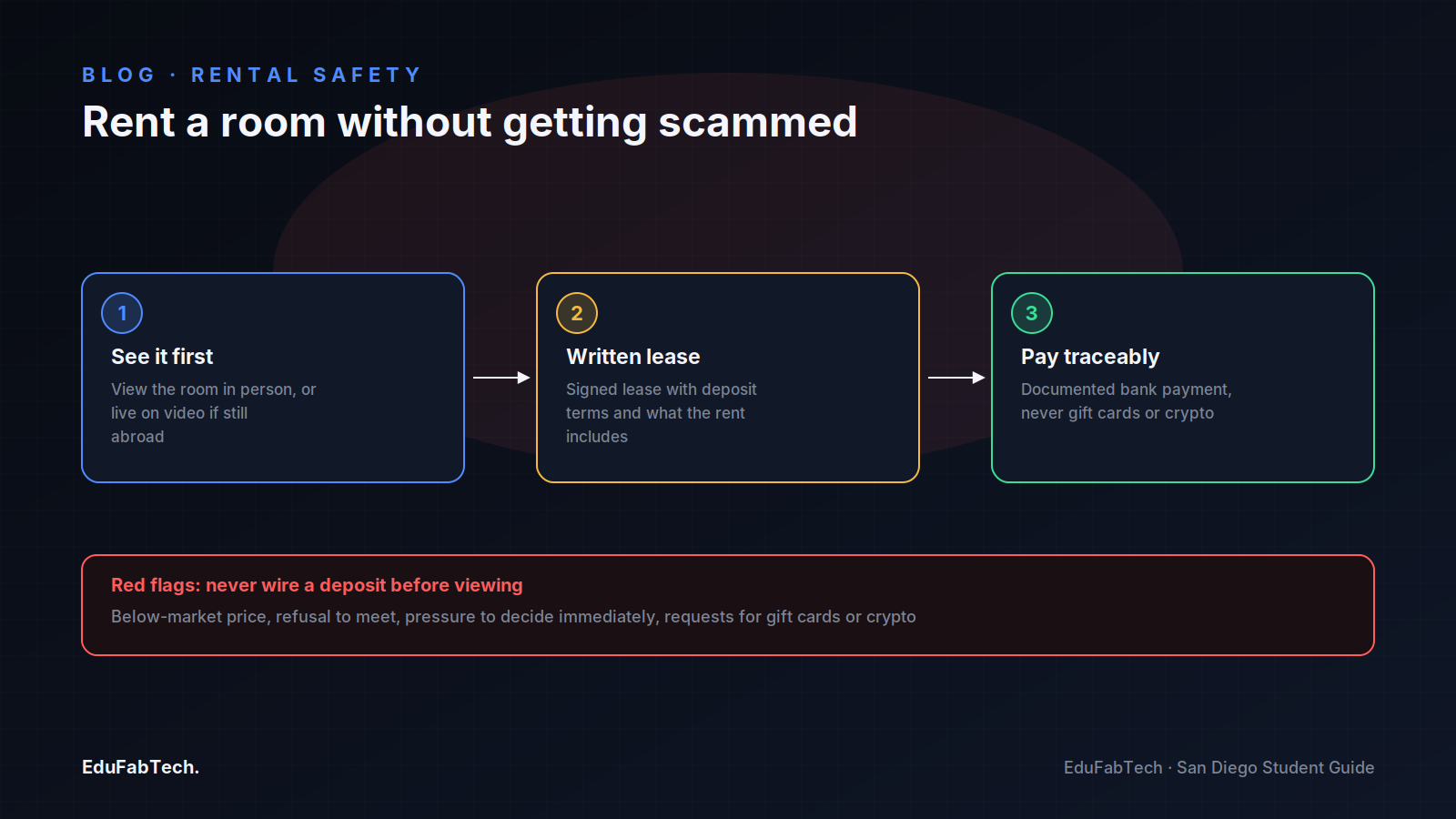
On scams, one rule above all: never send money for a room you have not seen. See the place in person, or on a live video call if you are still abroad, before you pay a cent. A genuine landlord will not need a deposit wired to "hold" a room before you have viewed it, and will not insist on a bank transfer, gift cards or cryptocurrency — those payment methods are chosen precisely because they cannot be reversed. Be wary of a listing priced well below everything else, of anyone who refuses to meet or show the unit, and of pressure to decide immediately. Get a written, signed lease and pay in a traceable, documented way.
Furnishing a room without spending much
Furnishing cheaply is a San Diego skill, because the student turnover each June and September floods the second-hand market. The city's best-known destination is Kobey's Swap Meet, the large open-air market held at the Sports Arena site in the Midway district, which runs Friday to Sunday and has been a fixture there since 1980 — good for everything from kitchenware to bikes if you are willing to haggle. Thrift and charity shops are scattered through North Park, City Heights and the College Area, and the neighbourhood farmers' markets (Ocean Beach on Wednesdays, Hillcrest and Little Italy at the weekend) are the place for cheap produce rather than furniture.
Move-out weeks are the real bargain season: students leaving the city give away or sell furniture fast, and whole flats' worth of kit changes hands. EduFabTech lists second-hand things and used furniture around the city, including items given away free — worth checking before you buy anything new.
Working while you study
Rules on part-time work depend on your immigration status, and this is an area where you should rely on official guidance rather than word of mouth. For international students on the common study visa, the federal government's official guidance for students explains that on-campus employment is generally limited to no more than 20 hours per week while classes are in session, and that most off-campus work requires specific prior authorisation tied to your programme. The details change and depend on your category, so read the official source and speak to your university's international-student advisers before accepting any job; this guide is not legal advice. Domestic students face no such limits and can work as hours allow.
On-campus jobs — libraries, dining, labs, administration — are the simplest place to start, and the big campuses post them centrally. Beyond campus, San Diego's large tourism, hospitality and retail sectors generate a lot of casual work. You can browse current jobs and part-time work in San Diego on EduFabTech as a starting point.
Libraries, study spaces and getting around
Each university runs its own libraries, but the city's public network is a genuine asset. The San Diego Central Library downtown, with its distinctive domed reading room near Petco Park in the East Village, offers free Wi-Fi, bookable study rooms and long tables, and the branch libraries across the city give you somewhere to work closer to home. Campus cafés, the many independent coffee shops of North Park and Hillcrest, and the beach boardwalks double as study spots when you want a change of scene; EduFabTech also lists study spaces and desks around the city.
Getting around without a car means the bus and trolley network run by the Metropolitan Transit System. According to the system's current 2026 fare chart, a one-way fare is US$3.00, a day pass is US$7.00, and a regional monthly pass is US$85.00, all paid through the contactless Pronto system. There is a notable break for younger riders: under a pilot run by the regional transport planners and the Metropolitan Transit System, the Youth Opportunity Pass lets riders aged 18 and under travel free, and that pilot is scheduled to run through 30 June 2027. College students can buy discounted monthly and semester transit passes, often arranged through their campus — check with your institution, since terms vary. Be realistic, though: outside the trolley corridors, San Diego is built for cars, and a cross-town trip by bus can take a long time.
Costs, and the honest trade-offs
San Diego is an expensive place to live, and housing is the reason. The clearest official anchor comes from the universities' own budgets: University of California, San Diego estimated off-campus food and housing at US$19,527 for a single student for the 2025–26 academic year. That figure is a university planning estimate, not a rent quote, but it gives a sense of scale: housing is the dominant line in any San Diego student budget, and sharing is how most people make it work. Transport, by contrast, is modest if you use transit, and the mild climate keeps heating bills low.
What is good about San Diego for students is easy to list: the climate, the coastline, a strong research economy in biotech, defence and tech that creates jobs and internships, and a genuinely international, relaxed culture. What is hard is equally clear. The cost of housing is the single biggest strain, and rooms near the popular campuses are scarce. The city's spread-out geography means long commutes if you cannot afford to live close in, and life is much easier — and more expensive — with a car. Beach neighbourhoods can be crowded and noisy in summer, and the sheer pleasantness of the weather is itself part of what keeps demand, and prices, high. Going in with clear eyes about the budget is the best preparation.
A short checklist for the first weeks
- Confirm your enrolment and, if you are an international student, check in with your campus international-student office straight away.
- Line up a room — ideally a short-term one first — and never pay for a place you have not seen in person or on a live video call.
- Set up a Pronto account for the bus and trolley, and ask your university about discounted student transit passes.
- Get a library card for the public library network and find the campus libraries and study spaces you will actually use.
- Furnish from swap meets, charity shops and move-out giveaways rather than buying new.
- If you plan to work, read the official guidance for your visa category first and talk to your adviser before accepting a job.
- Learn your core transit routes early, and budget honestly — housing will be your largest cost by far.
San Diego rewards students who plan their housing and commute before they arrive and who treat the second-hand economy as a resource rather than a last resort. Browse what is currently listed across the city on EduFabTech's San Diego pages, and you will get a quick, honest read on what rooms, jobs and gear are really going for right now.
A quick question for readers
Do you work part-time while you study?
Many students work to pay the bills. See how common it is — and how many hours people really do.
Pick an answer, create a free account in a minute, and your vote counts. Already a member? Sign in
- UC San Diego Financial Aid and Scholarships Office. Cost of Attendance, 2025–2026 (2024 cohort, continuing undergraduates). University of California, San Diego, 2025. link
- San Diego Metropolitan Transit System. Fare Chart. San Diego Metropolitan Transit System (MTS), 2026. link
- San Diego Association of Governments / MTS. Youth Opportunity Pass Program. San Diego Metropolitan Transit System, 2025. link
- U.S. Department of Homeland Security. Working in the United States (Study in the States). U.S. Department of Homeland Security, 2025. link
- San Diego Public Library. Central Library at Joan & Irwin Jacobs Common. City of San Diego, 2025. link