Studying in San Francisco: universities, housing and student life
A practical, sourced guide to studying and living in San Francisco and its wider Bay Area — the campuses, where students actually live, what it costs, and the honest trade-offs.
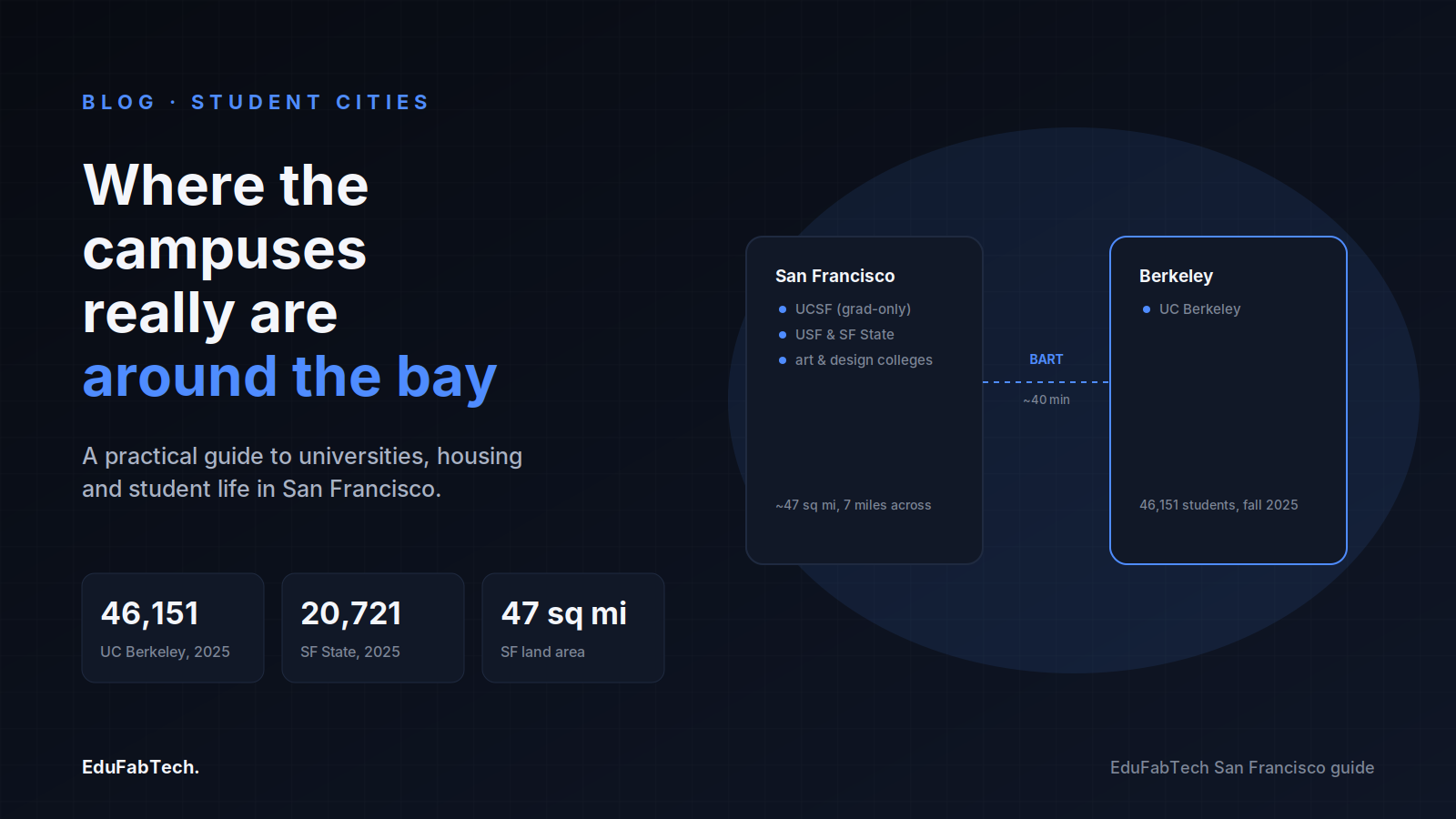
San Francisco is a small city with an outsized academic footprint. The city proper is famously compact — roughly seven miles across and about 47 square miles of land at the tip of a peninsula — yet it packs in professional schools, art and design colleges and a world-famous research hospital, while the region's single largest university sits across the water in the East Bay. For a student, that geography is the first thing to grasp: "studying in San Francisco" usually means studying somewhere in the wider Bay Area and commuting by train, bus or ferry, because the campuses are scattered across the hills and the bay.
The city's character rewards and tests students in roughly equal measure. The fog that pours over the western neighbourhoods most summer afternoons keeps the climate mild but grey; the hills turn every errand into exercise; and the cost of living is among the steepest anywhere. What you get in return is density of opportunity — technology, medicine, design and civic life all crowded into a few dozen square miles. This guide walks through the universities, where students live, how to find a room without being cheated, and what it honestly costs.
The universities, and what studying here is like
The largest and best known is University of California, Berkeley, which is not in San Francisco at all but in the East Bay city of Berkeley, roughly a forty-minute train ride away. Founded in 1868, it enrolled 46,151 students in autumn 2025 — 33,122 undergraduates and 13,029 graduate students — according to the university's Office of Planning and Analysis. Its graduate public-policy school, the Goldman School of Public Policy, and its continuing-education arm, UC Berkeley Extension, both run under that same umbrella.
Inside the city, the other University of California campus is University of California, San Francisco — a graduate health-sciences university with no undergraduates, organised around schools of medicine, nursing, dentistry and pharmacy. Its historic campus rises at Parnassus Heights above the Inner Sunset, with a second research campus at Mission Bay near the waterfront. A short distance away in the Civic Center area is University of California College of the Law, San Francisco, which was renamed from UC Hastings on 1 January 2023 following research into its nineteenth-century founder.
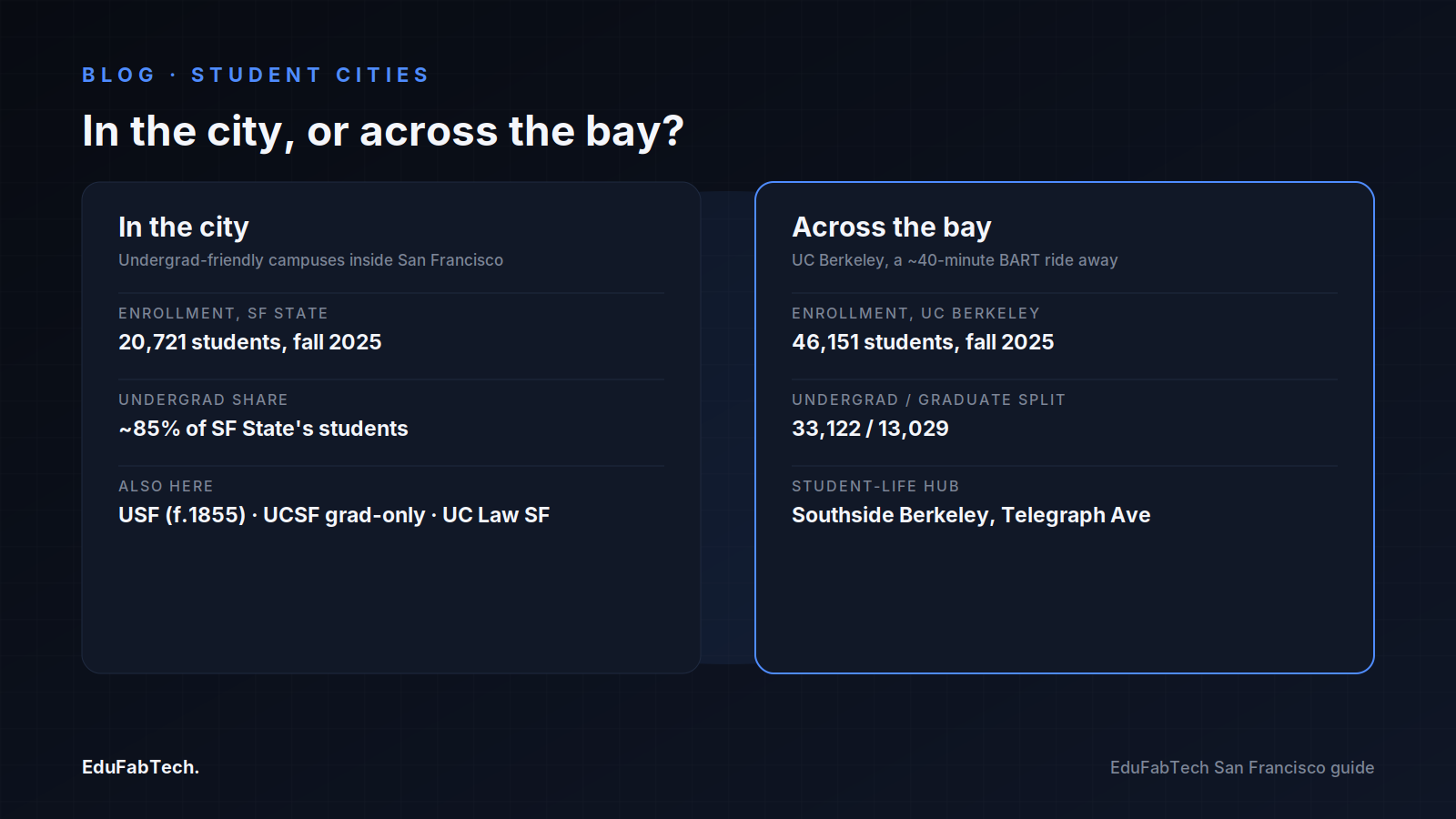
For undergraduates who want to be in the city itself, two names dominate. San Francisco State University sits on the city's southwest edge near Lake Merced, just inside the Daly City line; it enrolled 20,721 students in autumn 2025, about 85% of them undergraduates, according to the university's published facts. University of San Francisco, a Jesuit institution tracing its roots to 1855, occupies a hilltop campus — "The Hilltop" and the adjoining Lone Mountain — in the middle of the city.
San Francisco is also a city of art and design schools. California College of the Arts, a century-old art and design college that consolidated onto a single San Francisco campus after leaving its old Oakland site, announced in January 2026 that it will wind down and close after the 2026–27 academic year, with Vanderbilt University acquiring its San Francisco campus and planning to open there in 2027–28. Academy of Art University spreads studios and classrooms through buildings across downtown, and Golden Gate University, also downtown, concentrates on law, business and accounting for working adults. California Institute of Integral Studies, near the Mission, teaches psychology, counselling and integrative studies. The San Francisco Art Institute, one of the oldest art schools in the country, ended its degree programmes in July 2022 and no longer enrols students.
Other universities and colleges around the bay
Smaller and specialised institutions fill out the map. In Berkeley: Zaytuna College, a Muslim liberal-arts college; the Graduate Theological Union, a consortium of seminaries on "Holy Hill"; the Institute of Buddhist Studies; and Pacific Lutheran Theological Seminary. In Oakland: Lincoln University, one of the region's older private colleges; Samuel Merritt University, focused on nursing and the health professions; and the Academy of Chinese Culture and Health Sciences, which trains practitioners of Chinese medicine. Holy Names University, also in Oakland, graduated its final class and closed in May 2023 after 154 years.
Others ring the bay. Notre Dame de Namur University in Belmont paused traditional undergraduate admissions and now concentrates on graduate and degree-completion programmes; Oikos University is a small Christian university in San Leandro; and Patten University is a small Christian institution rooted in Alameda. In San Francisco itself you will also find Antioch University West, serving adult learners; Bay Area Medical Academy, an allied-health training school; and Presidio Graduate School, built around sustainable management. Animation Mentor, an online animation school, is based in Emeryville. And the historic San Francisco College for Women/Lone Mountain College — once an independent women's college — is today part of the University of San Francisco's Lone Mountain campus.
Where students actually live
Because the campuses are spread out, students cluster in very different corners of the region. You can browse rooms and listings by area through the city's EduFabTech San Francisco page, but it helps to know the neighbourhoods first.
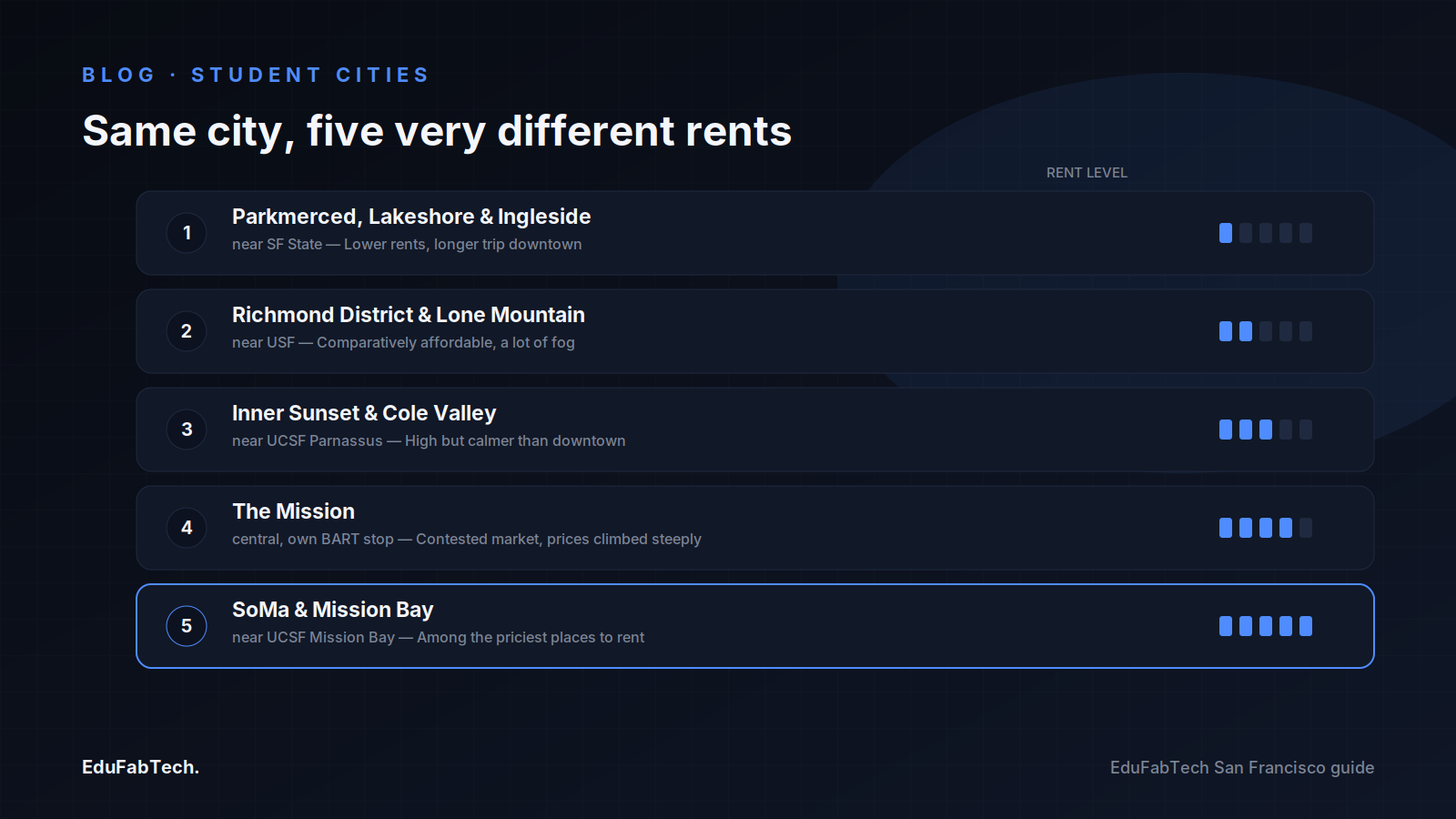
The Inner Sunset and Cole Valley wrap around UCSF's Parnassus campus and the eastern edge of Golden Gate Park. They are quiet, leafy and famously foggy, popular with medical and graduate students who want to walk to work; rents are high but calmer than downtown.
The Richmond District and Lone Mountain, north of the park, are the natural catchment for University of San Francisco. The Richmond is residential and comparatively affordable for the city, with some of the best and cheapest food in town along Clement Street and Geary Boulevard — and, like the Sunset, a lot of fog.
Parkmerced, Lakeshore and Ingleside sit next to San Francisco State University on the southwest side. Purpose-built apartment complexes and family houses give this area a more suburban feel and lower rents than the centre, at the cost of a longer trip downtown.
The Mission is central, sunny by local standards, and rich in food, music and nightlife, with its own BART station and Latino heritage. It is also one of the most contested rental markets in the city; prices have climbed steeply, but it remains a magnet for students at nearby schools.
SoMa and Mission Bay, the flatter eastern districts, hold newer apartment towers close to UCSF's Mission Bay campus and the downtown colleges. They are central and well connected but among the priciest places to rent.
Southside Berkeley, around Telegraph Avenue, is where much of University of California, Berkeley's student life happens — residence halls, student housing co-operatives and cafés, with BART running straight under the bay into the city.
Finding a room without being cheated
Housing is the hardest part of student life here: supply is tight and demand is relentless. Most students end up in a shared flat, a sublet, a room in a family home, or a university residence hall. Start looking six to eight weeks before term if you can, and before you commit, check the lease term and notice period, how much deposit is required, who else is named on the lease, whether the building is rent-controlled, and — crucially — how long the commute to campus really is by public transport, not by car. You can begin with rooms listed on EduFabTech's San Francisco rooms page or search by campus, for example near San Francisco State University.
Guard hard against rental scams. Always see the place in person, or at the very least on a live video call where the person can walk you through the actual room, before you pay anything. Never send a deposit or "holding fee" by bank transfer, gift card or cryptocurrency — legitimate landlords do not ask for that. Treat a listing priced far below the going rate as a warning sign, especially if the "owner" is conveniently out of the country and wants money before you can view it. If something feels rushed or too good, walk away.
Furnishing a room for almost nothing
You do not need to buy new. San Francisco has a deep second-hand culture: thrift stores such as the Community Thrift Store on Valencia Street in the Mission, the long-running Alemany Flea Market held on Sundays at 100 Alemany Boulevard, and, across the bay, the Ashby Flea Market beside the Ashby BART station and the sprawling reuse warehouse Urban Ore in Berkeley, where you can find furniture, doors, lamps and kitchenware. For food, the Ferry Plaza Farmers Market on the waterfront and the Heart of the City market at Civic Center are institutions. Plenty of students also furnish a room for next to nothing by browsing the second-hand and give-away listings on EduFabTech and watching neighbourhood give-away groups, where people leave usable things on the pavement rather than throw them out.
Working while you study
Part-time work is common, and the local wage floor is relatively high: the city's minimum wage rose to US$19.61 an hour on 1 July 2026, according to the city's official minimum-wage notice, and it applies to anyone working at least two hours a week in San Francisco. International students face extra rules. On a typical student visa, the national immigration authority limits on-campus work to 20 hours a week while classes are in session, and most off-campus work or practical training requires separate authorisation obtained in advance. This is not legal advice — rules change and individual cases differ, so read the official source directly in the government policy manual on student employment and confirm anything specific with your university's international-student office. Campus jobs and local openings are collected on the EduFabTech jobs page.
Libraries and places to study
Every university here has its own library — Gleeson Library at the University of San Francisco, the J. Paul Leonard Library at San Francisco State University, the UCSF Library at Parnassus, and the Doe and Moffitt libraries at University of California, Berkeley — and most welcome their own students around the clock near exam time. Beyond campus, the free public system is excellent: the Main Library at Civic Center, on Larkin Street, offers long opening hours, study rooms and desks, and a free library card, and dozens of neighbourhood branches put a quiet desk within walking distance of most students. Cafés double as study rooms across the city. More desks and bookable spaces are listed on the study-spaces page.
Getting around
Within the city, Muni runs the buses, the Metro light-rail lines, the historic streetcars and the famous cable cars. For longer trips, BART regional trains link San Francisco with Berkeley, Oakland and much of the East Bay — and with the international airport — tunnelling under the bay in minutes; Caltrain heads south down the peninsula, and AC Transit buses and ferries cover the East Bay and the water. A single reloadable Clipper card works across all of them. Fares are not trivial, but there are real discounts: Muni is free for all youth aged 18 and under, with no income test, and BART's regional low-income programme offers a 50% fare discount to qualifying adults aged 19 to 64 whose household income is under twice the federal poverty level. The hills make cycling hard work in places, but the flatter eastern districts are bike-friendly.
What it costs, and the honest trade-offs
There is no soft way to say it: housing is expensive. Across the whole rental market the citywide median rent was US$3,915 for a one-bedroom home as of the Apartment List October 2026 report, which is why students share flats and look well beyond the trendy districts. A room in a shared flat costs far less than a one-bedroom of your own, and rents fall as you move south and east of the centre or across the bay. Food, transport and entertainment can be managed on a student budget if you lean on markets, the public-transport discounts above, and the second-hand economy.
The good side is real. Few places put so much within reach: research hospitals, design studios, technology firms, and a civic and cultural life that is unusually dense for a city this size. The climate is mild year-round, the public transport is genuinely useful, the food is varied and affordable if you know where to look, and the ocean, the bay and the mountains are all close. The hard side is equally real: the cost of living and the chronic housing shortage dominate every decision; many students commute across the water daily; the famous summer fog keeps western neighbourhoods cool and grey for weeks; and the gap between great wealth and visible hardship on some downtown streets can be jarring. San Francisco rewards students who plan their budget and their commute, and frustrates those who assume either will take care of itself.
A checklist for your first weeks
- Sort a safe place to stay first — temporary if necessary — and never pay a deposit before seeing the room in person or on a live video walk-through.
- Get a Clipper card and work out your campus commute by Muni, BART or Caltrain before term starts.
- Register with your university library and the free public library, and scout one or two quiet study spots near where you live.
- Open a local bank account and keep the city's minimum-wage figure in mind when weighing part-time work.
- If you are an international student, confirm your work and visa rules with the international-student office before taking any job.
- Furnish the room from flea markets, thrift shops and give-away listings rather than buying new.
- Learn your neighbourhood on foot — the nearest market, pharmacy, late bus and quiet café make the biggest early difference.
A quick question for readers
Have you ever run into a rental scam or a fake room listing?
Scams target students every term. Sharing how common they are helps others stay alert.
Pick an answer, create a free account in a minute, and your vote counts. Already a member? Sign in
- Office of Planning and Analysis. UC Berkeley Quick Facts. University of California, Berkeley, 2025. link
- Office of Marketing and Communications. SF State Facts. San Francisco State University, 2025. link
- City and County of San Francisco. Minimum Wage Ordinance. City and County of San Francisco, 2026. link
- Apartment List Research Team. San Francisco, CA Rent Report. Apartment List, 2026. link
- San Francisco Municipal Transportation Agency. Free Muni. SFMTA, 2026. link
- San Francisco Bay Area Rapid Transit District. BART's low-income fare discount to increase to 50% on Jan. 1. BART, 2023. link
- U.S. Citizenship and Immigration Services. Policy Manual, Volume 2, Part F, Chapter 6 — Employment. USCIS, 2025. link
- Vanderbilt University. Vanderbilt University to establish full-time academic campus in San Francisco. Vanderbilt University, 2026. link
- Inside Higher Ed. Failed attempt at merger kills San Francisco Art Institute. Inside Higher Ed, 2022. link