Studying in San Jose: universities, housing and student life
A practical, sourced guide to studying and living in San Jose, California — its universities, neighbourhoods, housing, markets, work rules, study spaces, transport and real costs.
San Jose is the largest city in Northern California and the tenth-largest in the United States, yet it rarely feels like a single downtown with a clear edge. It is really the governing name for the southern floor of a wide, flat valley — the place the world calls Silicon Valley — and the campuses, jobs and neighbourhoods a student uses are scattered across that valley rather than clustered around one square. Summers are warm and dry, winters mild and wet, and almost everything is spread out and built for cars.
That shape matters for anyone choosing to study here. The student population splits into very different worlds. There is a large public university downtown, a historic private one in the next city over, a globally famous research university to the northwest, and a long tail of small, often technology-focused private schools — some thriving, some closed. Deciding where to live, how to commute and what you can afford depends heavily on which of these you attend.
This guide names the universities on record in and around San Jose, describes the neighbourhoods students actually live in, and sets out — with sources and years — what the place costs, how to find a room safely, where to study, and how to get around. For current listings in the city you can also browse EduFabTech's San Jose pages.
The universities, and what studying here is like
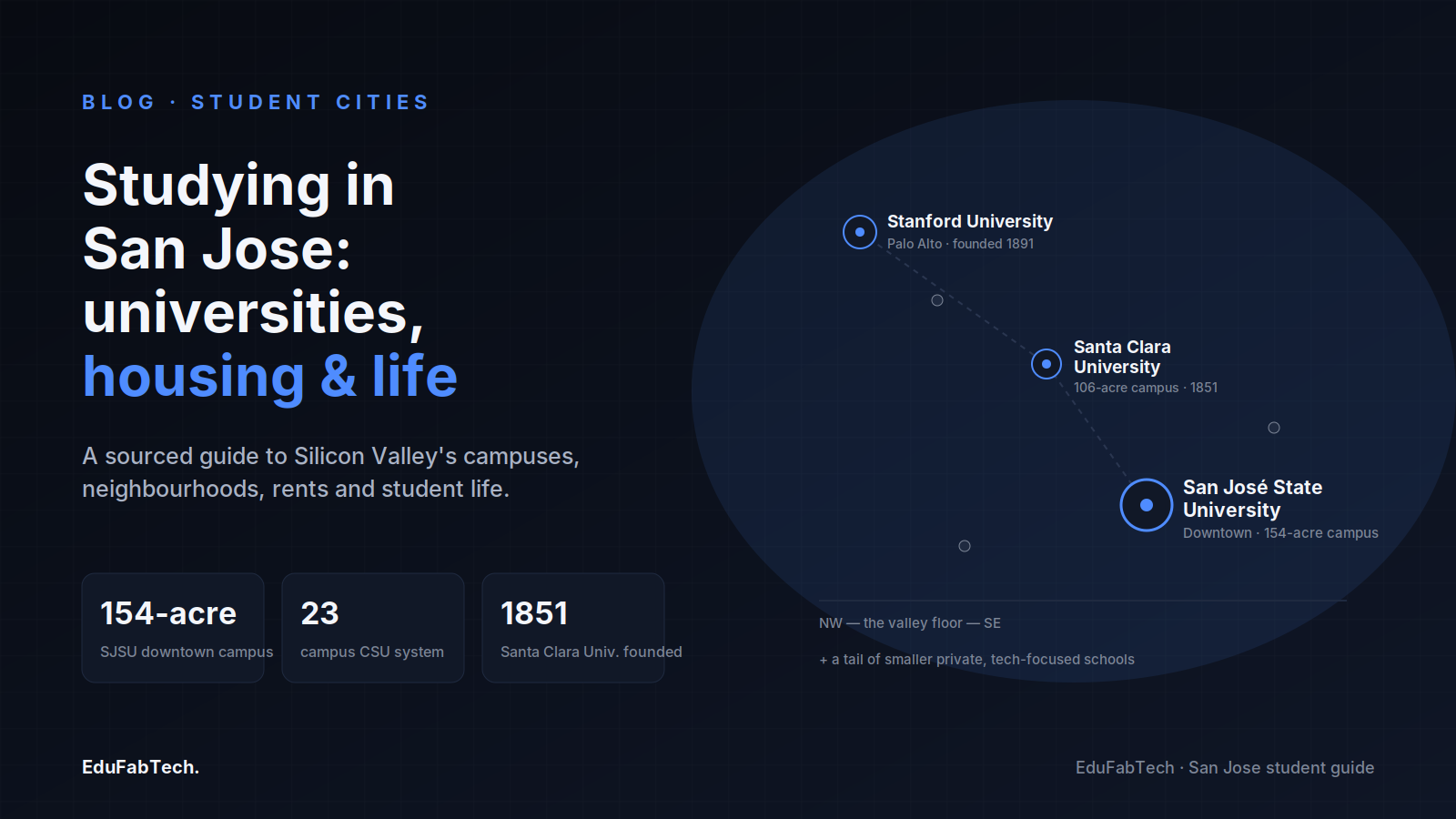
The everyday student city belongs to San José State University (SJSU), whose main campus sits in downtown San Jose. The university describes that campus as a roughly 154-acre, 19-block rectangle in the city centre, and it is the founding campus of the 23-campus California State University system and the oldest public university in the western United States. It is a large, commuter-heavy, strongly career-oriented school, and much of downtown's student life — cafés, study crowds, cheap food — radiates from it.
Twenty miles to the northwest, in its own community of Stanford next to Palo Alto, is Stanford University, founded in 1891 and known worldwide for engineering, computer science and its deep ties to the surrounding technology industry. Admission is highly competitive, and its presence shapes the whole valley's research culture even for students who will never enrol there.
In the neighbouring city of Santa Clara, Santa Clara University occupies a 106-acre campus around the old mission. The university states it was founded in 1851 and is the oldest operating institution of higher learning in California; it is a private Jesuit, Catholic university with well-regarded engineering, business and arts and sciences programmes. You can see rooms and services near it on the Santa Clara University listings.
Around these three sit a cluster of smaller, mostly technology-focused private institutions. International Technological University, in San Jose, is a small private graduate school built around engineering and business for working professionals; its accreditation and international-student status have changed in recent years, so anyone considering it should confirm its current standing directly before paying anything. San Francisco Bay University is a small nonprofit now based in Fremont; by its own account it was founded in 1984 and operated for years as Northwestern Polytechnic University before rebranding. University of San Jose is a small private nonprofit on North First Street in San Jose, founded in 2015 and aimed at graduate study. Palo Alto University, on Arastradero Road near Ladera at the edge of Palo Alto, is a specialist in psychology and behavioural health, tracing back to the Pacific Graduate School of Psychology founded in 1975. For vocational and nursing training, Unitek College runs a for-profit campus in Fremont.
Two well-known names on the valley's map are not open universities at all. Apple University, in Cupertino, is an internal corporate training programme for Apple employees — it grants no degrees and admits no outside students. The IBM Almaden Research Center, in the hills of southern Santa Clara County, is a corporate research laboratory famous as a birthplace of the hard-disk drive and the relational database; IBM announced in 2025 that it would move researchers off the historic Almaden site. Both are worth understanding as part of the local research ecosystem, but neither is a route to a student visa.
Other universities in and around San Jose
Several institutions on the city's record have closed or been absorbed, and it is honest to say so rather than imply they are still options. Silicon Valley University, in the Milpitas–San Jose area, was ordered by state regulators to close in 2018 after losing its accreditation. Herguan University, in Sunnyvale, lost its certification to enrol international students in 2016, after its former chief executive pleaded guilty to visa fraud in 2015, and later wound down. National Hispanic University, in the East Foothills area of San Jose, closed in 2015; it had been founded to serve Latino students. Bethany University, a Christian institution in Scotts Valley, closed in 2011. Henley-Putnam University, a San Jose school of strategic security, was absorbed into a larger private university and now operates as a school within it rather than as an independent campus. California South Bay University, a very small private school in the Sunnyvale area offering business and computer-science master's degrees, also appears to have ceased operating. For undergraduates who want an affordable local start, the community colleges — such as Evergreen Valley College in San Jose and Ohlone College in Fremont — are often the more practical entry point.
Where students live
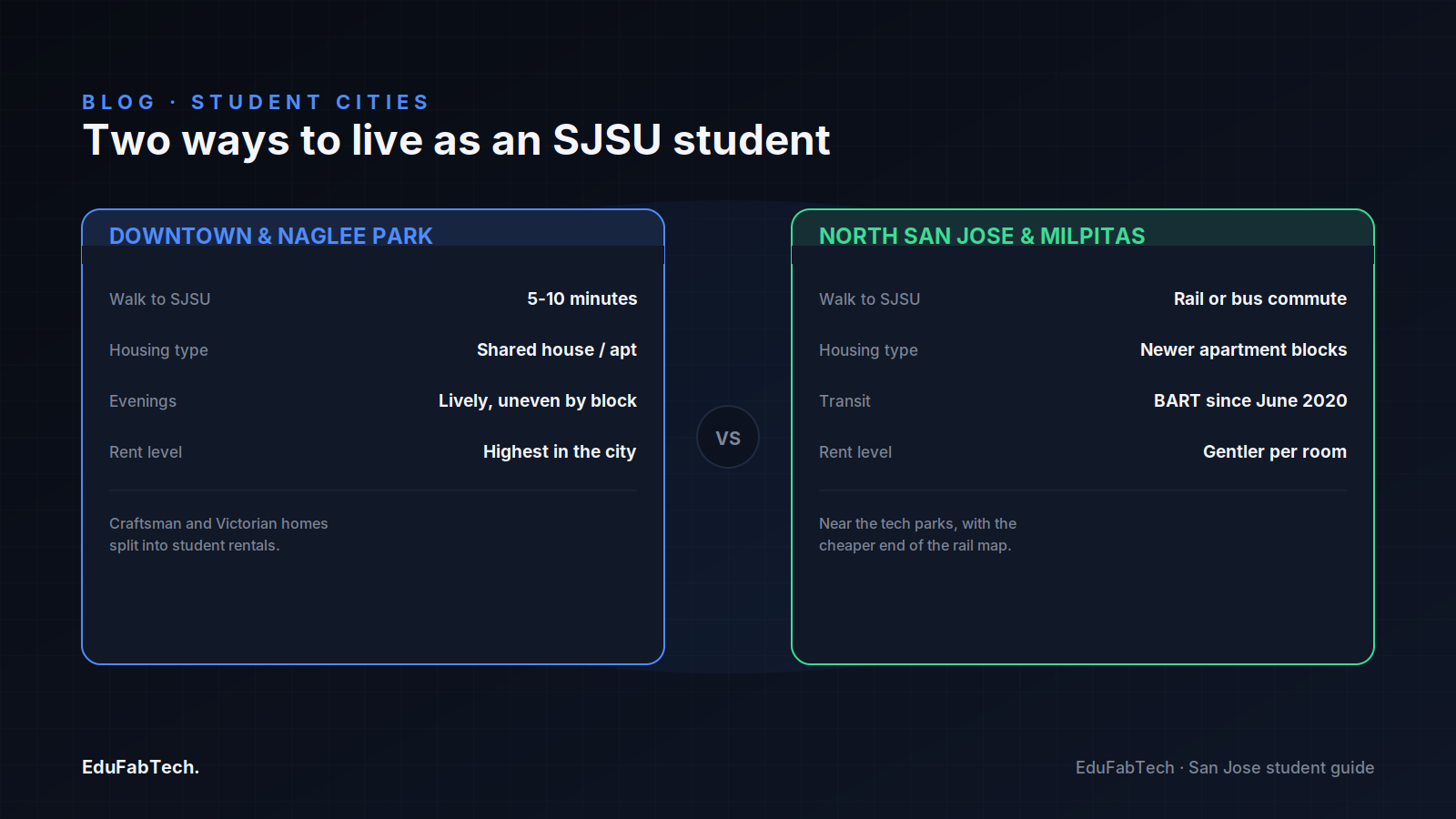
Downtown and the SoFA district. The blocks around San José State are the most student-dense in the city: walkable to class, close to the light-rail spine, and lively in the evenings along the South First Area (SoFA) arts strip. It is convenient but not cheap, and it can feel uneven block to block after dark.
Naglee Park. Directly east of the SJSU campus, this is a quiet grid of older Craftsman and Victorian homes, many split into student rentals. It offers the shortest walk to class outside downtown itself, which keeps demand — and rents — high.
Japantown. Just north of downtown, San Jose's Japantown is, by the account of local nonprofit newsroom San José Spotlight, one of only three historic Japantowns left in the United States. It is low-rise, food-rich and well connected to campus, and popular with graduate students who want character without high-rise prices.
The Rose Garden and Shasta–Hanchett. West of downtown around the municipal rose garden, these are leafy, established residential streets. They are calmer and family-oriented, a reasonable cycle or short bus ride to SJSU, and generally mid-to-higher in cost.
Santa Clara. The city around Santa Clara University is its own world of student housing — flatter, more suburban, and the obvious choice if you study there. It also sits well for commuting across the valley by train and road.
North San Jose and Milpitas. Newer apartment blocks near the tech parks, and the cheaper end of the rail map now that BART opened its Milpitas and Berryessa stations in June 2020. Commutes to downtown campuses are longer, but rents per room can be gentler and the transit links are good.
Finding a room — and not getting scammed
Most students here rent a room in a shared house or apartment rather than a whole flat, because whole-unit rents in the valley are steep. On-campus housing at the larger universities is limited and fills early, so start looking weeks before term, not days. Before you pay anything, confirm who actually controls the property, read the full lease, and understand what is included — utilities and internet are often extra. Check the commute at the real hour you would travel, not on a map, because valley traffic and transfer times change everything.
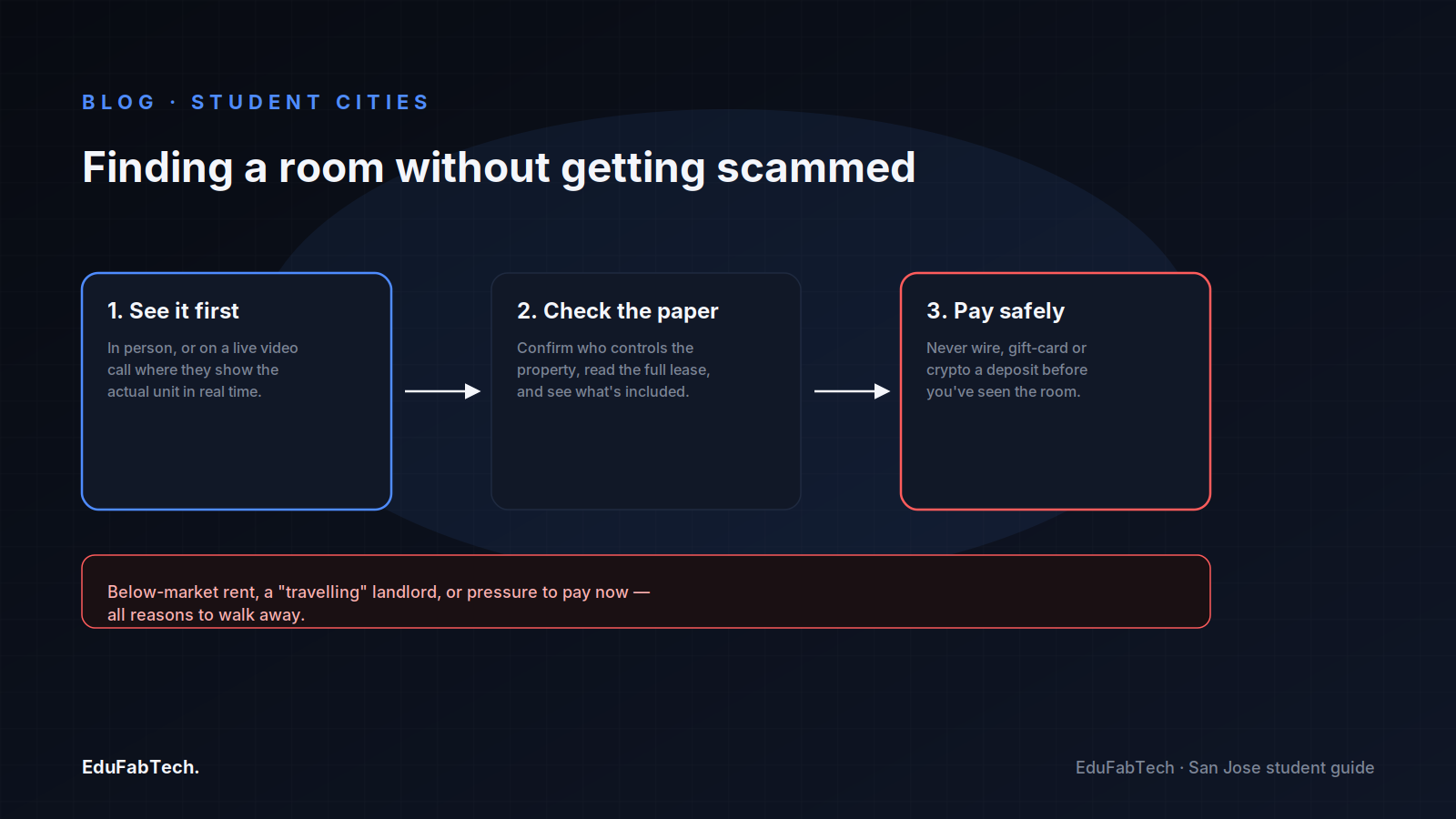
Treat rental scams as a live risk, especially if you are arriving from abroad and cannot visit in person. The single most important rule: see the room before you pay — in person, or at the very least on a live video call where the person shows you the actual unit and answers questions in real time. Never send a deposit or "holding fee" by bank transfer, gift card or cryptocurrency to secure a room you have not seen; those methods are chosen by fraudsters precisely because the money cannot be recovered. A listing far below the going rate, a landlord who is "travelling" and cannot show the place, or pressure to pay immediately are all reasons to walk away. You can start from rooms listed on EduFabTech and still apply every one of these checks.
Furnishing a room: second-hand shops and the flea market
Because so many students and tech workers cycle through the valley each year, the second-hand market is deep. The city's landmark is the San Jose Flea Market on Berryessa Road, which by its operators' history opened in 1960 on former orchard land and today runs across roughly 120 acres with thousands of vendors — a good place for furniture, kitchenware and bicycles if you are willing to bargain. Thrift and charity shops across the valley, campus "free" and move-out boards at the end of each term, and neighbourhood giveaway groups are the other reliable sources. On EduFabTech you can browse local second-hand things and used furniture. Furnishing a room for very little is realistic here; the trick is timing your search to the end of a semester, when leases turn over and people give things away rather than move them.
Work and money
Part-time work rules depend on your immigration status, and you should rely on the official source rather than hearsay. The United States government's information service for international students explains that a student on the main academic study visa may generally work on campus but, in its words, "may not work more than 20 hours per week when school is in session," with some options for off-campus or training-based employment that require separate approval; read the current rules on the official federal information service for international students and confirm your own case with your university's international-student advisers. This is general information, not legal advice, and the details change. Local part-time openings students actually use — campus jobs, cafés, tutoring, retail — turn over constantly; some are collected on the San Jose jobs page.
The valley is expensive, and it helps to anchor that in sourced numbers rather than impressions. For 2026–2027, San José State University's cost-of-attendance budget estimates a nine-month total of about US$37,735 for an undergraduate living in campus housing and about US$38,137 for one living off campus, with the off-campus budget assuming roughly US$14,104 for housing and US$7,245 for food over those nine months, on top of tuition of about US$9,553. Those are university planning figures for one institution, but they give an honest order of magnitude: housing is the dominant cost, and living with parents or in a shared room well outside the centre is how many students make the sums work.
Libraries, study spaces and getting around
The standout place to study is the Dr. Martin Luther King Jr. Library in downtown San Jose, a genuinely unusual building shared between the city and San José State University. According to a Council on Library and Information Resources report, when it opened in 2003 it was the first combined major city-and-university library in the United States, an eight-storey building of about 475,000 square feet — meaning its collections and study floors are open both to students and to the wider public. Beyond it, the branches of the city library system, campus libraries and the valley's many cafés give plenty of options; additional desks and bookable rooms show up on the study-spaces page.
Getting around means the Santa Clara Valley Transportation Authority (VTA), which runs the local buses and the light-rail line through downtown and North San Jose, connected to the regional BART, Caltrain and commuter-rail networks — Caltrain in particular is the usual way students reach Palo Alto and the Stanford area without a car. Several local campuses bundle a VTA transit pass into enrolment that gives unlimited bus and light-rail rides within the county; check whether your own institution offers one, because it can be the difference between an affordable commute and an expensive one. That said, San Jose remains a car-oriented city, and many students end up relying on a bicycle plus transit, or a shared car, depending on where they land.
The honest balance, and a first-weeks checklist
What is good about studying in San Jose is real: sunshine most of the year, proximity to some of the world's leading technology companies and research, strong engineering and computing programmes, a deep second-hand economy, and a genuinely multicultural food and neighbourhood life. What is hard is mostly one thing with many faces — cost. Rents are among the highest in the country, the city sprawls so commutes eat time, and the housing shortage means good rooms go quickly and scams follow the desperation. It is a place where planning ahead pays off more than almost anywhere else.
For the first few weeks, a practical order of operations:
- Sort temporary accommodation first, then view rooms in person before committing to a lease.
- Never pay a deposit by bank transfer, gift card or crypto to hold a room you have not seen.
- Check your real commute at the real hour, and confirm whether your campus includes a VTA transit pass.
- Register with your university's international-student office and confirm your work rules with them before taking any job.
- Furnish from the flea market, thrift shops and end-of-term giveaways rather than buying new.
- Get a library card for the King Library — it serves both students and the public — and find your quiet study spot early.
- Build a small buffer into your budget; the valley is more expensive than almost any guide number suggests, and the cushion matters.
A quick question for readers
Do you work part-time while you study?
Many students work to pay the bills. See how common it is — and how many hours people really do.
Pick an answer, create a free account in a minute, and your vote counts. Already a member? Sign in
- San José State University, Financial Aid and Scholarship Office. Cost of Attendance (2026–2027). San José State University, 2026. link
- U.S. Department of Homeland Security. Working in the United States — Study in the States. U.S. Department of Homeland Security, 2024. link
- Santa Clara University. Undergraduate Bulletin 2026–27: Campus. Santa Clara University, 2026. link
- Patricia A. Breivik and others. Space Designed for Lifelong Learning: The Dr. Martin Luther King Jr. Joint-Use Library. Council on Library and Information Resources (CLIR), 2005. link
- Bay Area Rapid Transit. BART opens Milpitas and Berryessa stations for passenger service. Bay Area Rapid Transit (BART), 2020. link
- San Jose Flea Market. History of San Jose Flea Market. San Jose Flea Market (Berryessa), 2024. link
- San Francisco Bay University. Our Story. San Francisco Bay University, 2024. link
- The PIE News. Herguan University barred from recruiting international students. The PIE News, 2016. link
- Inside Higher Ed. 'Suspect' California University Shut Down. Inside Higher Ed, 2018. link
- Thomas Claburn. IBM moves scientists out of Almaden Research Center. The Register, 2025. link
- San José Spotlight. Fact brief: Is San Jose's Japantown one of only three left in the U.S.?. San José Spotlight, 2024. link